













On December 30, 2025, the Saudi-led military coalition carried out an airstrike on the port of Mukalla in southern Yemen, targeting Emirati military support for the Southern Transitional Council (STC) forces.
This marked an unprecedented escalation between the two nominal allies in the Yemen war. It came just days after STC forces expanded their control over southern provinces, ousting the internationally recognized Yemeni government from its temporary seat in the coastal city of Aden.
So, what is the strategic significance of Mukalla and Aden’s ports in this fraught context between the Gulf allies? Why is the UAE fighting in these two critical cities? And what lies behind its keen interest in Yemen’s ports and coastlines?
Escalation in Mukalla
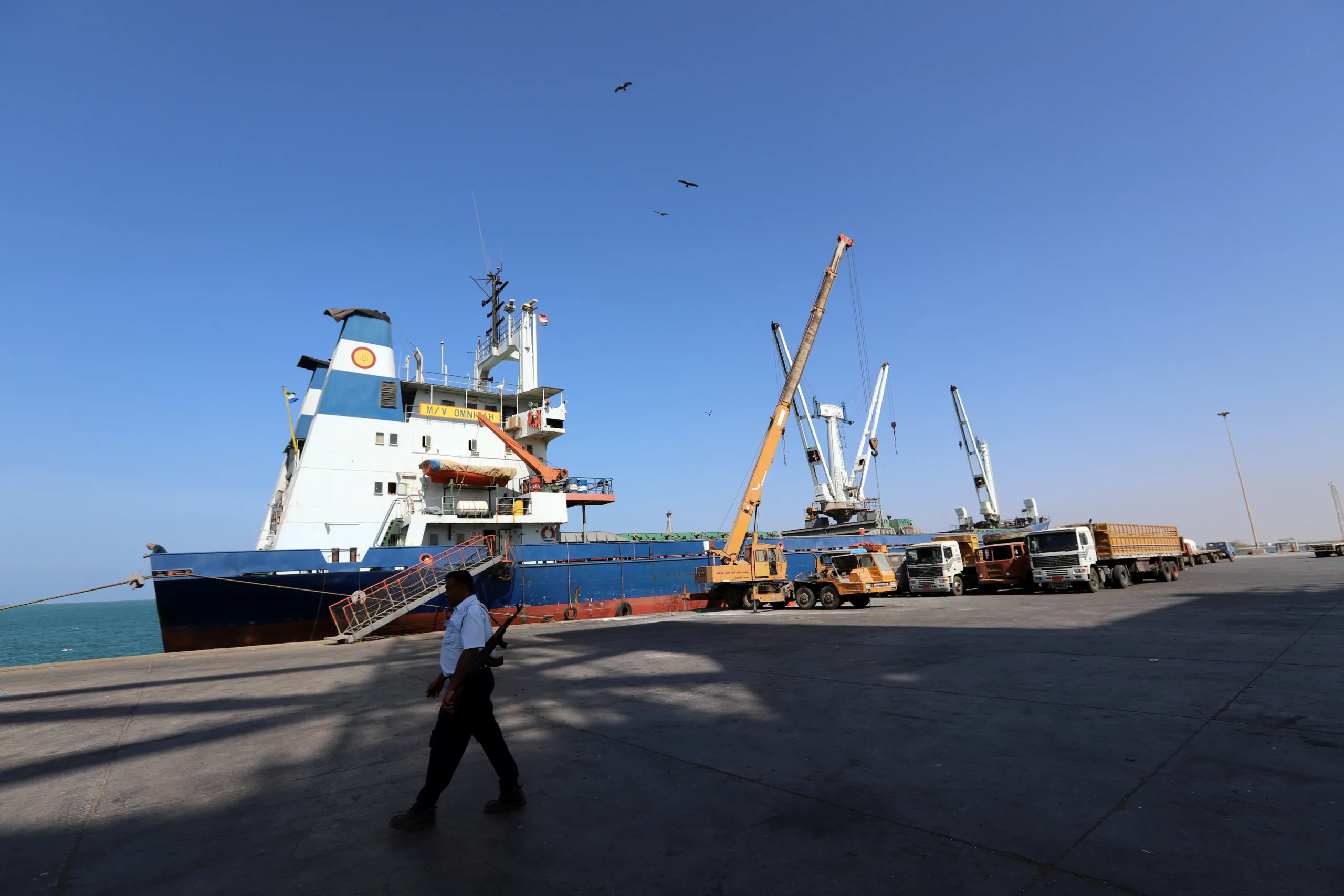
Mukalla’s port is far more than just a maritime dock it is the gateway to Hadhramaut province, which overlooks the Gulf of Aden and serves as Yemen’s main hub for oil resources.
Securing influence in Mukalla thus grants the UAE a commanding lever over the country’s most resource-rich region an influence that is as much political and economic as it is military.
This is why Mukalla’s port became a flashpoint in the recent escalation between Riyadh and Abu Dhabi. According to a Saudi statement, two ships arrived from the Emirati port of Fujairah without prior clearance, turned off their tracking systems, and unloaded large quantities of weapons and vehicles to support STC forces in Hadhramaut.
In response, Saudi fighter jets launched a limited strike on the dock where the shipment had been offloaded. The Saudi sources said the strike caused no casualties or collateral damage.
The operation signaled a major shift in Riyadh’s stance. Saudi Arabia backed an official Yemeni demand for the immediate withdrawal of Emirati forces from Yemen within 24 hours and declared its national security a “red line”—a clear sign of deteriorating relations with Abu Dhabi.
Rashad al-Alimi, President of the Presidential Leadership Council, announced the cancellation of the mutual defense pact with the UAE and publicly accused Abu Dhabi of “fueling internal conflict” by supporting the STC’s rebellion against the legitimate authorities.
In response, the UAE expressed “deep regret” over Riyadh’s statement, denouncing it as containing “fundamental inaccuracies” about its role in Yemen’s unfolding events.
The Emirati Foreign Ministry claimed the referenced shipment did not include weapons and that the vehicles unloaded were not intended for any Yemeni faction but were instead for use by Emirati forces operating in Yemen.
A Struggle for Influence in Aden
Aden’s port is also at the heart of the ongoing battle over Yemen’s strategic maritime assets. Since its liberation from Houthi control in 2015, Aden has served as the temporary capital of the Yemeni government and as a vital gateway to the Arabian Sea.
Whoever controls Aden effectively holds the reins of “money, power, and supply” customs revenue, trade flows, and humanitarian aid distribution along with significant symbolic weight in any future political arrangements.
Yemen’s markets depend heavily on imports via the Port of Aden, making it a lifeline for food and fuel supplies in areas outside Houthi control an additional reason that dominance over the city is a valuable strategic card.
But Aden has become a fault line between the internationally recognized government and the UAE, which backs the STC in its bid to establish an independent South Yemen.
In August 2019, fierce clashes erupted in Aden, resulting in STC forces backed by Emirati air support—seizing control of the city. Reports indicated that the UAE carried out airstrikes against government forces to bolster its separatist allies.
The clashes forced the Yemeni government out of Aden, leading to a de facto power-sharing arrangement over the south. In an effort to bridge the rift, Saudi Arabia later brokered the Riyadh Agreement to divide power between the factions.
Although the STC eventually joined a unity government, tensions simmered beneath the surface. These erupted again in December 2025, when separatist forces tightened their grip on Aden, forcing government officials to flee the city once more.
The UAE’s Port and Coastal Ambitions
These recent events underscore the UAE’s determination to establish a stronghold along Yemen’s coast and ports.
Since the early years of the war, Abu Dhabi, in coordination with Riyadh, aimed to prevent the Houthis from seizing control of strategic maritime gateways like Hodeidah, to shield global shipping routes from piracy or Iranian threats.
But starting in 2018, the UAE adopted a more independent maritime strategy, focused on its own interests. It began building a “chain of ports” stretching along Yemen’s southern coast and extending toward the Horn of Africa.
This vision centers on consolidating Emirati influence through direct control or management of key ports, leveraging its commercial arm DP World which had previously secured a contract to operate Aden’s port before the deal was canceled in 2012.
During the war, the UAE funded and trained loyal local forces like the Hadhrami and Shabwani Elites—under the guise of combating Al-Qaeda and securing coastal provinces. But this also enabled Abu Dhabi to entrench its hold over southern ports, energy fields, and export terminals.
As a result, the UAE and its allies have managed to secure footholds in the ports of Aden, Mukalla, and Mokha, as well as gaining control over the strategic islands of Socotra and Mayyun near the Bab al-Mandeb Strait.
This Emirati emphasis on port control has led to a simmering rivalry with Saudi objectives in Yemen, according to the Carnegie Endowment for International Peace.
While Riyadh seeks to restore the Yemeni government’s authority over the entire country—including its strategic ports Abu Dhabi views a fragmented Yemen as better serving its interests, ensuring continued direct influence over key maritime infrastructure.
This clash of priorities has already led to proxy confrontations between militias supported by both sides—as seen in Aden and Shabwah in recent years weakening the anti-Houthi coalition and culminating in today’s open rift between Riyadh and Abu Dhabi.
Controlling Global Trade Routes
The battle for southern Yemen’s ports is deeply intertwined with global trade routes and the strategic Bab al-Mandeb Strait.
Roughly 10% of the world’s oil exports pass through Bab al-Mandeb, which connects the Indian Ocean to the Red Sea and the Suez Canal.
-
Aden’s port, situated near the strait, serves as a maritime crossroads for vessels moving between the Indian Ocean and the Mediterranean via the Suez Canal.
-
Mukalla’s port is a key terminal for Yemen’s crude oil and natural gas exports, meaning control over it translates to leverage over a vital economic artery.
Policymakers in Abu Dhabi are acutely aware that whoever controls these ports holds significant economic and geostrategic clout. Experts argue that dominance over Aden and Mukalla confers enough influence to shape the flow of global maritime trade.
This explains the UAE’s reinforced military presence on Mayyun (Perim) Island at the entrance to the strait and in the Socotra archipelago in the Indian Ocean, providing oversight of both sides of the Bab al-Mandeb corridor.
Ultimately, the UAE’s fight in Mukalla and Aden appears to be part of a broader strategy to entrench its maritime dominance, control trade routes, and bolster its standing as a global logistics hub.
By backing local allies and establishing facts on the ground, Abu Dhabi is seeking to ensure these critical ports remain within its orbit whether in competition with regional rivals or amid diverging goals from its nominal partner, Saudi Arabia.
In short, for the UAE, “Ports First” is not just a slogan it’s the cornerstone of a regional strategy to secure economic and strategic supremacy.


