











The United Arab Emirates has signed a major package of economic agreements with the Republic of Chad, amounting to approximately $20.5 billion a move signaling a significant shift in the trajectory of relations between the two nations and reflecting Abu Dhabi’s broader push to bolster its presence in Chad specifically and Central Africa more broadly.
These agreements followed the UAE–Chad Business and Investment Forum, held in Abu Dhabi on November 10–11, part of a strategic effort to deepen economic and investment cooperation and to cement the UAE’s role as a key player in the African landscape.
The high-level forum resulted in 40 memoranda of understanding signed between public and private sector entities from both countries. These covered energy, agriculture, mining, textiles, tourism, education, and manufacturing, as well as partnerships with several multilateral institutions.
Chad also secured funding commitments from around 30 donors and international financial institutions, including the World Bank Group, the Islamic Development Bank, the African Development Bank Group, the Arab Bank for Economic Development in Africa, and Afreximbank underscoring international confidence in the emerging economic alliance between N’Djamena and Abu Dhabi.
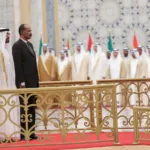
On the political front, UAE President Sheikh Mohamed bin Zayed Al Nahyan hosted Chadian President Mahamat Idriss Déby Itno at the Qasr Al-Bahr Palace in Abu Dhabi, where the two leaders discussed ways to strengthen bilateral ties across all sectors.
President Déby, whose country faces significant economic challenges, expressed his deep appreciation for the UAE’s support and described the forum as “a turning point in bilateral relations and a significant step toward a sustainable development partnership.”
However, these economic overtures are unfolding against a regionally sensitive backdrop. They coincide with allegations that N’Djamena has provided indirect support to Sudan’s Rapid Support Forces (RSF), amid reports linking Chadian territory to Emirati military and financial supply lines.
From this angle, key questions emerge: Are these agreements the start of a legitimate new phase of economic integration between two nations pursuing mutual interests? Or do they amount to a political reward from the UAE to Chad for its role in the Sudan conflict, revealing a strategic blend of economics and geopolitics in Abu Dhabi’s Africa policy?
Chad’s Role in Fueling the Sudanese Conflict
Chad, Sudan’s neighbor along a 1,403-kilometer border the second-longest after South Sudan has ceased to be the reliable partner it once was. Despite strong historical and tribal ties, including 13 tribes straddling the shared border, the situation on the ground reveals a stark departure from past solidarity.
Geopolitical and demographic dynamics have transformed the border into a conduit for conflict. In recent years, weapons have flowed steadily from Chad into Sudan, driven by long-standing resource disputes in Darfur over pastureland and water. This influx has worsened both Sudan’s economic and social crises, inflaming local tensions and deepening the refugee emergency.
Darfur’s protracted crisis since 2003 has highlighted Chad’s central role in fueling the conflict, leveraging its tribal and historical connections to local militias.
With the outbreak of Sudan’s war of generals in April 2023, tensions between Khartoum and N’Djamena escalated dramatically. Sudan, backed by the African Commission on Human and Peoples’ Rights, formally accused Chad of supplying the RSF with weapons and ammunition.
These accusations backed by documentary evidence and video footage have pushed bilateral relations to a precarious tipping point. They reveal the fragility of the shared border, where strategic interests collide with localized divisions and armed strife. Chad now stands as a contradictory neighbor socially and geographically close, yet actively projecting power into Sudan’s internal conflict.
N’Djamena: As a Gateway
Chad’s role has evolved from that of a passive neighbor to a key player in the UAE’s regional strategy. It has become a strategic bridge for funneling military and logistical support to Sudan’s RSF, led by Mohamed Hamdan Dagalo (Hemedti).
This goes beyond conventional military cooperation. It signals a covert Emirati footprint on Sudan’s borders, echoing the UAE’s previous involvement in Libya under the leadership of Khalifa Haftar only now set on a new African frontier at the heart of Darfur’s humanitarian and security crisis.
Numerous reports corroborate this shift. On April 19, 2023, a large Emirati military shipment landed at N’Djamena airport, including two Chinese FK-2000 air defense systems. Officially, the aid was described as part of efforts to bolster Chadian security.
But military analysts noted this was more than just technical assistance; it formed part of a wider strategy to entrench UAE influence across the Sahel. Chad now serves as a dual-use platform: officially to support local security, but in practice as a transit hub for military aid to RSF forces in Darfur.
Just five days earlier, on April 14, Chadian junta leader Mahamat Déby met with Sheikh Mohamed bin Zayed and UAE national security advisor Tahnoun bin Zayed at Qasr Al-Bahr in Abu Dhabi. The closed-door session hinted at pre-planned coordination to establish an advanced military base supporting cross-border operations, under the guise of bilateral security cooperation.
Since then, the corridor from N’Djamena to the Sudanese border via Am-Djarass has been secured by FK-2000 systems, operated by crews previously trained at the UAE’s Al Dhafra Air Base. Chad has thus become a staging ground for a broader geopolitical contest—one that seeks dominance over Sudan’s western flank.
A July 2023 investigation by Arab intelligence platform Eekad further revealed intensified Emirati flights to Chad and increased activity at Am-Djarass airport, which has served as a hub for RSF-bound military aid. Satellite imagery confirmed the construction of new military camps near the site.
In August, a second UAE coordination office opened in Am-Djarass, ostensibly to manage humanitarian support, but in reality reinforcing a broader strategic agenda for regional expansion.
A Question of Timing
Given the mounting accusations against Chad and the UAE for supporting the RSF and stoking Sudan’s instability, and as Khartoum intensifies diplomatic actions against both countries on the international stage, Abu Dhabi’s decision to sign dozens of economic agreements with N’Djamena comes at an exceptionally delicate moment raising critical questions about the true motives behind this sudden rapprochement.
The UAE’s official rationale, centered on deepening economic and investment ties, has failed to convince many observers. Analyses suggest that the growth in bilateral ties may largely reflect Chad’s role in facilitating Emirati military and logistical support to the RSF, particularly by granting access to its airspace and airports for strategic transfers.
From this perspective, the deals appear to be political and economic rewards for Chad’s cooperation, or at the very least, a move to strengthen a strategic alliance amid shifting dynamics in Sudan and the broader Sahel region. It underscores Abu Dhabi’s efforts to anchor its regional influence using economic instruments that serve clear geopolitical ends.
In conclusion, the timing of the UAE–Chad agreements invites deeper scrutiny. It blurs the lines between economic ambition and political strategy. The correlation between expanding economic ties and the use of Chadian infrastructure for military operations suggests that these agreements may be far more than trade deals they are potentially tools of power projection, aimed at reinforcing the UAE’s influence and Chad’s role in the volatile Sudanese theater.


