










Just days after the outbreak of Israel’s war on the Gaza Strip, the 27 leaders of the European Union swiftly condemned Operation Al-Aqsa Flood and reaffirmed their support for Tel Aviv and what they termed its “right to self-defense.”
The Hungarian EU Commissioner, Olivér Várhelyi, went a step further, announcing the immediate suspension of aid to Palestine—interpreted at the time as a clear consensus within the EU backing Israel’s military campaign and its ongoing war of annihilation in Gaza.
However, EU foreign policy chief Josep Borrell soon rejected Várhelyi’s remarks, asserting that aid to the Palestinian people would not be halted—though he did note a review to ensure funds wouldn’t reach Hamas. This marked the first public crack in what appeared to be a unified European stance.
By November 2023, about six weeks into the war, European positions had fragmented further, notably during a UN vote on ceasefire resolutions proposed by Brazil and then Russia. EU member states split into three camps: Spain, Ireland, and France voted in favor; Austria, Hungary, and the Czech Republic opposed; while Germany and Italy abstained. Ultimately, the resolution was blocked by a US veto.
The war in Gaza has laid bare the fragility of Western unity. It has eroded the once-solid geopolitical alliance between Europe’s powerhouses—and their American patron—exposing the hollowness of long-standing claims about shared values, cohesive foreign policy, and unbreakable solidarity.
This war has become a severe test of Western identity, revealing the extent to which its professed humanitarian ideals have buckled under the weight of political polarization and pragmatic interests. In the resulting confusion, Israel has been granted a de facto blank check, exploiting the divisions to push forward its expansionist colonial agenda.
Western Division: A Shifting Landscape
Unlike the unequivocal US stance—which, both before and during the war, has offered unconditional support to Israel—the European position has been more nuanced and divided. The Biden administration’s unwavering alignment with Tel Aviv has turned its officials into virtual spokespersons for Israel: Secretary of State Marco Rubio, special envoy Steve Witkoff, Ambassador Mike Huckabee, and even President Trump have all played key roles in shielding Israel from international accountability.
In Europe, however, the picture is more complex. After nearly two years of relentless bombardment and humanitarian catastrophe in Gaza, the EU response has splintered into three main camps:
1. The Critics of Israeli Aggression:
Countries like Ireland, Spain, Belgium, Malta, Slovenia, and non-EU member Norway have taken an outspoken stance condemning Israeli actions. They call for an immediate end to the war and support Palestinian rights and statehood. Despite their principled positions, these nations lack the political heft to transform rhetoric into EU-wide policy.
2. The Unwavering Supporters of Israel:
This camp includes Germany, Austria, Italy, the Netherlands, and much of Central and Eastern Europe, including Greece, Cyprus, Hungary, and the Czech Republic. These countries back Israel ideologically and politically, regardless of the legal or moral consequences of its actions. However, signs of change have emerged—especially in Germany.
In May 2025, German Foreign Minister Johann David Vadvol surprised many by stating, “We will not show solidarity with Israel by compulsion, nor should our struggle against anti-Semitism be exploited to justify the war in Gaza.” Shortly after, Chancellor Friedrich Merz criticized Israel’s operations, calling them “unjustifiable” due to the heavy civilian toll—marking a significant shift in tone from Berlin and its allies like the Netherlands.
3. The Hesitant Middle Ground:
Nations like France, the UK, Australia, New Zealand, and Canada oscillate between condemnation and support. While expressing concern over civilian suffering, they continue supplying Israel with arms—fuelling the very war they publicly criticize. Under growing public pressure, their rhetoric has shifted, with stronger calls to recognize Palestine and critique Israeli policies. Yet, material support for Tel Aviv remains largely intact.
Caught Between Values and Interests
Western policy continues to struggle between its professed commitment to human rights and its strategic self-interest. The unprecedented scale of the war has forced Western governments to confront a moral dilemma: maintain business as usual with Israel, or align with international calls for justice.
This political schizophrenia has played out over months. Instead of pressuring Israel to end its assault, the EU has pivoted to symbolic gestures like recognizing Palestine, without using its substantial leverage to stop the violence.
Three main forces have driven this shift:
1. Popular Pressure:
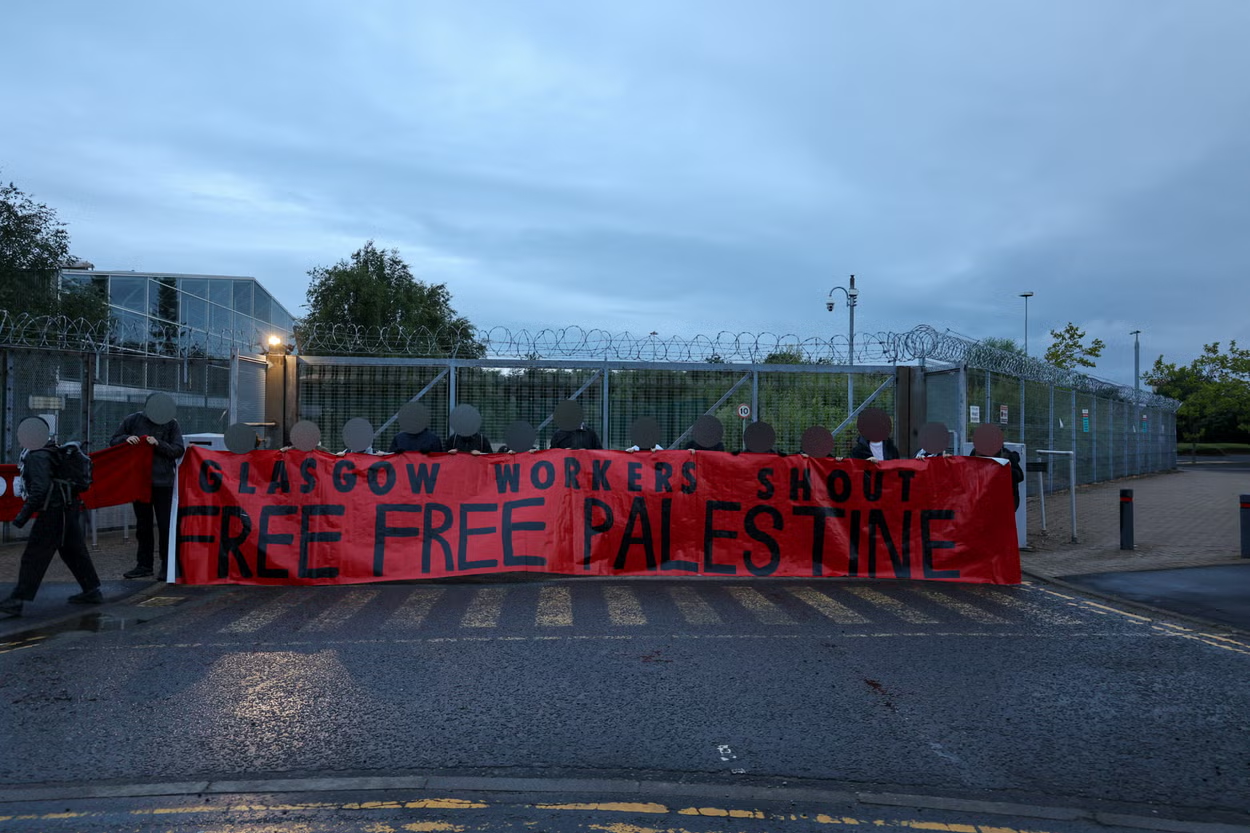
Mass protests across Europe, fueled by large Arab and Muslim communities, have made it politically costly for governments to ignore public outrage. The global tide of sympathy for Palestinians has become a rolling fireball—difficult to extinguish.
2. Political Constraints:
Gruesome images from Gaza and the ICC’s arrest warrants for Israeli officials, including Netanyahu and former Defense Minister Yoav Gallant, have pushed EU governments into a corner. Ignoring such international rulings undermines Europe’s own institutions and its stance on issues like Russian aggression.
3. Strategic Pragmatism:
Europe, particularly France and the UK, fears that continued instability in Gaza could jeopardize their economic and political interests in the Middle East. By recognizing Palestine, they hope to regain regional influence, counterbalance US dominance, and reassert themselves as credible global actors.
Gaza and Iraq: Echoes of a Strategic Rift
The current divide over Gaza evokes memories of the 2003 Iraq War, when the US and UK stood alone against French and German opposition. Today’s split again pits American militarism against European diplomacy. Washington has used its UN veto five times to block ceasefire efforts, while parts of Europe seek a more balanced approach.
Public sentiment has played a role in both conflicts, with widespread protests across Western capitals condemning US policy—then in Iraq, now in Gaza. However, unlike Iraq, where Europe faced direct military involvement, the Gaza war sees Europe as a bystander, using only diplomatic tools.
The Gaza conflict also lacks the economic imperative that drove the Iraq invasion. Instead, it carries symbolic weight—moral, legal, and humanitarian—making it an ideological fault line rather than a geopolitical battleground.
A Green Light for Netanyahu
This lack of Western consensus has proven to be a strategic gift to Netanyahu’s government. With the US firmly in Israel’s corner and Europe divided and ineffective, Tel Aviv enjoys unparalleled international support—or at least, impunity.
This imbalance not only enables further atrocities in Gaza but emboldens Israel to escalate settlement expansion in the West Bank without fear of repercussions.
It raises difficult questions: Is symbolic recognition of Palestine the most Europe can offer? Do economic and arms ties with Israel undercut the credibility of its moral posture?
The duplicity is stark—European nations signal support for Palestinian rights while increasing trade and arms sales with Israel, before and during the war. This contradiction reveals a web of interests too deep and entangled to dismantle without serious political will.
Thus, recent statements in support of Gaza seem less an ethical awakening and more a symbolic appeasement—aimed at placating domestic and international audiences while maintaining the status quo.
Ultimately, the fragmentation of Western policy appears more as a division of roles than a clash of principles. It disperses responsibility and blunts the force of any unified diplomatic action—something Israel fully understands and skillfully exploits.
Yet even symbolic shifts can be harnessed. As the saying goes: “If you can’t get it all, don’t abandon it altogether.” These cracks in the Western position offer an opportunity—albeit limited—to build a cumulative political case for Palestinian rights. But doing so demands strategic, coordinated, and relentless diplomatic and media efforts from all fronts.


