












Since the onset of its aggression on October 7, 2023, the Israeli occupation has employed a variety of genocidal tactics in Gaza. It has not been content with indiscriminate bombing; instead, it has repeatedly devised novel, atypical methods in a persistent effort to pursue its unspoken aim: the depopulation of Gaza and its erasure from the map.
From the use of artificial intelligence to select targets for indiscriminate bombardment, to torching entire neighborhoods and blowing up infrastructure, and driving the population into forced displacement—each method in this war follows its own methodology, and each instrument serves in orchestrating mass death under the guise of “deterrence” or “self-defense.”
Starvation has long been among the strategic tools used by commanders of war. Just two days after the war erupted, former Israeli Defense Minister Yoav Galant announced a total starvation siege on Gaza: “No electricity, no food, no water, no fuel—everything is closed. We are fighting human animals, and we act accordingly.”
Other Israeli officials have echoed this consensus on starvation as a tactic. Finance Minister Bezalel Smotrich said it might be just and moral to starve two million people in Gaza, and recently the Interior Minister of Israel condemned the resumed entry of aid as providing “oxygen to our enemies.”
The occupation does not merely wield bread to break Palestinian will; it is conducting an organized famine-as-war that seeks to weaponize starvation for the long term. This report outlines how the occupation uses starvation as a component of a methodical genocide targeting not only Palestinians’ bodies, but their will and their right to remain on their land.
Mass Death
In Gaza, no one is safe from death, in whatever form it takes. If you survive a bullet piercing your home today, tomorrow hunger may claim your life after months of siege and malnutrition. Even if your body is stronger and can withstand deprivation, you risk bombardment at aid distribution centers—the only hope for your family’s survival.
A UN report has confirmed that Gaza faces a catastrophic emergency—Phase 5, the most critical on the Integrated Food Security Phase Classification (IPC). According to IPC projections for May 11–September 30, 2025, the number of people in crisis-level starvation could escalate to 470,000 individuals—22% of Gaza’s population—threatening mass famine .
This alarming figure is underscored by the rising death toll among children from malnutrition—66 children, according to the Gaza government media office—and the daily arrival of 5,000 malnutrition cases in hospitals, overwhelming the health system’s capacity.
Euro-Med Human Rights Monitor has reported a silent wave of death among the elderly and children due to starvation crimes, severe deprivation, and absence of healthcare.
The occupation does not wait for starvation to finish the job—it accelerates it. After intensifying the siege and then allowing meager humanitarian aid, Palestinians are drawn to aid centers—only to be massacred at the flour gates.
Since May 27, at least 549 Palestinians have been gunned down by Israeli forces while trying to obtain food from centers run by the Gaza Humanitarian Foundation, which Euro-Med describes as “death traps” used as instruments of genocide .
Israeli authorities deliberately assigned aid distribution to the Gaza Humanitarian Foundation—a body created in February 2025 with direct support from Israel and the U.S.—instead of entrusting seasoned international relief agencies, according to Euro-Med.
These massacres have become almost daily. On June 11, 2025, Israeli shelling killed 57 and injured 363 near an aid center. In Khan Younis, artillery killed 51 and wounded over 200 near Gaza Valley bridge .
UN Secretary-General António Guterres described the aid distribution mechanism supported by the U.S. as “unsafe and resulting in the killing of civilians.”
These tactics are not new. One of the most notorious incidents happened at the Nabulsi roundabout on February 29, 2024, when Israeli fire killed at least 112 Palestinians and injured 760 as they sought aid .
Forced Displacement
From the very first hours of the aggression, the occupation transformed starvation into a coercive arm to push residents of northern Gaza southward: choking off food supply and coupling it with relentless bombardment to make staying unbearable.
Aid distribution sites—such as those in Nitsarim and Morag—are strategically placed in the south, creating a cruel incentive for people to flee north, according to Human Rights Watch.
The International Committee of the Red Cross and other international bodies have warned that this aid strategy could lead to “mass forced displacement,” especially impacting vulnerable groups such as mobility-impaired people and children.
Since May 19, only 28 WFP trucks have reached northern Gaza, while over 9,500 tons of wheat flour have been delivered to southern centers by June 22.
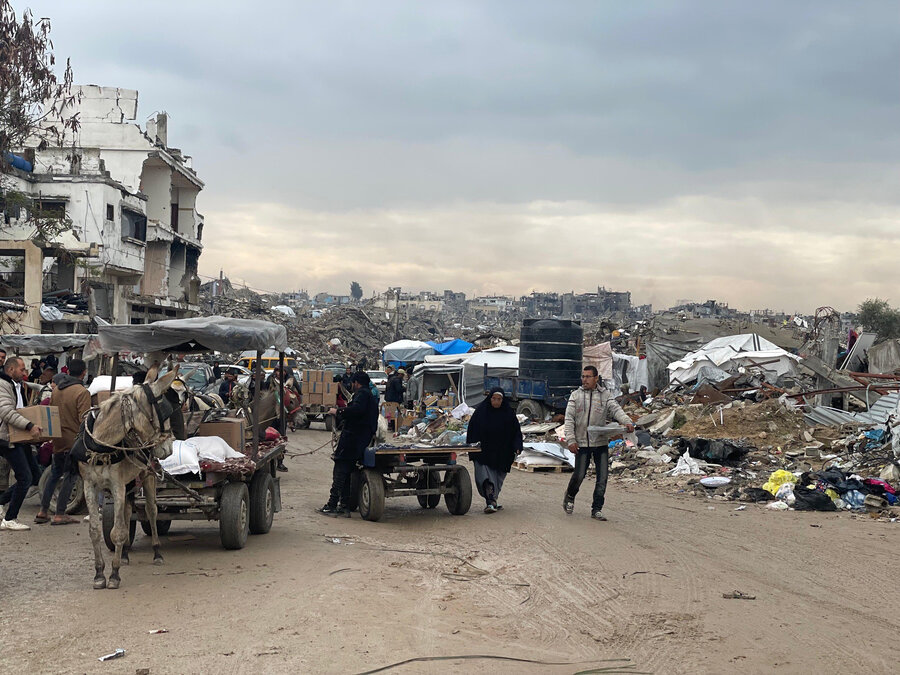
Israeli Prime Minister Benjamin Netanyahu has endorsed the military plan “Gideon’s Vessels,” which entails three phases beginning with the expulsion of northern residents to Rafah in the south, under the guise of “safe zones” for aid distribution.
The UN estimates that 1.9 million people—around 90% of Gaza’s population—are internally displaced, with many forced to move multiple times to areas lacking adequate infrastructure.
Euro-Med states that the occupation is corralling Gaza residents into a narrow southern coastal strip in preparation for forced expulsion, aligning with Netanyahu’s political condition tied to the “Trump plan.”
Some Israeli officials have even openly linked starvation to forced displacement. National Security Minister Itamar Ben-Gvir, for instance, insisted that aid should only enter Gaza with the consent of those emigrating .
Aid as a Surveillance Tool
Once starvation drives masses to aid centers, Israel reportedly exploits the desperation of Palestinians to recruit intelligence sources. An investigation by Arabi Post revealed that the occupation uses aid crowds to identify resistance members and gather information.
Eye-witnesses said distributions begin around 2–3 a.m., when Israeli forces dim lights to blend agents into the crowd and collect intelligence undetected.
Biometric scanning at aid sites, managed by the Gaza Humanitarian Foundation, further allows the identification and later apprehension or targeting of resistance-affiliated individuals .
The Gaza Interior Ministry warned that biometric checks could be utilized to trace and target Palestinians after distribution.
Israeli officials acknowledge that the new aid system enables checking whether recipients are connected to Hamas—a tacit admission of intelligence-driven intent .
This intelligence gathering extends beyond identification. Israeli security agencies, including Shin Bet, are reported to support gangs such as “Abu Shabab” in looting aid and collecting extortion at aid trucks, according to Haaretz .
The gang, led by Yasser Abu Shabab, a fugitive from Gaza prisons, reportedly includes some 100 members recruited by Shin Bet. They hijacked UN aid convoys, resold humanitarian supplies, and set fire to a gas truck to block aid routes.
They operated near Kerem Shalom crossing and at aid distribution points in western Rafah .
Where Aid Means Death
“I stood helpless as my child starved; I told him to sip the little water we had,” said Palestinian mother Zeinat, capturing the plight of tens of thousands of mothers in Gaza whose voices echo unheard.
This helplessness forces mothers and fathers to queue for hours at aid centers turned death traps, living a surreal scenario that resembles an apocalyptic end. Waiting children burst with hunger, hoping for crumbs that never come.
“We arrived at 6 a.m., and in the end got nothing. Here children wait for a free meal and water; people have no means of living,” said displaced father Atef Ma’rouf from Beit Lahia.
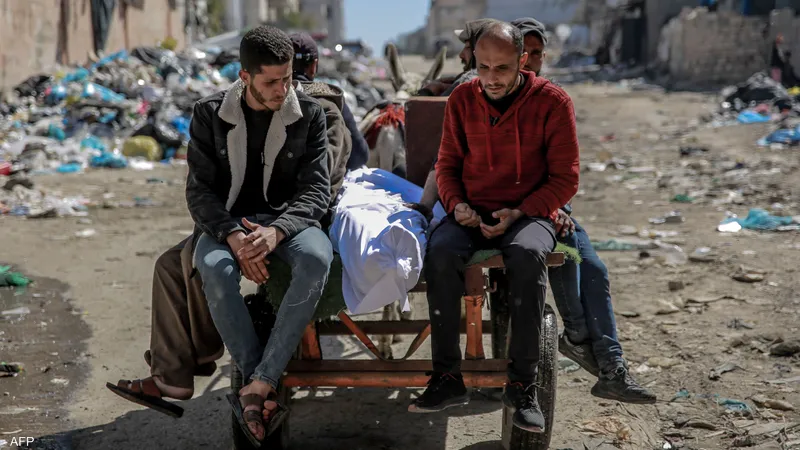
Yet these attempts do not always end peacefully. Palestinians are faced with the choice: starve or get shot. Dozens of massacres have occurred at aid distribution points.
Médecins Sans Frontières criticized the mechanism as designed to humiliate Palestinians—forcing them to choose between starvation or risking their lives for basic aid—and UNRWA said it represented a new form of killing by herding them to die at distribution points .
Israeli occupation shows chilling sophistication in weaponizing starvation not only to deprive Gazans of food and water, but to inflict psychological torture and humiliation. This is part of a broader ethnic-cleansing scheme, unfolding amid global complicity and silence as children die of hunger in a world that, one would think, has no place for hunger.


