










By the end of March 2026, tensions between Paris and Tel Aviv had escalated from rhetorical sparring to concrete action, marking the latest step in a deterioration that began just weeks after Israel’s assault on the Gaza Strip in 2023.
In its most recent move, France refused to allow U.S. weapons shipments to Israel to pass through its airspace in the context of the war against Iran. In response, Israel’s Ministry of Defense announced the suspension of all arms purchases from Paris, declaring that France could no longer be considered a partner.
How, then, did the relationship unravel step by step and what do these developments reveal about the limits of French influence in the region and Israel’s evolving view of Paris?
1. The Gaza War Rift
When Hamas launched the “Al-Aqsa Flood” operation in Israeli settlements and occupied territories on October 7, 2023, French President Emmanuel Macron responded with solidarity. He strongly condemned the attacks and affirmed that France “stands in solidarity with Israel,” supporting what he described as its “right to defend itself.”
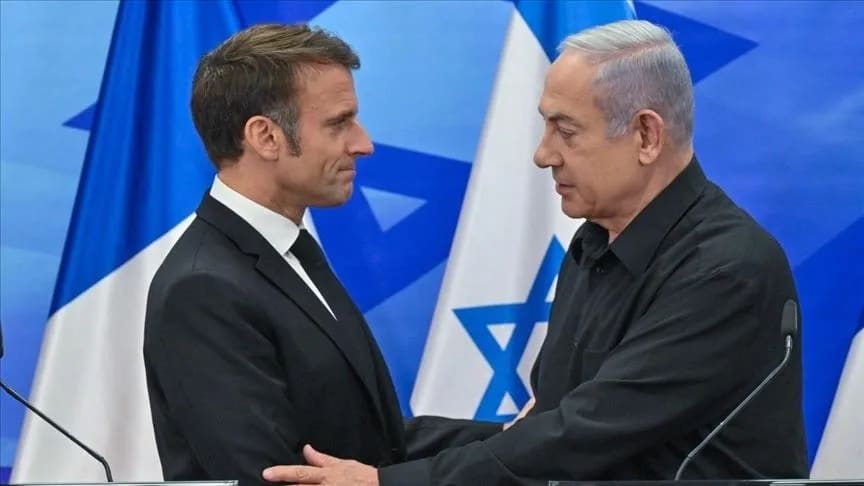
This pro-Israel stance lasted only a few weeks. It began to shift as Israel’s military campaign in Gaza intensified and thousands of civilian casualties mounted.
On November 10, 2023, Macron called for a halt to the bombing of Gaza, stating that there was “no justification” for the ongoing Israeli airstrikes and urging a permanent ceasefire.
This transition—from solidarity to criticism—angered the Israeli government, particularly as France increasingly called for humanitarian corridors and hosted an aid conference in Paris.
2. Lebanon Deepens the Divide
As the conflict spread from Gaza to Lebanon, Paris sought to play mediator. In February 2024, it presented a written proposal to Beirut aimed at halting hostilities. The plan included a 10-kilometer withdrawal of Hezbollah fighters from the border, deployment of the Lebanese army, a cessation of Israeli airstrikes, and negotiations over border demarcation.
In June 2024, Macron announced that he had reached an understanding with the United States and Israel to accelerate a roadmap for calming tensions along the border.
However, the mediation faced obstacles: Hezbollah refused to discuss any agreement before the war in Gaza ended, while Israel insisted on maintaining freedom of “military operations.”
Lebanon represents the “real test of France’s influence” in the Middle East, particularly given its history as a former colonial power, its deployment of around 700 troops in the UNIFIL peacekeeping force, and its longstanding diplomatic leverage there.
3. Rafah Breaks French Cover
In May 2024, tensions erupted into open confrontation. During Israel’s assault on Rafah which left dozens of civilians dead Macron reiterated his opposition to the operation, warning that its continuation would lead to an “unprecedented catastrophe.”
Days later, France’s Ministry of Defense barred Israeli companies from participating in the Eurosatory international arms exhibition in Paris, citing the lack of appropriate conditions amid Macron’s calls to halt operations in Rafah.
This symbolic move marked a shift in the dispute from the diplomatic arena to the defense sector, provoking anger in Tel Aviv, which viewed it as politically motivated.
4. The Arms Market Turns Adversarial
As the war persisted, France moved from criticism to imposing restrictions on defense cooperation.
In June 2025, during the Paris Air Show, French authorities shut down the main pavilions of Israeli companies including Elbit Systems, Rafael, and Israel Aerospace Industries after they refused to remove offensive weapons from display.

The pavilions were covered with black curtains, and only smaller booths free of offensive equipment were allowed to remain. French Prime Minister François Bayrou justified the decision by stating that France prohibits the display of offensive weapons amid the Gaza war. Israeli companies, however, denounced the move as “political,” invoking memories of discriminatory practices.
In October 2024, the government had attempted to bar Israel from participating in the Euronaval exhibition, but a French administrative court overturned the decision—highlighting the limits of Paris’s ability to impose a comprehensive ban.
5. Recognition of the State of Palestine
In the summer of 2025, Paris escalated its political stance. Macron wrote to Palestinian Authority President Mahmoud Abbas expressing his intention to recognize the State of Palestine during the United Nations General Assembly.
On September 22 of that year, he formally announced the recognition in New York alongside other European countries, declaring that “the time for peace has come” and calling for an end to the war and a return to negotiations.
Tel Aviv reacted angrily. Prime Minister Benjamin Netanyahu described the move as “a surrender to terrorism” and an interference in Israel’s sovereignty.
For Israel, this recognition—the first by a major Western power—was seen as a strategic shift aligning France with Palestinian rights, further exacerbating tensions.
6. The Iran War: Arms Purchases Drop to Zero
The final turning point came in late March 2026. As part of the U.S.–Israeli war against Iran, Washington requested the use of French airspace to transport munitions to Israel.
Paris refused permission in at least one instance, according to European diplomats, prompting Israel to accuse France of “blocking aid transfers.” French media clarified that this was not a blanket ban: requests are reviewed case by case, and routes can be rerouted.
Nevertheless, Israeli Defense Minister Israel Katz announced that Tel Aviv would halt arms purchases from France, declaring that it was no longer “one of the friendly countries.”
Reuters reported that France’s share of Israel’s arms imports is relatively small, limiting the practical impact of the decision. However, its symbolic weight is significant, as it formalizes the rupture in defense ties.
Is French Influence Fading?
The successive developments suggest that France did not abruptly turn against Israel; rather, it moved gradually from solidarity to criticism, to symbolic defense measures, and ultimately to sharp political positions.
As Israel intensified its military campaign and leaned more heavily on its exclusive relationship with the United States, its willingness to view Paris as an essential partner diminished.
Polling by analytical centers indicates that Israel increasingly sees France as an “irritating” actor incapable of exerting meaningful pressure.
Analysts at the French Foundation for Strategic Research (FRS) note that Israel now regards Paris as a non-essential European player, preferring to rely on its special relationship with Washington and prioritizing military power over diplomacy.
The report warns that regional restructuring led by Israel could marginalize France and push it out of the Middle East altogether, as Paris faces the risk of exclusion from future regional arrangements due to the erosion of international law and the decline of negotiations with Tel Aviv.
Similarly, Manara magazine (affiliated with the Cambridge Middle East and North Africa Forum – MENAF) highlights that France’s ability to influence Lebanon remains limited and contingent on coordination with the United States, reducing its independent weight.