










هذا التقرير متاح أيضًا بـ العربية
As a shaky negotiating track between the United States and Iran moves forward, amid intermittent strikes and differences over the nuclear file and de-escalation, “Israel” is seeing a notable shift in its place within the US military deployment across the Middle East.
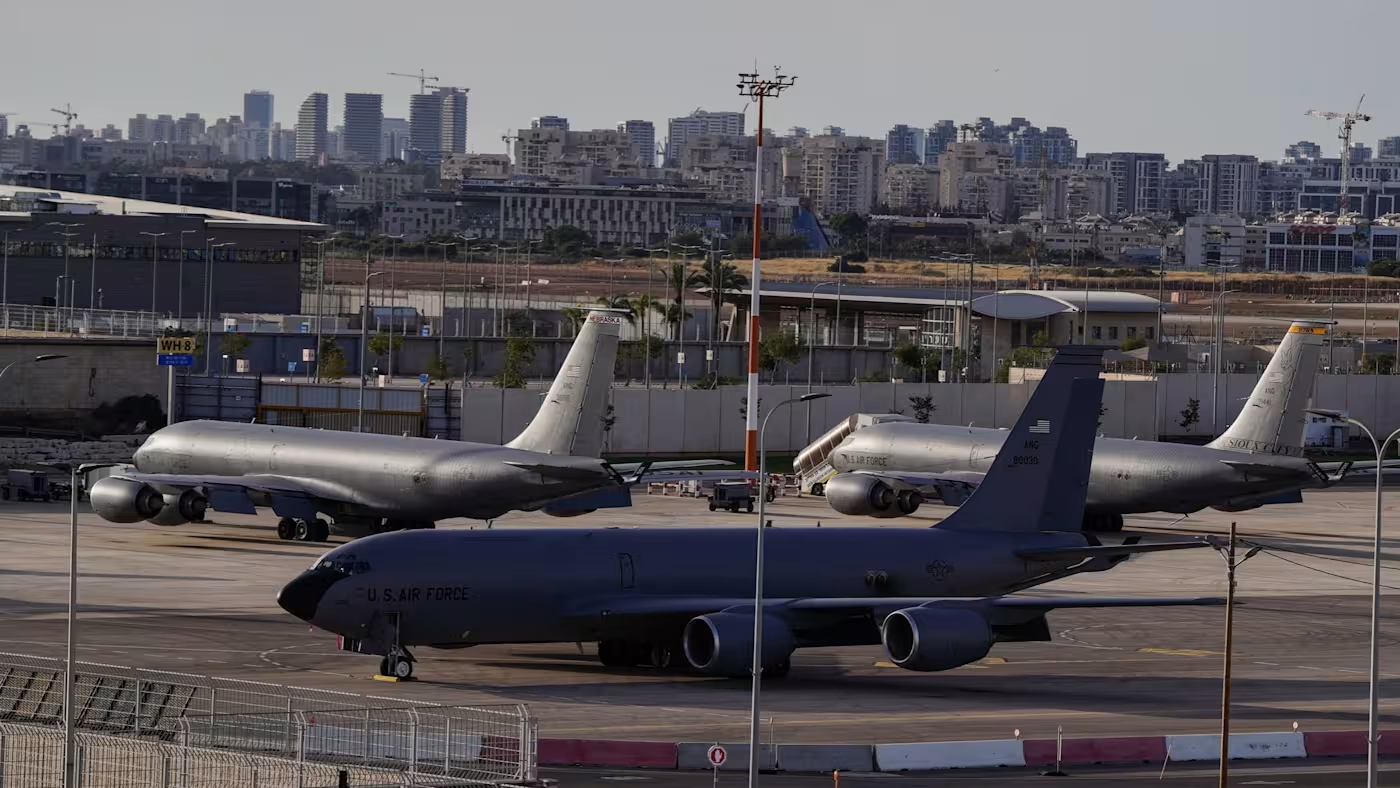
Since February 2026, there has been a rise in the number of US military aircraft landing at Israeli airports classified as “civilian,” such as Ben Gurion and Ramon, and images of F-22 Raptors or refueling aircraft are no longer a passing sight.
This shift is accompanied by Washington’s desire to keep these aircraft in place until at least the end of the year, and perhaps even until 2027, making the US military presence in the heart of “Israel” part of the calculations of deterrence and negotiation, according to Hebrew reports.
This expansion has created a paradox: civilian airports have been transformed into operational sites packed with cargo and refueling aircraft, and local airline employees now speak of a “terminal inside an American base.”
What has Washington deployed inside “Israel”?
The situation on the ground includes three main categories of aircraft:
1- F-22 Raptor fighters: Satellite images from MizarVision published by the newspaper Yedioth Ahronoth showed that the United States moved 11 F-22 aircraft to Ovda Air Base in the Negev desert.
These advanced air-superiority aircraft sit on the runways without any announced participation in attacks, but they reinforce air superiority and give Washington advanced deterrence and escort capabilities should operations against Iran resume.
2- Refueling aircraft: The deployment began between Ben Gurion Airport in “Tel Aviv” and Ramon Airport in the south of the occupied Palestinian territories with nine KC-46A aircraft and five KC-135R aircraft, then rose to more than 30 aircraft during March, according to the website Army Recognition.
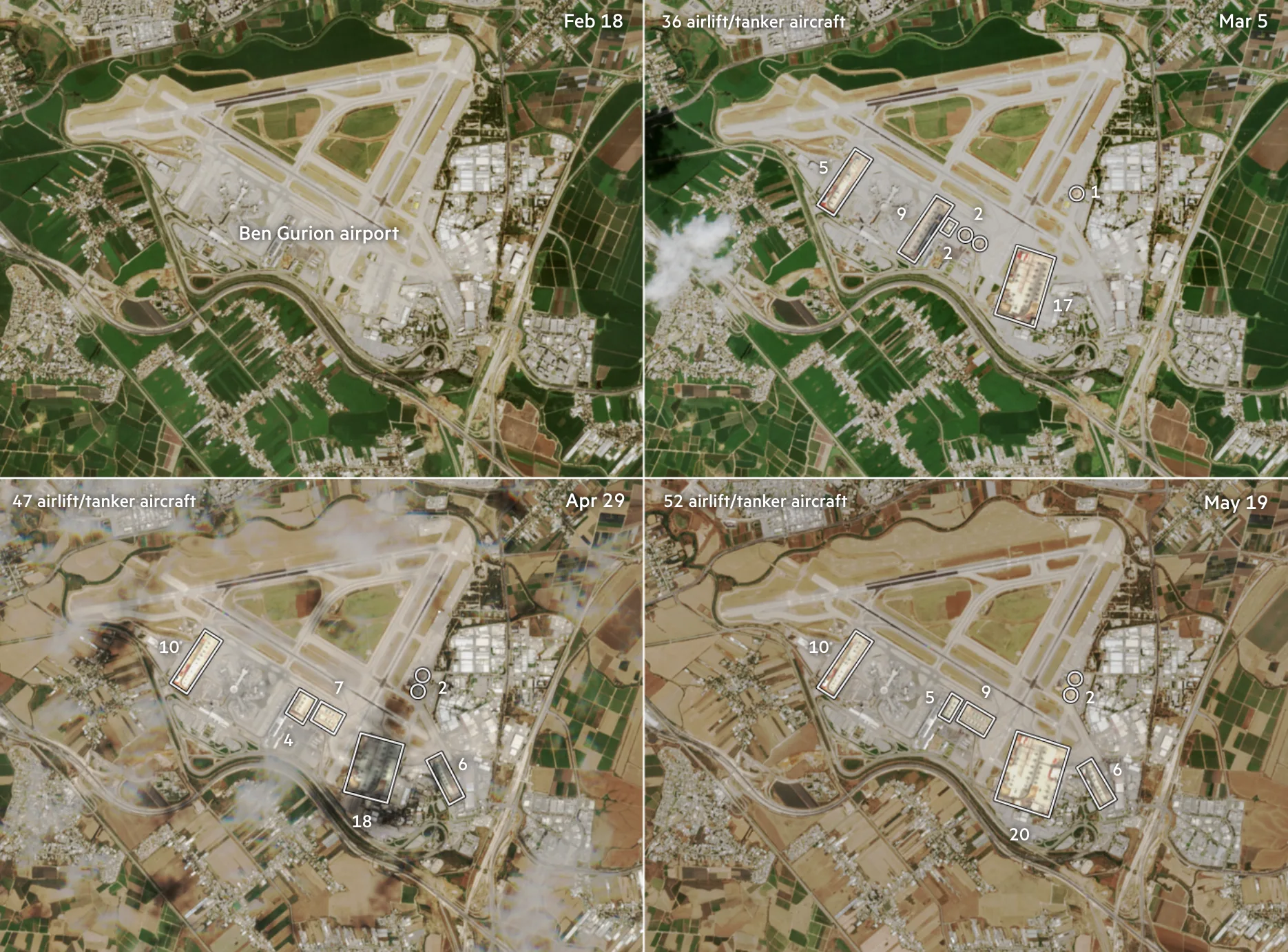
And the Financial Times indicates , citing satellite images, that the number of refueling aircraft at Ben Gurion rose from about 36 in early March to 47 after the ceasefire in April, then to 52 in mid-May.
3- Cargo and support aircraft: C-17 Globemaster III and C-130 Hercules aircraft were spotted transporting maintenance crews and equipment to Ovda, while some aircraft were moved to Lod military base to ease pressure on Ben Gurion.
The heavy deployment has made Ben Gurion look more like a military base, with aircraft occupying a large number of parking positions, causing civilian flights to be delayed for hours because no spaces are available.
Ramon, meanwhile, is a smaller airport used for budget and tourist aviation, and it hosts a number of refueling aircraft to ease congestion in “Tel Aviv”.
Why are they being deployed in “Israel”?
The shift from military support to operational partnership is due to several factors.
First: Gulf sensitivities. US bases in those countries appear constrained by greater political and security sensitivities, especially since Iran had previously warned its Arab neighbors against allowing their territory or airspace to be used against it.
US President Donald Trump also said that the leaders of Qatar, Saudi Arabia, and the UAE asked him to postpone a previously planned strike in order to give negotiations a chance.
Second: an additional operational axis. The deployment in Israel adds an alternative operational axis from the eastern Mediterranean and the Negev, reducing Washington’s reliance on Gulf bases and airspace that are more politically and security sensitive.
And “Israel” has advanced air infrastructure. Ben Gurion Airport has long runways and facilities capable of receiving massive aircraft such as the KC-46A, and its location near the Mediterranean allows aircraft to launch quickly toward Iran or the Red Sea.
In addition, the deployment of advanced F-22s provides an air umbrella for deterrence operations and sends a message to Iran that Washington is keeping the military option on the table despite the negotiations.
Third: the political factor. Driven by a desire to support the occupation government and demonstrate commitment to the alliance, “Israel” has shifted from being merely a recipient of aid to a partner in the US operational architecture in the region.
Israeli reports indicate that Washington informed Tel Aviv that the aircraft would remain until the end of 2026 and possibly into 2027, but Pentagon sources told the Jerusalem Post that they could leave within 72 hours if an agreement is reached with Iran.
In this way, the deployment allows the military presence to be used as a tool of pressure and threat in negotiations with Tehran and to improve Washington’s bargaining position.
What are the costs, concerns, and effects?
The military deployment has not come without a civilian cost. The presence of dozens of refueling aircraft has caused severe congestion at Ben Gurion Airport, where travelers complain of remaining inside the plane after landing because no parking stands are available.
And the CEO described what is happening as tantamount to a takeover of the airport, while the CEO of Israir said Ben Gurion had become a “terminal inside an American base.”
This coincided with the continued suspension or reduction of flights by major foreign airlines to “Tel Aviv” for varying periods because of security risks and operational restrictions, reducing supply and driving up prices.
The increase in fuel demand and disruptions in global supply lines raised the price of jet fuel by 130 percent in Israel, adding $50 to short-haul flights and about $400-$500 to long-haul flights, prompting aviation officials to describe this summer as “the most expensive in the history of Israeli aviation.”
Security concerns go beyond the economic dimension, as turning civilian airports into “operations centers” increases the risk that they will be viewed as part of the military infrastructure in any broad escalation.
The head of the Israeli Civil Aviation Authority, Shmuel Zakai, also warned that Israel effectively does not have an international airport operating efficiently under the current situation.
Warnings have also spread that the continued positioning could push insurance companies to raise premiums or reassess risks, and could lead to a decline in the tourism sector and the economy as a whole.