





هذا التقرير متاح أيضًا بـ العربية
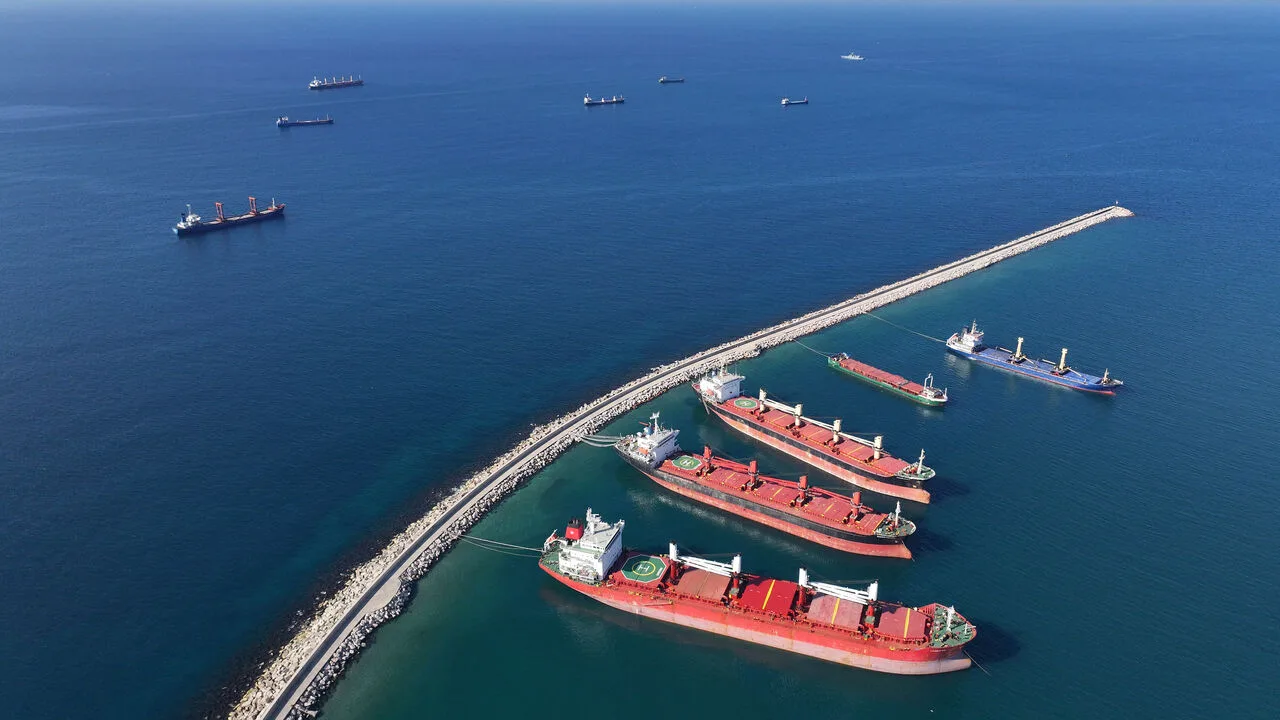
Over the past two decades, the UAE’s strategy has been built on constructing a broad logistics belt through investments in ports and maritime corridors stretching from the Gulf and the Horn of Africa to the Red Sea and the Suez Canal. With the recent escalation of security threats to shipping in the Gulf and the fallout from the latest confrontation with Iran, plans accelerated in the UAE to reduce dependence on the Strait of Hormuz.
Amid these shifts, Syria’s coast has begun to emerge as a vital geopolitical node and a foothold that gives the UAE a strategic position in the eastern Mediterranean, given its proximity to trade and energy routes toward Europe, as well as the opportunity it offers Abu Dhabi to connect Syrian geography to the network of ports and corridors it has worked to build over the past several years.
This shift has been reflected in the UAE’s geopolitical calculations in its relationship with the Syrian administration, as Abu Dhabi moved from caution to active economic partnership. President al-Sharaa’s recent meeting in the Emirati capital helped dispel Abu Dhabi’s concerns about the nature of Syria’s new system of governance, paving the way for economic movement in early May 2026, when Syrian Economy and Industry Minister Dr. Nidal al-Shaar met with UAE Ambassador Hamad Rashid al-Habsi to discuss ways of strengthening economic cooperation between the two countries.
Only days after that meeting, Damascus saw the launch on May 11, 2026, of the first Syrian-Emirati Investment Forum, which brought together 140 senior Emirati officials, businesspeople, and investors, along with more than 500 Syrian officials and businesspeople. The forum served as a broad platform to discuss investment opportunities in sovereign and vital sectors, with notable focus on Damascus and Syria’s coast.
But this Emirati investment push raises fundamental questions that go beyond reconstruction: How is the UAE seeking to strengthen its influence in the new Syria? What kind of economic tools is it relying on? And will these announced projects serve as an entry point for state-building, or are they merely a tool for redrawing the map of Emirati influence?
From rehabilitating Assad to unease over the new administration
Since 2011, the UAE’s position on Syria has been marked by pragmatism and constant adaptation. After aligning with the Gulf position supporting the opposition in the early years of the revolution, its stance underwent a radical shift by 2014 toward backing the Assad regime and supporting Russian military intervention, turning Abu Dhabi into one of the most prominent Arab governments supporting Assad’s regime, which it sought to rehabilitate regionally and internationally.
With the fall of the former regime in December 2024, reports revealed that Assad’s wealth had been smuggled aboard a private plane to the UAE, alongside accusations that the UAE coordinated with Israel to support moves by some Druze leaders to push the country toward partition.
In the wake of these rapid shifts, Syrian-Emirati relations entered a phase of caution and diplomatic coolness, driven by Abu Dhabi’s concerns over the rise of an Islamist current to power. Anwar Gargash, diplomatic adviser to the UAE president, publicly expressed the UAE’s concern over the Islamist affiliation and jihadist background of the factions that toppled the Assad regime.
Paralysis in the Strait of Hormuz: The inevitability of Syrian geography as a lifeline
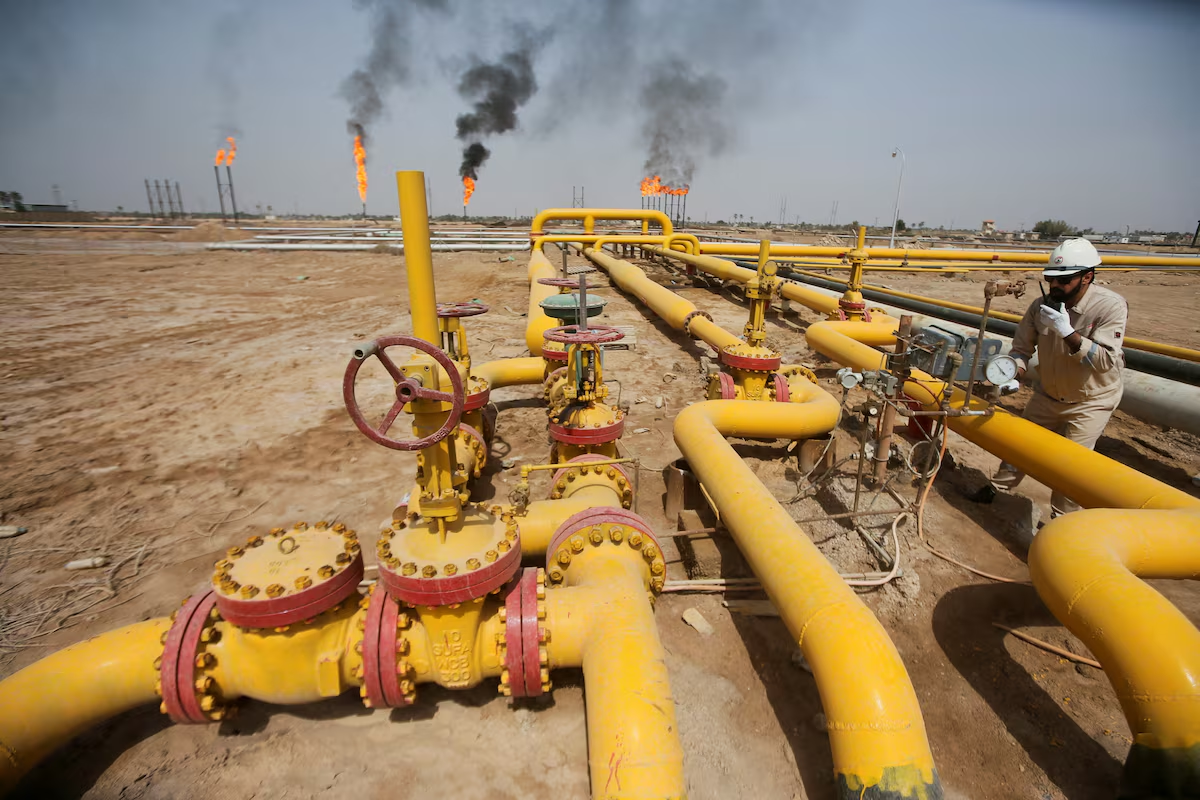
According to Mazen Alloush, director of public relations at Syria’s General Authority for Land and Sea Ports, after the Strait of Hormuz was closed, all neighboring countries in the region knocked on Damascus’ door seeking access to Syrian ports. Indeed, countries in the region, including Iraq and the UAE, began accelerating oil transport through Syria toward Europe.
The recent war on Iran and Tehran’s closure of the Strait of Hormuz marked a pivotal turning point in the political thinking of the UAE in particular toward Syria. According to political economy researcher Mustafa al-Sayed, the change did not occur so much in Damascus as within Abu Dhabi’s own strategy, which has increasingly begun searching for safer, more stable corridors and markets.
Experts’ readings converge on the nature of the UAE’s new motives toward Syria. Economic expert Mohammed Saad points out that Emiratis see Syria as a corridor for the region’s energy after the recent war on Iran and the closure of the Strait of Hormuz. Researcher Anas al-Qaed supports this view by saying that the UAE sees Syria’s coast as part of a broader regional connectivity strategy aimed at fortifying its maritime vulnerabilities, while also balancing rival powers such as Saudi Arabia, Türkiye, and Qatar over the future of Syria’s political and economic orientation.
From another angle, observers believe that the improvement in relations may have accelerated amid the war on Iran, as President al-Sharaa repeatedly expressed solidarity with Abu Dhabi. Syrian support was not limited to political rhetoric, but extended to providing technical information on how Iranian drones operate. This Syrian position won official praise in April 2026 from Anwar Gargash, senior adviser to the UAE president, who described Damascus’ stance toward the UAE as “positive and distinguished.”
The investment push and its security dimensions
Syrian-Emirati relations entered a new phase of partnership in May 2026 with the launch of the “first investment forum” in Damascus, an event that translated into a package of promises and investment projects focused on sectors such as real estate, infrastructure, ports, and telecommunications.
Despite the economic hopes attached to these Emirati investments, their dimensions go beyond the economy and reconstruction. Analysts believe that Emirati investments on Syria’s coast carry security and geopolitical dimensions that go beyond their declared economic character, and that the UAE’s entrenchment on the coast could turn into a tool of soft pressure that gives Abu Dhabi the ability to influence Damascus’ future political choices, especially since Emirati projects and investments are concentrated in sovereign sectors.
In Egypt after 2013, Emirati investments gradually turned into a network of influence within sovereign sectors and contributed to strengthening the UAE’s political presence inside the Egyptian state. Abu Dhabi also tried to build a similar model in several other countries, including Somalia, Senegal, Tanzania, Mozambique, and Angola.
Despite the promises these Emirati partnerships and investments carry of improving services, stimulating the economy, and creating jobs, they also raise growing questions about the nature of these agreements and the extent to which they will actually affect citizens’ lives. In this context, researcher Firas Haj stresses the need for the Syrian government to commit to full clarity and transparency regarding the details and terms of these Emirati investments.
There also remains ongoing debate over whether these partnerships will be limited to supporting economic recovery and reconstruction, or whether they represent part of a broader geopolitical competition in which economic tools are used to reshape influence inside Syria. Some believe this Emirati push is tied to the kind of influence Abu Dhabi is trying to build inside the new Syria.
The question is not whether Emirati investment exists, but rather its conditions, functions, and the limits of its impact on national decision-making.
Against this backdrop, the Syrian administration faces a test that places it under dual pressure: between the country’s need for funding and expertise, and the need to preserve the independence of economic decision-making and prevent it from becoming beholden to outside actors, as well as under the pressure of seeking performance legitimacy amid crushing economic strains and criticism related to competence and favoritism.
But alongside these cautious geopolitical readings, another current of analysts views the UAE’s new role in Syria positively and optimistically, describing it as a reflection of the Syrian state’s turn toward a free-market economy. In this context, political analyst Yasser al-Najjar notes that the UAE’s vast capabilities open the door to benefiting from its pioneering experience in digital transformation, electronic systems, technical fields, and advanced port management.
Some observers note that what distinguishes the Syrian case from other regional models such as Egypt is that Syria lies at the heart of a more complex web of international and regional conflicts. From this angle, businessman and vice president of the Economic Forum for Development in Damascus Mahmoud al-Darawi believes that the concerns raised about repeating the “Emirati model in Egypt” in Syria are not based on realistic data.
Al-Darawi explains that decision-makers in Damascus are inclined to distribute economic files according to the principle of international advantage and competence, so that each country or company is involved in the field in which it has excelled globally. He gives the example of the energy sector, where Syria is moving to enlist global companies with advanced oil and gas technologies, while opening up to the UAE to benefit from its expertise in ports.
Where are Emirati investments concentrated in Syria?
The UAE is repositioning itself within Syria’s new landscape through the economy and infrastructure, in sensitive locations such as ports. The nature of these investments shows that the UAE is moving according to a geopolitical vision tied to ports and logistics corridors. Having built broad maritime influence over the past two decades stretching from the Gulf to the Red Sea and the Horn of Africa, the UAE now appears to be trying to add Syria’s coast to that chain.
The port of Tartus, the country’s second-largest seaport, stands out as one of the most important strategic keys to the Emirati project. The port is one of the most prominent Syrian ports on the Mediterranean and represents a geographic node linking Europe, the Middle East, and North Africa.
That is why DP World signed a memorandum of understanding to develop and operate a multipurpose container terminal in Tartus worth $800 million. The deal thus became more than just a port investment, as the agreement also included cooperation in establishing industrial and free zones and cargo transit stations.
The UAE understands that controlling the port of Tartus means possessing a logistical key to regional trade routes and supply lines, and perhaps leverage against competitors such as Türkiye, especially since DP World announced that the agreement extends for 30 years.
Emirati investments do not stop at Tartus, but extend along Syria’s coast. In Latakia, AD Ports Group, in partnership with France’s CMA CGM Group, signed an agreement to acquire a 20 percent stake in Latakia International Container Terminal Co.
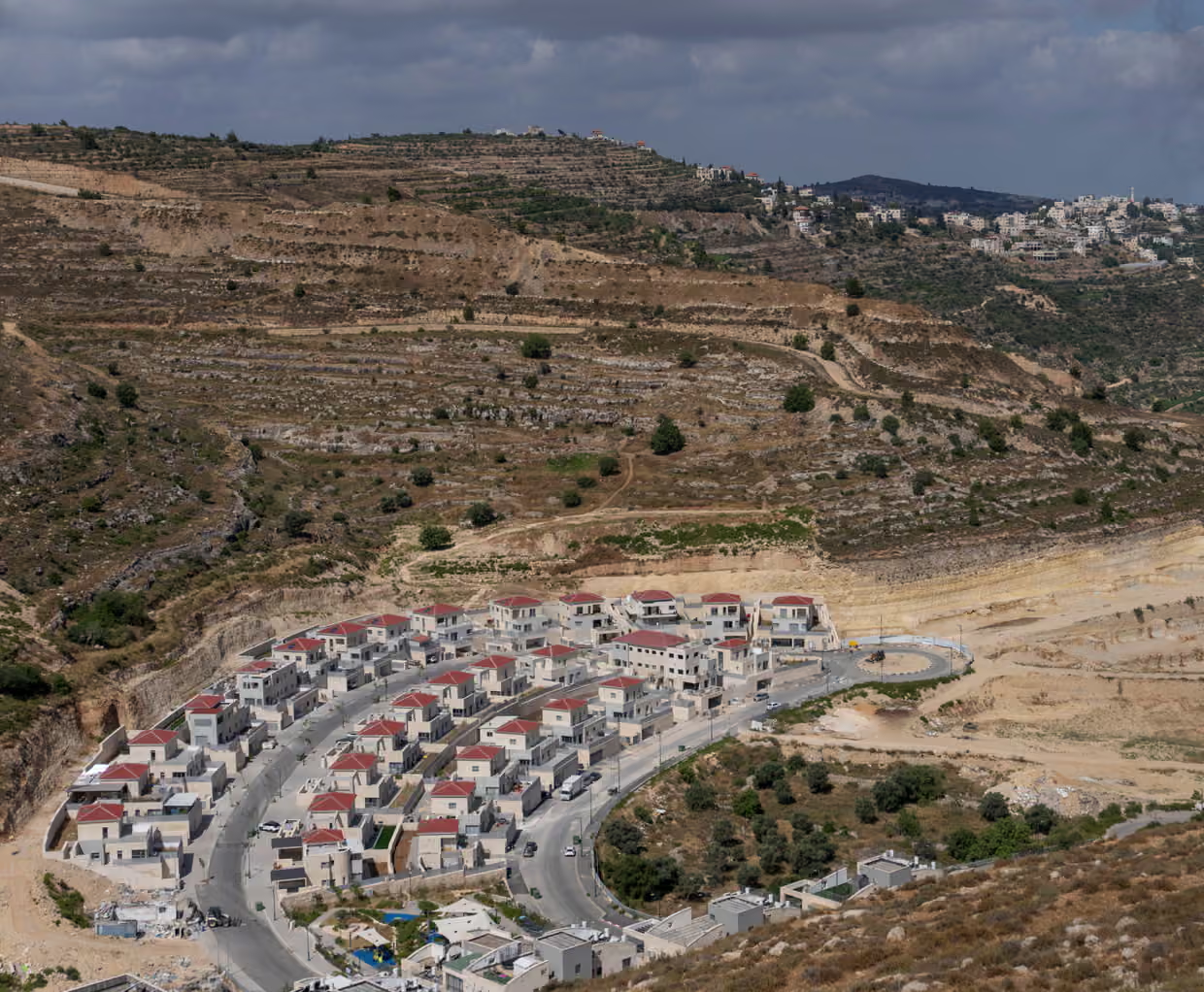
The coast has also seen the launch of major tourism and urban development projects, such as the “Marsa Shams” project being carried out by the Emirati company Meraas, and the Habtoor tourism project stretching along a 12-kilometer coastal strip, in addition to major real estate and tourism projects being studied by Eagle Hills and Emaar on Syria’s coast as well.
| Date | Emirati entity | Investment size | Project | Notes |
| May 2025 | DP World | $800 million | Development and operation of a multipurpose container terminal at the port of Tartus | Memorandum of understanding with Syria’s General Authority for Land and Sea Ports, also covering cooperation in establishing industrial and free zones and cargo transit stations. |
| September 2025 | Al Habtoor Group | Undisclosed | Tourism and residential project on Syria’s coast | Signing of an MoU between Al Habtoor Group and the Syrian Investment Authority to develop a project stretching along a 12-kilometer coastal strip in Latakia and turn it into an integrated residential and entertainment complex. |
| August 2025 | Emirati company Meraas | $150 million | The largest tourism investment project on Syria’s coast | The “Marsa Shams” project on Syria’s coast includes residential units, chalets, hotels, and entertainment and commercial facilities. |
| November 2025 | AD Ports Group in partnership with France’s CMA CGM Group | $22 million | Acquisition of a 20 percent stake in “Latakia International Container Terminal Co.” | The agreement strengthens the UAE’s direct presence on Syria’s coast. |
| May 2026 | Dana Gas | Undisclosed | Memorandum of understanding to develop Syrian gas fields | The project remains at the stage of preliminary understandings. |
| May 2026 | Emaar Properties | $11 billion | Development and real estate projects in and around Damascus | Includes reviving old projects dating back to before 2011. |
| May 2026 | Emaar Properties | $7 billion | Tourism and urban development projects on Syria’s coast | Aimed at developing coastal and investment areas linked to tourism. |
| May 2026 (under study) | Eagle Hills | More than $50 billion | Two massive urban development projects in Damascus and Latakia | The projects are still at the proposal and preliminary study stage and have not entered implementation. |
| May 2026 (under study) | Eagle Hills | Part of the overall project | The Latakia coastal project | Spans about 15 million square meters and includes more than 29,000 housing units, 2,800 hotel rooms, and major tourism and commercial facilities. |
| May 2026 (under study) | Al Wataniya UAE | $2 billion | Damascus Metro project | One of the most prominent infrastructure projects proposed in Damascus. |
The Habtoor project is particularly significant because it reflects a shift in Emirati interest from investing only inside Syrian cities to directly focusing on Syria’s coast. This investment trend aligns with Abu Dhabi’s official vision, expressed by UAE Minister of State for Foreign Trade Thani al-Zeyoudi, when he stressed the development of “free zones” in Syria.
In this context, economic policy expert and international relations professor at the Faculty of Economics at the University of Latakia, Dr. Dhulfiqar Abboud, believes that these Emirati projects cannot be separated from geopolitical calculations, and that investing in Syrian ports such as Tartus and Latakia enables the UAE to access Mediterranean basin and European markets through corridors alternative to the Strait of Hormuz.
Emirati interest also extends to digital infrastructure. Emirati promises in the digital sphere included introducing Visa and MasterCard services, developing technical infrastructure, and offering a new telecommunications operator. Dr. Dhulfiqar Abboud notes that Emirati investment in Syria’s fiber-optic network under the “SilkLink” project gives Abu Dhabi a competitive advantage in capturing the future of data and artificial intelligence in the region.
This digital ambition complements what was announced by Syrian Communications Minister Abdulsalam Haykal to The National regarding the desire of Emirati companies to win the license to operate the new mobile phone network before the application deadline closes at the end of this month.
In Damascus, meanwhile, Emirati investments are heading toward sectors linked to reshaping the urban economy and infrastructure. Emaar Properties has announced multibillion-dollar projects in and around Damascus, including reviving projects dating back to before 2011, such as “Eighth Gate” in Yaafour, alongside new real estate and tourism projects. The “Damascus Metro” project proposed by Al Wataniya UAE has also emerged.
Emirati investors confirm that the real estate sector is at the forefront of the investment destinations that attract them in Syria. In this context, Sultan al-Hindasi, director general of the Fujairah Chamber of Commerce and Industry, explained, saying: “We are studying investment opportunities in tourism, infrastructure, and logistics services, in addition to the services and industrial sectors.”
In reality, this geographic distribution of Emirati investments from the coast to Damascus reflects an attempt to enter the sectors most influential in the future of the Syrian state. The UAE is not entering through a single sector, but through an interconnected system of transport, ports, aviation, real estate, energy, and logistics services. These sectors do not only generate profits, but also control the movement of money, goods, and people, and determine Syria’s place in regional trade networks.
Economic expert Mohammed Saad raises an ethical and developmental question mark over the geography of investment, asking whether these projects will include marginalized areas or remain confined to Damascus and the coast. Economic researcher Diala al-Khatib echoes this view, stressing the need to ensure that developmental benefits flow to marginalized areas, alongside real institutional oversight of sovereign funds and major partnerships.
Emirati investment: Between a political insurance umbrella and fears of Israeli penetration
Since the signing of the normalization agreements, relations between Abu Dhabi and Tel Aviv have developed into a strategic partnership that goes beyond the economic dimension to deeper levels of security and technical coordination. The UAE had previously mediated talks between Syria and Israel in mid-2025.
In this context, some observers believe that the growing Emirati presence in Syria may be viewed in Israel with a degree of comfort, as Tel Aviv sees Abu Dhabi’s influence as a preferred option that helps curb Turkish influence.
Some analysts, meanwhile, believe that the Emirati presence in ports and vital projects in Syria could function as an “indirect umbrella” for Israel. On the one hand, some suggest that this Emirati presence could raise the political and diplomatic cost of any Israeli military escalation in Syria.
Researcher Anas al-Qaed believes there is a strong possibility that Syria’s leadership sees Emirati investments not only as an economic lifeline, but also as a form of political guarantee, increasing the diplomatic and strategic cost should Israel seek to destabilize the Syrian interior.
But on the other hand, business networks and port management under Emirati supervision could, indirectly, provide a logistical and informational window for “Israel.” This may help explain the notable timing of the renewed emphasis on the decree banning the purchase or import of Israeli products, just one week after the conclusion of the “first Syrian-Emirati Investment Forum.”
The decree is not new in origin; rather, the Syrian presidency reaffirmed it at this specific moment, in a move that may reflect Damascus’ effort to draw boundary lines in its relationship with Abu Dhabi. Despite the Syrian government’s openness to Emirati investments, the renewed emphasis on banning Israeli products appears to be an early attempt to block any potential exploitation of trade agreements or shared ports as a transit window or a form of indirect normalization.