









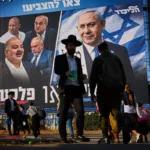




On March 23, 2026, Bezalel Smotrich stood before his parliamentary bloc in the Knesset and delivered a speech that addressed borders with unusual directness. He invoked the Litani River as a line demarcating the northern sphere mirroring developments unfolding on other fronts such as Gaza and Syria.
Simultaneously, airstrikes targeted bridges spanning the river, while displacement within southern Lebanon expanded, driven by escalating evacuation orders and sustained military pressure on border villages.
This alignment between rhetoric and action returns southern Lebanon to the center of a broader scene that transcends the immediacy of the moment. It raises questions about the nature and limits of this presence: is it a contingent development shaped by wartime dynamics, or the continuation of a much older trajectory formed over decades?
At the turn of the twentieth century, the Litani River already featured in Zionist conceptions aimed at delineating a geographic space tied to resources and economic function. In that formative moment, the Zionist movement sought to present a comprehensive vision of borders.
In subsequent phases, southern Lebanon continued to appear within this framework through various milestones: political correspondence and proposals in the 1950s; military operations bearing the name “Litani” in the late 1970s; the period of occupation; and later confrontations that repeatedly brought the south back to the forefront of conflict.
Together, these episodes reveal a continuity in treating this space as part of a broader equation involving security, resources, and borders.
Within this continuum, southern Lebanon emerges as a space where geography intersects with political and military transformations, with the Litani functioning as a persistent element whose significance extends beyond its physical location.
Before Borders: Maps That Preceded the State
In February 1919, Chaim Weizmann presented a map of the proposed “Jewish national home” at the Paris Peace Conference 1919. Contrary to European expectations that it would be confined to the borders of Mandatory Palestine, the map extended northward to include southern Lebanon, designating the Litani River as its boundary.
Standing alongside him was David Ben-Gurion, in a moment when the Zionist movement sought to anchor its geographic vision within the emerging international order. Although this proposal did not materialize politically at the time, the Litani retained its place in border-related thinking and remained a constant in subsequent strategic discussions.
The concept of the “Land of Israel” drew on varied interpretations of biblical texts, offering divergent geographic boundaries. With the Zionist movement’s transition into political action in the early twentieth century, these ideas were transformed into maps and legal documents presented to the international community.
In 1918, Ben-Gurion outlined a detailed geographic vision for the future state, placing the Litani as its northern boundary, with extensions toward the Awja Valley south of Damascus, Sinai, and Transjordan reflecting a shift from symbolic imagination to precise territorial planning.
When presented at the Paris Conference, these visions took the form of formal claims encompassing Palestine and parts of its surroundings, with clear emphasis on resources and natural outlets—revealing the linkage between borders and economic function. The submitted documents explicitly stressed the importance of controlling water sources, including lands south of the Litani.
In contrast, the region’s actual borders were shaped by the Sykes-Picot Agreement, which redistributed territory according to British and French interests. Water sources, including the Litani, fell under French influence, while other areas were divided based on oil, railways, and imperial balances.
At the Paris Conference, the Zionist movement attempted with partial British backing to revise this arrangement. However, the French position prevailed, solidifying the geographic separation between Palestine and Lebanon under separate mandates. This outcome reflects how borders were ultimately shaped more by colonial balances than by coherent geographic or hydrological logic.
Despite this, the Litani continued to occupy a place in Zionist thinking across three interrelated dimensions: a historical-religious dimension linking northern Palestine with southern Lebanon; a water-economic dimension tied to resource sustainability; and a geographic-security dimension viewing the river as a natural boundary.
With the agreements of 1920 and 1923, international borders between Lebanon and Palestine were formalized. Yet this did not end debate within the Zionist movement. These borders remained embedded within a broader vision open to expansion, shaped by shifting power dynamics.
This was evident in Ben-Gurion’s 1937 assertion that “a partial Jewish state is not the end but the beginning,” and that “the limits of Zionist aspirations are a matter for the Jewish people alone.”
The Litani: A River That Moves Through Politics
In December 1919, Weizmann wrote to British Prime Minister David Lloyd George, stating: “The economic future of Palestine depends on its water supply, and that supply lies to the north toward Hermon, the sources of the Jordan, and the Litani River.” The formulation was practical, framing water as a structural necessity in defining vital space.
The Litani originates in Lebanon’s Beqaa Valley west of Baalbek, flowing south before turning west toward the Mediterranean over a course of roughly 170 kilometers. Its basin covers about one-fifth of Lebanon and contributes significantly to the country’s water flow. Its proximity to the border with Israel gives it added strategic significance, effectively dividing southern Lebanon into two zones.
Around the river, an integrated economic system has developed, anchored by Lake Qaraoun, dams, and hydroelectric plants, and supporting a major agricultural sector accounting for roughly 35% of Lebanon’s agricultural output.
By contrast, Israel’s water environment is semi-arid, relying on groundwater, the Jordan River, and increasingly desalination. While technological advances have reduced pressure on natural sources, water remains central to security considerations amid population growth.
Within this context, the Litani appears as the nearest external resource potentially integrable into broader water management strategies. Estimates suggest that control over southern Lebanon and access to the Litani could add up to 800 million cubic meters annually around 40% of Israel’s current water consumption.
This strategic importance has persisted for over a century, from Theodor Herzl’s early ideas in Altneuland to later technical proposals linking the Litani to the Jordan River system.
From Vision to Plan
In October 1948, during the 1948 Arab-Israeli War, Israeli forces advanced into southern Lebanon, reaching the Litani. While an advance toward Beirut was considered, the decision was made to establish defensive positions before withdrawing under armistice arrangements.
In subsequent years, discussions became more structured. The diaries of Moshe Sharett reveal internal debates over expansion and strategy. A 1954 letter from Ben-Gurion described Lebanon as the “weak link” in the Arab League, proposing the creation of a separate political entity and the annexation of the south up to the Litani.
Similarly, Moshe Dayan proposed exploiting Lebanon’s internal divisions to facilitate intervention and eventual control.
By the early 1960s, Yitzhak Rabin identified the Litani as an ideal northern boundary, reflecting continuity with earlier visions.
Field Trajectory and the Limits of Control
In March 1978, Israel launched Operation Litani, advancing to the river. United Nations Security Council Resolution 425 called for withdrawal and established UNIFIL.
In 1982, a full-scale invasion reached Beirut but failed to produce lasting political arrangements. The subsequent “security zone” relied on local proxies, yet resistance movements grew stronger.
By 2000, Israel withdrew, ending nearly two decades of direct presence. The 2006 war reaffirmed the limits of military objectives, as a new deterrence balance emerged.
Across these phases, a recurring pattern is evident: military advances achieve temporary control but struggle to sustain long-term stability due to local resistance, internal Lebanese complexity, and international constraints.
2024–2026: Testing the Equation Again
In February 2025, Israeli settlers linked to the “Ori Tzafon” movement crossed into southern Lebanon near Yaroun symbolically testing the boundary.
This comes amid shifts in the balance of power, including the weakening of Hezbollah following clashes in 2023–2024.
Domestically, Israel has seen the rise of religious-nationalist currents within government. Smotrich has openly proposed the Litani as a northern border, while Prime Minister Benjamin Netanyahu has revived references to “Greater Israel.”
Internationally, strong U.S. support has reduced traditional constraints on Israeli military action.
Ambition Persists—But So Do Limits
In 1954, Sharett described plans regarding Lebanon as a high-risk gamble. Seven decades later, similar ideas re-emerge under different conditions.
From the 1919 Paris Conference to contemporary political discourse, the Litani remains a central axis in Zionist strategic thought.
Yet field experience reveals a consistent constraint: while military forces can reach the river, sustaining control proves far more difficult. Local resistance continues to regenerate, reinforcing the link between occupation and opposition.
Between a map presented over a century ago and today’s political rhetoric, the idea persists. But southern Lebanon remains a space where ambition meets resistance where imposed visions are continually tested against geography, population, and the enduring will to remain.


