





هذا التقرير متاح أيضًا بـ العربية
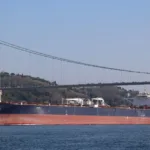
In the middle of a humid night near the Strait of Hormuz, a small tanker appeared on a ship-tracking screen flying the Malawian flag and bearing a Chinese name. But just a few hours later, its Automatic Identification System (AIS) went dark and it vanished. When it reappeared, it was flying a different flag and had changed course toward a port unrelated to its declared voyage.
This scene is not unique; it has become part of a phenomenon known as the “shadow fleet” — a network of ships and companies that circumvents U.S. sanctions and turns the Hormuz corridor into a gray zone where the boundaries between legitimate trade and prohibited activity dissolve.
How deeply has the shadow fleet penetrated the blockade?
The United States imposed a naval blockade on Iran’s oil exports on April 13, 2026, and the number of transits fell from 125–140 per day to just a handful daily, while dozens of tankers were trapped in the Gulf.
Although Washington succeeded in rerouting dozens of tankers — as reports indicate that 37 ships had been turned back by April 25 and 48 by early May — the “shadow fleet” network appears capable of adapting.
And maritime monitors recorded 14 transits through the strait on April 30 (seven entering the Gulf and seven leaving), all with AIS activated and no dark voyages.
But on the same day, the number of “dark” events rose in the Gulf to 131 cases, suggesting that some vessels chose to manipulate their movements outside the strait.
And TankerTrackers estimates indicate exports of between 13.7 million and 16.5 million barrels during the period from February 28 to March 11, while two VLCCs (Hero II and Hedy) managed to transport about four million barrels in mid-April.
At the same time, dozens of tankers became floating storage units near Kharg Island, waiting for a chance to depart or transfer their cargo to other tankers.
An investigative report by Al Jazeera tracked 202 voyages between March 1 and mid-April, 77 of them linked to Iran, and 61 vessels on sanctions lists, underscoring that sanctions did not halt trade entirely but made it more costly and complex.
The data showed that an Iranian oil tanker named Roshak, an unidentified cargo vessel numbered “13448,” and the Panamanian cargo ship Manali crossed the strait during a brief truce, while other tankers — such as Flora, Genoa, and Skywave — switched off or jammed their electronic systems to mislead radar.
At the same time, 18 VLCCs were waiting for their turn to load at Kharg Island, while 65–75 million barrels of oil were being used as floating storage.
What methods does the shadow fleet use?
1. Disabling or jamming the Automatic Identification System
Many “shadow fleet” vessels follow a pattern that begins with appearing on radar and then disappearing, as reports confirm that disabling or jamming the AIS is the most common tactic.
Three tankers on U.S. sanctions lists — Flora, Genoa, and Skywave — were reported to have deliberately shut down their AIS devices during transit, while tracking data showed that the Indian tanker Desh Garima turned off its device while crossing the strait, then switched it back on once it had moved away from the area.
A notable exception was Wen Yao, a petroleum products tanker identified as the first sanctioned vessel to cross the strait in March without turning off its AIS.
2. Changing flags and names
In addition to disabling devices, vessels rely on changing their flags and names. An Al Jazeera investigation uncovered 16 ships flying the flags of small states — such as Botswana, Madagascar, Guinea, Haiti, and the Comoros — to avoid scrutiny.
And on April 24, the U.S. Treasury Department listed tankers such as Lisboa, LPG Sevan, Lynn, Global Vivian, and Magnolia under sanctions for using Panamanian or Hong Kong flags and shell companies in the Marshall Islands and the UAE.
Some tankers also change their names to shed their histories, as happened with the oil tanker Majestic X, formerly known as “Phonix,” which changed its flag to Guyana before being seized by the U.S. Navy while smuggling Iranian oil.
3. Complex routes and gray waiting zones
Alongside flags and names, “shadow fleet” tankers choose complex routes. On the first day of the blockade, three tankers crossed the Strait of Hormuz — Christianna, Murlikishan, and Peace Gulf — heading to Iraq or India, using northern and southern lanes in the Gulf of Oman.
Days later, two VLCCs succeeded — Hero II and Hedy — in reaching the Arabian Sea carrying about four million barrels of oil.
But a number of vessels, such as Bavand and Rich Starry, were forced to turn back after attempting to break through, while the U.S. Navy took control of the gas tanker Sevan in the Arabian Sea and sent it back.
Some vessels also deliberately stop in gray waiting zones near the Gulf of Oman or the Arabian Sea to change course or receive new instructions, making them harder to track.
4. Ship-to-ship (STS) cargo transfers
Among the most controversial methods are ship-to-ship cargo transfers. Gcaptain reported on May 2 that the gas tanker Sarv Shakti, flying the Marshall Islands flag, loaded its cargo through such an operation near the Dubai coast before crossing the strait en route to India.
Other reports pointed to similar transfers in the Strait of Malacca and Indonesian waters, meaning some Iranian cargoes change identity out of sight and reappear as though they originated from other ports.
These operations are often carried out at night and away from official ports, and are recorded in shipping documents as ordinary commercial voyages.
Who provides the fleet with its commercial and legal cover?
Behind these operations stands a network of companies and brokers. For example, Anka Energy and Logistics Co , registered in the Marshall Islands and the UAE, owns the gas tanker Sevan, which was used to transport about 750,000 barrels of propane and butane to Bangladesh in 2025.
Meanwhile, Al Anchor Ship Management FZE in the UAE manages tankers such as G Summer, while Ocean Jewel Shipping Co. Ltd in Shanghai manages the tanker of the same name.
These companies often benefit from complex ownership structures and registration offices in multiple countries to mislead investigators.
Washington has tried to tighten the noose around this network. On April 24, the Treasury Department announced sanctions targeting 40 companies and vessels involved in the fleet, including firms such as Lisboa Shipping Co., Gale International FZE, Al Seer Marine, and China’s Hengli Petrochemical refinery.
The department named tankers with specific identification numbers, including Lisboa (IMO 9257711), LPG Sevan (IMO 9177806), Magnolia (IMO 9258519), and Covenio (IMO 9263227), all operating under Panamanian or Hong Kong flags.
An Al Jazeera investigation indicated that 15.7% of these vessels’ operators are Iranian, 13% Chinese, more than 11% Greek, and 9.7% based in the UAE, while about one-fifth of the operators remain unknown.
Alongside the companies, buyers play a central role. Most of the oil leaving via the “shadow fleet” heads to Chinese refineries, especially Hengli Petrochemical, which was placed under sanctions for receiving Iranian oil through this network.
And trading intermediaries participate in East Asia and the Gulf by purchasing the oil and then reselling it after altering its documents. The Fujairah corridor in the UAE and Omani ports also provide safe areas for ships to wait and conduct transfers between them, while vessel registration in the Marshall Islands, Panama, and the Comoros provides legal cover that hinders inspection efforts.
Marine insurance and classification operations complete this chain, as insurers in some countries turn a blind eye to vessels’ histories or ownership in exchange for high fees, allowing them to dock at certain ports and obtain safety certificates.
While major companies comply with sanctions, smaller or intermediary firms stand out as willing to take the risk for profit, making it difficult for the U.S. Navy or classification agencies to stop the fleet’s operations, because the vessels may be legally registered and receive insurance and certificates.
Thus, turning Hormuz from a monitored strait into a gray zone shows that the battle to control Iran’s oil trade is not only at sea, but also in registration offices, insurance networks, and ownership documents.