





هذا التقرير متاح أيضًا بـ العربية
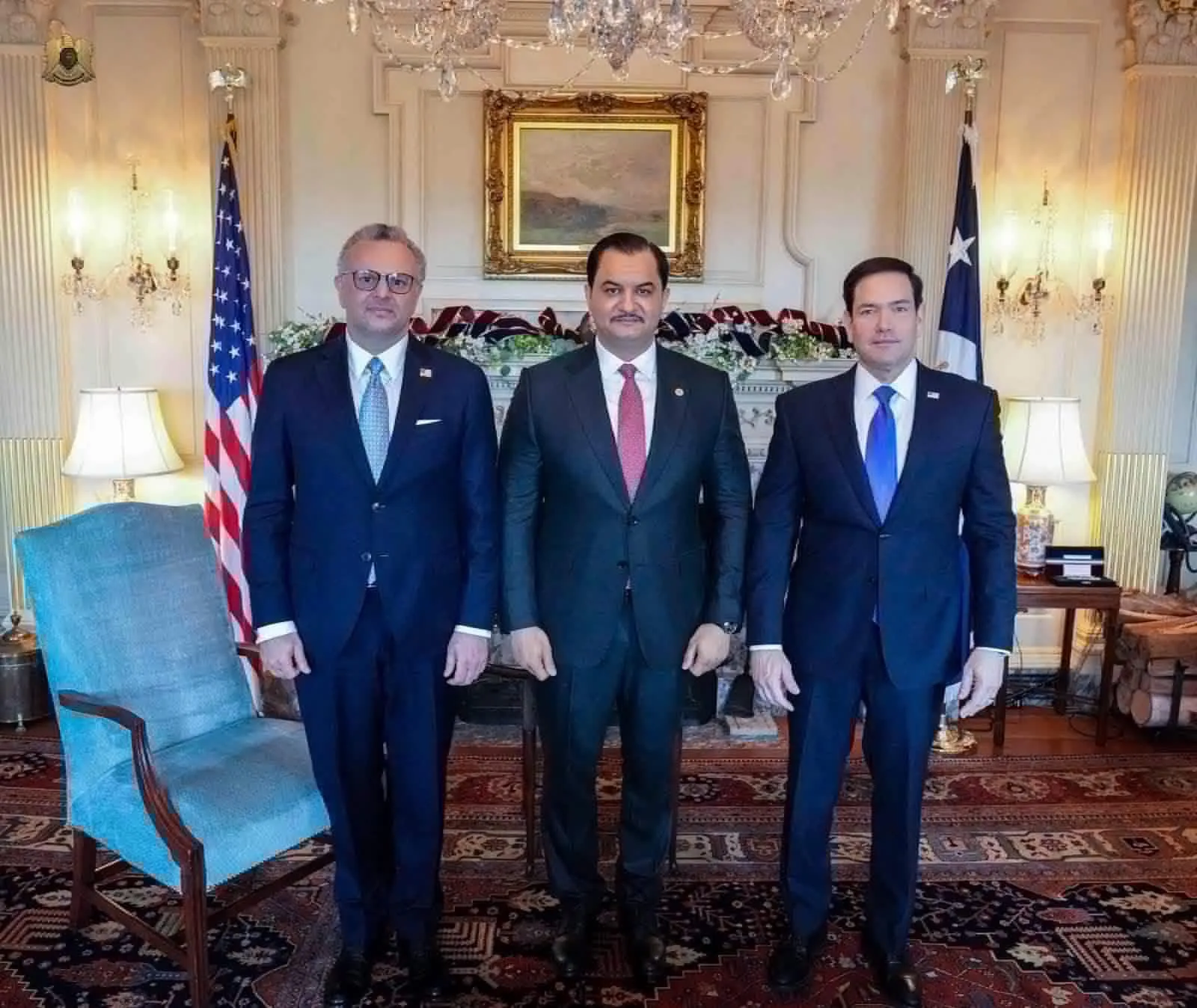
The United States has recently intensified its political engagement in Libya in a striking way, signaling a shift by Washington from the position of a cautious observer to that of a direct actor in the file. One of the clearest signs of this move was the meeting held in Washington on June 29 between US Secretary of State Marco Rubio, Saddam Haftar, deputy commander-in-chief of the “National Army,” and Massad Boulos, the US president’s adviser on Arab and African affairs.
The meeting came about a week after Washington received a delegation representing the Government of National Unity in Tripoli, headed by Deputy Defense Minister Abdul Salam al-Zoubi. Talks were held with Boulos and the deputy commander of US Africa Command, AFRICOM, covering a number of issues tied to unraveling the complexities of the Libyan crisis, foremost among them the security and military tracks, the unification of institutions, and preparing the political ground for any possible settlement.
These simultaneous meetings with key parties from both the eastern and western camps indicate that the US vision for the Libyan file has begun to take on clearer contours, and that the initiative on the table is no longer confined to media statements or diplomatic communiqués, but has moved to the level of direct practical engagement with the influential forces on the ground.
But this US engagement, at this intensity and at this particular moment, has opened the door to a broad wave of questions about Washington’s real motives and what it hopes to achieve by reactivating its presence in a file that for years remained in a state of relative stagnation within US calculations.
Why is America returning to the Libyan file now? What does it want? And does it really have sufficient tools to untangle a complex crisis in which local, regional and international interests overlap?
What about the American initiative?
To begin with, it must be noted that Washington has not yet officially announced a comprehensive document for what is known as the “American initiative” to resolve the Libyan crisis. What is on the table so far appears closer to an undeclared diplomatic vision, or a preliminary road map, whose features are gradually emerging through statements by US officials, as well as leaks and media reports linked to the recent moves on the Libyan file.
According to statements by US officials, the declared goal of this initiative is to unify Libya’s military, economic and political institutions and create the conditions necessary for the establishment of a democratically elected government. On the surface, these goals do not differ from those contained in previous UN and international tracks.
What is new this time is Washington’s attempt to push a more direct approach that deals with the actual centers of power in eastern and western Libya.
The expected map of power is one of the most sensitive points in the initiative. According to what the newspaper “Financial Times” reported, citing informed sources, Washington is pushing for a power-sharing arrangement between the eastern and western camps that would keep Abdul Hamid Dbeibah as prime minister, in exchange for granting Saddam Haftar a senior position within a presidential structure or executive council.
On the military side, the initiative places the issue of unifying the military and security establishment at the heart of any possible settlement. In this context, Washington starts from the conviction that any elections or unified government will remain fragile and liable to collapse as long as weapons are distributed among rival authorities and forces in the east and west.
For that reason, the US approach does not appear to separate the political track from the security track, but rather sees control over the military sphere as a basic condition for the success of any political transition.
The economic dimension is also present as one of the central pillars of this vision. The United States has pushed toward unifying public spending, on the basis that the financial split has remained one of the factors fueling the political and military divisions. In this context, the signing of Libya’s first unified budget since 2013, in April 2026, worth 190 billion Libyan dinars, came as an important step toward financial and institutional reconciliation, and a message that unifying resources could be a practical entry point to unifying authority.
Although the Americans are keen to portray the initiative as complementary to the UN track rather than a substitute for it, especially since the UN road map itself is based on parallel tracks that include an electoral framework, a unified government and an organized political dialogue, with a timeline ranging from 12 to 18 months to reach elections, fears remain that the American initiative could turn into a parallel track that precedes the electoral milestone with a political deal among the dominant forces, only for elections to be postponed again later under the slogan of consolidating stability.
A pragmatic approach
The US approach to the complexities of the Libyan file starts from a basic premise: that achieving real political stability, or organizing calm and sustainable elections, remains difficult unless the balance of power is first brought under control within the institutions that command money, weapons and oil.
Accordingly, Washington appears convinced that any electoral process not preceded by a relative dismantling of the drivers of conflict or at least their containment and neutralization during the coming phase will remain vulnerable to collapse or to reproducing division.
To achieve this goal, the US vision rests on several parallel tracks, foremost among them pushing toward unifying the military institution, or at least reducing the severity of discord and lack of cohesion among its components in the east and west. Washington also places the unification of public spending and the budget at the center, given that the financial split has remained one of the main drivers of the political and military divisions, alongside efforts to form a unified executive authority to lead the transitional phase, provided that it is based on a minimum level of understanding and coordination among the influential parties and avoids reproducing the bilateral conflicts that obstructed previous settlement tracks.
Although the American initiative dates back in its roots to roughly more than a year ago, it did not acquire this political and media momentum until recently, when Washington moved from quiet contacts to direct diplomatic action. The United States has indeed taken some steps that reflect an attempt to translate this vision into practice, including support for the adoption of the first unified national budget in 13 years, organizing joint military exercises in Sirte under the supervision of US Africa Command, AFRICOM, and pushing for the establishment of a joint security operations room between the east and west.
What does Washington want?
America’s return to the Libyan scene cannot be read simply as an expression of Washington’s desire to untangle the crisis. At the core of its approach, the current US administration is operating according to a pragmatic logic governed by the compass of interests and gains. From this perspective, it can be said that the growing US engagement at this moment is aimed at achieving a set of overlapping objectives political, security, economic and logistical.
At the top of these objectives, Washington seeks to prevent Libya from turning into a strategic vacuum open to rival powers, foremost among them Russia, which has a clear presence and influence in eastern and southern Libya, in addition to close ties with retired Field Marshal Khalifa Haftar and his camp. The United States therefore does not want to leave that influence to expand without competition or restraint.
At a minimum, it seeks to narrow Russia’s room for maneuver in the Libyan file and to reassert its presence in an arena that for years remained open to multiple regional and international arrangements.
There is also a security and logistical objective tied to Washington’s desire to strengthen its presence in North Africa, as a space that directly intersects with the African Sahel, where the issues of irregular migration, arms smuggling, armed groups and transnational criminal networks overlap. In this context, Libya acquires particular strategic importance as a main gateway to the African interior and a link between the north and center of the continent, making its stability or instability a factor affecting the broader US security calculations in the region.
The economic dimension, meanwhile, represents one of the most prominent drivers of US engagement, if not the most prominent. Washington is moving with its eye on Libyan oil, not only as an important economic resource, but also as a factor affecting the stability of the energy market. Libya holds Africa’s largest proven oil reserves, with production estimated at about 1.35 million barrels per day this year, and investments aimed at raising production capacity to 2 million barrels per day by 2030.
Such factors make Libya an attractive arena for US interest, especially as Washington constantly seeks to diversify energy sources and strengthen the presence of its companies in vital production regions, from Venezuela to the Gulf, passing through Libya, the eastern Mediterranean and the Middle East.
Accordingly, the renewed US presence in Libya cannot be separated from calculations of influence, energy and regional security. Washington is not only looking for a political settlement that ends Libya’s division, but for a formula that ensures Libya does not become an open space for its adversaries, and that its resources and geopolitical position remain within an equation the United States can influence and steer.
Family entrenchment … rising fears
Although the US approach is presented, on the surface, as an attempt to untangle Libya’s crisis by unifying state institutions and ending the political and military divide, the other side of this initiative raises fears that it could shift from a path toward settlement into a mechanism for reproducing the crisis in a more organized form. Instead of opening the way to a genuine political transition and comprehensive elections, it may end up entrenching the influence of rival families within the structure of power.
This is the point highlighted by Tim Eaton, a researcher at the British think tank Chatham House, in his article published in Foreign Policy.
Eaton argues that Washington’s reception of Saddam Haftar, and his meeting with the US secretary of state, represents a notable political development. At the same time, however, it raises fundamental questions about whether America is effectively moving toward granting international legitimacy to a power-sharing arrangement between the Haftar and Dbeibah families.
While the Trump administration says its goal is to establish a “unified government and unify all institutions,” the formula being circulated, according to the analysis, appears closer to giving the Dbeibah family the premiership in exchange for empowering the Haftar family with an advanced position in the Presidential Council or the coming executive structure, potentially entrenching the influence of both sides rather than moving beyond it.
Foreign Policy warns that this arrangement, even if presented as a transitional phase supporting the UN road map, could turn into a permanent formula if Dbeibah and Haftar seek to cement their positions within power. Eaton believes Haftar and his son’s record does not reflect a genuine willingness to share power, suggesting that Saddam Haftar would view any new post as a platform for expansion and control over the state.
At the same time, the Dbeibah family would not accept retaining the premiership without guarantees limiting the military influence of its rivals. The danger, then, lies not only in the initiative’s failure, but in its success in a form that ends the division superficially while reproducing it within the state institutions themselves.
A temporary freeze, not a final solution
There is no doubt that the US push to advance the political initiative may succeed, to some extent, in stirring the stagnant waters of the Libyan file, given the political and economic influence Washington possesses and its ability to affect the conflict’s parties. Its keenness to avoid the outbreak of a direct confrontation between the two main camps in the Libyan scene also explains its parallel openness to both sides, eastern and western, and its attempt to manage the balance between them rather than fully align with one of them.
The United States has already begun laying the first building blocks of this path through practical steps that preceded the recent meetings in Washington, including support for the adoption of a unified budget, organizing joint military exercises and opening channels for security coordination between the east and west. Yet these steps, important as they are, are not enough on their own to end a highly complex Libyan crisis.
The crisis is not only about the names of those who hold power, but about an intertwined structure of contested legitimacy, uncontrolled weapons, public money, and tribal and regional loyalties.
Any arrangement limited to distributing positions between Haftar and Dbeibah may therefore succeed in temporarily calming the scene and halting escalation, but it will not address the roots of the crisis. There are influential tribal forces in the center and south, powerful armed groups in the west, and networks of economic and security interests, both domestic and foreign, that cannot be bypassed. Any US approach that does not take these entities into account may find itself facing a fragile settlement, liable to explode at the first real test.
Ultimately, despite the degree of optimism stirred by US engagement over the possibility of breaking the deadlock, fears remain that the initiative could shift from an opportunity for a solution into a deal among centers of power to divide influence and political gains.
That raises broad question marks over Washington’s ability on its own to settle a file in which the interests of local, regional and international powers intersect, and in which the calculations of security, energy and power are intertwined in a way that makes any partial settlement vulnerable to reproducing the crisis rather than ending it.