



هذا التقرير متاح أيضًا بـ العربية
Over the past decades, Türkiye has built up a broad network that carries crises unfolding beyond the country’s borders into domestic public debate, then turns sympathy into donation drives, popular delegations, convoys, medical teams, aid ships, and projects that continue for years.
This capacity emerged during the wars in Bosnia, Kosovo, and Chechnya, and expanded with the Pakistan earthquake, the Indonesia tsunami, and the Somalia famine. It then took on a wider scope during the Syrian revolution, the Rohingya displacement, and the Israeli assault on Gaza.
Civil society groups, mosques, municipalities, businesspeople, volunteers, and media outlets all help operate this network, alongside state institutions and their development and relief agencies. As its activity has expanded, these efforts have helped strengthen Türkiye’s humanitarian and international ties and broaden its presence in crisis zones.
The anniversary of the Srebrenica genocide in July 2026 brought this phenomenon back into focus, with official, media, and popular Turkish participation in Bosnia and Herzegovina, and with the Foreign Ministry commemorating the anniversary in Ankara. About two weeks later, set off from that Bosnian town a civilian convoy bound for the West Bank via the Balkans, Türkiye, Iraq, and Jordan, with Turkish activists playing prominent roles in organizing it.
The two events linked a memory shaped during the Bosnian war to a contemporary mobilization toward Palestine, raising the question of what factors enable Turkish society to turn distant causes into organized cross-border activism.
How were Türkiye’s solidarity networks formed?
Turkish humanitarian activity beyond the country’s borders took shape along two tracks that emerged at different stages: the first was governmental, tied to technical cooperation and foreign aid; the second was civic, expanding through wars and crises that mobilized volunteers, associations, and donation networks.
The institutional history of Turkish aid goes back to the founding of the organization that later became the Turkish Red Crescent in 1868, while the Turkish Foreign Ministry points to technical assistance the republic provided to Afghanistan in its early years.
In 1985, the State Planning Organization launched the first modern official foreign aid program, covering Gambia, Guinea, Guinea-Bissau, Mauritania, Senegal, Somalia, and Sudan. The program marked a clear beginning for a governmental track focused on technical cooperation and capacity building, then gradually expanded to include emergency relief and health, education, and infrastructure projects.
The governmental track acquired its specialized institution with the establishment of the Turkish Cooperation and Coordination Agency, TIKA, in 1992. It was initially created to build ties with the Turkic republics that became independent after the collapse of the Soviet Union, then expanded into the Balkans, the Caucasus, the Middle East, Africa, and Asia.
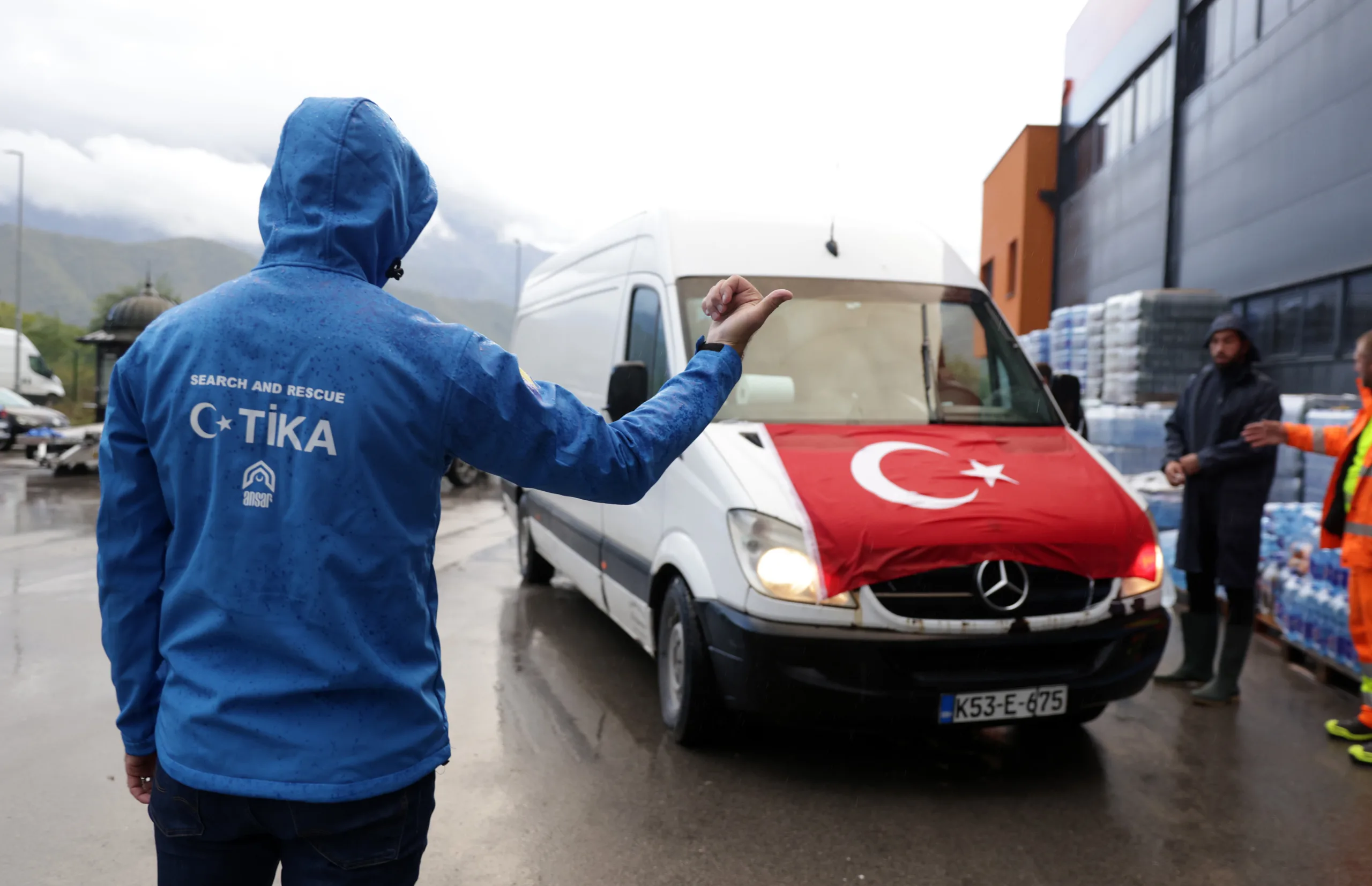
In 2009, the Disaster and Emergency Management Presidency, AFAD, was established and became a central body for coordinating disaster response inside Türkiye and abroad, alongside the Foreign Ministry, the ministries of health, education, and interior, and the Turkish Red Crescent.
At the same time, as the official track expanded, the Bosnian war that broke out in 1992 pushed a generation of Turkish volunteers and associations to work inside conflict zones, helping build civic networks whose experience later extended to Palestine, the Caucasus, Africa, and Asia.
The Humanitarian Relief Foundation for Human Rights and Freedoms, IHH , traces its origins to volunteers who moved to aid Bosnians during the war, before it was officially registered in Istanbul in 1995.
This institutional narrative intersects with academic studies on the emergence of Turkish humanitarian organizations with an Islamic reference point. Researcher Pinar Akpinar linked their formation to the causes of Afghanistan, Bosnia, Palestine, and the wars in Kosovo and Chechnya.
The Bosnian war gave these networks early field experience in cross-border work and helped shift temporary campaigns into institutions with staff, offices, warehouses, and international ties.
Images of siege and massacres, religious and historical bonds, a sense of the international community’s failure, and geographic proximity all helped cement Bosnia in Turkish memory.
That relationship continued after the war through projects to restore mosques and historic buildings, education and scholarship programs, social assistance, and the participation of Turkish delegations in the peace march and the commemoration of the genocide in Srebrenica.
In recent years, the memory of Srebrenica has also moved to a fixed official level inside Türkiye. On July 10, 2024, Presidential Circular No. 2024/8 was issued, placing the July 11 commemoration events under the coordination of the Foreign Ministry with the participation of public institutions.
The gradual overlap between the governmental and civic tracks paved the way for a broad system that combines fundraising and field expertise with the state’s diplomatic and logistical capacities.
From donation drives to long-term projects
Türkiye’s solidarity system operates through a network in which roles are distributed among associations, donors, businesspeople, municipalities, media outlets, and official institutions.
Associations launch campaigns, raise funds, and recruit volunteers; companies help with transport and the provision of goods and services; and the state secures diplomatic channels and coordination with governments and international organizations. The Turkish Red Crescent combines its legal independence with its supporting role for the authorities in disaster management and relief.
The mobilization process usually begins with media coverage, public appeals, and mosque sermons, then moves to donations, warehouses, and transport companies. Once resources reach implementing bodies, they are turned into food shipments, medical teams, housing, schools, hospitals, and water projects.
Municipalities, television programs, association branches, and business networks have helped broaden the donor base and establish institutions that maintain field teams and local partners in dozens of countries.
The following graphic presents the trajectory of the Turkish response in five crises, from urgent aid to the housing, schools, social and health centers, and long-term projects that grew out of it. It also shows how the nature of each crisis and the possibility of field access shaped the form of intervention and its outcomes.
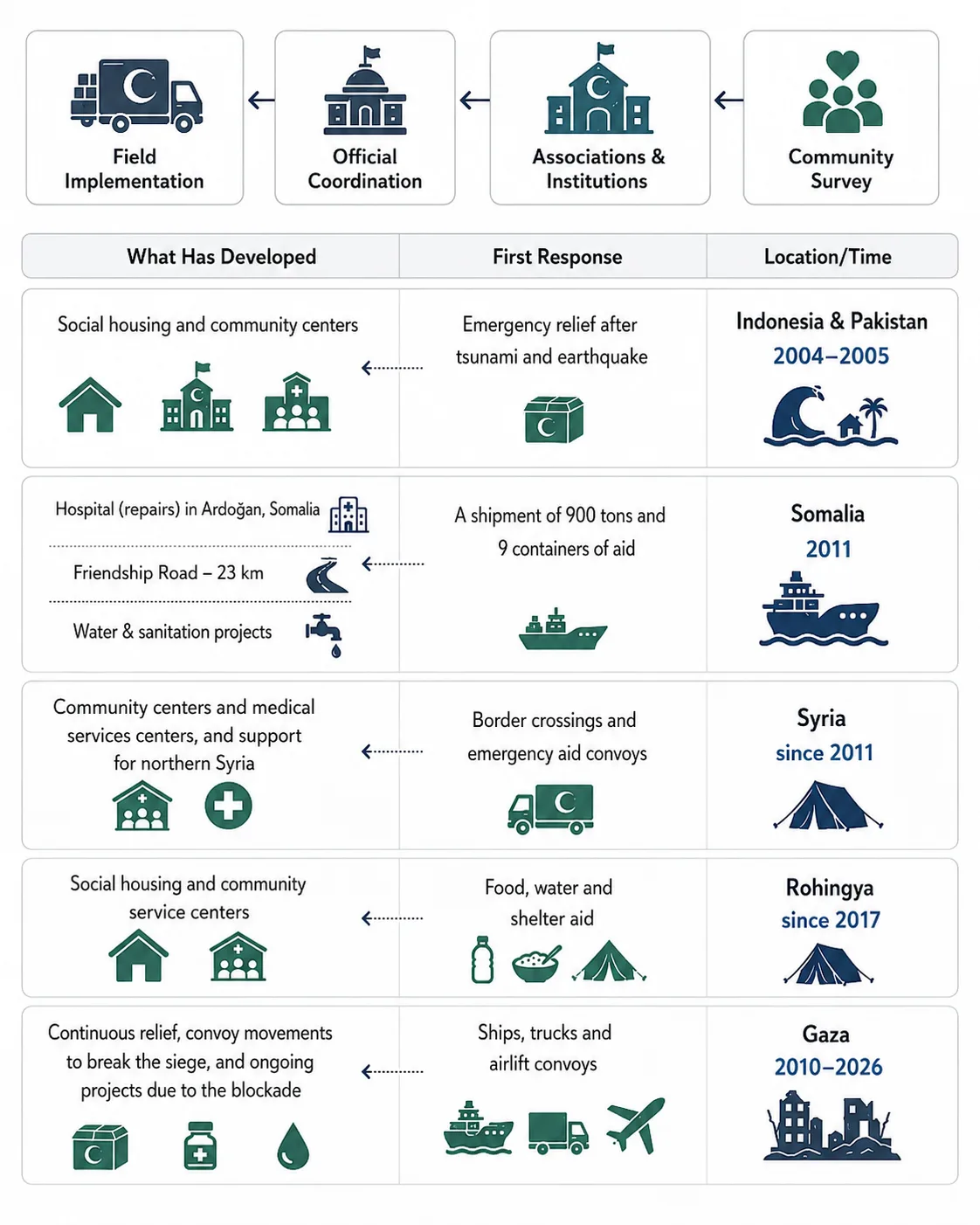
Somalia offered the clearest example of a popular emergency campaign turning into a long-term institutional presence. In August 2011, then-Turkish prime minister and current Turkish President Recep Tayyip Erdogan visited Mogadishu during the famine that struck the Horn of Africa.
The visit was followed by a campaign involving TIKA, the Turkish Red Crescent, associations, and business organizations, and Türkiye also reopened its embassy in Mogadishu in November of the same year.
The Turkish Foreign Ministry describes the effort launched at the time as the largest foreign aid campaign the country had organized up to that point, saying the value of subsequent humanitarian and technical assistance exceeded $1 billion. That official figure combines governmental and civic contributions and projects carried out over multiple years.
In August 2011, the Humanitarian Relief Foundation sent a ship carrying 3,000 tons of food, medicine, and medical supplies collected through donations inside Türkiye, then dispatched a second ship carrying 6,000 tons that included foodstuffs, medicines, and equipment for drilling water wells. The Independent Industrialists’ and Businessmen’s Association, ASKON, contributed 50 trucks loaded with aid.
The response then moved into health, education, roads, and agriculture. Turkish institutions helped establish and operate the Recep Tayyip Erdogan Training and Research Hospital in Mogadishu, while TIKA built the 23-kilometer Friendship Road and supported schools, orphanages, and training programs. Turkish associations also carried out projects in water, agricultural education, medical services, and child care.
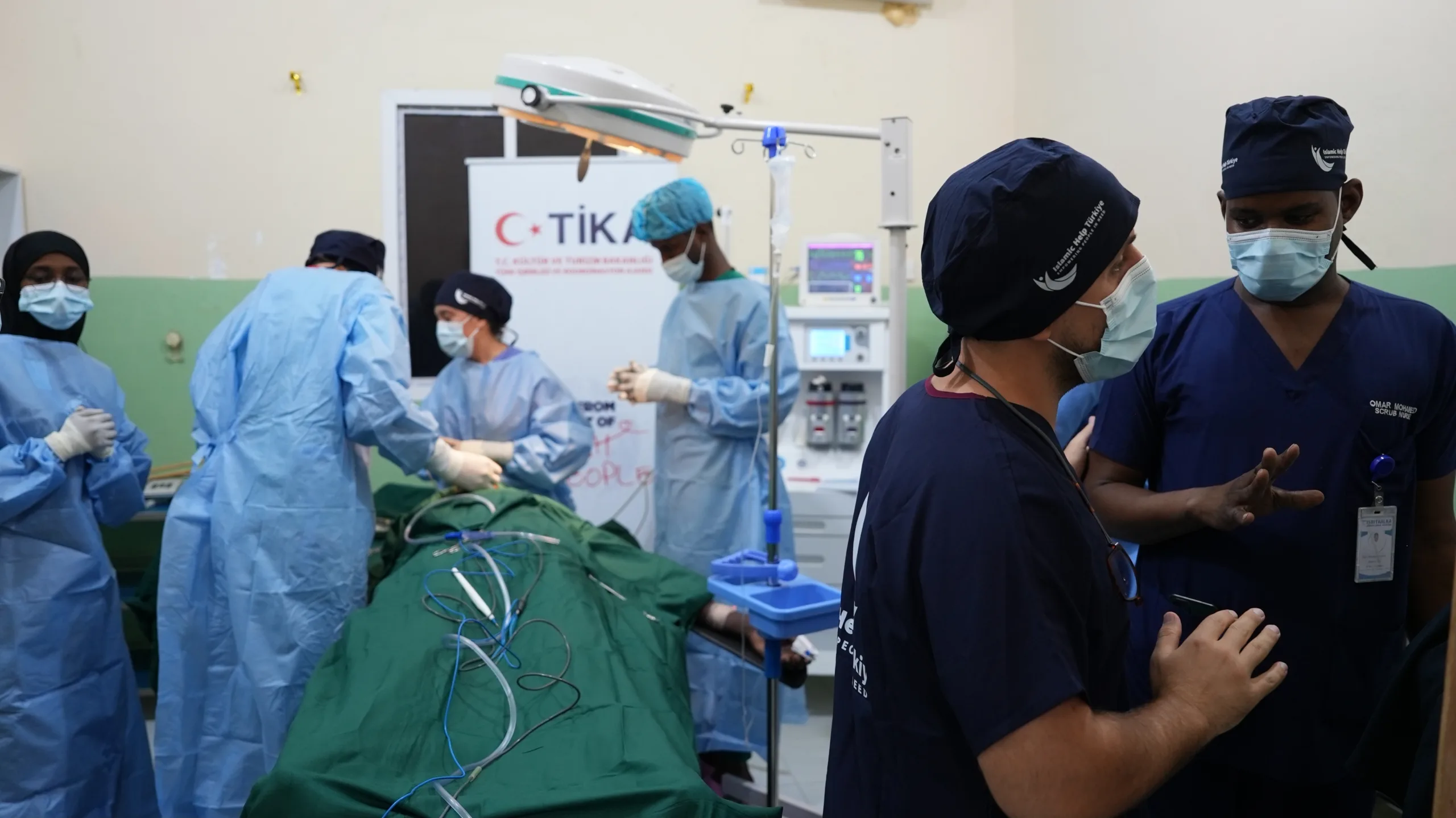
TIKA reports indicate that in one of its early phases, the hospital was receiving about 6,000 patients and performing nearly 100 operations a month, then provided services to more than 160,000 patients in 2017. Turkish doctors took part in operating it and training Somali personnel, turning the famine campaign into a health, education, and logistics infrastructure tied to long-term relations with the Somali government and society.
In a study published in 2017, the South African Institute of International Affairs argued that Turkish activity in Somalia combined humanitarian aid with infrastructure, trade, and diplomacy, helping expand Ankara’s presence in the Horn of Africa.
Solidarity with Gaza took a different path, one tied to ships, convoys, and mass mobilization. The Mavi Marmara became a defining moment in May 2010, when Israeli occupation forces attacked it while it was part of a flotilla bound for the enclave, killing nine Turkish activists before a 10th activist died in 2014 from his wounds. The incident entrenched within Turkish society the image of civic action that combines delivering aid, attempting to break the blockade, and political protest.
Relief operations expanded after October 2023 through air and sea shipments transported to Egypt’s Port of El Arish. In March 2024, the Turkish Red Crescent announced the arrival of the “Ship of Goodness,” carrying about 2,737 tons of food, water, flour, clothing, tents, and medical supplies.
In April of the same year, the ninth ship arrived carrying 3,774 tons, including 227,000 food parcels, 826 tons of flour, shelter and hygiene materials, and supplies for children, with a value the organization estimated at about $6.1 million.
In October 2025, AFAD said the total amount of material the Turkish system had delivered to Gaza had exceeded 100,000 tons via 14 planes and 16 ships since October 2023. It said the total included contributions from the Turkish Red Crescent, associations, public institutions, and citizens, in addition to operations coordinated by the agency itself.
IHH continued working on the flotilla track, and in March 2024 it presented two ships for participation in an international maritime initiative, one for cargo and the other to transport volunteers and humanitarian workers. The flotilla’s departure was delayed by legal and technical problems related to ship registration and flags, while aid campaigns directed to the enclave continued.
In July 2026, this pattern extended to the “Palestine Convoy ,” which showed the continued ability of Turkish networks to bring together participants from different countries and organize cross-border overland movements. Organizers chose Srebrenica as a symbolic stop on the convoy’s route, linking the memory of genocide in Bosnia to the war on Gaza and the call to act for Palestinians.
How does Turkish humanitarian diplomacy work?
The map of Turkish solidarity is shaped by the scale of humanitarian need, along with religious and historical ties, media attention, and the possibility of access to crisis zones.
Bosnia, Palestine, Chechnya, Somalia, and the Rohingya have been major focal points in the activity of associations with an Islamic reference point, while natural disasters in Pakistan and Indonesia drew broad campaigns focused on emergency relief and reconstruction.
Researchers Hamdi Zengin and Ozgur Korkmaz examined the determinants of Turkish aid to 100 countries between 2005 and 2016 in a study published in the journal New Perspectives on Türkiye in 2019, and the results showed that aid distribution was linked to levels of poverty and humanitarian need.
Other factors also affect its distribution, including the activity of Turkish companies, trade relations, former Ottoman ties, religious affinity, and belonging to the Turkish sphere.
These findings indicate that the Turkish response takes into account the scale of humanitarian need while drawing on historical and social ties and existing cooperation networks with recipient countries.
During the rule of the Justice and Development Party, the concept of “humanitarian diplomacy” became the official framework for presenting this role. wrote international relations professor Melihah Benli Altunisik in a study issued by Norway’s Chr. Michelsen Institute in September 2019, that the concept expressed a Turkish approach combining humanitarian response with a more visible international role in crisis zones.
Implementing this role depends on cooperation between state institutions and civil associations, turning relief campaigns into hospitals, schools, roads, and educational programs whose impact continues after the emergency phase ends.
The government provides permits, diplomatic channels, coordination, and technical resources, while associations possess donor and volunteer bases and the capacity for mobilization and fieldwork.
The results of this model vary according to the nature of each arena. Partnership with the Somali government made it possible to turn aid into hospitals, roads, and education and training programs, after which Turkish relations expanded to include trade, diplomacy, and security cooperation.
In Bosnia, reconstruction, heritage, and education projects were accompanied by close relations and sustained Turkish support for the Bosnian state. But the restrictions imposed on access to Gaza increased the weight of maritime shipments, convoys, and protest and symbolic actions compared with stable projects on the ground.
Ultimately, Türkiye’s capacity for humanitarian mobilization rests on the integration of associations’ field experience with a broad social base and the state’s capabilities in transport, financing, and diplomacy.
This integration has given aid a direct impact in crisis zones and strengthened Türkiye’s humanitarian presence and its relations with beneficiary societies and states. The scale of mobilization varies according to each cause’s standing within Turkish society, the nature of the crisis, the possibility of field access, and the cooperation networks already in place with the country concerned.