









هذا التقرير متاح أيضًا بـ العربية
The US-Israeli war on Iran has put Egypt’s gas network to a difficult test. Israel’s Energy Ministry shut down the Leviathan field and other gas facilities for security reasons, halting supplies that had been flowing to Egypt before the field resumed operations after a shutdown that lasted about a month.
At the same time, liquefied gas facilities in the Gulf were disrupted and shipping through the Strait of Hormuz was thrown into disarray, driving up energy prices and the cost of making up Egypt’s shortfall from international markets. Prime Minister Mostafa Madbouly said on March 18 that the monthly gas import bill had risen from about $560 million to $1.65 billion since the war began.
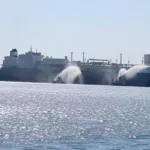
On July 29, a fire broke out at the Port of Damietta as the war entered a new round of escalation that included US strikes inside Iran and Iranian attacks on US forces in Jordan. Maritime security firms Ambrey and Vanguard said a drone struck the floating storage and regasification unit Energos Winter before the fire spread to the gas carrier GasLog Salem.
Egypt’s Ministry of Petroleum and Mineral Resources confirmed that the fire had been brought under control with no injuries, and its statement merely noted that the impact was still being assessed without specifying the cause of the incident or who was responsible.
The Damietta incident has intensified the pressures the war has placed on Egypt’s gas sector, as the crisis has moved beyond a soaring import bill and disrupted regional supplies to hit one of the facilities Egypt relies on to receive, store and regasify liquefied gas before feeding it into the grid.
The incident comes as domestic production falls to less than 4.4 billion cubic feet per day, while Egypt is expected to import an average of about 2.96 billion cubic feet per day through pipelines and LNG cargoes between July 2026 and June 2027, equivalent to roughly 1.081 trillion cubic feet over the year.
The map of fields, processing and receiving stations, and transmission lines reveals how far the network can reroute supplies when one of its gateways is disrupted and the point at which the crisis begins to reach electricity and industry.
Where is gas produced in Egypt?
The bulk of Egypt’s gas production comes from deep waters in the Mediterranean Sea , according to what the Ministry of Petroleum and Mineral Resources said on July 8, 2026, while onshore and shallow-water fields in the Nile Delta and the Western Desert add volumes that support the network.
The ministry has not published a recent breakdown specifying each region’s share, but the size of the fields and the locations of processing stations place the Mediterranean and the Nile Delta at the center of the production map, compared with a limited contribution from the Gulf of Suez and North Sinai.
Zohr field forms the single largest block on that map. It lies about 190 kilometers north of Port Said and is operated by the Italian energy company Eni through Petrobel and Petroshorouk in partnership with other companies.
Its average production reached about 1.9 billion cubic feet per day during the first half of 2024, compared with a peak of nearly 2.7 billion in 2019, before the Zohr 6 well added about 65 million cubic feet per day in August 2025. The Petroleum Ministry said at the end of the same year that Zohr provides nearly a quarter of domestic production.
To the west, the West Nile Delta area includes the Raven, Giza, Fayoum, Taurus and Libra fields , operated by the British energy company BP in partnership with Harbor Energy.
The fields are linked to the West Alexandria processing plant, with capacity ranging between 1.4 billion and 1.6 billion cubic feet per day, and two new wells at Raven added about 140 million cubic feet per day during 2025. Nearby are the deepwater West Delta fields, including Scarab, Saffron, Simian and Siena , operated by Burullus Gas under the leadership of the British energy company Shell and linked to the Rosetta and Idku facilities.
The following map shows the distribution of the main gas fields across the eastern Mediterranean, the eastern and western Nile Delta, and the Western Desert, as well as the processing stations that receive their output before it enters the national grid. It also shows the concentration of gas lines at Dahshur, from where supplies are distributed to Cairo, Upper Egypt, the Canal cities, the Red Sea and industrial zones.
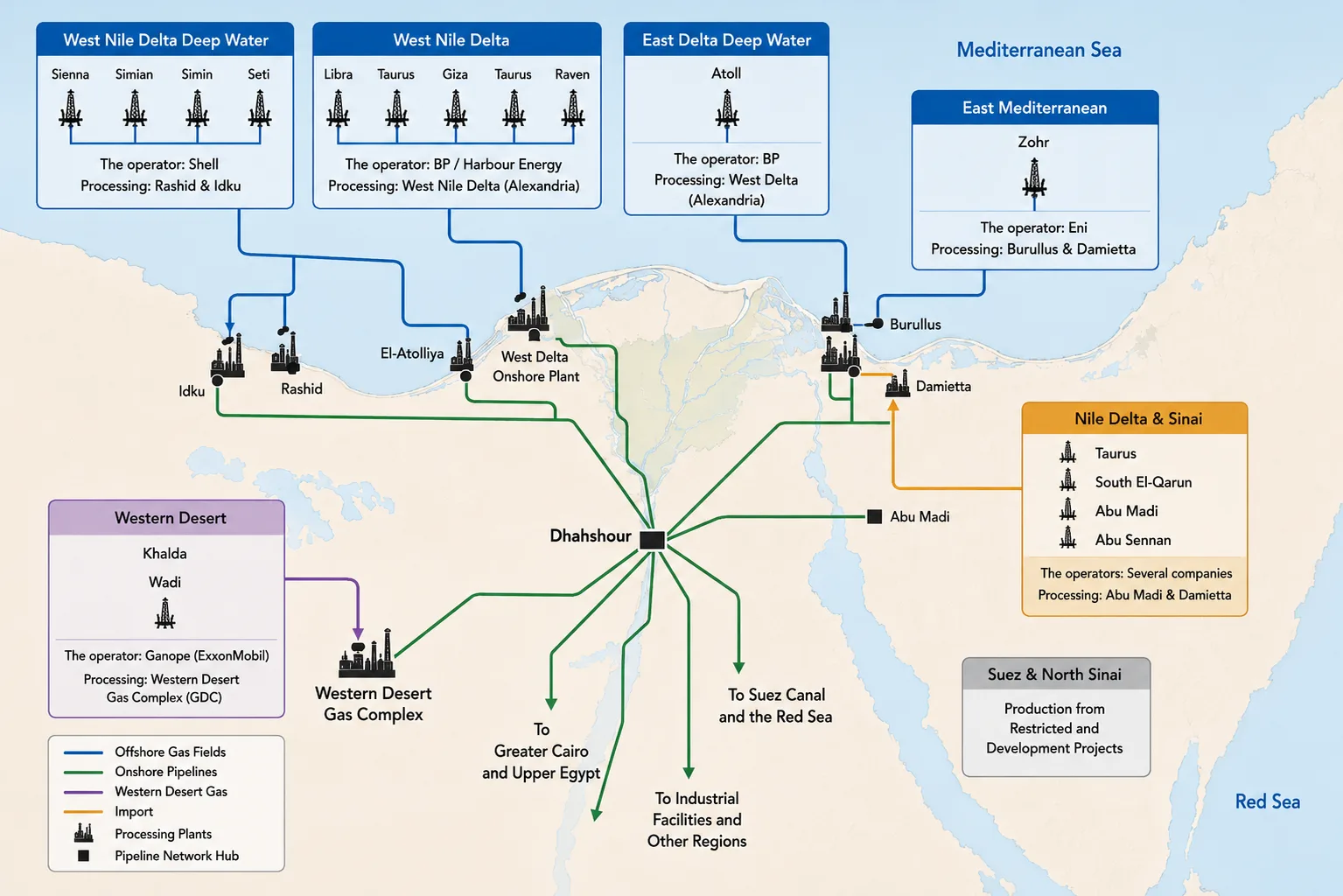
In the eastern offshore Nile Delta, Atoll field produced about 350 million cubic feet per day when operations began, and additional wells were later tied in to maintain a level of about 360 million. It is operated by BP through Pharaonic Petroleum.
As for the Nouras, South West Baltim and Abu Madi fields , their supplies are gathered within the Abu Madi and El Gamil system in the northeastern Delta.
That system transports about 700 million cubic feet per day, making El Gamil one of the main gathering and processing points for gas coming from the Delta and the eastern Mediterranean.
Onshore fields add smaller volumes that help slow the production decline. Output from the Desouq area, which Harbor Energy operates through Desouq Petroleum, reached about 14,000 barrels of oil equivalent per day in March 2026.
In May, the Petroleum Ministry announced the discovery of the Nidoco N-2 well in West Abu Madi, with expected production of 50 million cubic feet per day, while the Wanda well, operated by Khalda Petroleum in the Western Desert, entered service in July at a rate of about 40 million cubic feet per day.
Western Desert gas reaches the Western Desert Gas Complex in Amreya to separate derivatives before the processed gas is pumped into the grid. In April 2026, the Petroleum Ministry raised the complex’s design capacity to about 1.5 billion cubic feet per day with the launch of the fourth train, while production from the Gulf of Suez and North Sinai remained limited, with some projects and discoveries still in development and tie-in stages.
These additions come at a time when Egypt’s total gas production had fallen from more than 6 billion cubic feet per day at the start of 2021 to about 3.5 billion in April 2025, before recording a partial improvement later.
The decline in output from major fields and the slow arrival of new volumes have increased the importance of imported gas via pipelines and LNG cargoes in meeting daily demand from electricity and industry.
How does gas get from the fields to the consumer?
Gas extracted from the Mediterranean, the Nile Delta and the Western Desert moves through gathering lines to coastal and onshore facilities that separate water, impurities and condensates and regulate pressure and specifications before it is pumped into the national grid operated by the Egyptian Natural Gas Co., or GASCO.
From there, supplies are distributed among power plants, factories, fertilizer and petrochemical complexes, and city networks, while the available surplus goes to the liquefaction plants in Damietta and Idku.
Offshore fields are linked to specific processing routes: gas from Zohr and the eastern Delta enters through Port Said and El Gamil, output from the West Nile Delta and Atoll reaches West Alexandria facilities, while Western Desert gas passes through the Amreya complex for derivative separation.
After this stage, flows converge within a network whose main lines reached 8,264 kilometers in length by the end of 2023, with design capacity of up to 262 million cubic meters per day, according to the Petroleum Ministry.
The following diagram shows the sources of gas inflows, processing and regasification stations, and then its movement through the control center in Dahshur to consumption sectors and liquefaction plants.
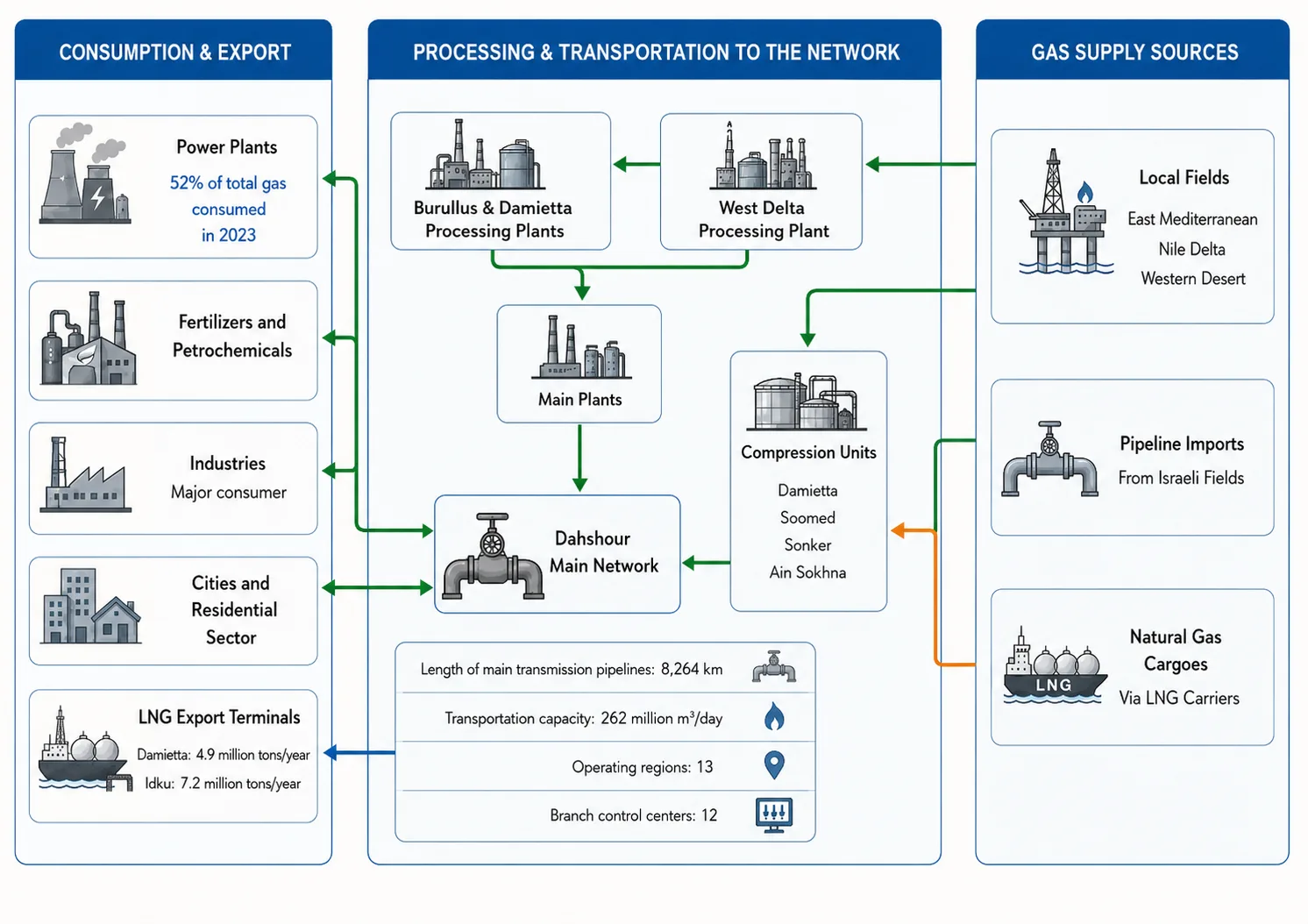
The network includes 13 operational areas and 12 sub-control centers, in addition to the national control center and the data exchange center in Dahshur, as well as the NATA control system.
These centers regulate gas pressure, direction and the quantities allocated to each area, while compressor stations connect the Delta, Cairo, Upper Egypt, Canal cities and coastal lines. Dahshur’s location gives the network the ability to reroute part of the flows between north and south and east and west when supplies change or demand rises.
The network transported about 68 billion cubic meters of gas in 2023, with the electricity sector accounting for 52 percent. During 2025, GASCO received and pumped about 2.3 trillion cubic feet, while power plants’ peak withdrawal reached 6.2 billion cubic feet per day.
That volume places electricity at the top of distribution priorities, followed by fertilizer plants, petrochemicals and energy-intensive industries, then the rest of industrial activity and household and commercial use.
Imports enter the grid through two main routes. The first comes via pipelines from Israeli fields in the eastern Mediterranean, foremost among them Leviathan, and these supplies accounted for an estimated 15 percent to 20 percent of Egyptian consumption during 2025.
The second route comes through LNG cargoes received by floating units in Damietta and Ain Sokhna, which then return it to its gaseous state and pump it into the grid.
Egypt has expanded its use of these units as domestic production has declined and pipeline imports have become more vulnerable to military disruptions in the region, while the Egyptian Natural Gas Holding Co., or EGAS, manages the import and regasification program.
The Petroleum Ministry announced on June 12, 2026, the operation of the Hoegh Galleon and Energos Eskimo units inside the facilities of the Arab Petroleum Pipelines Co., or SUMED, and the Energos Power unit at the Sonker terminal in Ain Sokhna.
On June 26, the ministry added the Energos Winter unit in Damietta, bringing the fleet’s total declared regasification capacity to about 2.7 billion cubic feet per day.
Sonker is linked to the national grid by a 36-inch pipeline about 17 kilometers long, and the design capacity of some units operating in Sokhna is about 750 million cubic feet per day. The volumes each unit pumps are determined by available cargoes, berth conditions, grid pressure and the level of demand on the day of operation.
On the Mediterranean coast, the Damietta and Idku plants receive gas from the grid to liquefy it for storage or export. Damietta’s annual capacity is about 4.9 million tons, compared with 7.2 million tons for the Idku complex.
With domestic production declining, export operations have fallen and priority has shifted to covering the domestic market, while the Petroleum Ministry used Damietta’s facilities during the summer of 2026 to store liquefied cargoes and withdraw them when needed.
Can the network make up for a shutdown in Damietta?
The three units operating in Ain Sokhna — including two inside SUMED facilities and a third at Sonker — make it possible to reroute some cargoes that had been headed to Damietta and provide the grid with more than one point for receiving imported gas.
Compensation requires rescheduling ships and securing a berthing and unloading slot, then raising pumping rates from the replacement unit in line with the capacity of onshore pipelines and pressure levels within the grid.
The amount of spare capacity in the three units remained unknown after the incident. The Petroleum Ministry announced the fleet’s total capacity without detailing daily operating rates for each unit, the volume of gas stored on board, or the remaining capacity at SUMED and Sonker berths.
Those figures determine how much gas can be replaced immediately, because a unit’s design capacity includes the quantities it was already pumping before the Damietta incident. Rerouting ships is also constrained by location and route: Damietta is on the Mediterranean, while the main alternatives in Ain Sokhna are on the Red Sea.
A cargo that had been headed to Damietta would need its sailing plan adjusted and would have to transit the Suez Canal if arriving from the Mediterranean, then wait for an available berthing window. As for the cargo the gas carrier GasLog Salem was unloading at the time of the incident, it has become part of an ongoing operational process that requires assessing the condition of the vessel, the cargo and the berth before determining its next destination.
The Idku complex is among the alternatives to Damietta’s liquefaction plant when gas designated for export is available, while replacing the damaged regasification unit is centered on the Sokhna and SUMED units. Idku’s role is to turn gas coming from the grid into liquid, whereas regasification units receive imported LNG and return it to the grid.
If the disruption continues for days, EGAS has options that include diverting some cargoes to Sokhna, using gas stored in other units, adjusting grid flows, and increasing the burning of mazut and diesel at power plants when demand rises.
The government can also reduce consumption by gas-intensive industries to preserve supplies directed to electricity and households, something Egypt did during the June 2025 crisis when Israeli pipeline gas imports fell.
The government cut supplies to fertilizer and chemical plants and increased the use of liquid fuels at power plants in an effort to avoid load shedding — an approach that places fertilizer plants, petrochemicals and some heavy industries at the forefront of sectors exposed to supply cuts if a new shortage occurs.
If the Damietta unit remains out of service for weeks, pressure on the other units and ship arrival schedules will increase, as published estimates put the maximum capacity of the Energos Winter unit at around 450 million cubic feet per day.
If the unit had been operating near that level before the incident, replacing it for an extended period would require similar capacity in Ain Sokhna or a reduction in consumption, while the ministry has not announced its actual pumping rate on the day of the incident.
Pressure increases if the Damietta outage coincides with lower Israeli pipeline supplies, as happened when the Leviathan field was shut during the war on Iran, or with a heat wave that raises electricity consumption, or a decline in output from one of the major domestic fields.
In that case, the loss of part of overland imports would coincide with the disruption of one of the gateways for receiving LNG and with rising demand, pushing the government to expand supply cuts to industry and increase the use of mazut and diesel, potentially reviving the risk of load shedding if the deficit persists.
EGAS plans to add the Hoegh Gandria unit, owned by Hoegh Evi, with capacity of up to 1 billion cubic feet per day during the fourth quarter of 2026. The new unit will raise receiving capacity in Sokhna and widen the room for maneuver, but it was still not in service when the Damietta incident occurred in July.
Egypt’s gas map shows an ability to contain a short disruption in Damietta by diverting some cargoes to Ain Sokhna, rearranging supplies between electricity and industry, and increasing the use of liquid fuels when needed.
That margin shrinks if the outage is prolonged or coincides with disruption to Israeli gas or a decline in domestic production, because the other regasification units are already operating to close a gap between supply and demand, while the authorities have not announced the extent of their spare capacity or their berth schedules. The incident therefore erodes part of the safety margin Egypt relies on to cover summer consumption.