







هذا التقرير متاح أيضًا بـ العربية
The targeting of two ships at Egypt’s Damietta port on the Mediterranean coast by a drone of unknown origin on the evening of Wednesday, July 29, even though it caused no human casualties, represents a notable development that moves the conflict unfolding in the region into an entirely different phase, both vertically and horizontally, according to a statement issued by the Egyptian government on Thursday morning.
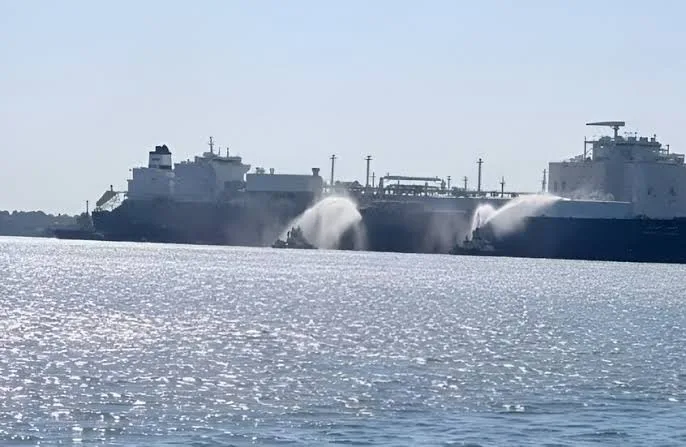
Reuters had cited the maritime security firm Ambrey as saying that a floating liquefied natural gas storage and regasification unit, owned by a US company and flying the Marshall Islands flag, was attacked by at least one drone while docked at Damietta port. Egypt’s Petroleum Ministry, meanwhile, said only in its initial statement that a fire had broken out aboard the two ships without specifying the cause, opening the door to speculation and conjecture before the Cabinet settled the matter in a later statement, confirming that the vessel had been attacked by a drone.
Damietta port, located on the Mediterranean, is one of Egypt’s most important ports and a vital regional transit point, especially amid disruptions to global shipping caused by the escalating war in the Middle East. The port also includes strategic facilities for receiving liquefied natural gas, storing it, regasifying it, and pumping it into the national grid.
Accordingly, the targeting of Damietta port by a drone cannot be treated as a passing incident. Rather, it represents a dangerous development in the course of Iranian-American escalation in the region and raises a host of questions about the party behind the operation, the objectives it sought to achieve, the implications and messages this development carries, as well as the nature of the moves and options available to Cairo in dealing with it.
Clear media confusion
The incident was met with a state of media and official confusion in Egypt, revealing the extent of the disarray surrounding the scene in the face of an exceptional event of this kind. It began when Reuters, citing Ambrey, reported that the explosion had resulted from a drone attack. In response, outlets affiliated with the state-owned United Media Services, such as Al-Dostor, along with private sites such as Cairo 24 and Telegraph Egypt, rushed to publish news that a fire had broken out on three ships at Damietta port, before the report was deleted minutes later.
In a later development, Al-Dostor published a denial of the report, citing a source at the Petroleum Ministry who said operations inside Damietta port were proceeding normally, before the newspaper deleted that report as well. It then returned to publish the Petroleum Ministry’s statement, which confirmed that a fire had broken out aboard two ships — one a regasification unit and the other a gas tanker — without specifying the cause of the fire. Later, the newspaper deleted the statement before republishing it again without any change in its content.
Shortly after the Petroleum Ministry’s statement was published, TV host and member of parliament Mostafa Bakry denied, in a post on his account on X citing security sources, that ships in Damietta port had come under a drone attack, before later deleting the post. The same account was published by Brig. Gen. Samir Ragheb, who provides strategic analysis on a number of Egyptian and Arab media channels, on his Facebook account, though he kept his post up and did not delete it.
A number of pro-regime media figures, across various Egyptian, Arab, and international platforms, moved in the same direction, asserting that there were no drones and no deliberate attack, and ruling out that possibility almost categorically. They based this on what they described as the Egyptian air defense system’s ability to detect such threats and intercept them early, arguing that the likelihood of a drone successfully reaching Damietta port was nearly nonexistent.
Why was the Egyptian response delayed?
It is worth noting at the outset that Cairo did not deny the existence of a drone behind the fires on the ships in Damietta. However, the Petroleum Ministry’s statement merely announced that the fire had broken out without clarifying its causes, leaving the door open to speculation. There was no denial of the drone hypothesis, but neither was there official confirmation of it, and this may have been one reason for the confusion surrounding the scene.
The government’s delay in describing the incident as a deliberate drone attack can be attributed to several explanations, foremost among them the need for a technical verification of the nature of the incident and a determination of its circumstances, in addition to the focus in the first hours on managing the crisis, extinguishing the fire, and securing the port before turning to management of the media narrative.
Added to this were a number of political considerations that prompted Cairo to proceed cautiously and study the situation carefully before officially confirming the drone-targeting hypothesis, since formally adopting that account would have shifted the incident onto an entirely different track, with all the security, political, and diplomatic consequences that entails.
Cairo also most likely sought to preserve room for diplomatic maneuver and give itself sufficient time to conduct the necessary assessments and contacts with the parties concerned before issuing official wording that could place it in a political bind or commit it to subsequent positions and steps.
Here, an extremely sensitive point emerges: Egypt’s official announcement that a drone was behind the fires imposes a set of pressing questions that must be answered. Where was the drone launched from? Who was responsible for it? What were the primary objectives of this targeting? How was it able to breach the airspace and reach Damietta port despite the enormous spending on the army, the military establishment, and armaments? And what kind of Egyptian response is expected to this violation of sovereignty and national security?
What does the incident signify?
The incident points to a number of important and pivotal implications, foremost among them the widening of the conflict from the Red Sea to the Mediterranean, opening the way for the war to expand beyond its traditional geographic scope since its outset. The shift in threat from narrow waterways such as the Strait of Hormuz and Bab el-Mandeb to the Mediterranean, with all its strategic and commercial importance, carries broader risks and demands more serious readings of where regional escalation may lead.
This targeting also constitutes a direct message to the United States that its interests are now exposed to danger, and that the range of reachable targets is no longer confined to traditional confrontation zones, but may extend to relatively distant locations, including facilities and ships in the Mediterranean and elsewhere.
One of the less direct messages is a warning to Egypt against becoming involved in the conflict or being dragged into confrontation, which could make its energy facilities and vital assets future targets. This warning gains significance in light of the region’s recent widening confrontations, following Saudi escalation against the Houthis and then against Iran-backed militias in Iraq.
The escalation also carries a message with an international dimension: that global energy security is no longer insulated from the repercussions of the war, and that escalation may exceed its current boundaries into a wider sphere threatening shipping traffic, energy supplies, and the global economy.
This is what The New York Times revealed when it quoted two Iranian sources as saying that the “Damietta explosion” was intended to send a message that global shipping and energy supplies could face further disruptions if Iran chose to escalate, without the two sources disclosing the party behind the attack.
Who is responsible for the Damietta attack?
Although no party has yet claimed responsibility for the incident, the list of accusations, by the logic of probabilities, points to four parties that may have had an interest in this targeting or in launching the drone. Iran and its axis top these possibilities, as they are the most prominent suspect in operations of this kind, given the nature of the target, the timing of the attack, and the possible messages it carries.
The targeted vessel is owned by a US company, and the attack would shake the map of regional and global energy security. Moreover, its occurrence in the Mediterranean suggests an attempt to expand the conflict beyond its traditional arenas — all objectives that serve Tehran by raising the cost of confrontation, enhancing its capacity to exert pressure, and improving its negotiating position in any forthcoming political track.
In this context, it is not necessary that the drone have been launched directly from Iranian territory, given the long distance and the high likelihood of its being detected, tracked, and shot down. It may instead have been launched from a closer point through one of Tehran’s allies or proxies in the region, such as the Houthis in Yemen, Hezbollah in Lebanon, or Iran-aligned armed factions in Iraq, and perhaps through other groups active near the Mediterranean.
Yet this possibility itself raises important questions: Would Tehran risk its relations with Cairo by carrying out such an operation, even though Egypt is playing a pivotal role in mediation aimed at ending the war? Is it in Iran’s interest to draw Egypt into confrontation at a time when Cairo has not directly engaged in operations against Iran, apart from a limited and symbolic military presence of some Egyptian forces or aircraft in a number of Gulf states? And is trying to send an escalatory message to the United States worth the risk of opening a new front of tension with Egypt?
The second possibility points to Israel, as one of the parties that stands to benefit most from widening the conflict and igniting more fronts in the region. Such escalation could serve Benjamin Netanyahu’s government, especially with elections approaching, by giving it an opportunity to prolong its political life amid declining popularity and widespread criticism of its handling of the war, particularly as it pressures Donald Trump’s administration to push toward further escalation with Tehran.
The third possibility points to Russia or Ukraine. Although this scenario appears less likely, it remains theoretically possible, especially given both sides’ use during the war of naval and aerial drones to target ships and energy facilities. Even so, there are as yet no clear indications directly linking the incident to the Russian-Ukrainian conflict.
The fourth possibility concerns regional powers that may have an interest in inflaming the situation and reinforcing polarization against Iran, whatever the cost to regional stability. In this context, the names of some regional states may be raised, foremost among them the UAE, which has previously faced political and media accusations of engaging in moves aimed at intensifying pressure on Iran and reshaping regional balances of power, alongside other parties that may be linked to Sudan and Ethiopia.
How is Cairo acting?
At the outset, it must be emphasized that what happened represents a notable shift in the scene, a clear violation of Egyptian sovereignty, and a direct threat to its national security, bearing in mind that identifying the manufacturer of the drone and the entities that possess this type of drone is not especially difficult. Through analysis of the wreckage, examination of the technical components, and review of radar data, its path can be traced and its launch point and the party likely behind the attack can be determined.
In light of this predicament, Cairo faces several possible courses of action. The first is to contain the incident without directly accusing any specific party, as happened previously with Turkey, giving it more time to complete technical and security investigations, absorb the shock of the attack, and recalculate its position. Announcing the identity of the responsible party would place Cairo under heavy political and security obligations and burdens, and could compel it to respond. On the other hand, the cost of silence may carry internal and external repercussions no less serious.
In line with this path, Egypt may seek to internationalize the incident in a measured way through the Security Council, the United Nations, and the International Maritime Organization, while stressing that it reserves the right to take whatever it deems appropriate to protect its sovereignty and national security. In parallel, it could exert indirect political pressure on the perpetrating party through back-channel diplomacy, while using the incident in the future to strengthen its political and negotiating position.
This targeting may also push Cairo to reassess its political and security positions, prompting it to expand military and intelligence cooperation with Arab states affected by drone attacks, especially Saudi Arabia, Jordan, and the Gulf states, alongside the United States and some European countries. It may also increase the likelihood of Egypt joining regional and international arrangements or alliances aimed at protecting waterways and maritime facilities, now that it too has become vulnerable to targeting.
On the domestic level, Cairo is also likely to be forced to tighten its security measures and strengthen protection for ports and energy and strategic facilities, whose targeting had previously been considered unlikely. But recent developments show that various vital Egyptian facilities may become potential targets amid a regional escalation whose scope is widening and whose fireball is rolling in ways whose outcomes are difficult to predict.
The military option, though relatively unlikely in light of Egypt’s doctrine, which tends toward containment and avoiding escalation, remains a possibility. Cairo understands the regional repercussions and steep costs that such an option could entail, costs it may not be prepared to bear at present. But it could become a serious option if the perpetrator’s identity is conclusively established, if the targeting is repeated, or if it results in major material losses or casualties.
In sum, what happened represents an extremely sensitive shift that could move Cairo from the position of a mediating state to that of a direct party to the war a shift the Egyptian state is keen to avoid interpreting or handling through that lens, preferring instead to confine the implications of the incident to the scope of controlled messages with limited effect and impact.
Even so, the entire region remains perched atop a volcano amid growing fears of a new escalation and the expansion of the war into arenas not previously included, placing the whole Middle East before an exceedingly complex security, political, and economic predicament that may prove difficult to contain if escalation continues at its current pace.