







هذا التقرير متاح أيضًا بـ العربية
Washington is searching for a new formula for its presence in the Sahel after losing, in just a few years, a key part of its military and security tools there, most notably through the withdrawal of US forces from Niger.
At the same time, the French presence in Mali, Burkina Faso and Niger has receded, while Russia has expanded its military footprint and armed groups have continued to escalate their operations.
In this environment, Algeria’s growing role on the region’s northern border, after repairing relations with Sahel states, should inspire policymakers to recognize its strategic importance in regional stability.
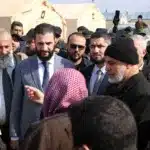
It was in this context that Mass’ad Boulos, adviser to the US president for Arab and African affairs, made his third visit to Algeria since the summer of 2025, in a trajectory that has included the signing of a military cooperation memorandum, intensified contacts with US Africa Command “AFRICOM”, and the opening of energy, gas, minerals and investment files to broader cooperation.
During his visit in September 2026, Boulos described Algeria as an “important partner” for the United States in strengthening regional security, reflecting the weight Washington assigns to a country that combines direct borders with Mali and Niger, security expertise in the Sahara, and political channels with actors that are difficult for Western capitals to reach.
Algeria sees this opening as an opportunity to attract capital and technology, diversify its military options, and expand political dialogue with Washington, despite its ongoing ties to Russia and China, which complicate regional alignments and policy decisions. Addressing these ties helps policymakers understand Algeria’s strategic balancing and potential constraints.
A Sahel in Flux: Why Is Algeria More Valuable to Washington Now?
The security environment surrounding Algeria has changed rapidly in recent years. France ended its military operations in Mali and, beginning in 2022, started withdrawing about 2,400 troops, before its forces also left Burkina Faso and Niger after coups and deteriorating relations with the military governments.
The biggest US loss came in Niger, where withdrew Washington in 2024 about 1,000 troops and evacuated the drone base in Agadez in the country’s north-central region, on which it had spent nearly $100 million and which had served as an important hub for surveillance and combating armed groups.
In May 2025, Michael Langley, the former commander of US Africa Command, or AFRICOM, spoke of the decline in US security influence in West Africa and the need to find other ways to maintain engagement in the region.
This rising violence, with nearly 10,000 deaths linked to Islamist armed groups in the Sahel over the past year, underscores the critical need for security analysts to understand evolving threats.
The center attributed about 76 percent of Sahel deaths to Jama’at Nusrat al-Islam wal-Muslimin and nearly 19 percent to ISIS. In contrast, the total number of deaths linked to these groups since 2022 reached about 49,000.
At the same time, Africa Corps forces affiliated with the Russian Defense Ministry remained in Mali after the Wagner Group’s presence ended, and Moscow expanded its military cooperation with Bamako as well as with Niger and Burkina Faso.
This environment increased Algeria’s value, given its position on the northern edge of the crisis zone. Its borders stretch about 1,359 kilometers with Mali and 951 kilometers with Niger, in addition to long borders with Libya and Mauritania. At the same time, its security services have accumulated extensive experience in dealing with armed groups, smuggling networks, and political and military movements in northern Mali.
Algeria led the mediation that resulted in the 2015 Mali peace agreement, hosted regional counterterrorism mechanisms including the Joint Operational Staff Committee, and maintained contacts with Tuareg and Arab actors in northern Mali, giving it knowledge of the region different from that of many external partners.
That influence suffered a severe blow between 2024 and 2025, after Malian authorities ended the Algiers Accord in January 2024, followed by an even sharper crisis in April 2025 after Algeria shot down a Malian drone near Tinzaouaten.
Burkina Faso, Mali and Niger recalled their ambassadors from Algeria, the latter two withdrew from the Joint Operational Staff Committee, and Bamako escalated its dispute with Algeria to the International Court of Justice.
The Institute for Security Studies Africa, or ISS Africa, said the crisis damaged the structure of regional security cooperation and revealed the extent of the decline in Algeria’s influence in the Sahel.
This picture began to improve in 2026 with the return of ambassadors between Mali and Algeria, Algeria’s reopening of its airspace to Malian aircraft in July, and improved relations with Niger after junta leader Abdourahamane Tiani visited Algeria in February.
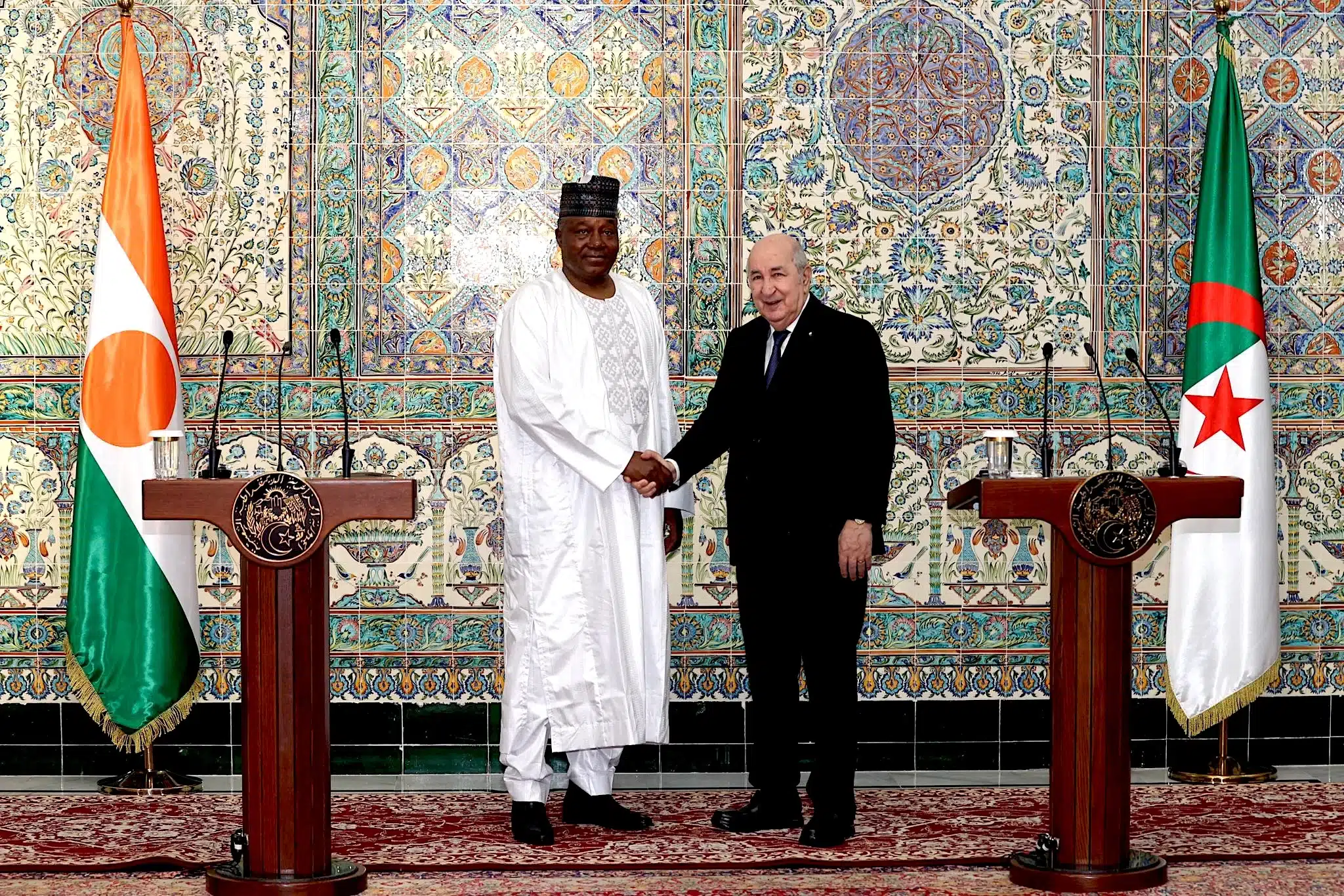
In an analysis published by ISS Africa in March 2026, the institute described Algeria as a pivotal actor because of its geography and shared security threats, while noting continued suspicion in Bamako toward its contacts with northern factions. It argued that borders and security interests give Algeria a presence that is difficult to bypass in a region where centers of influence have become more numerous.
The French newspaper Le Monde offered a similar reading, describing Tiani’s visit to Algeria as a potential turning point after years of lost influence, and arguing that developments in northern Mali had brought Algeria back into the “game” after a period in which Bamako and Russia had marginalized it.
The newspaper noted that historical ties with the Tuareg gave Algeria the ability to communicate with parties outside the Malian government’s control, while turning those channels into political results remains tied to Bamako’s calculations and the positions of local forces.
For its part, the International Crisis Group considered that improving relations opens the way to reorganizing border security and advancing a broader political track in northern Mali, linking the success of any mediation to Bamako’s willingness to return to a political path after years of relying on military force.
In August 2026, another sign of changing Algerian behavior emerged when, following an attempted mutiny in Niger, Algeria sent four Su-30 fighter jets, an Il-76 transport aircraft and an Il-78 refueling aircraft to Niamey.
And quoted Le Monde as citing Algerian security expert Akram Kharief, who described the move as a shift in Algerian behavior and a departure from “strategic restraint,” indicating greater readiness to act when Algeria considers the stability of a neighboring state directly tied to its own security.
Algeria’s return to this role gives Washington a partner with knowledge of the borders and the Sahara, channels in northern Mali, a renewed relationship with Niger, and the ability to help rebuild regional security arrangements weakened by coups and the departure of Western forces.
At the same time, Washington has begun opening more direct channels with Sahel regimes, while Rabat has built its own relationships with Mali, Niger and Burkina Faso. This gives Algeria greater weight in files tied to northern Mali and the Saharan borders, within a US policy that relies on more than one partner in the region.
Shared Interests, Different Goals: What Does Each Side Want?
The rapprochement between Washington and Algeria accelerated from the start of 2025, when the two signed a military cooperation memorandum in January during the visit of the AFRICOM commander. The agreement created a framework for communication, training, and defense cooperation.
In the same month, US energy company Chevron signed a cooperation agreement on offshore exploration with Algeria’s National Agency for the Valorization of Hydrocarbon Resources, ALNAFT. Boulos then visited Algeria in July 2025 and returned in January 2026, before talks expanded in April to unconventional gas, critical minerals, counterterrorism and implementation of the military cooperation memorandum.
His third visit in September came to consolidate that trajectory, as he discussed regional security, energy, trade and developments in the Sahel with President Abdelmadjid Tebboune, Prime Minister Seifi Ghrieb and Foreign Minister Ahmed Attaf.
Boulos’ previous contacts with Tebboune had addressed deepening security cooperation and expanding opportunities for US companies, placing Sahel security and economic interests at the heart of the current US push.
On the security side, Washington is seeking broader information on the movements of armed groups and transit networks in the Sahara after losing its direct presence in Niger. It also benefits from Algeria’s knowledge of northern Mali and its contacts with local actors, while the military cooperation memorandum and the joint committee provide a framework for expanding training, information-sharing, and defense coordination.
And called ISS Africa in July 2026 to activate military and intelligence coordination between Algeria and Mali and revive broader regional frameworks to confront the security crisis, issues that align with Washington’s search for local tools after the decline of the direct military deployment model.
Algeria’s rivalry with Morocco in the region also factors into these calculations, after Mali, Niger and Burkina Faso endorsed in April 2025 the Moroccan initiative allowing landlocked Sahel states access to Atlantic ports. Then, in July 2026, members of the Economic Community of West African States signed an intergovernmental agreement supporting the Nigeria-Morocco gas pipeline project.
The proposed project is about 6,900 kilometers long, with a capacity of up to 30 billion cubic meters annually and an estimated cost of about $25 billion, while Algeria is betting on the Trans-Saharan Gas Pipeline through Niger, alongside expanding its investments in energy and mining and its security ties with neighboring states.
An analysis by the Carnegie Endowment for International Peace argued that the Atlantic initiative gives Morocco room to expand its influence southward through ports, investment and soft power, despite obstacles related to financing, security, distances and Mauritania’s position. The Atlantic Council, meanwhile, linked Algeria’s moves to an attempt to restore its position in the Sahel amid Moroccan expansion.
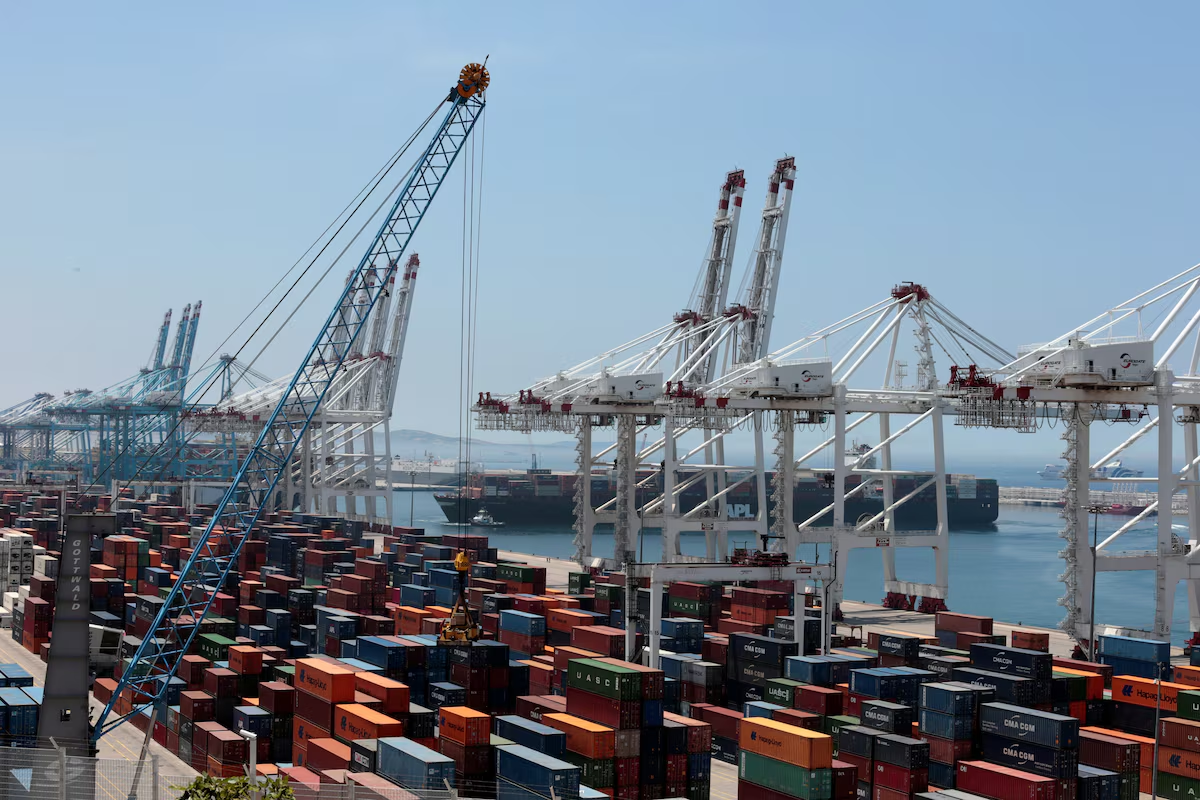
The two countries offer Washington different advantages. Morocco is more closely tied to the Atlantic, investment networks and financing, while Algeria has direct borders with Mali and Niger and security expertise in the Sahara and northern Mali.
These differences explain why Washington continues to expand its relationship with Algeria alongside its close partnership with Rabat. Total US trade in goods and services with Morocco reached about $9.6 billion in 2025, compared with about $3.9 billion with Algeria, and the kingdom is linked to the United States by a free trade agreement and longstanding defense cooperation.
Economically, Washington is seeking to expand its companies’ presence in the energy and mining sectors. An amendment to Algeria’s mining law that took effect in August 2025 opened more space for foreign investment, with foreign ownership potentially reaching 80 percent in some extraction projects through required partnerships with state entities.
Boulos’ talks in April 2026 also addressed unconventional gas resources and opportunities for US companies in critical minerals, while the agreement with Chevron on offshore exploration signaled that energy cooperation was moving into specific projects.
For Algeria, meanwhile, the relationship with the United States offers capital, technology, additional defense options and a closer political connection to decision-making circles in Washington. The military cooperation memorandum provides a channel for training, technology and equipment at a time when Russian systems remain a core component of its armed forces.
US investments also give Algeria an additional source of financing and expertise in gas and mining. At the same time, repeated visits by Boulos and the arrival of the US deputy secretary of state and the AFRICOM commander in Algeria in April 2026 raised political contact between the two countries.
The Libya file remains present in this rapprochement, though with less weight. A US mediation effort that lasted months helped secure Libya’s first unified budget since 2013 in April 2026, worth 190 billion dinars. Boulos then continued his contacts with Libyan parties and regional capitals on unifying institutions and power-sharing.
In a report published by Le Monde on Sept. 13, Cairo, Ankara, Riyadh, Abu Dhabi and Doha featured prominently in Boulos’ moves related to Tripoli, while Algeria’s importance centers on securing its long border with the country. Southern Libya is connected to routes for weapons and fighters extending toward the Sahel.
Closer, But Not Aligned: How Far Can the Relationship Go?
Algeria’s relationship with Russia places a clear ceiling on any expansion of cooperation with Washington. For decades, Moscow has remained a major source of Algerian arms, and the two countries have maintained a broad political and defense partnership. At the same time, developments in Mali in 2026 showed that their channels go beyond the arms file.
Africa Intelligence, the publication specializing in African political and economic affairs, reported on July 14 that Russian diplomacy had worked for about two months to repair relations between Algeria and Bamako, drawing on high-level contacts and African mediation to push the normalization process forward.
In April, Le Monde reported that Algeria had proposed to Moscow facilitating an orderly withdrawal of Africa Corps personnel after fighters from the Azawad Liberation Front recaptured the northern Malian city of Kidal from the Malian army and its Russian allies. A Western source told the newspaper that Algeria helped secure the evacuation, drawing on its relations with the Tuareg.
These facts show that Algeria’s recovery of part of its influence in Mali was accompanied by practical coordination with Russia, giving Washington a partner capable of expanding its tools in the Sahel while retaining working channels with Moscow.
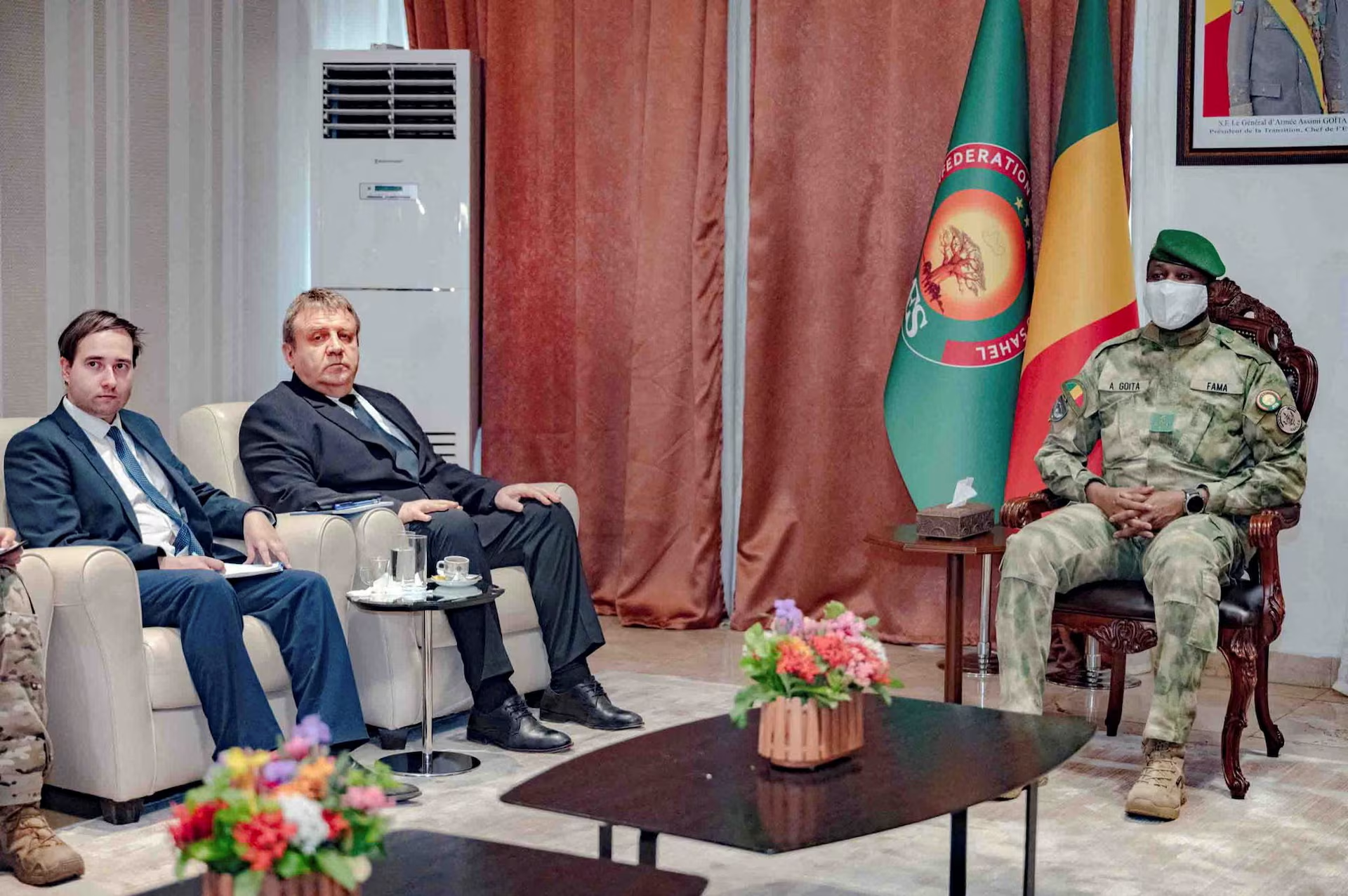
China retains a deeper economic presence than the United States. Algeria and Beijing entered the second five-year plan for comprehensive strategic cooperation between 2022 and 2026, covering trade, energy, agriculture, science and technology, space and health.
And reached Chinese-Algerian trade of $12.48 billion in 2024, including $11.68 billion in Chinese exports, compared with $3.9 billion in total goods and services trade between the United States and Algeria in 2025. The gap illustrates the scale of the space US companies are seeking to enter in the energy, mining and technology sectors.
Western Sahara remains the most sensitive point of disagreement, as the United States maintains its support for Moroccan sovereignty and the autonomy proposal. In contrast, Algeria supports self-determination and the Polisario Front.
In October 2025, UN Security Council Resolution 2797 gave the Moroccan proposal greater weight within the negotiating framework. Then, during his visit to Algeria in April 2026, US Deputy Secretary of State Christopher Landau said the two sides looked forward to working together on the issue, requiring Washington to manage its strategic relationship with Morocco while also keeping Algeria present in any negotiating track on the dispute.
Palestine also places a political limit on how far the relationship can expand. Algeria maintains a position rejecting normalization with Israel and places support for the Palestinian cause at the core of its foreign policy, while Washington continues its strategic partnership with Israel.
Even so, military and economic cooperation and political contact between Washington and Algeria continued through 2025 and 2026, keeping disagreement over Palestine central to shaping the political relationship and the limits of regional rapprochement.
A study published by The Washington Institute for Near East Policy in July 2025 argued that the defense cooperation memorandum and the joint military committee provide a basis for expanding information-sharing, counterterrorism, and opportunities for US companies, with economic competition with China in the background of US engagement.
In a different reading published by Manara Magazine, affiliated with the Middle East and North Africa Forum at the University of Cambridge, in March 2026, the distance Algeria maintains from Washington and its avoidance of US bases or security umbrellas were seen as a source of its value to regional parties that do not trust the West.
These readings align with a trajectory in which Algeria expanded its cooperation with the United States, Europe, Turkey, and China, while preserving its relationship with Russia and maintaining a wide margin in managing regional files.
The areas most likely to expand in the coming period appear to be information-sharing, border security, military training, counterterrorism, maritime security and joint defense committees, alongside US investments in energy, gas and mining.
A rapid transformation in Algeria’s arms structure or the hosting of US bases remains far from the policy Algeria has followed so far, while the minerals file is still at the stage of opportunities and discussions compared with the clearer progress in the energy sector.
Boulos’ third visit sums up the course of the relationship: Washington is moving to expand cooperation with Algeria in security, energy and trade, while Algeria is using this opening to diversify its partnerships and sources of investment and technology. Its relations with Russia and China, its rivalry with Morocco, and its positions on Western Sahara and Palestine remain the factors that define the ceiling of this rapprochement.
