











هذا التقرير متاح أيضًا بـ العربية
At a seminar organised by the Asbar Center for Media and Strategic Studies in Riyadh in the summer of 2011, participants discussed Saudi Arabia’s strategic importance as one of the world’s leading oil powers and the considerable economic and political influence that comes with it. But the centre’s director at the time offered a warning alongside this conventional view: Saudi Arabia is a leading global oil power, but owning and producing oil does not, in itself, guarantee lasting economic stability.
The argument was that the kingdom faces geopolitical flashpoints to both its east and west. If they erupted simultaneously, Saudi Arabia could find itself awash in oil but unable to export a single barrel to global markets. Much of the maritime supply network on which the Saudi economy primarily depends could also be disrupted.
At the time, the warning had not gained enough political and strategic weight for those present to discuss it as a plausible scenario. It may have seemed a far-fetched hypothesis. Nevertheless, it provided an early basis for considering one of the most serious vulnerabilities underlying Saudi power: its strength in oil production could lose much of its strategic value if its ability to transport that output to global markets were disrupted.
Today, 15 years after that seminar, the US war against Iran has brought those fears into sharper focus, exposing geographical vulnerabilities that had previously received less attention. What was once a concern confined to highly unlikely scenarios has become a practical challenge shaping the kingdom’s economic and strategic calculations.
The problem does not necessarily lie in Saudi Arabia’s ability to produce oil. The greater challenge is transporting and exporting it safely and consistently to overseas markets. Saudi oil security has therefore become more complex: vast reserves and enormous production capacity are not enough without a secure, diversified network of routes and export outlets that can keep Saudi oil flowing to global markets during crises.
In the second report in the series “Alternative geography“, we examine Saudi Arabia’s search for geographical and logistical alternatives that reduce its exposure to longstanding vulnerabilities and give it greater room for manoeuvre beyond the geopolitical chokepoints surrounding it. We then consider the central question: can this “alternative geography” overcome the constraints of Saudi geography and create a more flexible, independent network for energy and trade? Or will these remain partial, temporary solutions, with new vulnerabilities and risks that may emerge at the first real geopolitical test?
Geography and strategic vulnerabilities
Saudi Arabia’s geography presents one of the starkest paradoxes underlying its power. Its vast oil wealth has helped cement its economic and political standing regionally and internationally. Yet it has also left the country highly exposed to geographical and strategic vulnerabilities. For years, these remained potential risks; mounting regional turmoil has turned them into pressing concerns for Saudi decision-makers.
Although the kingdom covers more than 2.1 million square kilometres, its oil industry is concentrated primarily in the Eastern Province, which contains its most important oilfields, processing facilities and much of its energy infrastructure. This concentration makes Saudi Arabia heavily dependent on the Gulf and the Strait of Hormuz to reach the Arabian Sea and Indian Ocean, and then the Asian markets that are the main destination for its oil exports.
This is the kingdom’s first geographical bottleneck: huge oil reserves and massive production capacity do not, on their own, guarantee a continued flow to markets if export routes are disrupted. The current war has once again placed this dilemma at the centre of Saudi calculations.
In response, the kingdom has spent years developing its western route, transporting some of its oil from the Eastern Province through the East-West pipeline to Yanbu on the Red Sea. From there, tankers can head north through the Gulf of Suez and the Suez Canal to the Mediterranean and European markets, or south through Bab el-Mandeb, the Gulf of Aden and the Arabian Sea to Asian markets. Saudi Arabia has thus created a route that bypasses the Strait of Hormuz, in both theory and practice.
But recent regional developments have again exposed this alternative’s limits. Bab el-Mandeb and the Red Sea have become part of the conflict, serving as arenas for pressure and confrontation, particularly as the Houthis’ role and threats to shipping have grown. Saudi Arabia may therefore find itself escaping one chokepoint at Hormuz only to encounter another at Bab el-Mandeb.
The kingdom faces a particularly delicate geopolitical predicament. Its eastern route is exposed to risks at Hormuz, while its western route remains vulnerable to those in the Red Sea and Bab el-Mandeb. Diversifying ports alone is therefore insufficient without also meaningfully diversifying the geographical corridors connecting the kingdom to global markets.
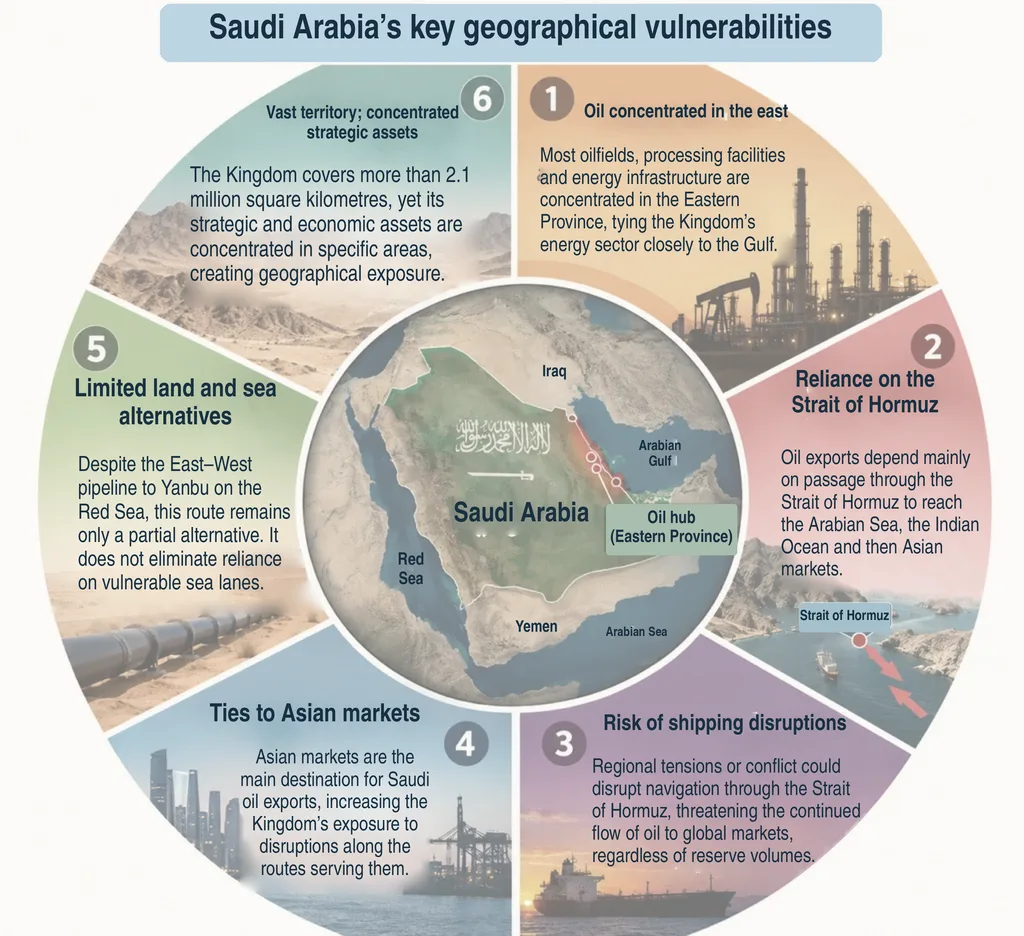
The vulnerabilities extend beyond maritime routes. Saudi oil infrastructure forms a closely interconnected network, running from oilfields in the east through processing centres, pipelines and refineries to export ports. A major disruption at a key point can reverberate throughout the network, potentially disabling large parts of the system even if the fields themselves remain capable of production.
Water is another particularly sensitive geographical vulnerability. Saudi Arabia is extremely arid and has limited natural water resources, making it heavily reliant on seawater desalination. Desalination facilities, electricity grids and water transmission lines have consequently become strategic infrastructure, as sensitive as oil installations. Widespread attacks on or disruption to these facilities can quickly turn a breakdown in essential services into a direct national security challenge.
Water scarcity also affects food security. The desert environment, limited water resources and scarcity of arable land constrain the kingdom’s ability to become fully self-sufficient in food through domestic production alone. It must therefore rely, to varying degrees, on overseas markets and international supply chains for a significant share of its food needs.
Saudi geography thus presents a striking paradox: the location and wealth that have historically been a principal source of strength also account for some of the kingdom’s greatest vulnerabilities. From this perspective, the search for an “alternative geography” is gradually becoming a strategic necessity, beyond its economic role in improving flows of trade and energy. The aim is to reduce, as far as possible, dependence on a limited number of sensitive routes, export outlets and geographical hubs.
War deepens the vulnerabilities
The current war with Iran has given Saudi Arabia another reason to accelerate its search for strategic alternatives that reduce its exposure to geographical vulnerabilities, particularly after the heavy economic losses it has suffered since February 2026. Indicators suggest the Saudi economy contracted by about 4.8 per cent year on year in the second quarter of this year. This was driven by a sharp decline in oil-sector activity, which shrank by about 24.7 per cent amid wartime disruptions to production, exports and regional flows of energy and trade.
These losses are particularly serious given oil’s continuing importance to the Saudi economy. The sector accounts for about 22 per cent of GDP, oil revenues provide more than half of government revenues, and oil represents roughly 60 per cent of total exports. Any prolonged disruption therefore quickly affects public finances, government spending, investment and major projects, as well as energy exports. It could force the kingdom to reorder its priorities and postpone or freeze projects and investment plans, including some linked to NEOM and other projects.
As the war continues and associated tensions spread, losses are likely to rise further. According to some estimates, losses during 2026 could range between $21.8bn and $24.9bn. In a more severe scenario combining disruption in the Strait of Hormuz, turmoil in Red Sea shipping and escalating attacks on oil facilities, potential revenue losses could reach between $48.8bn and $51.3bn.
The danger lies both in the scale of these losses and in their effects across sectors, from oil and energy to food, services, supply chains, investment and major projects. The war’s consequences are a stark strategic warning, revealing the costs that geography can impose when vital routes and export outlets become arenas of conflict and competing pressure. The search for geographical and logistical alternatives has accordingly moved closer to becoming a national security imperative.
Energy: alternative routes and storage
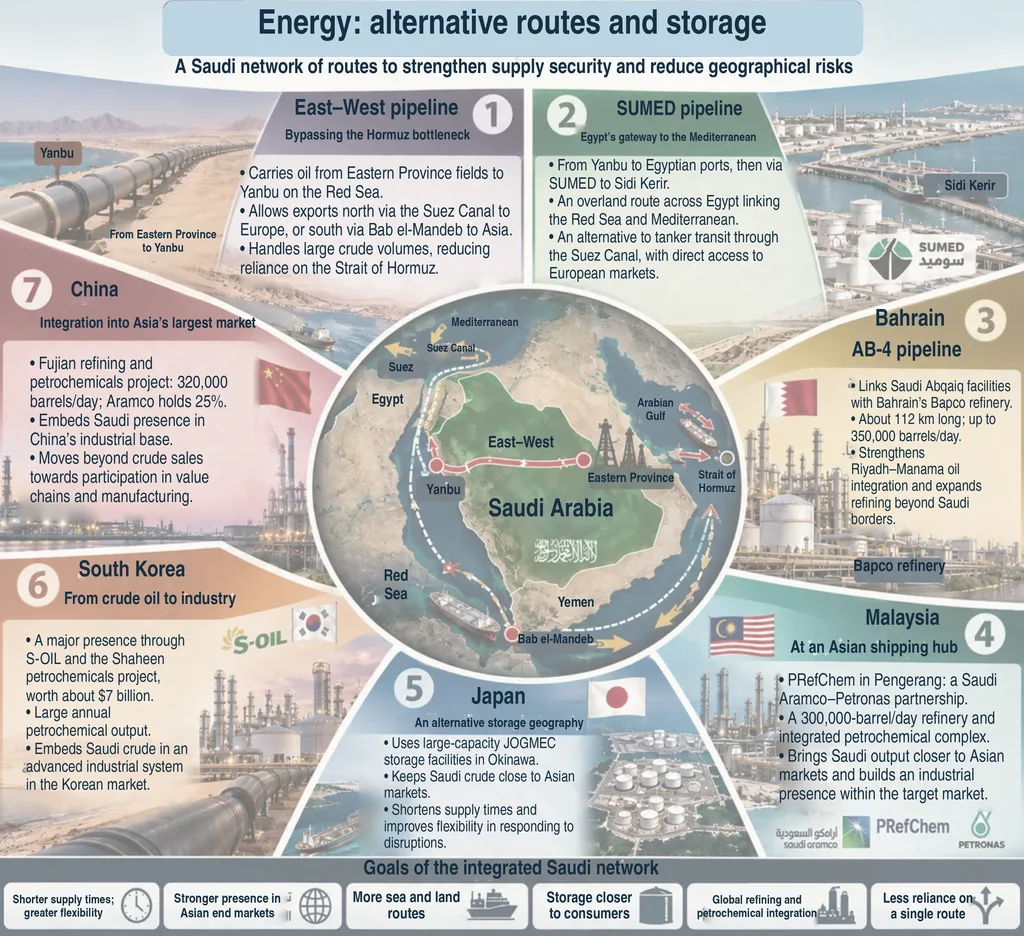
From Egypt and Bahrain to Malaysia, Japan, South Korea and China, Saudi Arabia has sought in recent years to build an interconnected network of energy routes and projects. Together, these form an integrated system intended to address different geographical vulnerabilities.
Viewed collectively, these projects appear to be more than separate oil and commercial investments: they seem intended to give each investment strategic value by addressing, directly or indirectly, a vulnerability exposed by recent geopolitical developments.
The East-West pipeline: bypassing Hormuz
Disruptions in the Strait of Hormuz have exposed the dangers of relying on a major chokepoint for Saudi oil exports. They have pushed the kingdom to deepen its reliance on the East-West pipeline, which carries oil from fields and facilities in the Eastern Province across Saudi territory to Yanbu on the Red Sea. From there, it can travel north towards the Suez Canal, the Mediterranean and European markets, or south through Bab el-Mandeb to the Arabian Sea and Asian markets.
The pipeline has particular strategic importance as one of the main routes for transporting Saudi oil without passing through the Strait of Hormuz. It can now handle vast volumes of crude, giving it a growing role in the Saudi export system, especially when risks to Gulf shipping routes increase.
Yet while this alternative addresses the Hormuz problem, it does not eliminate geographical vulnerability entirely; it shifts some of that vulnerability elsewhere. The pipeline, its pumping stations and its infrastructure extending over long distances remain exposed to attack, as previous Houthi attacks on some of its stations have shown.
Sending oil south from Yanbu also exposes it to risks at Bab el-Mandeb. If the strait closes or suffers prolonged disruption, the route becomes less strategically valuable for exports to Asia. The East-West pipeline therefore bypasses one Saudi chokepoint without freeing the kingdom entirely from the risks of maritime corridors.
SUMED: Egypt’s gateway to the Mediterranean
The SUMED pipeline is one of the most important overseas elements of Saudi Arabia’s network of alternatives. Saudi oil can travel from the Eastern Province through the East-West pipeline to Yanbu, then cross the Red Sea by ship to Egyptian infrastructure. From there, it can pass through SUMED to the port of Sidi Kerir on the Mediterranean and onwards to European markets.
Aramco’s stake in SUMED gives this system added importance in Saudi calculations. The pipeline provides an overland route across Egypt between the Red Sea and the Mediterranean, offering an alternative to tanker transit through the Suez Canal and reducing reliance on some traditional chokepoints.
From this perspective, Egypt serves as a geographical and logistical extension of Saudi Arabia as well as a transit state for its oil. It gives the kingdom more direct access to the Mediterranean and European markets, making SUMED one of the most important components of an “alternative geography” beyond Saudi borders.
Bahrain: expanding oil infrastructure through the AB-4 pipeline
Within the Gulf, the AB-4 pipeline offers another model for extending Saudi Arabia’s energy network beyond its borders. The roughly 112-kilometre pipeline links Saudi facilities in Abqaiq to Bapco’s refinery in Bahrain. It runs through both countries and has a capacity of about 350,000 barrels per day.
The pipeline allows the kingdom to expand refining and supply beyond its territory through cross-border energy infrastructure, strengthening oil-sector integration between Riyadh and Manama. Its geographical value as a way around regional chokepoints is relatively limited, however. It ends within the Gulf and thus remains dependent on the Strait of Hormuz as the Gulf’s principal maritime gateway to global markets.
Malaysia: a Saudi foothold near an Asian shipping hub
Malaysia is a key part of Saudi Arabia’s strategy to strengthen its presence in Asian markets. It serves both as an energy market and as an industrial and logistical foothold near one of the world’s most important shipping and trade corridors. Saudi investment there addresses a different problem from those at Hormuz and Bab el-Mandeb: the long distance between Saudi producers and Asian consumers.
In Pengerang, in Johor state, Saudi Aramco and Malaysia’s Petronas became equal partners in the PRefChem project. It includes a refinery with a capacity of nearly 300,000 barrels per day and an integrated petrochemicals complex. Aramco also committed to supplying a large share of the project’s crude oil needs, directly linking the industrial facility to Saudi supplies.
Aramco’s presence in southern Malaysia gives the kingdom a foothold near the Strait of Malacca and South and East Asian markets, reducing the strategic distance between Saudi production and Asian demand centres. Saudi Arabia thus becomes more than a Gulf crude exporter: it participates in refining, petrochemicals and value chains within its target market, establishing a more deeply rooted presence in one of the world’s most important trade and energy hubs.
Japan: building an alternative “storage geography”
In Japan, Saudi Arabia has approached the problem differently, moving some of its stockpiles closer to consumers rather than waiting for oil to travel from the kingdom whenever demand arises. Aramco has used storage facilities with substantial capacity owned by Japan’s JOGMEC in Okinawa, positioning Saudi crude near Japanese and Pacific Rim markets.
This model’s importance lies in building what can be described as an “alternative storage geography”, rather than creating a new geographical corridor. It moves some of Saudi Arabia’s capacity to respond to market demand into the region where that demand originates. With some crude already in East Asia, every barrel need not begin its journey in the Gulf when demand arises. This reduces delivery times and gives Aramco greater flexibility in responding to sudden disruptions.
South Korea: processing crude within the consumer market
In South Korea, the Saudi strategy goes a step further, from storing oil near consumers to helping convert crude into value-added products within the Asian market. Aramco has a substantial presence in South Korean refining and petrochemicals through S-OIL, while the Shaheen project is one of the clearest examples of this approach.
The roughly $7bn project aims to produce large quantities of petrochemicals annually. Its strategic value extends beyond the investment itself: it embeds Saudi crude within an advanced Asian industrial system and turns the relationship with the Korean market from one of “producer and buyer” into a deeper connection across refining, manufacturing and value-added supply chains.
China: integrating into industry in one of Asia’s largest markets
The same approach is even clearer in China, where Aramco is expanding its refining and petrochemicals investments as part of a long-term strategy to cement its presence in the Chinese market. The Fujian project is part of this strategy: a vast refining and petrochemicals complex with refining capacity of about 320,000 barrels per day, in which Aramco holds a 25 per cent stake. It is scheduled to become fully operational by the end of the decade.
The strategic significance is that Saudi Arabia is going beyond securing a long-term buyer for its oil to participate directly in the consuming country’s industrial system. Joint Saudi refinery and petrochemicals projects in China thus extend the kingdom’s oil industry beyond its borders.
Taken together, these projects show that Riyadh is seeking a network of alternatives, each serving a different purpose, rather than a single “geographic alternative” that addresses every vulnerability. The East-West pipeline bypasses Hormuz; SUMED provides access to the Mediterranean; Bahrain expands the Gulf refining network; Malaysia offers a position near Asian shipping hubs; Japan provides storage close to consumers; and South Korea and China offer integration into industry and end markets.
Overseas ports: extending Saudi Arabia’s reach along global trade routes
Saudi efforts to build an “alternative geography” that reduces the geopolitical vulnerabilities of its oil trade extend beyond diversifying supply lines and investing in refineries and overseas storage hubs. They also include ports and logistical hubs abroad. Here, a distinction is needed between Saudi shipping companies’ commercial reach and access to dozens of ports, and direct investment in operating and developing foreign port terminals. The latter gives the kingdom a more sustainable economic presence in international trade infrastructure, gradually turning it from a user of routes and ports into an investor in parts of their operations.
Bangladesh offers one of the clearest examples. Saudi Arabia’s Red Sea Gateway Terminal International (RSGTI) won a 22-year concession to operate and develop the Patenga Container Terminal at Chittagong Port, its first experience of operating a terminal outside the kingdom.
The terminal has a design capacity of about 500,000 TEUs a year. Planned capital investment was estimated at about $170m, before the project subsequently secured $100m in financing, alongside additional investment in equipment, infrastructure upgrades and operational efficiency.
Saudi Arabia’s Public Investment Fund holds a 40 per cent stake in the international platform dedicated to the company’s overseas expansion. This gives the project added economic and strategic significance, linking it to wider efforts to diversify Saudi investments and build logistical assets abroad.
Chittagong’s economic value extends beyond the capital invested or the terminal’s operating capacity. The port is Bangladesh’s main maritime gateway, and the country is one of the world’s most important centres for manufacturing and exporting ready-made garments. The port also sits on the Bay of Bengal, near the trade corridors linking the Indian Ocean to the Strait of Malacca and East Asia.
The investment therefore gives Saudi Arabia a foothold in one of Asia’s growing trade regions. It adds direct participation in operating an international supply-chain hub to the kingdom’s established presence in oil, refining and storage. The project can also be seen as a starting point for transforming the company from a port operator centred on Saudi Arabia into an international operator across multiple markets, opening the way to further concessions and logistical assets abroad.
This approach complements the maritime network the kingdom has built through companies such as Bahri, whose services reach about 150 ports worldwide. But the economic distinction is fundamental: port access provides a transport network and commercial reach, while operating a terminal provides a long-term investment asset, operating revenues and a presence in cross-border logistics and trade services. The significance of the Saudi shift lies in its attempt to establish an economic stake within ports, beyond simply reaching them. It is moving from owning and operating ships on global trade routes to building investment interests in some of the hubs through which that trade passes.
If this model expands in the coming years, overseas ports could become another pillar of Saudi Arabia’s “alternative geography” strategy. They would serve as a means of distributing some of its logistical assets and interests beyond its borders and moving closer to production centres, consumption hubs and end markets, rather than directly replacing domestic ports or the maritime routes on which Saudi oil depends.
Farms abroad: overcoming water and climate constraints
Oil production and export routes were not the only geographical vulnerabilities pushing the kingdom to seek alternatives abroad. Agriculture and food security present an equally sensitive challenge. Water scarcity, limited arable land, desert conditions and a harsh climate impose structural constraints on agricultural expansion and high levels of self-sufficiency in several basic commodities. Food has therefore become a national security concern for Riyadh as well as an economic and agricultural issue, particularly as international crises have exposed global supply chains’ vulnerability to disruption.
Riyadh has responded by building agricultural and food-sector operations abroad to overcome some of these domestic geographical constraints. Central to this strategy is the Saudi Agricultural and Livestock Investment Company, “SALIC“, owned by the Public Investment Fund. It is one of the main bodies tasked with supporting Saudi food security through investment in agriculture, livestock production and food-trade supply chains within and outside the kingdom.
In recent years, its portfolio has grown to include investments in seven countries across five continents, giving it access to more than 20 million tons of strategic commodities worldwide. According to company data, SALIC supplied the kingdom with more than 8 million tons of strategic commodities between 2021 and 2025 and helped meet about 25 per cent of Saudi wheat needs in 2025.
The distribution of these investments reveals an attempt to build an “alternative agricultural geography” by establishing a presence in countries with natural resources and production advantages that Saudi Arabia lacks:
- Australia: SALIC owns Meridian Farms, which covers nearly 200,000 hectares of agricultural land used for grain production and livestock farming. It also has meat-sector investments through partnerships with Minerva Foods. Australia provides access to grain, feed and meat from a country with extensive natural resources and production capacity. Investment there therefore serves as an overseas counterweight to some of Saudi Arabia’s domestic agricultural constraints.
- Ukraine: Saudi investment has entered one of the world’s most important grain-producing regions through United Farmers Holding and SALIC’s acquisition of a 12.6 per cent stake in Ukraine’s MHP in 2024. MHP has extensive operations in grain, oils and poultry. Ukraine’s importance to Riyadh stems from its position within one of the world’s fertile black-soil belts, offering access to agricultural production capacity that would be difficult to replicate within the kingdom.
- India: Saudi investment has focused on securing part of the rice supply chain, particularly basmati rice, a staple in the Saudi market. SALIC took a stake of about 30 per cent in Daawat Foods, alongside its investment connection to LT Foods Group. This allows the kingdom to move gradually from buying rice on international markets to owning direct interests in the production and supply chain of one of its most important food imports.
- Canada: The strategy extends beyond direct agricultural investment to control over parts of the grain trade’s logistical infrastructure. Through investment in G3 Global Holding in partnership with Bunge, SALIC gained a presence in an extensive Canadian grain trading and handling system, including storage, grain elevators, ports, and transport and export networks. This gives Saudi Arabia a position within the chain that moves grain from production areas to international markets, as well as access to the commodity itself.
- South America, particularly Brazil: Investments focus on meat and animal protein through partnerships with Minerva Foods. They reflect efforts to establish a foothold in regions with large agricultural and livestock surpluses, diversifying import sources and providing an additional buffer during crises and global market disruption.
The most significant development in this strategy, however, is Saudi investment in Olam Agri, in which SALIC’s stake has risen to 80.01 per cent. This goes beyond owning a farm or a stake in an agricultural company in a single country. It gives Saudi Arabia a presence in a global agricultural and trading network spanning more than 30 countries and dealing in grain, feed, oils, pulses, cotton and other agricultural commodities and products.
At this point, the concept of an “alternative agricultural geography” changes. Alongside seeking farmland abroad to compensate for water scarcity and a lack of fertile land at home, Saudi Arabia is moving towards ownership of operations throughout global food value chains, from farming and production to storage, handling, trade, ports and distribution. Investment in a global network such as Olam Agri therefore gives Riyadh access to an integrated international food system, beyond a collection of separate agricultural assets.
Saudi Arabia’s food security strategy thus resembles its approach to energy. Just as Riyadh is trying to overcome vulnerabilities at Hormuz and Bab el-Mandeb by diversifying its oil pipelines, refineries, stockpiles and ports beyond its borders, it is seeking to overcome constraints on water, climate and farmland through a geographically dispersed global network of food production, storage and trade. Both approaches rest on the same principle: what Saudi geography cannot provide at home, the kingdom seeks to secure by extending its strategic reach abroad.
Can alternative geography overcome these vulnerabilities?
This extensive network of alternatives, from energy routes, refineries and storage hubs to ports, agricultural investments and global food chains, raises a central question: how much protection can it give the kingdom against its geographical vulnerabilities?
Owning assets, interests and routes abroad does not necessarily eliminate risk. In some cases, it may simply redistribute it geographically. An alternative corridor may encounter a new chokepoint; overseas investment remains subject to the host country’s stability and political and economic fluctuations; and international transport and trade networks remain vulnerable to wars, crises and supply-chain disruption.
Recent developments have starkly demonstrated this dilemma. On 18 September 2026, the Houthis targeted three of the 11 pumping stations along the East-West pipeline, one of the alternative routes. This disrupted parts of the system and complicated crude loading and export operations at Yanbu, prompting Aramco to notify some European refineries that it would not deliver their scheduled shipments during the coming October.
The real test of this strategy is therefore whether these investments can function during crises when traditional routes are disrupted, rather than their size or the number of countries they span. This makes the question more urgent: can this network become a viable, safe and sustainable alternative to Saudi geography, or is it merely a backup that eases the impact of the kingdom’s underlying vulnerabilities without being able to eliminate them?