








هذا التقرير متاح أيضًا بـ العربية
In less than a year, the US has reorganised its military operations in the Levant in a shift not seen since its forces returned to Iraq and Syria in 2014 to fight the Islamic State group.
US sites in Syria were gradually closed, culminating in the handover of the last main base in April 2026. On 30 September, troops and equipment assigned to Operation Inherent Resolve — launched by Washington in 2014 to manage coalition operations against the Islamic State — left Erbil Air Base, ending the coalition’s military mission in Iraq.
The Combined Joint Task Force, which managed the coalition’s operations against the group, remained in place but moved its headquarters to Jordan. From there, it continues to oversee efforts against the Islamic State in Syria, working with coalition partners and Syrian forces.
The withdrawals ended an arrangement that had lasted for years. Iraq had served as a base for troops, logistics, intelligence and command facilities supporting operations on both sides of the Iraqi-Syrian border, while US forces maintained bases in Syria.
Having withdrawn from both countries, Washington now runs part of the mission from outside their borders. Jordanian bases and facilities have become more important within a broader US military deployment reshaped by the war with Iran. Missile and drone attacks on US sites in the Gulf exposed the risks of concentrating troops, aircraft and stockpiles at a small number of bases.
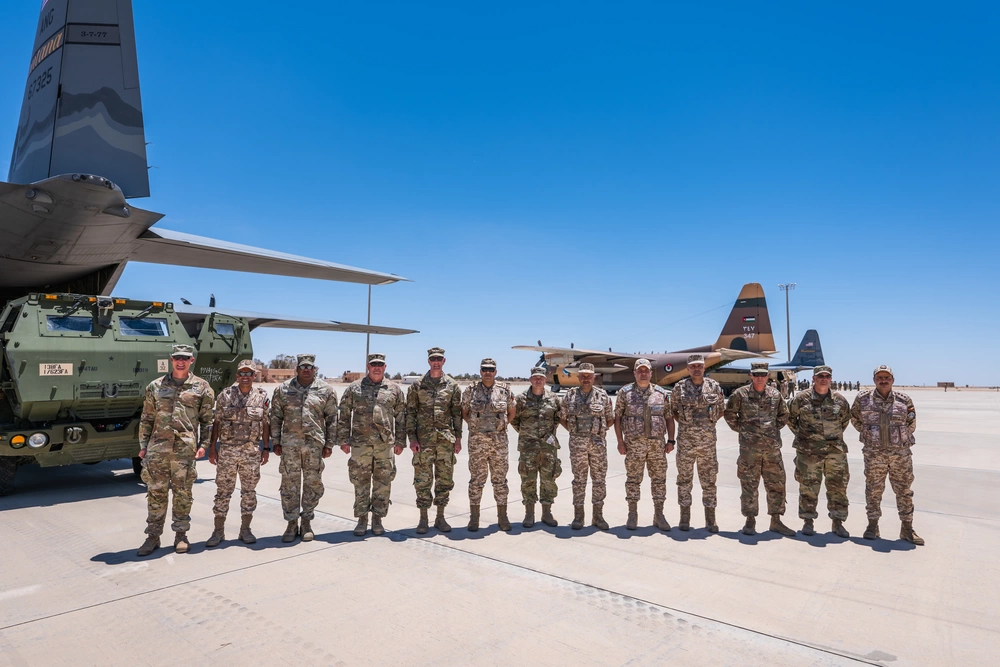
The shift gives Jordan a different role in the region. The kingdom, which has hosted US forces for decades, now hosts the operation’s command headquarters, air bases upgraded to accommodate US aircraft, a forward position near its borders with Iraq and Syria, and a network of air defence, communications and logistics facilities.
Jordan’s expanding role forms part of a wider redistribution of US forces in the region, as the kingdom has become the closest base from which to manage operations involving Syria and Iraq.
From bases in Iraq and Syria to command in Jordan
The process began with an agreement announced by Baghdad and Washington on 27 September 2024. The US State Department said the two governments had agreed to end the coalition’s military mission in Iraq in two phases.
The first would end the coalition mission and establish bilateral security partnerships. The second would retain the ability to support operations against the Islamic State in Syria from Iraqi territory until September 2026, subject to security conditions and consultations between Baghdad, Washington and coalition partners.
The Combined Joint Task Force for Operation Inherent Resolve then began gradually repositioning its forces. A report by the operation’s US inspector general, covering April to June 2025, documented its withdrawal from sites in Baghdad and Ain al-Asad Air Base, with some forces consolidated at other locations. Erbil retained its role as a hub supporting operations in Syria.
The process accelerated in 2026 as conditions in Syria changed. On 11 February, US forces left al-Tanf, near the point where the Syrian, Iraqi and Jordanian borders meet, and handed the base over to the Syrian authorities.
At the time, US Central Command (CENTCOM) commander Admiral Brad Cooper said the forces would remain ready to respond to Islamic State threats by supporting locally led efforts. Some personnel withdrawn from al-Tanf were redeployed towards Jordan, including to Tower 22 on the Jordanian side of the border, about 20 kilometres from the former US base in Syria.
US forces continued to leave sites in northeastern Syria until the handover of the last main base on 16 April 2026, ending more than a decade of direct US military presence in the country.
In an analysis published on 20 April, the Center for Strategic and International Studies (CSIS), a US policy and security research institution, argued that the withdrawal placed greater responsibility on the Syrian authorities in areas where the group was active. It said the US continued to provide training, intelligence and support, but warned that Washington would struggle to perform the same role on the ground if new security vacuums emerged.
The new arrangement became clearer on 11 August, when CENTCOM announced new leadership for Operation Inherent Resolve and described the force as “headquartered in Jordan,” while retaining its mission to provide advice, assistance and capabilities to partners fighting the Islamic State.
The Iraq phase ended on 30 September, when CENTCOM announced that troops and equipment had left Erbil Air Base and that Operation Inherent Resolve’s mission in Iraq was over. It said Erbil had been the task force’s main operational centre, hosting most of the roughly 1,500 US and coalition troops involved in operations against the group during the final phase.
From its headquarters in Jordan, the Combined Joint Task Force continued to manage efforts against the Islamic State in Syria alongside coalition partners and Syrian forces. Washington’s military relationship with Baghdad shifted to a bilateral defence framework.
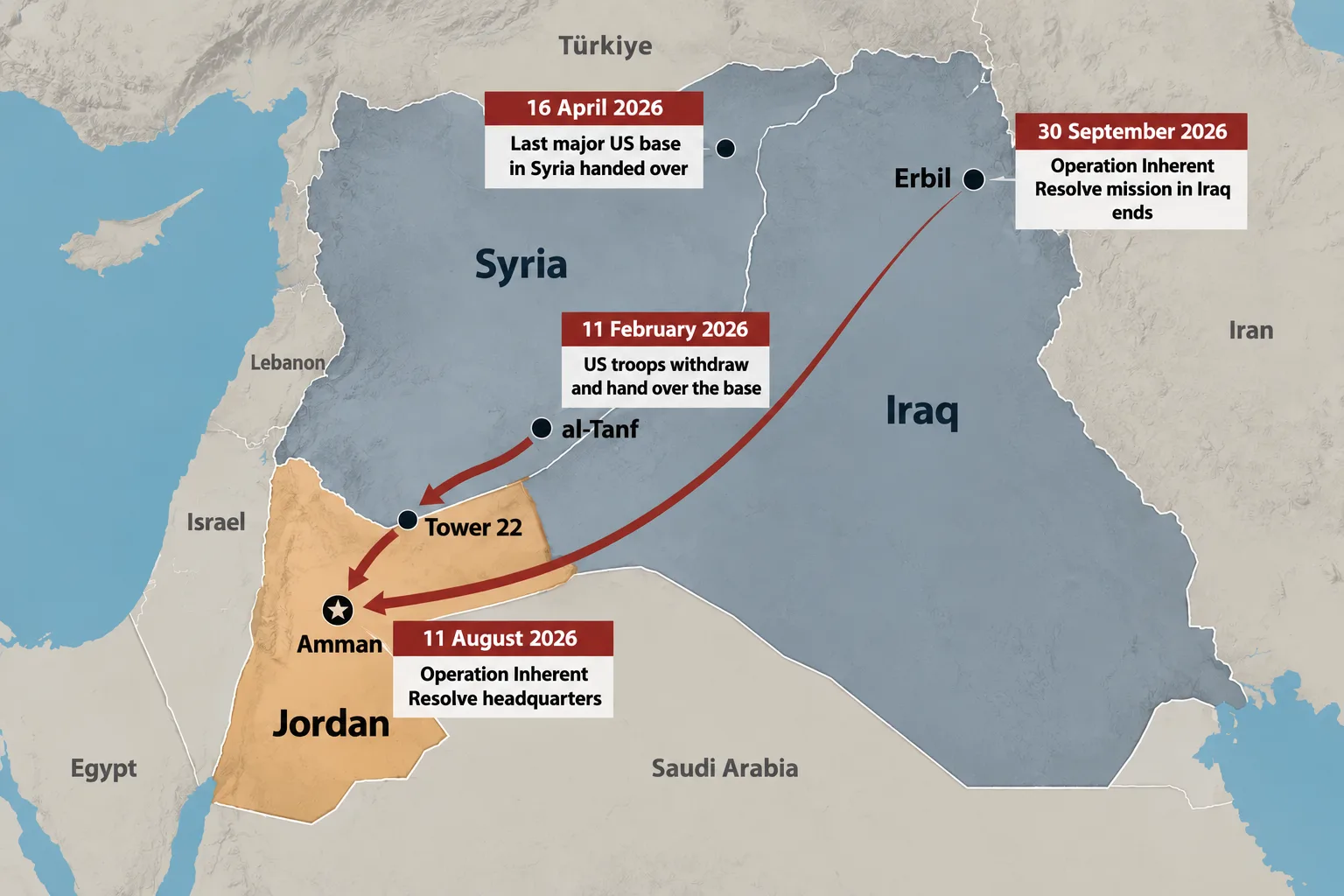
The transition changes how Washington manages operations on both sides of the Iraqi-Syrian border. Instead of running the mission from nearby sites within the two countries, it now commands operations from outside both theatres, relying more heavily on local forces and support from Jordan and the Gulf.
In a study published on 9 September, the Atlantic Council argued that Iraq and Syria had formed a single “theater” for confronting the Islamic State for nearly a decade. Changing that structure, it said, required Damascus to take on greater responsibility and made intelligence sharing and the development of Syrian forces’ capabilities more important.
The study noted that cooperation against the group would increasingly be managed “at a distance,” using intelligence and assets in Jordan and the Gulf. It predicted that Washington would increasingly use arms sales, bilateral security cooperation and economic ties to exert influence in Iraq as its reliance on a direct military presence declined. It also predicted that moving forces rapidly would become more difficult when crises arose in the country.
Washington continues to support Baghdad following the end of the coalition mission. The Counter-ISIS Train and Equip Fund budget for the 2026 fiscal year allocated more than $212 million to selected units for training, equipment, planning and joint operations. The US administration maintains that Baghdad will lead the fight against the group within Iraq under the new bilateral defence relationship.
Why Jordan’s military role has grown
Jordan’s military role rests on arrangements established years before the latest shift. In a report dated 8 January 2026, the Congressional Research Service described military and intelligence cooperation as a pillar of relations between Amman and Washington. Drawing on figures from December 2024, it estimated that about 4,000 US troops were in the kingdom, engaged in missions to combat the Islamic State and strengthen Jordan’s security.
A defence cooperation agreement signed in 2021 gave US forces the right to access and use 12 Jordanian military facilities and sites for training, transit, basing and logistics.
These include Muwaffaq Salti Air Base near Azraq, Prince Hassan Air Base, King Faisal Air Base in al-Jafr, King Abdullah II Air Base, the King Abdullah II Special Operations Training Center, Camp Titan and the Royal Jordanian Naval Base at the Port of Aqaba, along with training facilities and other sites.
Muwaffaq Salti is the most important base for US air deployments in Jordan. US-funded expansion work in recent years has included runways, aircraft parking aprons, accommodation, maintenance and storage facilities. The upgrades allow it to accommodate larger groups of military aircraft, as well as transport and reconnaissance aircraft.
David Schenker, a former US assistant secretary of state and a fellow at The Washington Institute for Near East Policy, argued that Jordan’s importance had grown following losses and damage at US bases closer to Iran. In an analysis published on 17 September 2026, he noted that Muwaffaq Salti had been a major hub for C-17 military transport aircraft and had hosted about 60 combat aircraft in February.
Schenker linked Jordan’s growing importance to its position west of the Gulf, which gives US forces greater “strategic depth” from Iran while keeping them close to Syria, Iraq and the eastern Mediterranean. He also pointed to Jordan’s connections to Saudi Arabia and occupied Palestine, and its access to the Red Sea through Aqaba.
Tower 22 became more important after al-Tanf closed. Before the withdrawal, it had played a key role in supporting and supplying the US garrison in Syria. The official US Army investigation into the January 2024 attack on Tower 22 found that its primary mission was to support and sustain the forces at al-Tanf.
After US forces left al-Tanf in February 2026, some were redeployed to Tower 22. The site thus remained a forward position near the meeting point of the Jordanian, Syrian and Iraqi borders. The US Department of Defense did not disclose the number of personnel there or details of its new mission.
Jordan’s role differs from those of Washington’s main bases in the Gulf. In Qatar, Al Udeid Air Base hosts the Combined Air Operations Center, which manages and coordinates a large share of US and regional air activity. On 12 January 2026, CENTCOM opened an air and missile defence coordination cell there with the participation of regional states. US Air Forces Central also maintains a forward headquarters at the base.
In Bahrain, Naval Support Activity in Manama hosts CENTCOM’s naval command and the US Fifth Fleet, which is responsible for maritime operations in the Gulf, the Red Sea and the Arabian Sea. Kuwait is a major hub for ground logistics, storage, maintenance and the movement of troops and equipment, particularly through Camp Arifjan and facilities associated with the US Army.
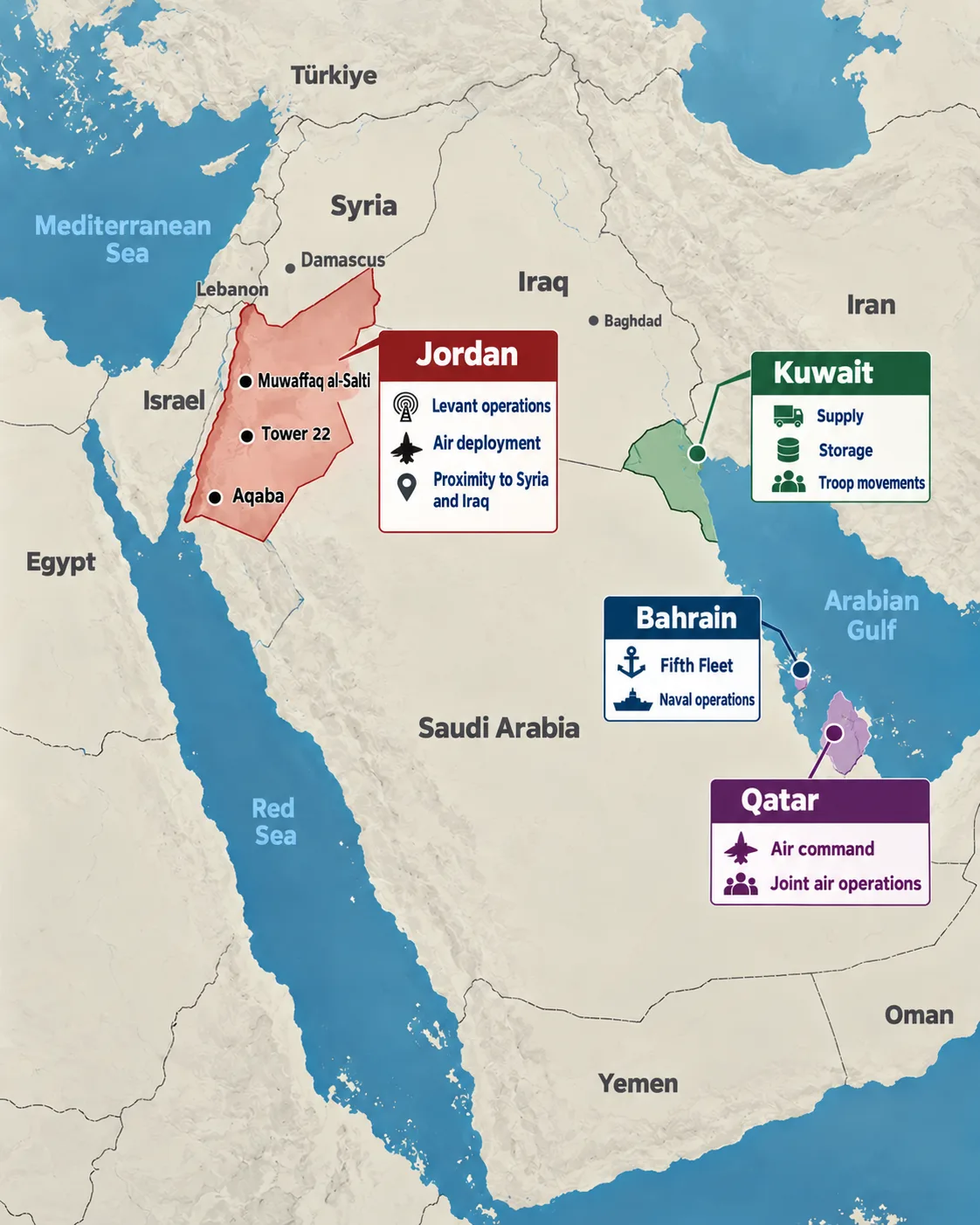
Jordan’s role in this network centres on the Levant: it hosts the command overseeing the fight against the Islamic State in Syria and serves as a hub for air and logistical deployments close to Syria and Iraq. Its growing importance coincides with a broader US review of regional deployments following the Iran war.
Christian Alexander, a researcher specialising in Gulf security and defence policy, examined this shift in an analysis published on 2 September 2026 by the Stimson Center, a US-based international security research institution. He argued that the war had exposed the risks of concentrating large numbers of aircraft, munitions, sensors and command facilities at a small number of known locations.
Alexander argued that the next phase would involve distributing aircraft, fuel, munitions, radars and command centres across more facilities, while retaining major hubs whose functions were difficult to relocate.
This approach creates more opportunities for Jordan to host US assets supporting operations involving Iraq, Syria and the eastern Mediterranean. It also increases the kingdom’s importance within the military network Washington is reshaping after the Iran war.
A partnership that protects Jordan and exposes it to attack
Substantial financial support underpins Jordan’s military partnership with the US. A memorandum of understanding covering the 2023 to 2029 fiscal years stipulates that the US administration will seek to provide $1.45 billion annually in economic and military aid. The Congressional Research Service estimated that Jordan had received about $33.8 billion from Washington by the end of the 2025 fiscal year.
Washington has strengthened Jordan’s air defences in recent years and deployed US systems and crews in the kingdom. Facilities used by US forces have also provided aviation, reconnaissance, warning and intelligence support. These capabilities have become more important as long-range missiles and drones have proliferated and threats from Syria, Iraq and Iran have increased.
The same facilities have also placed Jordan directly in the line of fire. On 28 January 2024, a drone attack on Tower 22 killed three US soldiers and wounded dozens. The site was then helping supply the al-Tanf garrison. The threat widened during the confrontation with Iran in 2026, when military sites in Jordan came under missile and drone attacks.
Jordanian military defences and facilities also help intercept Iranian missiles and drones heading west. Some bases have become part of the defensive line along the route of attacks towards “Israel,” making them more valuable targets in any wider regional confrontation.
This role has grown since Jordan took part in intercepting projectiles entering its airspace during rounds of confrontation between Iran and “Israel,” while Amman insists that these operations are intended to protect the kingdom’s territory, population and facilities. That position becomes more complicated when the sites under attack are themselves used by US forces.
Alexander argues that countries hosting US bases benefit from the deterrence, warning, defence and support capabilities that the military presence provides. The military presence also exposes them to adversaries targeting US infrastructure during crises. In his view, this is one reason Washington is seeking to spread its assets across multiple sites, strengthen fortifications and air defences, and improve its ability to move quickly between bases.
The debate surfaced in Jordan in the summer of 2026, when more than 300 politicians, academics, lawyers, retired officers and tribal figures signed a letter calling for a review of the defence cooperation agreement with the US and for the kingdom to be kept out of the regional confrontation. They warned of the security, political and economic costs of the expanding role of bases used by US forces.
Speaking at the Aspen Security Forum in the US on 16 July 2026, Jordanian Foreign Minister Ayman Safadi said US forces operated in the kingdom under long-term military cooperation arrangements and Jordanian sovereignty. He stressed that Amman would not allow its territory to be used to launch an attack on another state, and that any attack on Jordanian territory violated the kingdom’s sovereignty, regardless of who carried it out.
Sean Yom, a political science professor at Temple University specialising in Jordanian affairs, places this dilemma at the heart of the two countries’ security relationship. He told the Los Angeles Times that the partnership provided Jordan with protection and support while its military ties to Washington increased the likelihood of it being targeted. That paradox puts pressure on the kingdom amid widespread domestic sensitivity over US policy and its support for “Israel.”
Jordan’s security concerns nevertheless extend beyond the confrontation with Iran. They include Islamic State activity, smuggling networks across the Syrian border, the spread of armed groups in Iraq and Syria, and the risks posed by cross-border drone and missile attacks. US intelligence, air defence, training and military aid remain important to Jordan’s response to these threats.
With Operation Inherent Resolve no longer present in Syria and Iraq and its command transferred to Jordan, the kingdom is becoming more prominent in US regional deployments as the nearest rear base for operations in the Levant. The role increases Jordan’s importance to Washington while raising the security and political costs for Amman.
