










هذا التقرير متاح أيضًا بـ العربية
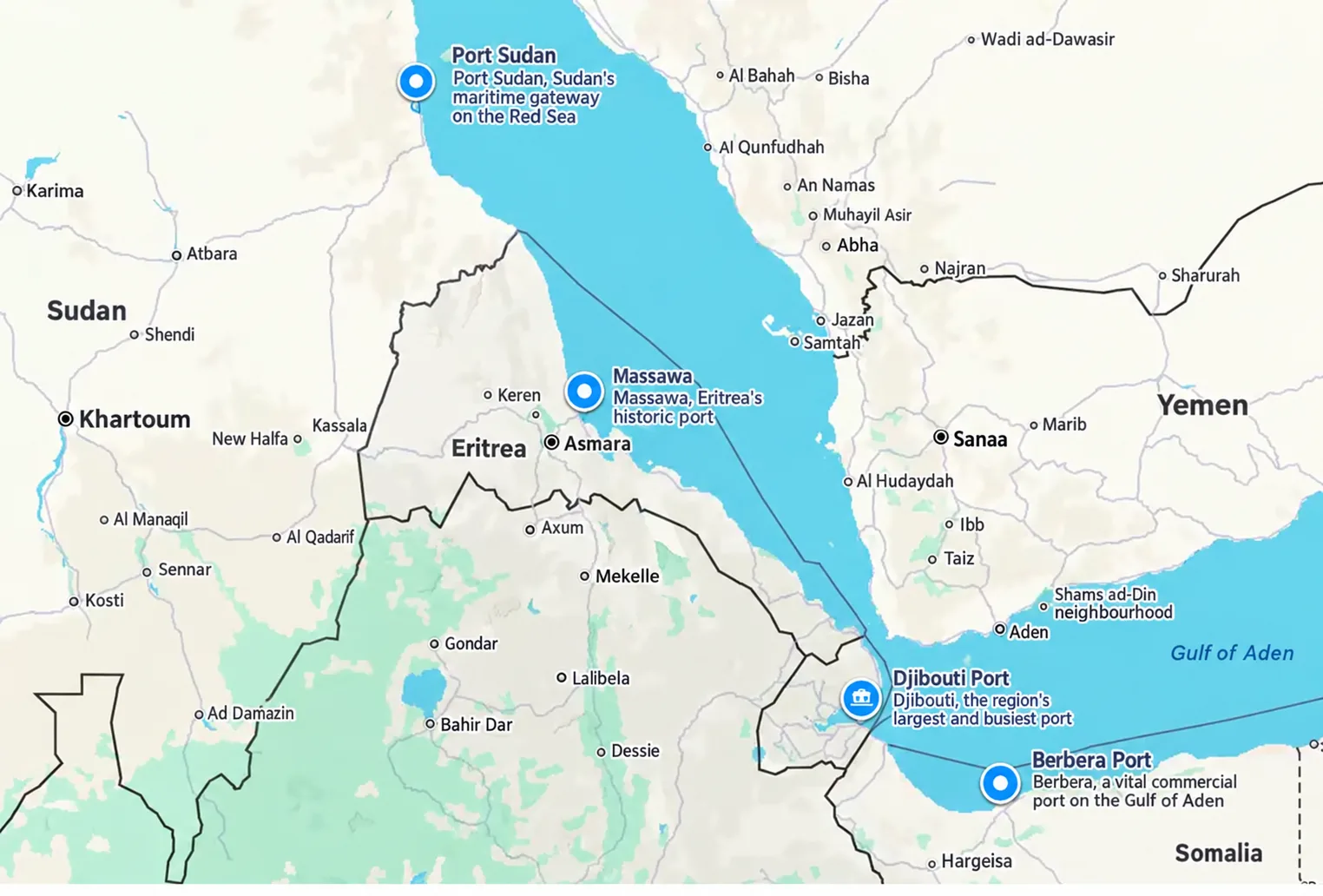
Along roughly 1,600 miles of coastline between Berbera and Port Sudan, more than 10 international and regional powers are competing for berths, runways and stakes in Horn of Africa ports. Their presence has made this stretch of coast one of the region’s most heavily militarised areas, and one of its most fragile.
The ports are no longer simply gateways for trade. They have become tools of strategic influence and political and military pressure, with direct implications for Red Sea security. Researcher Seife Ayele Asfaw reaches this conclusion in a paper for the Amani Africa centre, arguing that the region’s infrastructure “is no longer politically neutral at all,” and that competition over it reflects rival visions of the regional order. These are shaped by the overlapping interests of the UAE, China, Russia and the US, alongside regional powers such as Egypt and Türkiye.
The UAE has become central to this competition, expanding its presence by acquiring strategic ports and connecting them to the African interior. Studies and analyses have linked this policy to shifts in the balance of influence in East Africa and growing tensions with central governments in several Horn countries.
Deals involving Berbera, Port Sudan, Djibouti and Assab have helped reshape the distribution of influence in the region. They have also bound the balance of power along the African coast more closely to that in the Gulf.
Djibouti: Rival armies, neighbouring bases
Djibouti, with a population of no more than one million, hosts one of the world’s most striking concentrations of military power. Bases belonging to the US, France, Japan, Italy and China sit within a small area overlooking the Bab el-Mandeb Strait.
The most prominent is Camp Lemonnier, Washington’s only permanent military base in Africa. It houses about 4,000 troops and serves as a key hub for US drone operations over Yemen and Somalia. Under a contract announced in 2014, Washington pays $63m in annual rent, or about $630m over a decade, up from about $38m a year.
A few miles away, China opened its first overseas military base in 2017, paying annual rent of about $20m.
The proximity of these bases carries risks. In 2018, the US Department of Defense reported incidents in which it said lasers directed from the vicinity of the Chinese base at US aircraft had caused eye injuries to pilots. Beijing denied the allegation. With two major military powers operating in such a confined space, and no publicly declared arrangements to prevent clashes, Djibouti is particularly vulnerable to direct friction between them.
Behind this concentration of military power lies a fragile economy. Djibouti depends heavily on payments for foreign bases and on Ethiopian trade passing through its ports, which handle about 95 per cent of Ethiopia’s external trade.
Its debt burden has also grown. External debt rose from less than 34 per cent to about 68 per cent of GDP. Chinese institutions hold more than half of the approximately $2.6bn total, prompting the International Monetary Fund to classify Djibouti as facing debt distress.
The port of Djibouti
After debt-servicing costs tripled, Djibouti suspended repayments to China in late 2022. Negotiations with the Export-Import Bank of China subsequently led to repayments being deferred until 2027, according to the IMF.
Debt is only one source of vulnerability. Djibouti is also involved in a protracted legal dispute over one of its most important strategic assets. In early 2018, the government terminated DP World’s contract to operate the Doraleh Container Terminal. Control then passed to Djibouti amid China’s growing presence in the country’s ports sector.
DP World, an Emirati company, took the dispute to the London Court of International Arbitration and secured a series of rulings. One, issued in March 2019, ordered the payment of about $385.7m in compensation for breaching an exclusivity clause. The awards totalled about $685m, but the Djiboutian government continues to refuse to enforce them, arguing that they are not binding on it.
The dispute took another turn in September 2025, when a ruling cleared the state-owned Ports of Djibouti company of liability in one of the related cases. The government hailed an “unappealable” victory. DP World maintains that the earlier awards remain in force and that its claims against the government are approaching $1bn.
Berbera: Ports, bases and recognition
Berbera, in Somaliland, has become another valuable source of influence in the Horn of Africa. In 2016, DP World signed a $442m agreement to operate and develop the port. The ownership structure allocated 51 per cent to the Emirati company, 30 per cent to Somaliland and 19 per cent to Ethiopia.
Ethiopia’s participation later stalled after Addis Ababa failed to fulfil commitments to develop the road connecting it to the port. In 2022, Somaliland declared that Ethiopia had forfeited its stake.
On 1 January 2024, the focus shifted from port investment to sovereignty. Ethiopian Prime Minister Abiy Ahmed and Somaliland’s then-president, Muse Bihi, signed a memorandum of understanding granting landlocked Ethiopia access to the sea through the lease of a roughly 20-kilometre coastal strip. It also included arrangements for an Ethiopian naval presence, in exchange for discussions about possible Ethiopian recognition of Somaliland as an independent state.
The memorandum triggered a serious diplomatic crisis with Mogadishu, which regarded it as a violation of Somalia’s sovereignty and territorial integrity. Somalia recalled its ambassador from Addis Ababa and sought regional and international support against the agreement.
Türkiye subsequently mediated between the two countries. Its efforts produced the Ankara Declaration in December 2024, under which Ethiopia reaffirmed its respect for Somalia’s sovereignty and territorial integrity. In return, the declaration provided for Ethiopia to pursue commercial access to the sea through arrangements to be negotiated with the Somali government.
Technical negotiations were due to begin at the start of 2025 and conclude within four months. The first round took place in Ankara in February, but the talks made no decisive progress. By late 2025, the Somaliland memorandum was no longer at the centre of the dispute. Meanwhile, Addis Ababa and Hargeisa began repairing relations: Somaliland’s new president, Abdirahman Mohamed Abdullahi, known as “Irro,” visited Addis Ababa in October 2025.
US and Israeli interest in Berbera further complicated the situation. Berbera International Airport’s runway, built by the Soviets in the 1970s, stretches about four kilometres, making it one of Africa’s longest. It has become a strategic prize. Somaliland offered Washington military basing rights in Berbera in exchange for recognition, and US Representative Scott Perry introduced a bill to that effect in Congress in June 2025.
The bill remained stalled in the House Foreign Affairs Committee. In a letter to Congress in mid-2026, the US State Department affirmed that Washington continued to regard Somaliland as part of Somalia and recognised federal Somalia’s unity and sovereignty.
On 26 December 2025, “Israel” recognised Somaliland’s independence. Reports cited by Bloomberg subsequently said it was seeking to establish a military base near Berbera, or use the existing Emirati base there, to confront the Houthis and Iran. Houthi leader Abdul-Malik al-Houthi responded by warning that any Israeli presence in Somaliland would be a “military target.”
Commercial traffic has also grown. Traffic through Berbera Port rose by about 30 per cent between 2023 and 2025, while its share of regional container trade in the Horn of Africa reached 14 per cent, up from no more than nine per cent previously.
The port’s director says a potential agreement with Ethiopia could increase trade traffic by nearly another 80 per cent. This prospect has raised concerns in Djibouti, which depends heavily on fees from Ethiopian imports and exports passing through its port.
Port Sudan: A strategic asset caught in war
Competition over Port Sudan may not have been the only reason war broke out in Sudan on 15 April 2023, but it was undoubtedly one of the underlying struggles.
In December 2022, months before the war, the Sudanese government signed a preliminary $6bn agreement with an Emirati consortium including AD Ports Group and Invictus Investment. The project involved building and operating Abu Amama Port on the Red Sea, north of Port Sudan, alongside a free economic zone, an international airport, a 450-kilometre road and an agricultural area spanning 400,000 feddans. Sudan was to receive 35 per cent of the project’s net profits.
Port Sudan is one of the country’s most important strategic assets. It sits on an international shipping route and could serve neighbouring landlocked countries, including Ethiopia, Chad and South Sudan. South Sudan already relies on the port’s maritime facilities to export its crude oil.
The UAE’s attempts to enter Sudan’s ports sector began years earlier. In 2020, Lebanon’s Al-Akhbar newspaper reported that a visit to Khartoum by Anwar Gargash, then the UAE’s minister of state for foreign affairs, was linked to efforts to secure a deal giving Abu Dhabi control of Port Sudan. The newspaper said the UAE had previously pursued the same objective under ousted President Omar al-Bashir.
According to Al-Akhbar, efforts were also made to press Washington to support a DP World plan to take over the port. The newspaper described these moves as part of attempts to expand Emirati involvement in oil and gas and strengthen the UAE’s regional influence. It also linked them to a visit to Abu Dhabi by Rapid Support Forces Deputy Commander Mohamed Hamdan Dagalo, known as Hemedti, days before Gargash travelled to Khartoum.
Emirati involvement later shifted from proposals concerning Port Sudan to the Abu Amama project. In November 2024, however, Sudan’s finance minister announced the cancellation of the project agreements, arguing that the memorandum of understanding had not been binding. The decision came amid escalating tensions between Khartoum and Abu Dhabi over Sudanese accusations that the UAE was supporting the Rapid Support Forces during the war.
⭕How did the UAE’s support for the Rapid Support Forces undermine its economic influence in #Sudan?
Sudan is taking a decisive stand by canceling Emirati concessions on the #Red_Sea, in a move to strengthen its sovereignty after disputes over Abu Dhabi’s support for the “#Rapid_Support_Forces.”👇 https://t.co/TotI6PkI3E
— NoonPost (@NoonPost) November 6, 2024
Port Sudan’s strategic importance grew as it became the government’s de facto administrative capital, the headquarters of UN and diplomatic missions, and a principal gateway for imports and aid. About 90 per cent of Sudan’s foreign trade passes through its ports.
That importance also made the city a direct target in the war. In early May 2025, a series of drone attacks lasting several days struck fuel depots, the main power station, the airport and the port’s container terminal. The attacks caused widespread power outages and temporarily disrupted relief operations.
Journalistic investigations linked the attacks to an earlier escalation at Nyala Airport. There, Sudanese army drones carried out a strike that, according to subsequent reports, destroyed a cargo plane and killed foreign fighters. The escalation took place amid repeated accusations that the UAE was backing the Rapid Support Forces.
As Port Sudan grew in importance, international competition for a foothold on Sudan’s coast returned to the fore. After Bashar Assad’s regime fell in December 2024, Moscow renewed its efforts to secure a naval base on the Red Sea amid uncertainty over the future of its military presence in Syria.
On 12 February 2025, Sudan’s then-foreign minister, Ali Youssef al-Sharif, announced after meeting his Russian counterpart, Sergey Lavrov, that the two sides had reached an understanding on a Russian naval base. The proposed facility would accommodate up to 300 troops and four warships, including nuclear-powered vessels, for 25 years.
The project remained on hold amid competing regional interests. Reports described Saudi pressure to keep the Red Sea free of foreign military bases. Sudan Tribune quoted a military source as saying the Sudanese government had “frozen the establishment of a Russian base on the Red Sea for the time being.”
By mid-2026, the continuing war, stalled plans for the naval facility and insecurity along Sudan’s coast pointed to further delays. Russia’s ambassador to Khartoum, Andrey Chernovol, described progress on the project as “currently halted” because of the conflict. Its future remained uncertain, with no official announcement that it had been abandoned.
Russia is only one of several powers seeking influence in Port Sudan. Türkiye and Iran have both strengthened ties with the Sudanese army, while Egypt and Saudi Arabia remain influential in Red Sea security. Their involvement comes amid growing regional opposition to turning the coastline into a site for foreign military bases.
Assab: Sea access and Ethiopian-Eritrean tensions
The Eritrean coastal city of Assab lies at the centre of escalating tensions between Ethiopia and Eritrea. These have intensified since 2025, with military movements along the border and reports of fortifications and troop deployments nearby.
Ethiopia’s continuing efforts to regain direct access to the sea underpin the dispute. Abiy Ahmed has repeatedly described maritime access as an “existential issue” and raised Ethiopia’s loss of its coastal outlet following Eritrea’s independence in 1993. He has called for arrangements allowing Addis Ababa access to Eritrean ports. Asmara regards this rhetoric as an infringement of its sovereignty and has rejected any proposal that could diminish it.
Assab also has a recent history of foreign involvement. Between 2015 and 2021, the UAE established a military and logistics base there to support coalition operations in Yemen. Satellite imagery showed extensions to runways, hangars and military facilities. In 2021, Abu Dhabi began dismantling parts of the base and withdrawing, as documented by Planet Labs images analysed by the Associated Press.
Several explanations have been offered for the withdrawal. Some linked it to the UAE’s reduced need for the base as military operations in Yemen scaled down; others attributed it to deteriorating relations between Abu Dhabi and Asmara.
Those tensions later deepened as Eritrean President Isaias Afwerki criticised the UAE’s regional role. In a media interview in early 2026, he accused Abu Dhabi of working with “Israel” to control a network of vital ports across the Red Sea and Gulf of Aden.
In February 2026, Addis Ababa sent Eritrea a message demanding the withdrawal of forces it said were stationed in border areas inside Ethiopian territory. It also accused Asmara of allying with the Tigray People’s Liberation Front and supporting Fano militants in the Amhara region. Eritrea rejected the accusations as “false and fabricated.”
The dispute over Assab increases the risk of conflict. Middle East Eye, citing a former Ethiopian official, reported that Abiy Ahmed had nearly gone to war with Eritrea the previous year to seize the port, allegedly with Emirati backing and at Abu Dhabi’s behest.
The account remains attributable to a single source. It is not, on its own, sufficient to establish the existence of an Ethiopian-Emirati plan to take over Assab. Nevertheless, the combination of border tensions and disputes over sea access makes the port a potential trigger for confrontation.
Turning commercial access into influence
The four cases share a pattern: commercial contracts gradually become tools of security and political influence. Long-term operating concessions give companies, and the powers backing them, a lasting presence within strategically sensitive infrastructure.
Bosaso Port in Somalia’s Puntland region offers another example. In 2017, P&O Ports, a DP World subsidiary, received a 30-year concession in a deal worth nearly $336m.
In practice, civilian and military uses overlap through what is known as “dual use”. A deep-water berth that receives container ships can also serve naval vessels. A commercial cargo runway can accommodate military transport aircraft and drones. Fuel depots and logistics facilities can support both.
Official descriptions of some facilities illustrate this overlap. Beijing calls its Djibouti base a logistics support facility. The US Department of Defense says the site contains barracks, underground facilities and hangars capable of servicing helicopters and drones. These features show how difficult it can be to separate the infrastructure’s logistical function from its military role.
The UAE’s presence in the Gulf of Aden follows a similar pattern. At various stages, its interests have extended to Berbera, Bosaso and Assab. In Bosaso, satellite images analysed by Yale University’s Humanitarian Research Lab showed construction and expansion of aviation facilities between 2024 and 2025, including runways, helicopter pads and hangars capable of accommodating drones.
Subsequent investigations linked those facilities to supply lines for Sudan’s Rapid Support Forces. In January 2026, Somalia’s federal government cancelled its trade and security agreements with the UAE amid growing tensions over Emirati activities in Somalia’s regions. Abu Dhabi subsequently began reducing its presence.
Bosaso returned to the centre of competition in late July 2026. An agreement between Puntland’s regional administration and US Africa Command, or AFRICOM, allowed an expanded US presence at the base, a development covered in a previous report.
The costs across the Red Sea
Competition along the African coast has consequences for shipping routes towards the Gulf and Yemen, as well as global trade through the Suez Canal.
Since the Houthis began attacking shipping in November 2023 in solidarity with Gaza, they have targeted more than 100 commercial vessels, sunk four ships, seized another and killed at least eight sailors. The attacks forced the world’s largest shipping companies to divert vessels around the Cape of Good Hope.
The financial impact has been substantial. According to Suez Canal Authority head Osama Rabie, canal revenues fell from a record $10.25bn in 2023 to $3.991bn in 2024, a decline of 61 per cent. The number of vessels passing through the canal dropped from 26,434 to 13,213 over the same period.
By May 2026, President Abdel Fattah el-Sissi estimated cumulative losses at about $10bn. According to JPMorgan estimates, diverting around Africa adds roughly 3,500 nautical miles and 10 to 14 days to an Asia-Europe voyage, increases fuel consumption by up to 40 per cent and adds $200 to $400 to the cost of transporting a container.
War risk insurance premiums also rose sharply. Before the crisis, they stood at about 0.05 per cent of a ship’s value. At the peak in 2024, they reached around one per cent, according to Marsh McLennan data. For a vessel worth $100m, that meant a premium of up to $1m for a single transit.
Following the Gaza ceasefire in October 2025, major attacks stopped and signs of a partial recovery emerged. Canal revenues reached about $7bn in 2025, while companies including MSC and CMA CGM resumed limited sailings through Suez.
Washington responded to the shipping threat through the US-led Operation Prosperity Guardian. The EU launched Operation Aspides in February 2024 to protect passage.
The recovery remained fragile. Maersk recorded losses of $153m in its ocean segment in the fourth quarter of 2025. Tensions returned with renewed regional escalation in 2026 and the Houthis’ announcement of a new naval blockade. Insurance premiums rose again, and the overwhelming majority of container traffic between Asia and Europe continued to travel around the Cape of Good Hope through mid-2026.
From the Nile Basin to the Gulf
Competition over ports has produced overlapping regional alignments that connect maritime access with disputes over water.
One alliance brings together Egypt, Eritrea and Somalia. It took shape at a trilateral summit in Cairo in October 2024, which established a trilateral committee at foreign minister level.
الصومال وإريتريا.. لماذا تبني مصر شبكة شراكات بحرية بالقرن الإفريقي؟
Egypt’s principal concern is the Grand Ethiopian Renaissance Dam, which Cairo regards as an existential threat to its water security. The dam was officially inaugurated in September 2025. When Addis Ababa subsequently announced plans to build three more dams on the Blue Nile at a cost of nearly $3.5bn, el-Sissi responded sharply.
Egypt has begun deploying about 1,100 soldiers as part of the African Union Support and Stabilization Mission in Somalia, or AUSSOM, its first military deployment to the country. Addis Ababa described these moves as a strategy of “encirclement.”
On the other side is the growing alignment between Ethiopia, the UAE and Somaliland. Abu Dhabi is one of Ethiopia’s leading investors and has supported Addis Ababa’s efforts to broaden its options for access to the sea.
This support aligns with Ethiopian rhetoric that presents both water and maritime access as national security issues. For Addis Ababa, the Grand Ethiopian Renaissance Dam and sustainable access to the sea are strategic priorities for a landlocked country of more than 130 million people.
Türkiye’s relationships are more complex. In February 2024, it signed a 10-year defence and economic cooperation agreement with Somalia. The agreement provides for support in building, training and arming the Somali navy, and protecting Somalia’s coastline of more than 3,000 kilometres, in exchange for economic arrangements concerning the exploitation of marine resources.
Ankara also operates the TURKSOM base in Mogadishu, a major centre for training Somali forces.
At the same time, Türkiye is sponsoring reconciliation between Ethiopia and Somalia through the Ankara Declaration. It maintains extensive economic ties and investments in Ethiopia, alongside a presence in Sudan and elsewhere in the region. Ankara must therefore balance its strategic relationship with Mogadishu against its growing interests in Addis Ababa.
Israel’s recognition of Somaliland in December 2025 complicated that balance further. It raised Turkish concerns about an expanding Israeli presence in a region Ankara considers an important part of its sphere of influence in the Horn of Africa and Red Sea.
This rivalry overlaps with Russia’s search for a Red Sea foothold, China’s established military and economic presence in Djibouti, and US efforts to strengthen its security presence in the region.
When ports become targets
The most dangerous consequence of this competition is its capacity to fuel internal conflicts in coastal states rather than strengthen their stability.
In Sudan, disputes over ports have generated tensions in the east for years. In autumn 2021, the Supreme Council of Beja Nazirs, led by Mohamed al-Amin Turk, shut down Port Sudan for weeks. The closure was a protest against the East Sudan track of the Juba Peace Agreement and a move in preparation for the coup of 25 October 2021.
It caused losses estimated at about €45m, created a backlog of around 950 containers and caused shortages of fuel, medicine and wheat. In 2025, the same port became a direct military target, attacked by drones believed to be Emirati.
In Somalia, disputes between Mogadishu and the administrations of Somaliland and Puntland show how ports can become flashpoints for state fragmentation. When the federal government cancelled the UAE’s agreements in Berbera, Bosaso and Kismayo, Puntland said Mogadishu “has no authority” to revoke agreements signed by the regional administration. It also suspended cooperation with the federal government.
Eritrea illustrates a different pattern: isolation and dependence on income derived from its strategic location. It leases access to whichever power it considers useful to its interests, from the UAE in the past to earlier overtures towards Iran and closer ties with Saudi Arabia today. None of this has translated into domestic development.
Despite its apparent stability, Djibouti remains vulnerable because of its heavy dependence on payments from foreign powers and its mounting debt.
Across these cases, the possibility that ports themselves could become military targets, as in Port Sudan, poses an immediate threat to the idea that infrastructure can provide security and stability.
Corridors of power or sources of fragility?
Over the past decade, competition along the coast between Port Sudan and Berbera has gone beyond berths and runways to reshape sovereignty in the Horn of Africa.
Coastal states are no longer the only actors determining what happens at their ports. Landlocked countries such as Ethiopia have become key players in shaping maritime access and port arrangements.
Regional powers including the UAE, Saudi Arabia, Türkiye and Iran compete alongside the US, China and Russia, while Israel’s presence is growing. Investments in ports, bases and transport corridors have become some of the most important means of building influence in the region.
The cases examined here follow a recurring pattern, albeit to different degrees. A contract or investment begins at a port, then affects security, alliances and sovereignty. In Djibouti, dependence on foreign bases and Ethiopian trade has coincided with rising debt and a growing Chinese presence.
In Berbera, competition has moved beyond port operations to link sea access with recognition of Somaliland. Port Sudan’s commercial and security importance has drawn regional and international powers to the city. Assab remains central to Ethiopian-Eritrean tensions over maritime access.
These developments have made the two sides of the Red Sea increasingly difficult to consider separately. Gulf security is tied to events along the African coast. Instability in Bab el-Mandeb directly affects the Suez Canal and international trade. Disputes over the Grand Ethiopian Renaissance Dam, ports and Ethiopian access to the sea intersect with security alliances stretching from Egypt, Somalia and Eritrea to the Gulf.
Yet the race for ports has not necessarily strengthened the states that host them. In several cases, deals and foreign interventions have fuelled disputes over sovereignty, the distribution of resources and the authority of central governments. Eastern Sudan and the disagreements between Mogadishu, Puntland and Somaliland illustrate these tensions. Eritrea, meanwhile, regards Ethiopian rhetoric on sea access with growing concern.
In a highly polarised environment, a port promoted as a source of trade and development can become a focus of domestic and international rivalry, or even a military target, as the attacks on Port Sudan demonstrated. The risks increase when rival powers’ bases and facilities sit close together, without a regional framework capable of managing the resulting friction.
For the foreseeable future, the forces driving escalation appear stronger than those favouring a settlement. A new confrontation on the Ethiopian-Eritrean border would return Assab to the centre of the crisis. Renewed escalation in Bab el-Mandeb would again put pressure on shipping and the Suez Canal. A revival of Russia’s base project in Sudan, or a new development concerning Somaliland, could reshape existing alliances.
Without more effective regional mechanisms to regulate competition over ports and maritime corridors, this infrastructure will remain a meeting point for competing international and regional interests. The states hosting it will continue to bear a large share of the risks.
