




هذا التقرير متاح أيضًا بـ العربية
The “Baghdad Belt” is one of the most geographically sensitive areas in Iraq’s post-2003 landscape. Surrounding the capital on all four sides, it provides strategic, security and economic depth for the city. Over the past two decades, it has become the setting for a quiet struggle and intense demographic competition.
Under the cover of security plans at some times and investment and housing projects at others, these areas are undergoing profound structural changes that are redrawing their demographic and social map. This is particularly significant given the predominantly Sunni identity that has defined the belt for centuries, making it a tribal ring surrounding and protecting the capital.
Arab tribes have inhabited the area around Baghdad since the early Abbasid era, in places then known as Nahr Isa, Sarsar, Nahr al-Malik and the Kalwadha river, among others. Their lands were highly fertile and densely settled with villages and estates. Relying on an advanced network of historic rivers and canals, these tribes formed the demographic and agricultural backbone of the black-soil lands surrounding the Abbasid capital.
After Baghdad fell to the Mongols in 656 AH and the old irrigation systems were destroyed, the city’s outskirts suffered a major agricultural and demographic collapse. Most irrigated land became barren or was used for seasonal grazing. These areas flourished again between the 17th and 19th centuries, when resident tribes revived them, replanted their land and established settlements that later became known as the “Baghdad Belt.”
Where geography and demography overlap
The strategic importance of the Baghdad Belt cannot be understood without examining its complex geography. It stretches across a vast area linking the capital to the provinces of Anbar, Salahuddin, Diyala and Babil, connecting the heart of the state to its peripheries.
This vital region is divided into major sectors encompassing towns and villages with a strong tribal and agricultural character. The southern belt begins with Mahmoudiyah, Yusufiyah, Arab Jabour, al-Bu’aitha and Hor Rajab, extending to Jurf al-Sakhar in northern Babil province. These areas provide a direct link to the Middle Euphrates and the southern provinces.
The western belt includes Abu Ghraib district and its outlying towns and villages, along with al-Bakriya, al-Radwaniyah, Sadr al-Yusufiyah and other areas, reaching the outskirts of Fallujah. It is the gateway to Anbar and the western desert.
The northern belt comprises the districts of Tarmiyah, Taji and al-Rashidiyah, extending to al-Nibai subdistrict, where it meets Salahuddin and Diyala provinces. To the east and southeast lies al-Mada’in district and its associated areas, stretching to al-Suwaira and al-Shijiriyah in northern Wasit province.
Population and tribal identity
Local experts and research centres estimate the population of the Baghdad Belt at between two million and three million, spread across interconnected urban, rural and tribal communities.
Throughout its history, the Baghdad Belt has had a predominantly Sunni identity. It is home to major Sunni Arab tribes including al-Jubour, al-Dulaim, al-Janabiyin, al-Mashahada, Zoba, al-Hayaliyeen, al-Ubaid, al-Kartan, al-Masara, al-Nadawat, al-Bu Issa, al-Aqeedat, al-Sawamra, al-Izza, al-Bu Hashma, al-Ghurair, al-Mujamma, al-Bu Hamdan and al-Owaisat.
This strong Sunni tribal presence historically formed a natural extension of the northern and western provinces, making the belt a geopolitical bulwark against attempts at Iranian-backed demographic domination.
After the former regime fell in 2003, the belt became a source of concern for successive governments and Shia political forces. They saw it as a uniformly Sunni “demographic siege” around the capital, where Shia political decision-making has been concentrated for more than two decades.
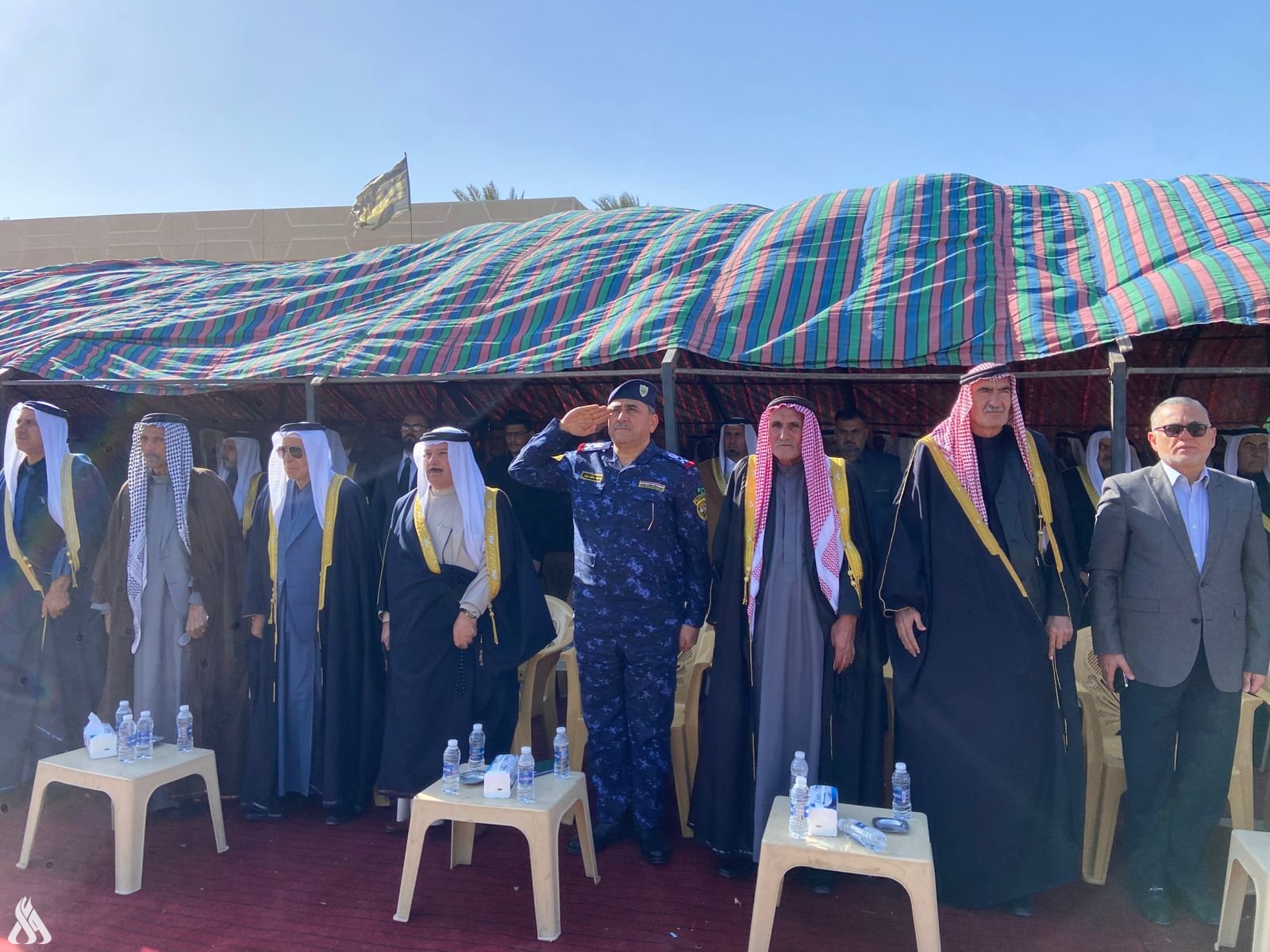
A tribal gathering in the Baghdad Belt affirms support for anti-drug efforts and restricting weapons to the state – Iraqi News Agency
Twenty years of demographic change
Since 2003, the Baghdad Belt has experienced a series of violent and systematic shocks that have destabilised its population structure. These changes resulted from overlapping security, political and economic factors.
They can be divided into three main phases. The first was sectarian violence and forced displacement between 2006 and 2008, following the bombing of the al-Askari shrine in Samarra. During that period, the belt became a theatre of sectarian violence, with militias targeting entire villages and neighbourhoods in al-Mada’in, Yusufiyah and Mahmoudiyah.
This drove mass waves of forced displacement, with Sunni families fleeing to central Baghdad, the western provinces, the Kurdistan Region and other countries. Displaced families from other areas replaced some of them, in an effort to establish new population enclaves aligned with the ruling forces.
Areas such as Mahmoudiyah, Latifiyah, al-Mada’in and Arab Jabour became volatile front lines because of their geographical position linking Baghdad to the southern and western provinces. Armed militias and extremist groups carried out widespread killings at fake vehicle checkpoints and on the basis of identity. They also targeted entire villages with mortar fire and night-time raids.
Reports by the International Organization for Migration and the UN refugee agency documented an increase in the number of internally displaced people in Iraq to more than 2.8 million by 2008. People displaced from the Baghdad Belt accounted for a high proportion of them. Amnesty International also recorded clear patterns of forced displacement, destruction of agricultural property, and seizure of property and land intended to prevent residents from returning.
“Counterterrorism” and pretexts for displacement
The second phase was the war against ISIS and systematic displacement between 2014 and 2017. The group exploited the belt’s dense orchards and network of waterways to infiltrate the area and establish safe havens that directly threatened the capital.
Under the slogan of “fighting terrorism,” Popular Mobilization factions conducted extensive military operations that resulted in the forced evacuation of entire towns, such as Jurf al-Sakhar, as well as parts of Mahmoudiyah, Latifiyah and Abu Ghraib.
The effects of the fighting continued after liberation, as tens of thousands of displaced families were prevented from returning home. Security authorities and the factions controlling these areas attributed this to “security vetting” procedures, the presence of mines and the need to obtain “security permits” through complicated processes.
As a result, vast areas were turned into camps and closed military zones. Foremost among them was Jurf al-Sakhar subdistrict, renamed Jurf al-Nasr, along with large parts of Latifiyah, Mahmoudiyah and the Abu Ghraib belt. Their original residents are barred from even approaching them.
More than 140,000 people were displaced from the Sunni area of Jurf al-Sakhar in northern Babil province. Its residents still live in displacement camps, including Bzeibiz in Anbar, despite the area having been fully retaken in October 2014. UN mission reports indicate that dozens of villages in southern and western Baghdad remain entirely empty of their residents.

Housing complexes and “soft change”
The third phase, termed “soft change,” involved laws, confiscation and economic pressure. It began to take shape after 2018. Following the end of the war against ISIS and the onset of relative security in these areas, the strategy for changing the population structure and controlling the Baghdad Belt shifted from “hard violence” to what can be described as “soft change.”
This phase relied on state institutions, legislation, legal measures and investment to entrench the status quo and target the economic conditions of farmers and local residents.
These methods included applying strict laws, such as Law No. 10 of 2012 on confiscating and freezing the assets of former regime figures and their relatives up to the second degree. This enabled the state to take over vast tracts of agricultural land owned by families that had lived in the belt for decades.
Farmers also faced strict security and economic restrictions, including bans on drilling artesian wells, restrictions on transporting crops, and prohibitions on importing fertilisers and equipment under the pretext of security concerns. Hundreds of homes were demolished on the grounds that they lay within railway, oil refinery or other exclusion zones. Restrictions on bringing in construction materials forced residents to seek mediation and pay levies to government bodies or armed factions.
These sustained pressures impoverished farmers and left their land fallow, forcing many to sell it at low prices to investment entities or investors acting as fronts for influential groups. This transferred control of the land and legally changed its designation.
Thousands of dunams of agricultural land in Arab Jabour, al-Radwaniyah and Abu Ghraib were converted into investment projects and housing complexes belonging to influential parties. Orders were also issued to confiscate other land on the grounds that its former owners were subject to accountability and justice procedures or rulings freezing movable and immovable assets.

Al-Rafil and the new administrative capital
On 15 June 2021, under former Prime Minister Mustafa al-Kadhimi’s government, the Iraqi Cabinet voted to launch “Rafil Residential City” officially as the new administrative capital. Contractual arrangements for the project were later completed through memorandums of understanding and major investment contracts signed with international and Arab companies to implement its phases.
The new “capital” covers an estimated 106,000 dunams around Baghdad International Airport, southwest of Baghdad. The project was to be built in successive phases. The first included housing complexes and educational facilities, among them the American University, as well as hospitals and commercial centres. Subsequent phases were designated for logistics, agricultural and environmental projects, with the aim of providing tens of thousands of housing units in horizontal and vertical developments and accommodating about 600,000 people.
The irony is that the land allocated to the project lies within the southern and western Baghdad Belt, in areas such as al-Radwaniyah, Yusufiyah and the outskirts of Abu Ghraib. These areas have historically been inhabited by Sunni Arab tribes and clans such as Zoba, al-Janabiyin, al-Dulaim, al-Jubour and al-Bu Issa.
The project faced strong objections from local notables and tribes. They stressed that, contrary to claims promoted by some official bodies, the land is neither barren nor empty, but inhabited and actively farmed. They saw its expropriation as a threat to their social stability and inherited property.
In recent years, Sunni lawmakers have warned, as have Sunni political forces, of political or sectarian motives behind the project. They said that establishing an investment city of this scale and attracting hundreds of thousands of residents from across Iraq and its provinces could, in the long term, change the area’s demographic and geographical composition. The government nevertheless continued with the project, which remains in its early stages, without responding to these objections.
Encroachment and bulldozing under legal pretexts
A review of the areas surrounding Baghdad shows systematic encroachment, land confiscation and changes to legal land designations in several places. Most notable is al-Radwaniyah, whose proximity to Baghdad International Airport and the former regime’s palaces gives it exceptional strategic importance.
Vast tracts of agricultural land owned by local tribes have been confiscated and converted into projects belonging to government entities or armed factions under the banner of “security zones surrounding the airport.”
Al-Bakriya has seen major land ownership disputes and changes to its residential character. Orchards have been bulldozed and converted into residential plots sold to parties from outside the area to create a direct demographic breach at the capital’s western gateway. Land belonging to residents has also been distributed to officers in some security agencies.
In al-Bu’aitha, Arab Jabour and Hor Rajab, factions within the Popular Mobilization Forces imposed full control over vast stretches of orchards and farms overlooking the Tigris River. Hundreds of dunams were bulldozed and turned into military headquarters, recreational complexes and private investment projects.
In Yusufiyah to the south, large areas of agricultural land were taken over on the grounds that they had belonged to former regime figures. This led to the transfer or allocation of the land to figures and investors linked to the factions and the ruling political system, depriving original residents of their livelihoods and pushing them to leave the area.
Salman Pak, the centre of al-Mada’in district, underwent an early and intense demographic transformation immediately after the US occupation because of the area’s religious significance as the site of the shrine of the companion Salman al-Farsi. Religion provided cover for expanding influence over property. Land around the shrine and neighbouring agricultural areas was expropriated, and thousands of families from southern Iraq were resettled there. This reduced the Sunni share of the population, although Sunnis had formed the overwhelming majority in the district and its subdistricts.
“Baghdad ring”: posts that exposed a project
On 27 July 2025, an incident occurred at the Baghdad/Karkh Agriculture Directorate in Dora after an official administrative decision dismissed its director and appointed a replacement.
The dismissed director refused to step down and immediately hand over his duties. He enlisted an armed force affiliated with Kataib Hezbollah, which stormed the directorate building and used the threat of armed force to prevent the new administration from taking over.
The incident quickly escalated into an armed confrontation with federal police tasked with protecting the government facility. A member of the security forces and a civilian who happened to be at the scene were killed, and 12 others suffered injuries of varying severity.
Security forces then imposed a tight cordon around the site and arrested 14 attackers along with the former director. The legal case concluded in November of the same year, when the Central Criminal Court sentenced the former director to death after convicting him on terrorism charges and of orchestrating the attack.
The incident revealed the scale of the competition and conflict over the areas surrounding Baghdad. That struggle has become open and systematic in recent years, particularly following statements and social media posts by prominent leaders in the Popular Mobilization Forces and Coordination Framework forces about what is known as the “Baghdad residential and investment ring project.”
On the surface, the project is an urban development initiative aimed at addressing Baghdad’s severe housing crisis by establishing new residential cities and major investment projects on the capital’s outskirts.
For many, however, its political and demographic dimensions have remained the main driving force. Its dangers take several forms, foremost among them expropriation and seizure through government decisions cancelling agricultural contracts granted to original residents decades ago, or invoking land confiscation laws under the pretext of the “public interest.”
Land designations are also being changed, with hundreds of thousands of dunams of agricultural land in the orchards of the eastern, southern and western Baghdad Belt being converted to residential and commercial use.
This bulldozing not only destroys Iraq’s agricultural identity but also destroys the livelihoods of Sunni farmers with centuries-old ties to their land.
New population blocs and demographic engineering
Observers believe that the construction of vast cities comprising tens of thousands of housing units in areas such as the outskirts of Abu Ghraib, al-Radwaniyah or Yusufiyah is not intended to serve the original residents, who lack the means to buy them because of economic marginalisation. Instead, they believe it aims to attract new population blocs from southern city centres and the heart of Baghdad’s densely populated Shia areas.
Discussion of the “Baghdad ring” project and hints from faction leaders went beyond economic proposals: their political implications centred on securing the capital by changing the demographics of the surrounding areas.
These forces see the Baghdad Belt’s retention of its traditional identity as a security, political and demographic vulnerability that could be exploited at any moment of future political change.
According to observers, the “residential ring” therefore aims to create a demographic buffer loyal to the ruling system, preventing any geographical or human connection between Baghdad and the surrounding Sunni provinces.
Forced transformations and quiet tension
Systematic land confiscation in the Baghdad Belt has dangerous implications for the future of civil peace and stability in Iraq. Sunni Baghdadis’ sense of marginalisation and exclusion is deepening, generating an underlying sectarian tension that could erupt into a severe crisis of trust in the state.
The project also entails the destruction of Baghdad’s food basket through the bulldozing of thousands of dunams of old orchards, alongside rising unemployment among tribal communities. It also demographically isolates Baghdad from its Sunni Arab surroundings, turning it into a city with a single political and sectarian identity, fully controlled through loyal residential rings.
The Baghdad Belt is thus no longer simply agricultural land on the capital’s outskirts. It has become a “thermometer” of the struggle for power and influence in the new Iraq. Policies pursued there, from earlier military displacement to current property expropriation and investment projects, reveal an intense desire among influential forces to reshape the population’s geographical distribution in ways that ensure the dismantling of the strong Sunni presence surrounding the capital.
Without a real political balance and legal and institutional protection for its original residents’ rights, this historic ring is heading towards an irreversible loss of identity and character. It is changing from a belt around the capital into a ring that tightens control over the city and the areas extending its strategic reach.