











هذا التقرير متاح أيضًا بـ العربية
After the fall of the Assad regime, Syria entered a different phase from what it had previously known. The country, which over recent years became notorious as one of the major centers for drug production and export in the region and the world, is now trying to recover and wash away that dark legacy left by the former regime. It is seeking to combat and put an end to the cross-border manufacture and trade of narcotics, as this concern has become one of the priorities in the new Syria.
Despite the Syrian authorities’ intensive efforts, the latest report by the United Nations Office on Drugs and Crime still warns that Syria remains a major hub for narcotics, placing the country before a major challenge.
It may be impossible to enumerate all the disasters left behind by the former regime in Syria, given their sheer number, but it can be said that the regime of ousted president Bashar al-Assad and its allies turned the country into one of the world’s largest drug-producing states over the past decade. Syria’s name became synonymous with Captagon and narcotics.
Just months after the regime’s fall, drug production and smuggling networks resumed their previous activity. Despite Syrian authorities pursuing them, their operations have taken on a new form from the past, with these networks working more covertly, in a more decentralized and individual manner, and adopting new smuggling methods and routes different from those they used before.
A New Chapter in Drug Trade and Production
The Captagon and narcotics industry in Syria during the former regime’s era was primarily linked to the Fourth Division, overseen by Maher al-Assad, the brother of the ousted president. During the final years of the regime, Hezbollah’s role in sponsoring and developing this trade, long associated with its name, expanded and moved into more intensive stages, under the patronage of the regime itself, which supervised it by land and sea. It was one of the regime’s main sources of funding, and the phenomenon preoccupied countries in the region after becoming a major dilemma and a direct threat to them.
After the regime fell in December 2024 and its military and security apparatus collapsed, along with the fading of Iran’s influence and that of its proxies in the country, foremost among them Hezbollah, a new phase opened in Syria that also affected drug manufacturing and trafficking. Syrian authorities launched an all-out war against those gangs that remained as part of the former regime’s legacy, a war declared by Syrian President Ahmed al-Sharaa from the moment he came to power, during the victory speech he delivered after the regime’s overthrow, in which he said: “It had become the largest Captagon factory in the world, and today Syria is purifying itself, by the grace of Almighty God.”
After the regime’s fall, the phenomenon of drug production in Syria moved into a second phase—as noted above—marked by decentralization in the way it operates. Those networks reorganized themselves and began relying on small drug factories spread across the country, while smuggling operations are now carried out by individuals using new and different methods, at times through foot caravans moving across borders via rugged and remote areas, and at other times through small balloons and drones.
Who Is Behind the Scourge Today?
With the fall of the Assad regime and the emergence of a new reality in the country, several parties continue today to engage in the drug trade and industry in Syria. But it certainly no longer enjoys the same momentum it once had under the regime. Today, raw materials are no longer readily available, and those networks have lost the security cover that had allowed them to operate freely, given that it was an industry sponsored and supervised by the head of the regime himself.
First come the networks operating in Sweida province in southern Syria, active in areas controlled by militias affiliated with Druze cleric Hikmat al-Hijri. These are currently considered the most active and have been so for years, and they did not stop operating even after the fall of the Assad regime. Today they constitute a major security concern for Jordan, to the point that Sweida has come to be known among many observers as the new drug region.
Second are the networks left behind by the Assad regime and Iran’s proxies inside Syria, most of them linked to Lebanon’s Hezbollah. They operate along two routes: the first from Syria to Lebanon, and the second from Syria toward Iraq, with a third, less active route toward Jordan. In addition, there are smaller networks operating inside Syria, whose activity is domestic across Syrian provinces, some of them linked to networks that had operated in areas formerly controlled by the Syrian Democratic Forces (SDF).
Syrian-Jordanian Coordination in the South
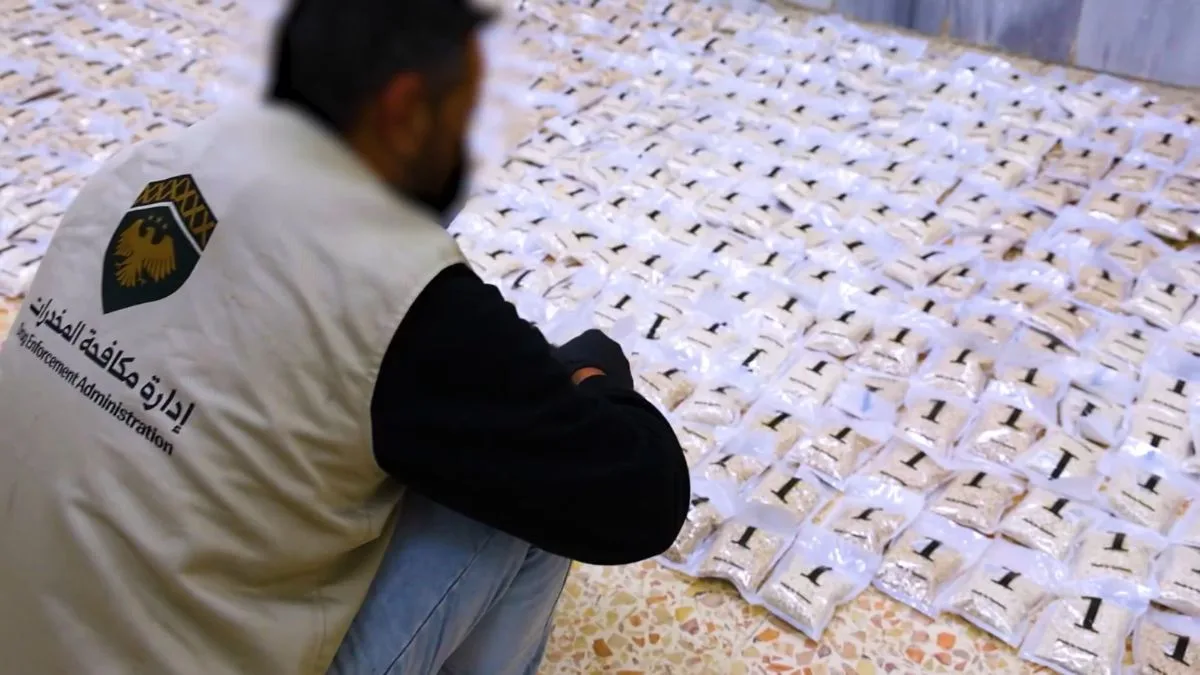
Hardly a week passes without the Syrian Interior Ministry announcing a security operation targeting drug smuggling networks, which occupy a large share of the country’s security forces’ efforts. The latest announced operation was on Wednesday, May 6, when it resulted in the seizure of a warehouse containing huge quantities of precursor chemicals used in the manufacture of narcotic substances in the Damascus countryside, during a security operation by the Anti-Narcotics Directorate.
It was preceded by a series of security operations in the Damascus countryside. On May 2, they resulted in dismantling an international smuggling link, uncovering secret manufacturing sites, and striking local trafficking hubs. The Anti-Narcotics Directorate was able to dismantle an international smuggling network active in the border area of Rankous, according to the statement.
View this post on Instagram
Perhaps the most prominent recent development in confronting drug traffickers came in the south of the country on the evening of Saturday, May 3, when Jordanian warplanes launched a series of airstrikes targeting the countryside of Sweida province. The strikes hit the home of a drug dealer in the town of Malah, the village of Busan in the eastern countryside, two strikes in the city of Shahba, in addition to a strike near the village of Imtan, and one strike each in the village of al-Kafr, the town of Arman, and the village of al-Anat, according to local sources.
This shelling and pursuit are nothing new for the Jordanian army—whose overriding concern has become the drug gangs in southern Syria—because this remains the most prominent threat that did not disappear with the fall of the Assad regime. The Jordanian Armed Forces had announced responsibility for carrying out the “Jordanian Deterrence Operation” targeting a number of sites belonging to arms and drug traffickers along the kingdom’s northern border front.
The Jordanian forces said in an official statement that, based on intelligence and operational information, the armed forces had identified the locations of factories, workshops, and warehouses used by those groups as launch points for their operations toward Jordanian territory, and these were targeted and destroyed. The Jordanian army added that it carried out the strikes with the highest degree of precision to prevent drugs and weapons from reaching Jordanian territory.
No official comment was issued by the Syrian authorities regarding the Jordanian operation, and it appears to have been silent coordination between the two sides given the sensitivity of the situation in Sweida, which is controlled by the “National Guard” militias affiliated with Hikmat al-Hijri. It is worth noting that Syria and Jordan formed a joint security committee in January 2025 to work on dismantling smuggling networks still active in southern Syria, especially in Sweida, which has turned into a narcotics hotspot, according to an investigation by Forbidden Stories.
The Jordanian Armed Forces had announced that the army thwarted three smuggling attempts involving a large quantity of narcotic substances using balloons on May 9, the first smuggling operation after the Jordanian strikes that hit Sweida on the 3rd of the same month, illustrating the scale and continued activity of drug gangs operating from militia-controlled areas in Sweida.
Syrian-Iraqi Coordination in the East
With the fading influence of militias affiliated with Iran’s Revolutionary Guard in Deir Ezzor province in eastern Syria, drug smuggling operations that had been highly active through the Al-Bukamal/Al-Qaim crossing appear to have stopped, as Iran’s proxies had controlled the crossing from both directions.
Syrian security forces had carried out there a series of security operations targeting several networks of drug and arms dealers and traffickers in Al-Bukamal in May 2025. Those operations succeeded in curbing the phenomenon that had been rampant while militias controlled the area. Deir Ezzor was considered the militias’ de facto capital in the country and was a vital corridor for moving drugs toward Iraq and from there to the Gulf states. Today, the most prominent smuggling route runs from the Damascus countryside and then through the Syrian desert to the Iraqi border.
On April 27, the Syrian Interior Ministry mourned one of its anti-narcotics personnel in Deir Ezzor, who was killed during a security operation in which a dealer was arrested with large quantities of drugs in the city of al-Mayadin east of Deir Ezzor. It is worth noting here that Deir Ezzor province witnessed in the final third of last April a series of security operations targeting drug dealers and traffickers in the province.
A Syrian security source from the Anti-Narcotics Directorate told Noon Post that “drug smuggling operations toward Iraq have declined very sharply during the current year 2026, due to the major efforts exerted by the security forces and the extensive coordination with the Iraqi side.”
The source added that “smuggling networks have begun resorting to transporting drugs from central Syria, including Homs and the Damascus countryside, through the Syrian desert, from where smuggling operations are carried out using small aircraft (drones) and balloons launched from remote desert areas toward Iraq. However, coordination with Iraq has greatly helped curb these breaches, in addition to the strict measures adopted by Syrian security forces in the area to prevent any smuggling operations.”
Even so, this front in particular still requires greater focus, since Iraqi militias linked to Iran are deployed on the Iraqi side of the border, and they were specifically involved in the drug smuggling operations run by the ousted Assad regime. On April 26, the Syrian Interior Ministry announced the foiling of an attempt to smuggle huge shipments of narcotic substances through a series of specialized operations carried out in the Damascus countryside and Homs provinces, targeting the dismantling of an international smuggling network with regional reach, in coordination with the General Directorate for Narcotic Drugs and Psychotropic Substances Affairs in the Republic of Iraq, according to the statement.
Today, Syria’s new authorities are trying to erase the catastrophic legacy left by Bashar al-Assad’s regime, which turned Syria into the world’s leading capital of Captagon and narcotics over the past decade, without exaggeration. For that reason, intensive efforts continue to combat the manufacture and trade of drugs in the country and dismantle smuggling networks that threaten neighboring states.
Through this effort, Syria aims to establish security and stability at home, and also to turn itself into a country with zero problems in the hope of attracting investment and supporting the wheel of development.
Yet the challenges along this path are significant: Sweida still remains outside the state’s orbit and is ruled by separatist militias that have no source of funding other than the drug trade, posing a major threat to Syria and Jordan, and beyond them the Gulf Arab states the “target market.”
At the same time, Iran’s arms are also still trying to reorganize and reposition themselves within the new reality taking shape in post-Assad Syria. These groups have a long history in drug production and trafficking and maintain deep lines of communication in Iraq and Lebanon.
Still, the course of operations carried out by Syria’s Anti-Narcotics Directorate is genuinely encouraging and reflects serious intent in dealing with this difficult and troubling file. A delegation from the Syrian Interior Ministry participated in the Third Baghdad Conference on Combating Drugs, held in December 2025, which aimed to coordinate in the field of combating drugs, explore ways to strengthen international and regional cooperation against drug trafficking, protect society from its dangerous effects, and exchange expertise and practical strategies among participating countries.