




NoonPost NoonPost

NoonPost

  • Politics
  • Economy
  • Society
  • Culture
  • In Depth
  • Focus
  • Explainers
  • Stories
AR
Notification Show More
نون بوست
The leadership battle: How the Turkish Republican People’s Party crisis escalated
العراق يسعى لأن يصبح جزءا من حركة الإنترنت العابرة بين الخليج وتركيا وأوروبا
From oil to data: How Iraq could become an internet corridor between the Gulf and Türkiye
نون بوست
From the “people’s army” to the “army of God”: the full story of the religiousization of Israel’s occupation army
وجود قيادتين في حزب الشعب الجمهوري خلق مشهدًا معقدًا
After the court ruling, who is running Türkiye’s Republican People’s Party?
نون بوست
“The heavy price Syrians paid will unite them”: An interview with Dr. Radwan Ziadeh
ميناء اللاذقية يستطيع استقبال الحاويات فقط أما نقلها إلى الداخل فيحتاج إلى شبكة أخرى
The route for goods from Latakia: Can Syria reconnect its sea to its inland?
نون بوست
After the Hasakah and Kobani elections, how far has the formation of Syria’s parliament progressed?
شاشة حاسوب تعرض سجلاً لجثة مجهولة الهوية في قاعدة بيانات الأشخاص المفقودين في مستشفى الناو في أم درمان، 18 أبريل 2026 (AP)
Graves without names: How many people are missing in Sudan’s war?
نون بوست
Asian partnerships and alternative corridors: Abu Dhabi’s strategy to escape the Gulf umbrella
نون بوست
How Is Turkish Military Technology Redrawing the Balance of Power in North Africa?
"أراد" هي وحدة "تدخل" مستحدثة في سلاح الجو التابع لجيش الاحتلال
“Arad”.. Why Did the Occupation Create an All-Female Force to Protect Its Air Bases?
عاد قطار الخليج إلى الواجهة بعد الإعلان عن إنجاز 50 ٪ من المشروع
A Revolution on Iron Rails: The Gulf Railway from the 2009 Dream to the 2030 Race
NoonPost NoonPost
AR
Notification Show More
نون بوست
The leadership battle: How the Turkish Republican People’s Party crisis escalated
العراق يسعى لأن يصبح جزءا من حركة الإنترنت العابرة بين الخليج وتركيا وأوروبا
From oil to data: How Iraq could become an internet corridor between the Gulf and Türkiye
نون بوست
From the “people’s army” to the “army of God”: the full story of the religiousization of Israel’s occupation army
وجود قيادتين في حزب الشعب الجمهوري خلق مشهدًا معقدًا
After the court ruling, who is running Türkiye’s Republican People’s Party?
نون بوست
“The heavy price Syrians paid will unite them”: An interview with Dr. Radwan Ziadeh
ميناء اللاذقية يستطيع استقبال الحاويات فقط أما نقلها إلى الداخل فيحتاج إلى شبكة أخرى
The route for goods from Latakia: Can Syria reconnect its sea to its inland?
نون بوست
After the Hasakah and Kobani elections, how far has the formation of Syria’s parliament progressed?
شاشة حاسوب تعرض سجلاً لجثة مجهولة الهوية في قاعدة بيانات الأشخاص المفقودين في مستشفى الناو في أم درمان، 18 أبريل 2026 (AP)
Graves without names: How many people are missing in Sudan’s war?
نون بوست
Asian partnerships and alternative corridors: Abu Dhabi’s strategy to escape the Gulf umbrella
نون بوست
How Is Turkish Military Technology Redrawing the Balance of Power in North Africa?
"أراد" هي وحدة "تدخل" مستحدثة في سلاح الجو التابع لجيش الاحتلال
“Arad”.. Why Did the Occupation Create an All-Female Force to Protect Its Air Bases?
عاد قطار الخليج إلى الواجهة بعد الإعلان عن إنجاز 50 ٪ من المشروع
A Revolution on Iron Rails: The Gulf Railway from the 2009 Dream to the 2030 Race
  • Politics
  • Economy
  • Society
  • Culture
  • In Depth
  • Focus
  • Explainers
  • Stories
Follow US

The Gulf after the Iran war and the rise of the Emirati-Israeli axis

محمد مصطفى جامع
Mohamed Gamie Published 26 May ,2026
Share
نون بوست

من اليسار إلى اليمين، رئيس وزراء الاحتلال الإسرائيلي بنيامين نتنياهو، ووزير الخارجية الإماراتي عبد الله بن زايد آل نهيان، ووزير الخارجية البحريني عبد اللطيف بن راشد الزياني، خلال توقيع اتفاقيات أبراهام عام 2020. الصورة: أليكس وونغ.

When the UAE signed the Abraham Accords in September 2020, it presented its relationship with Israel as an economic and technological path that would serve the diversification of the Emirati economy and strengthen investment, innovation, and tourism. But five years after the signing were enough to reveal deeper layers, as Abu Dhabi gradually shifted from a diplomatic partner into an advanced military pillar within the Israeli-American regional order. 

The deep transformation began in cybersecurity and intelligence, as reports indicate the existence of a joint intelligence platform called “Crystal Ball,” an advanced digital platform for exchanging intelligence and cyber information. It was launched as a joint project between the UAE and Israel and was dedicated to monitoring cyber threats and sharing information simultaneously between the two security apparatuses.

This was followed by a rapid expansion in defense industries. In January 2025, EDGE Group, the UAE’s state-owned defense arm in Abu Dhabi, acquired a 30% stake in Thirdeye Systems, an Israeli defense technology company specializing in the development of AI-supported optical and electronic recognition systems for detecting drones, with a commitment to inject additional investments to establish a joint venture. 

In December 2025, it was revealed that the UAE had been the secret buyer in a $2.3 billion deal with Elbit Systems, considered Israel’s largest private manufacturer of weapons and military equipment. The deal included Hermes 900 drones, along with a gradual transfer of technology that opens the door to local Emirati production of this system through one of EDGE’s companies.

The deal centers on equipping Emirati civilian and military aircraft with the advanced electronic protection system J-Music, which relies on active laser beams to disable the sensors of surface-to-air missiles. The UAE imposed strict conditions barring disclosure of the deal’s details, warning that any leak could lead to its cancellation, in order to avoid political embarrassment and protect its qualitative military edge.

This shift from importer to producer marks a qualitative change in the nature of the partnership and reflects Abu Dhabi’s ambition to transform itself into a regional defense manufacturing hub, supported by parallel partnerships with US companies such as Anduril Industries, a leader in defense technology, military AI, and autonomous systems development, in addition to the public presence of Israeli arms companies such as “Israel” Aerospace Industries and Rafael at the IDEX and NAVDEX exhibitions in Abu Dhabi since 2023 — an official acknowledgment of a partnership that until very recently had been taboo in the Arab sphere.

Iran war 

What had been moving slowly and without fanfare was transformed by the February 2026 war into an open and accelerated track. On the 28th of that month, the United States and “Israel” launched wide-ranging strikes on Iran, which responded with the largest campaign of its kind against the Arab Gulf states. According to the UAE Ministry of Defense, air defenses dealt with more than 294 ballistic missiles, 15 cruise missiles, and 1,600 drones.

In this context, UAE President Mohammed bin Zayed asked Israeli Prime Minister Benjamin Netanyahu to deploy Israeli air defense systems on Emirati soil. In April 2026, Israel deployed Iron Dome batteries inside the UAE, accompanied by dozens of Israeli occupation army soldiers to operate them, according to reports published by the Financial Times and Axios, before US Ambassador Mike Huckabee announced it publicly on May 12.
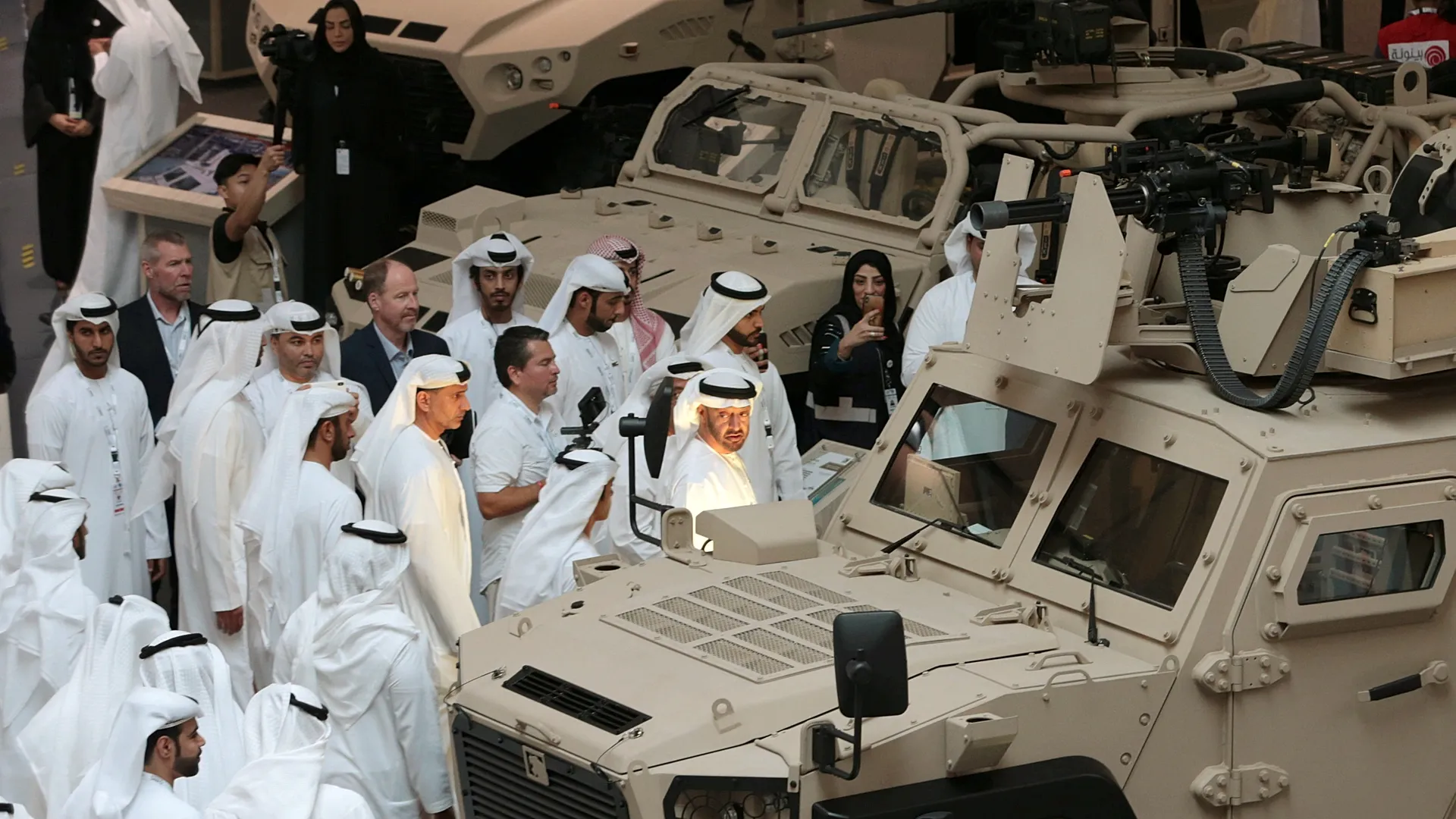
نون بوست
Archival photo of Abu Dhabi Crown Prince Mohammed bin Zayed Al Nahyan attending the International Defence Exhibition and Conference (IDEX) in Abu Dhabi, United Arab Emirates, Feb. 17, 2019. Reuters/Christopher Pike.

It was also revealed that Israel urgently deployed the Iron Beam laser system, alongside direct intelligence-sharing on Iranian launch preparations, with Israeli crews themselves intercepting dozens of missiles headed toward the UAE.

The most telling step came on May 19, 2026, when the British outlet Middle East Eye revealed the creation of a joint Emirati-Israeli fund to acquire and develop weapons systems, based on an equation described by a US official as: “Israel has the technology, and the UAE has the money,” noting that Emirati defense spending for 2026 was estimated at about $27 billion.

The US source said the UAE may also finance technological upgrades to Israeli air defense systems, confirming that the agreement was concluded during Israeli Prime Minister Benjamin Netanyahu’s visit to the UAE during the US-Israeli war on Iran. Netanyahu’s office issued an official statement regarding the visit, prompting a rare denial from Abu Dhabi.

Yoel Guzansky, a senior fellow at the Institute for National Security Studies in Tel Aviv who specializes in Gulf affairs, described the level of relations between the two sides by telling Middle East Eye: “The relationship between the UAE and Israel is the best ever, and this is the closest cooperation Israel has had with an Arab state.”

In a notable article published by the UAE ambassador in Washington, Yousef Al Otaiba, in the newspaper The Wall Street Journal under the headline “The UAE stands up to Iran,” the Emirati discourse shifted from reservation to clear engagement with the war’s objectives, alongside Israel and the United States.

Gulf concern

The Gulf position toward this Emirati shift is not unified, but it carries a shared degree of concern over Abu Dhabi’s transformation into an advanced gateway for the Israeli-American axis within the Gulf order.

Riyadh, for example, is seeking a delicate equation that combines deterrence toward Iran, insulating itself from reckless American adventures, and curbing growing Israeli influence in the Gulf through the UAE. According to analyses published by Lawfare, Saudi Arabia is continuing its partnership with Washington while at the same time deepening its military ties with Turkey and Pakistan and laying the groundwork for a broader geopolitical alliance that includes Jordan, Egypt, and Qatar.

Crown Prince Mohammed bin Salman also described what Israel committed in Gaza as genocide, a characterization Abu Dhabi has not adopted amid its growing partnership with the occupation state.

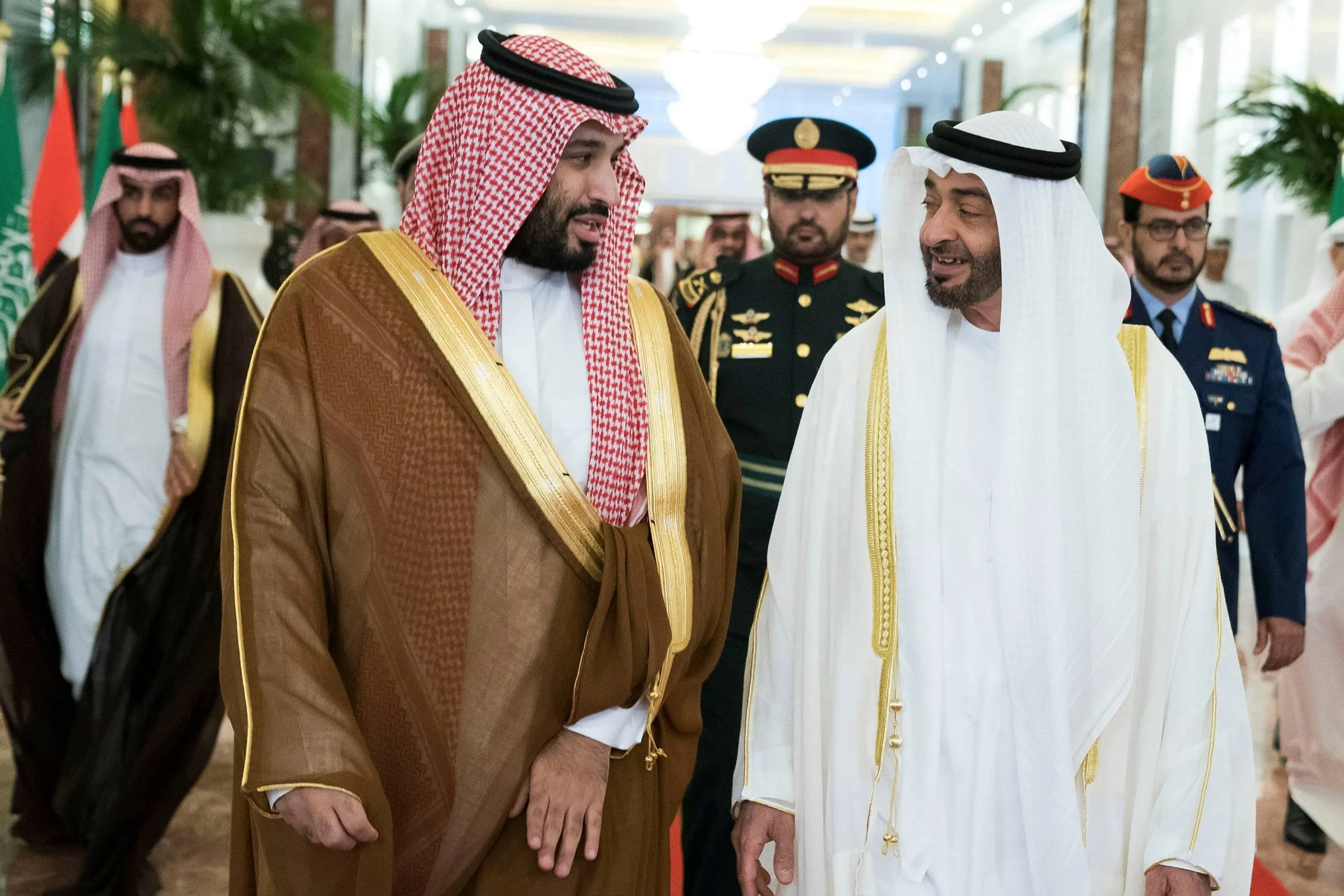
نون بوست
Abu Dhabi Crown Prince Sheikh Mohammed bin Zayed Al Nahyan welcomes Saudi Crown Prince Mohammed bin Salman at the presidential airport in Abu Dhabi, United Arab Emirates, Nov. 27, 2019. Emirates News Agency/handout via Reuters.

Doha, meanwhile, carries a vivid memory of the Israeli strike that targeted Hamas leaders on its soil in August 2025, which proved that its status as a mediator did not shield it from being targeted. It therefore called for a collective Gulf response, convened an Arab-Islamic summit after the incident, and strengthened its solidarity with its neighbors after Israeli attacks violated its sovereignty. It views with caution any deep security normalization that could fragment the Gulf’s collective security card.

Kuwait, for its part, has adopted a more reserved stance, as it still adheres to the traditional Arab position on the Palestinian issue. Kuwaiti public opinion, together with the legacy of parliamentary life, also imposes pressures that make any normalization politically costly. At the same time, Kuwait views with concern the possibility that Abu Dhabi’s involvement could push Tehran to widen the circle of deterrence toward all Gulf states, stripping it of the margin of neutrality it has long maintained.

By contrast, Muscat maintains its traditional role as a mediator and balanced relations with Tehran that stretch back decades. It sees Abu Dhabi’s integration into the Israeli-American order as threatening the diplomatic space it has long been keen to preserve and making it more difficult for it to play the role of mediator in the future.

Bahrain, meanwhile, appears the most aligned with the Emirati direction, having participated in multilateral naval exercises in the Red Sea led by the US Fifth Fleet and with direct Israeli participation in November 2021. Even so, Manama keeps its bilateral military cooperation low-key to avoid inflaming rising domestic public anger.

The Iranian view: Abu Dhabi is an advanced link in the deterrence system 

Tehran views the Emirati shift as a direct threat to its national security, not merely a sovereign choice. Since the war began, notable statements have been issued by Iranian officials, most prominently at the political level the accusation by Iranian Foreign Minister Abbas Araghchi during the BRICS summit in India on May 14 that the UAE had directly participated in military operations against his country.

Iranian state media quoted him as saying that Tehran had not previously mentioned the UAE “out of concern for unity,” but that it considers Abu Dhabi to have directly participated in the aggression against Iran. 

He added, according to Iran’s Tasnim: “They did not even condemn the brutal attack on the school on the first day of the aggression, the attack in which more than 170 innocent pupils were killed. In addition, the UAE did not condemn the aggression itself, and later actively participated in this aggressive act by providing military bases, airspace, territory, and facilities to America and Israel.”

He pointed out that the Emiratis had provided all kinds of intelligence and other facilities to the Israelis and Americans to launch attacks on the Iranian people. He also said: “I do not think our brothers in the UAE expected that when America and Israel attack us and the UAE supports them, we would simply remain silent.”

For all these reasons, Iran today classifies the UAE as an advanced link in the Israeli-American deterrence system: for hosting Israeli air defense systems and military crews on its territory during the war, for deep intelligence cooperation, and for transferring weapons technology to Emirati soil through joint production deals, in addition to the UAE’s use of its financial resources to fund the development of Israeli systems — making it a partner in shaping Israeli armament decisions in the future. 

On May 4, 2026, after aspects of the military rapprochement were announced, Iran sent signals to ships docked in Emirati ports to leave, in what was read as a symbolic escalatory move. At the same time, however, Tehran presents a dual discourse regarding Abu Dhabi, portraying it as the “weakest link” in the Gulf wall and the most vulnerable to any escalation, while diplomatically leaving the door open to cooling the relationship, mindful of the economic connection, as Dubai remains a vital platform for Iranian dealings with the world.

Constraints and obstacles 

Despite the accelerating pace of the Emirati-Israeli partnership, it still faces several objective constraints. The first is muted internal division: the UAE is made up of seven hereditary-ruled emirates, while the Al Nahyan branch in Abu Dhabi, led by Mohammed bin Zayed, dominates foreign and defense decision-making. Analytical reports and circulating leaks reveal sharp and unprecedented differences within the Supreme Council of the Union over the scope of authority and military cover granted to Israel.

While Abu Dhabi and Dubai represent the main engine of this partnership — with Abu Dhabi focused on defense, security, and strategic gains, and Dubai viewing the relationship through the lens of commercial, investment, and technological interests, especially in artificial intelligence and cybersecurity — reports indicate apprehension and resistance among the rulers of the “northern emirates,” especially the emirate of Sharjah, toward Abu Dhabi’s headlong policies.

The elites and rulers of those emirates see full alignment with Israel as threatening internal social stability and provoking the anger of popular constituencies that support Palestinian rights and reject normalization.

The second factor lies in geographic proximity: only short maritime distances separate the UAE from Iran, placing Emirati infrastructure — from Dubai’s skyscrapers to Abu Dhabi’s ports and oil facilities — within the direct range of Iran’s arsenal. The 2026 war proved that interception systems, despite their efficiency, did not prevent damage at a number of sites.

The third factor is the continued pressure of Arab and Muslim public opinion, especially in light of the war on Gaza, which has forced Abu Dhabi on more than one occasion to summon the Israeli ambassador in order to preserve a minimum level of regional legitimacy. The fourth factor concerns balancing against the Saudi role, as Riyadh, by virtue of its size and political weight, will not accept the UAE becoming a lone gateway that claims to represent the entire Gulf.

The fifth factor lies in the limits of American commitment. The article by Ambassador Yousef Al Otaiba, mentioned earlier, called for decisiveness rather than merely a ceasefire, in a clear expression of Emirati concern that Washington might retreat or hesitate to engage in a long and costly confrontation.

In light of these factors, three possible scenarios loom before the UAE. The first is to turn the partnership with “Israel” into a formal alliance, along the lines of the “Abraham Defense Cooperation” initiative introduced in the US Senate in March 2026. The second is to continue the partnership while lowering the level of public visibility, in order to avoid criticism from neighboring states and the Arab and Muslim surroundings. The third scenario is a partial retreat from this partnership if a regional settlement between Iran and its rivals succeeds.

The second path appears the most likely, as seen in Abu Dhabi’s attempt to deny the occupation prime minister’s visit during the war after a post issued by his office put it in severe embarrassment, prompting it to disable comments on the UAE Foreign Ministry’s page on X.

In sum, what is happening does not appear to be merely a development in bilateral relations between Abu Dhabi and “Tel Aviv”, but rather a pivotal moment redrawing the maps of regional security. By moving from a partner in the Abraham Accords to an advanced military pillar, the UAE is posing existential questions to the entire Gulf about how Gulf security is defined, and who has the right to formulate it and set its priorities today.

Accordingly, the UAE’s ability to balance the expected technological superiority derived from its partnership with “Israel” against its geographic and political obligations toward its Gulf and Iranian surroundings will remain the decisive factor in the sustainability of this new defense model within a highly turbulent and volatile regional environment.

TAGGED: Arab Normalization with Israel ، Normalization with Israel
TAGGED: Arab Normalization with Israel ، Normalization with Israel ، The Israeli Occupation ، UAE Affairs
Download this article as PDF
Share this Article
Facebook Twitter Whatsapp Whatsapp Telegram Email Copy Link
محمد مصطفى جامع
By Mohamed Gamie Sudanese Writer Interested in African Affairs
Sudanese writer interested in African affairs
Previous Article نون بوست The leadership battle: How the Turkish Republican People’s Party crisis escalated

Read More

  • The leadership battle: How the Turkish Republican People’s Party crisis escalated The leadership battle: How the Turkish Republican People’s Party crisis escalated
  • From oil to data: How Iraq could become an internet corridor between the Gulf and Türkiye
  • From the "people’s army" to the "army of God": the full story of the religiousization of Israel’s occupation army
  • After the court ruling, who is running Türkiye’s Republican People’s Party?
  • "The heavy price Syrians paid will unite them": An interview with Dr. Radwan Ziadeh
part of the design
NoonPost Weekly Newsletter

You May Also Like

“Arad”.. Why Did the Occupation Create an All-Female Force to Protect Its Air Bases?

“Arad”.. Why Did the Occupation Create an All-Female Force to Protect Its Air Bases?

نون إنسايت Noon Insight 22 May ,2026
NoonPost

An independent media platform founded in 2013, rooted in slow journalism, producing in-depth reports, analysis, and multimedia content to offer deeper perspectives on the news, led by a diverse young team from several Arab countries.

  • Politics
  • Society
  • Economy
  • Culture
  • Interviews
  • In Depth
  • Explainers
  • Stories
  • Profiles
  • Focus
  • Latest Reports
  • Long Reads
  • Interviews
  • Interactive
  • About Us
  • Our Writers
  • Write for Us
  • Editorial Policy
  • Advanced Search
Some rights reserved under a Creative Commons license

Removed from favorites

Undo
Go to mobile version