






هذا التقرير متاح أيضًا بـ العربية
On Aug. 30, 2025, Mohamed Hamdan Dagalo, known as Hemedti, stood in Nyala to take the oath of office as head of a 15-member presidential council claiming to govern Sudan. More than three years after the war broke out, another battle has begun to take shape alongside the fighting on the ground: the battle to build authority itself. At the heart of that battle, the Rapid Support Forces militia is moving beyond the logic of a conventional militia and toward an attempt to create fully fledged governing institutions in the areas under its control.
Over recent months, the RSF has begun speaking of a government, a presidential council, a transitional constitution, a security and defense council, foreign relations, and a political program — terms usually associated with states, not armed groups. In July 2025, the forces allied with it, known as the “Ta’sis” alliance, announced the formation of what it called the “Government of Peace and Unity.”
These steps cannot be read merely as a propaganda campaign or an attempt to improve the RSF’s political image. The institutions being announced are gradually accumulating within a broader vision aimed at transforming military control into stable political and administrative authority, especially after the prospect of a comprehensive military victory across all of Sudan faltered.
Why is the RSF no longer content with military control alone?
In the early stages of the war, the RSF appeared to be acting as a force seeking to seize the central state itself. The major battles in and around Khartoum reflected a wager on subduing state institutions or imposing a settlement that would make military power the basis of rule. But the course of the war gradually shifted as the fronts expanded and military attrition continued.
The turning point came when the Sudanese army regained control of Khartoum state in May 2025, prompting the RSF to consolidate its influence in Kordofan and Darfur while simultaneously launching its parallel political project.
Over time, military control alone became insufficient. A militia may be able to seize territory, but it cannot govern millions of people or gain lasting political legitimacy through military means alone. That created a need to build institutions capable of managing resources, services, borders, and foreign relations, even if only on a limited scale.
This pattern is not new. In many cases, armed movements that failed to decisively win wars in their favor turned instead to building parallel governing structures in the areas they controlled. This happened to varying degrees in South Sudan before secession, in Yemen with the Houthis, and in eastern Libya with the parallel institutions that emerged under the authority of Khalifa Haftar’s forces.
For the RSF, the step of signing the “founding charter” in Nairobi in February 2025 marked a clear political turning point. The discourse shifted from the framework of a military alliance to a declared authority project bringing together political and civilian forces and armed movements, along with an announced intention to establish a parallel government in the areas under its control.

The matter did not stop at the political charter. In February 2026, the Ta’sis alliance announced the approval of the parallel government’s program and budget, along with the completion of internal bylaws, the formation of specialized committees, and preparations for foreign relations and executive administration policies. These are steps that reflect an attempt to move from the stage of political declaration to that of actual institutional construction.
As a result, the RSF militia has begun acting as a political actor seeking to entrench a new reality on the ground, so that any future settlement will be forced to deal with its institutions as part of the existing political landscape.
There is another motive that is no less important. According to some estimates, the “Ta’sis” alliance wanted to facilitate arms import operations by giving the project political cover that would allow external backers to deal with it in a more formal framework. In other words, the parallel state project is not merely an attempt to govern; it also serves a logistical and political function that supports the continuity of the military project itself.
What does establishing a security and defense council in RSF-controlled areas mean?
On June 1, 2026, Mohamed Hamdan Dagalo, known as Hemedti, announced the formation of a Security and Defense Council within the structures of the “Ta’sis” government. From the outset, it was tasked with drafting strategic security and defense policies and overseeing the project of creating a new army, making it closer to a supreme sovereign institution than to a temporary committee or a limited executive body. According to the statement issued by the parallel “Ta’sis” government, the council will prepare for a “new national army.”
In contemporary political practice, a security and defense council serves as a coordinating body between military and security institutions, while also standing as one of the clearest symbols of sovereignty within a state. In most countries, such a council sets defense policy, makes decisions related to war and peace, and oversees top military and security institutions. Establishing a similar council within a parallel authority therefore means, in practical terms, moving from administering zones of military influence to attempting to build a governing system that possesses the basic tools of sovereignty.
This step takes on added significance when placed within the series of measures taken by the “Ta’sis” authority over recent months. Since the parallel government was announced in July 2025, the project has not stopped at forming a presidential council and an executive government, but has extended to the creation of gradually expanding legislative, administrative, and judicial structures.
In April 2026, a Council of Regions was announced as an oversight and representative body for the eight regions stipulated in the transitional constitution approved by the alliance. It later held its first session in Nyala as part of a process aimed at entrenching permanent institutions and expanding the administrative structure of the parallel authority.
In parallel, the alliance announced the formation of a judicial council tasked with overseeing the appointment of the chief justice and attorney general and completing the structures of the judiciary and the constitutional court. The decision came within an integrated vision aimed at creating executive, legislative, and judicial authorities operating outside the framework of the existing Sudanese state.
The new authority in Nyala has also begun taking economic and administrative steps no less important than the political institutions. In January 2026, information emerged about moves to establish a central bank and a parallel banking system in RSF-controlled areas, a step directly tied to efforts to manage resources and financing independently of the institutions in Khartoum.
In an attempt to assert its monetary independence from the Sudanese government, the Darfur 24 website, citing traders and local residents, reported that the parallel “Ta’sis government” had injected a new money supply into the markets of Nyala and other RSF-controlled areas through Al-Mustaqbal Banking and Financial Services Company.
These banknotes bear the signature of former Bank of Sudan governor Mohamed al-Fatih Zain al-Abidin (Jangoul), whom the parallel government appointed as governor of its own Bank of Sudan, after the RSF decided to ban the circulation in its areas of banknotes issued after June 2024 and signed by the current Bank of Sudan governor, Baraa al-Siddiq.
For that reason, the Security and Defense Council cannot be seen as merely an administrative detail within the “Ta’sis” project. The council comes as part of a gradual path toward building parallel governing institutions, beginning with the presidential council and government, passing through judicial and legislative councils and the financial sector, and culminating in the new military institution.
Who does Hemedti want to bring into the new army?
When the Security and Defense Council of the “Ta’sis” alliance announced that one of its first tasks would be overseeing the construction of a “new national army,” it was making an unmistakably political declaration. Armies are not built on fighters and weapons alone; they also rest on the alliances, loyalties, and political identity behind them.
According to the statements issued by the “Ta’sis” alliance, the initial core of this army will consist of the RSF, along with the Sudan People’s Liberation Movement-North led by Abdel Aziz al-Hilu, and the armed movements within the new political-military alliance. This reflects a clear attempt to move beyond the traditional image of the RSF as a force tied to specific tribes or regions and turn it into a broader military umbrella bringing together multiple forces under a single central command.
But from the outset, this project faces a fundamental dilemma. The forces expected to merge into the new army do not come from a single military background, nor do they rest on a shared combat doctrine. The RSF originally emerged from paramilitary formations that evolved out of the Janjaweed experience in Darfur before becoming an official force independent of the Sudanese army.
The SPLM-N led by al-Hilu, meanwhile, represents a continuation of the historic SPLM experience, which fought long wars against the central state under the banners of the “New Sudan,” secularism, and the right to self-determination. Between the two stand other armed movements that differ in their social composition, political goals, and combat experience.
The project also seeks, according to a number of observers, to absorb local groups and fighters from different conflict zones, especially in Darfur, Kordofan, and Blue Nile. Over the past three years, the current war has produced thousands of fighters involved in various local and tribal formations. Some fought alongside the RSF, while others remained neutral or acted according to purely local considerations. The new army project appears to be trying to absorb part of these forces rather than leave them outside the authority structure now being built.
The project is also betting on attracting military personnel from outside the formations that signed the charter, including former officers and soldiers or military figures opposed to the current leadership of the Sudanese army. Although there are no documented signs of large-scale defections within the Sudanese Armed Forces, the “Ta’sis” discourse is careful to present the proposed army as a national institution open to various military components, not merely a rebranding of the RSF and its allies.
This proposed composition reveals a political objective that goes beyond reorganizing the forces already fighting on the ground. Hemedti is seeking to redefine which entity has the right to represent the state militarily. From this perspective, the new army becomes a direct rival to the Sudanese Armed Forces, not an allied or auxiliary force. That is why the “Ta’sis” discourse is keen to use terms such as “national army” rather than speak of joint forces or a temporary military alliance.
Even so, building a unified army out of these disparate components remains an immensely complex challenge. African and Arab experiences over recent decades have shown that integrating armed movements and irregular forces into a single military institution does not necessarily produce a cohesive professional army. In many cases, the armies resulting from such arrangements turned into fragile alliances among competing forces that retained their old loyalties despite the existence of a shared central command.
For that reason, the battle over the new army is tied to the more important question of the kind of state the “Ta’sis” alliance wants to build. If the army is the institution that monopolizes legitimate violence within the state, then the identity of that army and its social and political composition will ultimately determine the shape of the authority Hemedti seeks to entrench in the areas under his influence and perhaps in all of Sudan if the balance of war shifts or a future political settlement produces a new reality.
Why do Nyala and Darfur represent the center of Hemedti’s project?
As the RSF alliance and its allies move from the stage of military action to that of building parallel institutions, Nyala has emerged as almost the only city with the political, military, and economic conditions needed to host this project over the long term. Militarily, Darfur today represents the largest contiguous geographic area under the influence, to varying degrees, of the RSF and its allies.
Nyala, the capital of South Darfur state, enjoys a strategic location that sets it apart from the rest of the region’s cities. It is connected to trade networks and cross-border routes with Chad, the Central African Republic, and Libya, and it contains one of the largest airports in western Sudan. Over the years of war, the city has become a major center for commercial and logistical movement within RSF-controlled areas, giving it an importance that goes beyond its traditional administrative role.

But geography alone does not explain the choice of Nyala. Darfur also represents the most important social and political depth for the RSF leadership. The force, which originally emerged in the environment of the region’s armed conflicts, still relies heavily on networks of influence and social and economic ties formed there over past decades. For the RSF leadership, Darfur therefore appears to be the region most capable of absorbing a new political project compared with other areas where central state institutions remain more present.
The region also possesses another highly important factor: its border location. Darfur borders four countries Chad, Libya, the Central African Republic, and South Sudan giving any authority that controls it broad room for commercial and logistical movement away from the ports and economic centers controlled by the government in Khartoum. Amid the ongoing war, these borders have become vital arteries for trade, the transport of goods, the movement of people, and smuggling, in addition to their well-known military importance.
The leaders of “Ta’sis” appear well aware of this advantage. Since the parallel government was announced, a large part of the political discourse has been directed toward presenting Nyala as the center for managing the institutions of the new state. The city has also hosted successive meetings of the presidential council, transitional councils, and bodies announced over recent months, in an effort to cement its image as the de facto capital of the political project now under construction.
In addition, Darfur offers a resource no less important than geography: economic wealth. The region contains vast gold-mining areas and is a major hub in the trade of livestock and cross-border goods. Although it is difficult to obtain precise figures amid the war, control over these resources gives any local authority a greater ability to finance its institutions and pay the salaries of its fighters and employees a basic element for the survival of any parallel governing project.
Even so, turning Nyala into the effective capital of a new political project is not without major challenges. The region continues to witness recurring tribal and security conflicts, and Sudanese army drones are capable of reaching most parts of Darfur and striking targets inside it, making any attempt to entrench stable governing institutions vulnerable to constant security and military pressure.
How do parallel institutions become a practical step toward the partition of Sudan?
So far, there has been no official declaration by the RSF or the “Ta’sis” alliance calling for Darfur’s secession or the partition of Sudan. The alliance’s documents and statements still speak of a unified Sudan, a new state, and refounding the country on different foundations. But the history of civil conflicts shows that political divisions begin with the construction of governing institutions separate from the central state.
A state is a set of institutions that monopolize the management of land, population, and resources. When an entity possesses an independent government, an independent army, its own security services, a separate judicial system, and its own financial administration, it effectively begins performing the functions of a state even if it does not declare itself an independent state.
That does not necessarily mean the RSF leadership has made a strategic decision to secede. There is another explanation that is no less important: These institutions may be part of a negotiating strategy aimed at raising the ceiling of political influence in any future settlement.
The more successful the alliance is in entrenching actual governing institutions on the ground, the harder it becomes to ignore it or treat it as merely an armed movement that can be disarmed and excluded from the political scene.
But the problem is that facts built for negotiating purposes can, over time, turn into independent political realities. Every new institution created outside the framework of the central state generates its own interests, elites, and economic and security networks. Over time, dismantling this structure becomes more difficult even if the parties reach a political agreement. This is what happened, to varying degrees, in many cases that saw the emergence of parallel authorities before they later turned into quasi-independent entities or separate states.
The continuation of the war over a long period also gives these institutions an additional opportunity to grow and take root. The longer the conflict lasts, the greater the need among local populations for services, administrations, courts, and security bodies to handle their daily affairs. If the parallel institutions succeed in performing some of these functions, they may acquire practical legitimacy as a matter of fact.
Even so, talk of Sudan’s partition remains premature. The RSF does not have international recognition for its parallel government, and the African Union and the United Nations still recognize the Sudanese government as the state’s official representative. Sudan’s demographic and economic makeup also makes any secession project more complicated than a mere political declaration or military control over a particular region.
So the more precise question may not be whether Sudan is heading toward partition, but whether the war is pushing the country toward a new reality in which rebuilding a unified state becomes more difficult with each passing day.
How do the UAE, Kenya, Chad, and eastern Libya affect the parallel state project?
The “Ta’sis” project cannot be understood as a purely internal Sudanese development. Just as states rely on their regional environments to consolidate authority and expand influence, emerging entities need an external space that allows them political, economic, and logistical movement. From this perspective, the story of the parallel state the RSF is trying to build appears closely tied to a network of relationships, borders, and interests extending beyond Sudan itself.
The UAE stands out at the forefront of the parties most closely linked to the controversy surrounding the Sudan war. Since the conflict erupted in April 2023, the Sudanese government has repeatedly accused Abu Dhabi of supporting the RSF militia, while multiple international reports have pointed to military and logistical support and mercenaries through complex networks for the RSF, along with gold-smuggling networks and diplomatic cover in international forums.
Regardless of the controversy surrounding military support, the UAE’s importance to the parallel state project goes beyond the direct military dimension. The RSF needs financial and commercial outlets and regional relationships that help it overcome the isolation imposed by war. In contemporary conflicts, financing and trade networks are no less important than weapons themselves, especially for an authority trying to build stable administrative and military institutions in a region cut off from the state’s traditional political center.
Politically, Kenya has played a pivotal role since it hosted the February 2025 meetings that produced the founding charter of the “Ta’sis” alliance, the agreement that marked the official starting point of the parallel government project. But the controversy over Nairobi’s role did not stop at hosting political meetings. Media reports and multiple investigations have spoken of planes registered in Kenya transporting supplies to Nyala, and Kenya has also been linked to the evacuation of wounded RSF fighters during different phases of the war.
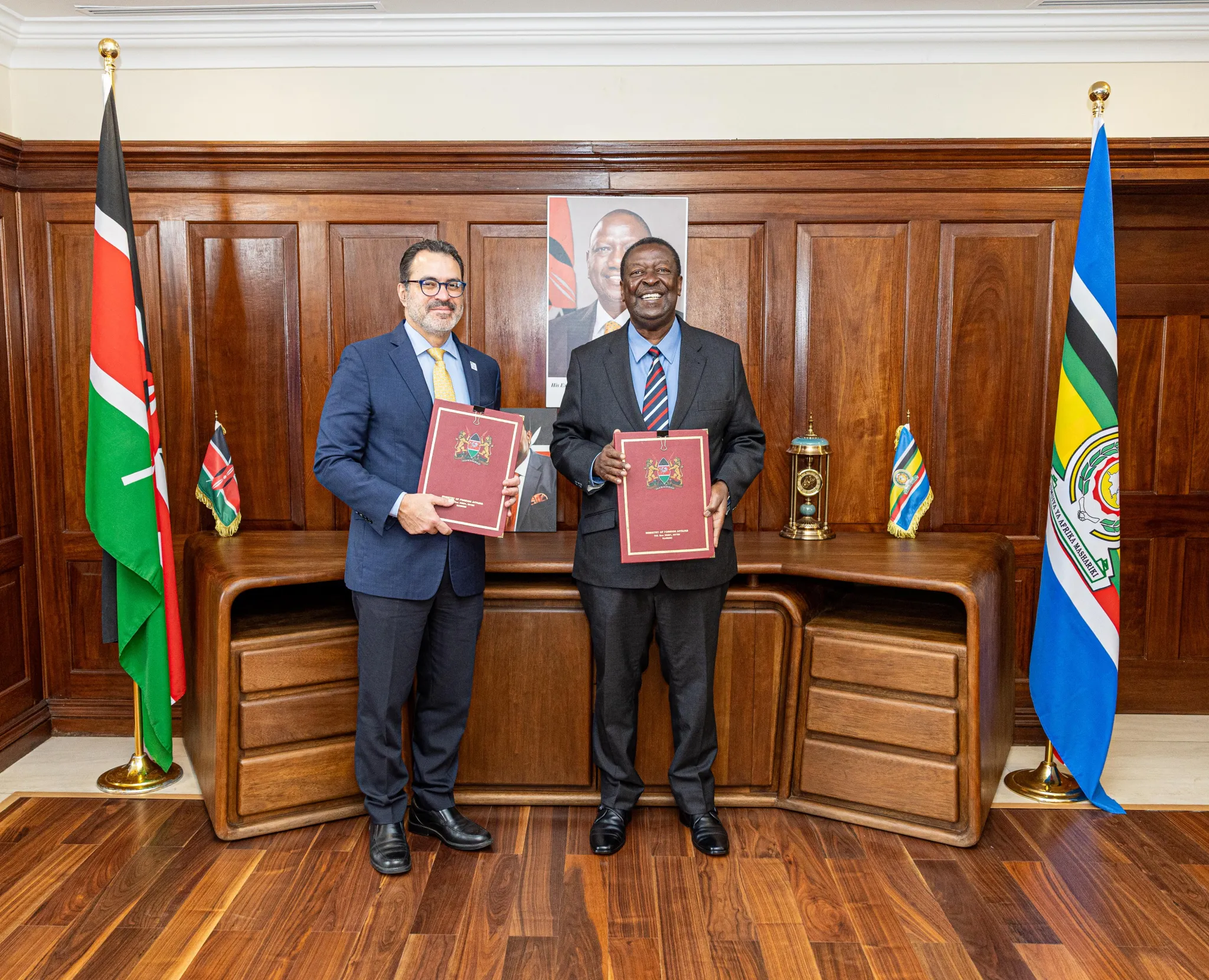
In June 2025, the Sudanese government accused Kenya of acting as a channel for supplying the RSF with weapons, which Nairobi strongly denied, insisting that its role was limited to political mediation and humanitarian efforts. The controversy intensified after the Sudanese army destroyed in May 2025 a Kenyan-registered Boeing 737 cargo plane at Nyala airport, saying it had been used to transport military supplies linked to the RSF. These developments prompted some voices in the United States to call for an investigation into the nature of relations between Kenya and the RSF, especially after Nairobi was designated a major non-NATO ally in 2024.
By contrast, Chad and eastern Libya represent the logistical dimension of the issue more than anything else. During the early years of the war, the Chadian border was one of the most important routes through which supplies entered Darfur. But intelligence reports and media leaks about military shipments and air defense systems passing through Chadian territory placed N’Djamena under growing pressure, pushing it to take greater distance from the RSF and try to avoid appearing as a direct party to the conflict.
In Chad’s case, geography appears more important than declared politics. The long border between Darfur and Chad has for decades been one of the region’s most vital arteries. During the current war, that border gained added importance because of the movement of refugees, trade, the transport of goods, and the social ties stretching between communities on both sides. At the same time, Chad cannot ignore developments in Darfur because any security or political changes there have a direct impact on its own internal stability.
Logistically, as the Chadian route declined in importance, attention shifted north to the Libyan city of Kufra in eastern Libya under the influence of Khalifa Haftar’s forces. It has gradually become an important logistical hub linking Darfur to the desert expanse stretching between Libya, Sudan, and Egypt, especially after the RSF militia took control of the border triangle.
For years, southeastern Libya has served as an important corridor for commercial and irregular movement across the Sahara. During the Sudan war, multiple reports emerged describing the use of routes and corridors stretching through southern and eastern Libya for supply movements and logistical and military activities linked to the RSF.

The issue here is not only the transport of weapons or fighters, but the nature of the geography itself. Darfur is not a closed region within Sudan’s borders, but part of a vast, interconnected desert space stretching toward Libya, Chad, and the Central African Republic. Any authority project that emerges in the region will be compelled to deal with these cross-border networks, whether it wants to or not.
In the end, the UAE, Kenya, Chad, and eastern Libya do not appear as actors separate from the story of the parallel state the RSF is trying to build. Rather, each represents a different kind of environment the project needs in order to endure: a political space that provides platforms for diplomatic movement, an economic space that helps with financing and trade, a geographic space that links Darfur to its regional surroundings, and a security space through which supplies and cross-border networks move.
In conclusion
When war broke out in Sudan in April 2023, the conflict appeared at its core to be a struggle over power within the state. But after more than three years of fighting, the most significant development produced by the war has been the emergence of a political project seeking to build full governing institutions outside the framework of the central state.
From the government and presidential council to the Security and Defense Council, and from the new army project to judicial and administrative councils, the RSF militia and its backers are now acting as a force trying to produce a parallel authority with the means to survive and endure within the space it controls.
That does not mean this project has become a fully fledged state or that it is inevitably heading toward secession. It still faces major obstacles related to international recognition, institutional capacity, and security and economic challenges, in addition to the continuation of the war itself and the possibility that the Sudanese army could expand its control in Kordofan and Darfur. But what is certain is that the mere start of building these institutions changes the nature of the conflict and reshapes the questions being asked about Sudan’s future.
For that reason, perhaps the most important question is not whether the RSF will succeed in building its parallel state, but whether Sudan will be able to recover the idea of a single state before the divisions produced by the war harden into a permanent political reality.