









هذا التقرير متاح أيضًا بـ العربية
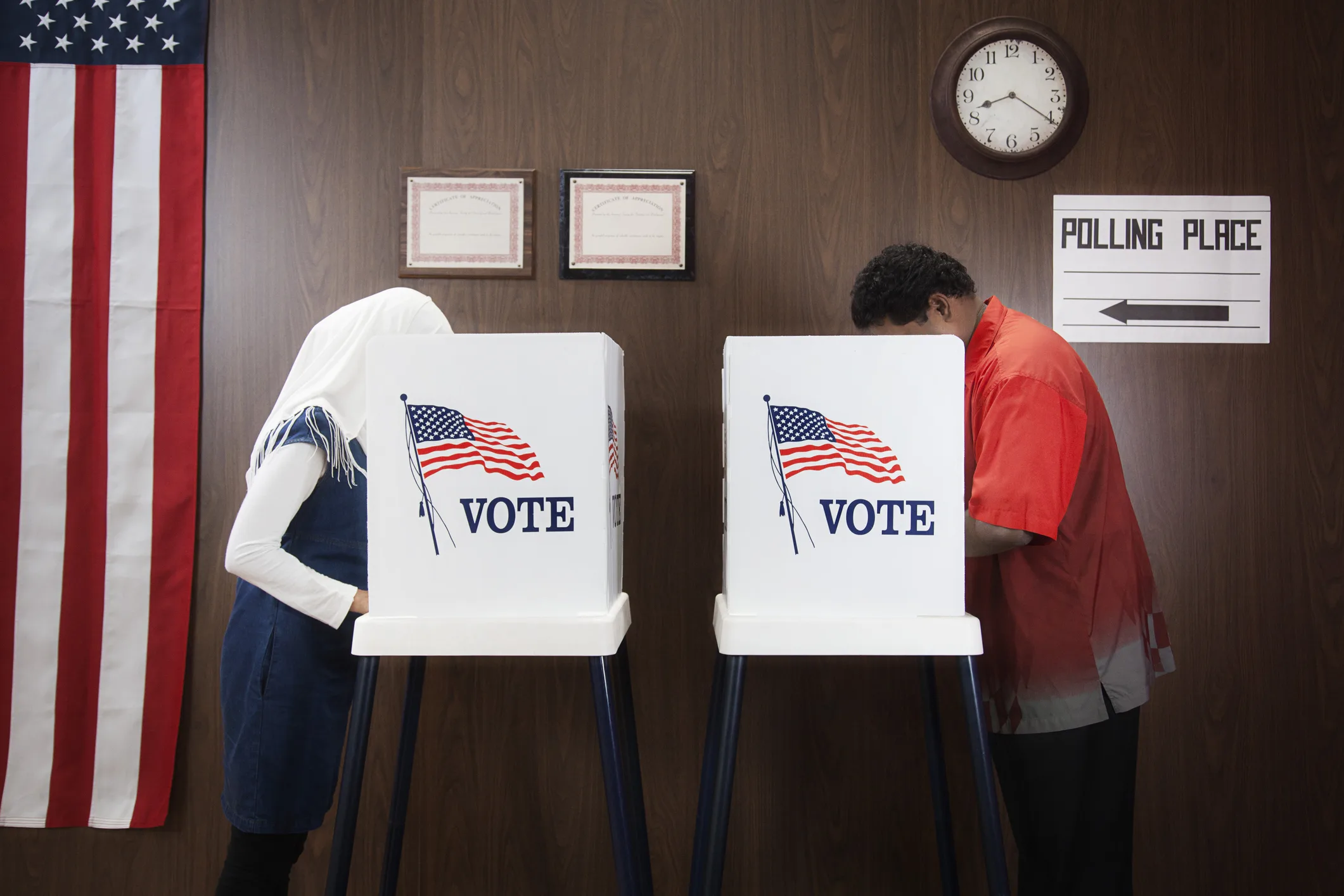
The current US primary elections are witnessing broad participation from the Arab and Muslim communities, marking a notable shift from the political insularity and isolation the two communities lived in a decade ago. This visible participation comes ahead of the midterm elections scheduled for next November, at the federal, state and local levels, to fill seats in the Senate and House of Representatives, gubernatorial posts in the states, as well as a range of multilevel administrative positions in US cities and counties, amid major challenges created by the Trump administration’s Islamophobic and anti-immigrant policies, alongside the wars raging in the Middle East.
The significance of this participation lies not only in its scale, but also in the nature of the political discourse carried by Arab and Muslim candidates, and in their effort to move from being affected by US policies to influencing them, drawing on the growth of both communities and their expanding organizational and electoral presence in recent years.
So what is the overall atmosphere surrounding Arab and Muslim participation in the US primary elections? What are the main slogans of their campaigns? Which names have stood out in the race? How are AIPAC and pro-Israel lobbying groups trying to obstruct their path? And what challenges await them? This article attempts to answer these questions and more.
Ready to enter the battle
The current primary elections are being held in 39 US states, and 435 electoral districts are expected to choose their candidates to compete in the midterm House elections, in addition to candidates who will compete for 35 Senate seats representing those states next November. These elections will play a decisive role in US politics for at least the next two years, as they will determine whether the Trump administration is given a free hand or constrained and its agenda obstructed.
Yet Muslim American participation has historically been low and inconsistent, with Muslims among the least represented groups in the US Congress relative to their share of the US population. In a study conducted by the Pew Research Center it found that 461 members of Congress are Christian, including 55.5 percent Protestant and 28.2 percent Catholic, compared with 32 Jews, four Hindus, three Buddhists and four Muslims, all of them concentrated in the House of Representatives, with no Muslim member in the Senate, an extremely small proportion compared with the broad presence and influence of Muslim communities in the United States.
In a poll conducted by the Council on American-Islamic Relations, or CAIR, the organization said 83 percent of registered Muslim voters in four key states — Texas, Chicago, North Carolina and Georgia — said they intended to cast ballots in the ongoing primaries. The poll showed that respondents strongly oppose US wars in the Middle East and the Trump administration’s domestic policies, and also refuse to vote for candidates who deny the genocide in the Gaza Strip, pointing to the reasons Muslim voters have turned out in large numbers to support their candidates in various electoral districts.
While Ruwa Romman the Palestinian American who ran for governor of Georgia in the current elections but was unsuccessful believes Muslims in the United States carry significant electoral weight, she says weak political awareness and limited organization in their ranks prevent them from fully leveraging that power.

Academic Nadia Ansary, chair of the psychology department at Rider University in New Jersey, argues, by contrast, that this small proportion is not accidental, but reflects a systematic campaign of anti-Muslim and anti-foreigner hostility, along with the financial and logistical challenges that have historically kept Muslims from entering US political life.
She said this campaign began with the Patriot Act after the Sept. 11 attacks, exposing Muslim communities to surveillance, spying and stigmatization as communities that harbor terrorism, and continued through travel bans and restrictions on the entry of citizens from several Muslim countries into the United States on the grounds that they pose a threat to national security.
Romman, who previously worked for CAIR, agreed regarding the manufacturing of hatred, saying the threats and hate speech targeting Muslims are nothing less than a fully developed industry, whose operators profit by running fierce attack campaigns and operations against Muslim Americans an industry funded by anti-Muslim groups with Zionist leanings.
As soon as Trump began his second presidential term, it became clear that his evangelical administration was fully prepared to pounce on 4.5 million Americans who practice Islam. From executive orders restricting immigration and entry into the United States from 12 Muslim-majority countries, to the fierce assault on students exercising their right to free expression and rejecting the genocide in the Gaza Strip, to the directed media coverage and digital campaigns demonizing Muslims, the administration appeared wholly unprepared for Muslims to occupy the front ranks of politics in the United States.
The broader political climate accompanying Republican control of Congress and the White House has been toxic first and foremost for Muslims, and secondarily for immigrants and people of color. Anti-Islam slogans have not been confined to Cabinet members and administration officials. A hard-line caucus of about 40 House lawmakers, called “Sharia Free America,” is leading a systematic campaign to incite against Muslims and spread hate speech and violence among its electoral base. At the forefront are Rep.
Andy Ogles of Tennessee and Rep. Randy Fine of Florida, who stirred broad controversy with posts and statements insulting and hostile to Muslim Americans.
Yet Zohran Mamdani’s victory in the New York City mayoral race late last year produced what has come to be known as the “Mamdani effect” a sense of hope and optimism that Americans are ready to elect Muslims of immigrant origin to sensitive political positions in major US cities. The organized attacks against Mamdani, and his victory despite them, only strengthened Muslims’ resolve and readiness to enter political life.
The Center for the Study of Organized Hate, based in Washington, documented about 35,522 anti-Muslim posts on X between July 24 the date of Mamdani’s victory in the Democratic primary and Oct. 31, the date of his victory in the general election.
Despite the optimism and determination sweeping the current election season, the landscape remains far from a bed of roses. The polarization created by the Trump administration and its intense hostility toward immigrants and Muslim communities continues to pose a direct challenge to emerging Muslim leaders.
In remarks to Deqa Dhalac, the first Muslim of Somali origin to serve as mayor of a US city, she explained why she declined to seek reelection as mayor of South Portland, Maine, a post she won in late 2022 in a historic election. Dhalac pointed to challenges related to racism that reached the level of direct threats as a main reason she did not want to go through the experience again.
Even so, hundreds of Muslims across the states are entering the electoral arena, running for gubernatorial, legislative and executive offices at multiple levels, distinguished by solid campaign platforms aligned with justice and human rights. Emgage Action, a US nonprofit focused on Muslim and Arab participation in the political process in the United States, says the most striking feature of the current election season is the emergence of a constellation of Arab and Muslim candidates seeking a new political approach that does justice to the American working class, puts an end to domestic corruption and racism, lifts the US hand from the production of violence in the Middle East, and ends its complicity in the ongoing genocide in the Gaza Strip.
Names that have risen to prominence
Michigan Senate candidate Abdul El-Sayed, a physician and academic of Egyptian origin, has drawn heightened attention because of the sensitivity of the office he is seeking. If he succeeds, he would become the first Muslim and first person of Arab origin to enter the US Senate. El-Sayed first rose to prominence in Michigan home to the largest Arab and Muslim community in the United States in 2018, when he ran for governor.
El-Sayed has strong prospects in Michigan’s Senate election, set for Aug. 4, with polls showing him leading with 34 percent of Democratic voters in the state compared with his rivals. He also enjoys broad support among progressive Democrats, led by Bernie Sanders, who entered the Senate as an independent despite his leanings and extensive ties with the Democratic Party.
El-Sayed has built his campaign on promises addressing economic life and health care for Michigan residents, challenging not only the exclusionary Republican agenda but also the Democratic establishment’s policies of class-based capitalism. Slogans such as health care for all, the right to affordable housing, quality education, a clean environment and removing corrupt money from politics have topped El-Sayed’s campaign on one hand, while US foreign policy above all unconditional support for “Israel” and its genocidal and colonial policies has occupied the other side of his campaign.

The United Auto Workers (UAW), the largest industrial union in North America, has endorsed Abdul El-Sayed in the Senate race, saying in an official statement that it wants “a fearless fighter in Washington” and that it trusts his ability to advance a working-class agenda with his moral clarity and exceptional courage. That gives El-Sayed important organizational and electoral resources from a labor body with more than 400,000 members in Michigan alone.
The upcoming Michigan primary is a test of the Democratic Party’s current direction, after winds of change began blowing through the entrenched base of the Democratic establishment, which has kept a safe distance from the middle and working classes and historically sided with major corporations and capital. The newer orientation of Democratic candidates especially among Arabs, Muslims and people of color of immigrant origin is now turning toward the working class, rural voters and young activists engaged on social media and in the student movement, as an alternative electoral base that could push the party leftward and away from the influence of political money that has long controlled its decisions and constrained attempts at renewal within it.
El-Sayed hopes to follow in Zohran Mamdani’s footsteps by communicating directly with the electoral base and speaking to its hopes and aspirations without the mediation of traditional party institutions.
Elsewhere, House candidate for New Jersey’s 12th Congressional District, Adam Hamawy, managed to defeat 12 other Democratic candidates in his district, qualifying for the midterm elections scheduled for next November in a state considered a traditional Democratic stronghold. Hamawy, a physician of Egyptian origin, holds bold positions in support of the Palestinian cause and volunteered in the Gaza Strip as a treating doctor during the ongoing Israeli war since 2023.
Also running is Aisha Wahab, a Muslim American of Afghan immigrant origin, for the House seat in California’s 14th Congressional District, succeeding Democrat Eric Swalwell, who resigned after a major scandal following accusations of sexual harassment. Wahab has so far won the backing of more than 100 Democratic leaders, in addition to a number of Democratic institutions active in politics.

Current and former Muslim lawmakers including Ilhan Omar of Minnesota, Rashida Tlaib of Michigan, Lateefah Simon of California and André Carson of Indiana are also seeking reelection to the House after paving the way for their peers to embark on this difficult path.
The new candidates have succeeded in breaking through the preconceived notion surrounding the loyalties and priorities of Arab and Muslim communities in the United States a notion that inaccurately suggests these communities are concerned only with US foreign policy and show little interest in the economic and social policies affecting the local communities in which they live.
That perception is often tied to the idea that these communities are alienated from American life and the surrounding society, detached from the everyday concerns of Americans.
But candidates who have succeeded in winning votes from Americans across social groups, backgrounds and political orientations have shown that Muslims and Arabs are also an integral part of American society, affected by the economic and social policies that shape their daily lives, the lives of their children and their surroundings and that they carry agendas and programs more progressive and equitable than many of their colleagues in the Democratic Party.
AIPAC and demonization campaigns
Pro-Israel lobbying groups, led by AIPAC, have mobilized major efforts to prevent the victory of candidates supportive of the Palestinian cause, especially Muslim ones, through advertising campaigns and generous financial backing for their rivals who are more aligned with Israel. AIPAC has adopted a subtle method in attacking candidates critical of “Israel”: instead of focusing on their political positions and beliefs, it has resorted to questioning their professional records and personal histories, concentrating its efforts on denying their merit and fitness for the offices they seek, without directly mentioning Israel or US foreign policy.
In the Illinois primaries, AIPAC poured about $22 million into four primary races, representing nearly one-fifth of the $100 million it said it intended to spend in the current primaries overall.
AIPAC has also turned to what are known as political action committees, or PACs, as a front for its political activity. These committees finance campaigns and support candidates in reaching the final stages, amid AIPAC’s poor reputation among the Democratic Party’s electoral base and its desire to keep part of its activity out of the spotlight. Among the most prominent such committees in Illinois were “Progressive Chicago Partnership” and “Chicago Elected Women,” two pro-Israel Democratic institutions that have faced accusations of using political money to advance foreign agendas and influence local US elections.
Illinois is one of the most important states in US-Israeli relations, given its large Arab and Muslim American population, in addition to its economic weight nationwide. In the primary for the House seat in the state’s 9th District, AIPAC spent between $5 million and $7 million trying to defeat Kat Abughazaleh, the Palestinian American who has made a striking impression in the current election cycle and built her campaign on sharp criticism of the Democratic establishment, the capitalist system and US support for Israel’s war on Gaza.
AIPAC publicly celebrated Kat Abughazaleh’s defeat, despite the loss of its own candidate, Laura Fine, as the pro-Israel Democratic candidate finished third with 20 percent of the vote.
Yet Abughazaleh’s failure to advance constituted, in AIPAC’s telling, a political victory. The organization posted on X a message calling Abughazaleh’s loss “a joyful night for Israel supporters” and “bad for everyone who opposes it,” adding that attacking and demonizing Israel supporters is a losing strategy in the United States.
By contrast, Alexandra Rojas, executive director of Justice Democrats, commented on what she described as AIPAC’s false celebration, saying the election results represented a resounding loss for the organization. It has become clear, she said, that AIPAC is losing influence within the Democratic Party and that no amount of money it spends can conceal its negative impact among Democratic voters, adding that its ability to steer and manipulate the party’s agenda has reached its limit.
AIPAC also targeted Democrat Daniel Biss, who emerged as the Democratic nominee for the midterm race in Illinois’ 9th District. Biss is Jewish, the son of an Israeli mother and the grandson of a Holocaust survivor, but after Israel’s war on Gaza he became one of the most prominent critics of unconditional US support for Israel. Biss has backed halting arms supplies to “Israel” and supporting the establishment of a Palestinian state, despite his previous visits to Israel and old ties with Zionist lobbying groups a shift that made him a prime target of AIPAC-led ad campaigns against him.
Elsewhere, Adam Hamawy’s capture of 28 percent of the total vote in New Jersey’s 12th Congressional District came as a shock even within circles of the traditional Democratic establishment. Some explanations sought to exaggerate the role of what were described as multimillion-dollar donations in building a strong electoral base for Hamawy. This time, pro-Israel actors tried to direct these accusations at the group “American Values,” which they described as pro-Palestinian, accusing it of giving $2 million to Hamawy’s campaign, enabling him to reach voters and present himself in a way unavailable to his rivals.
Many observers also attributed Hamawy’s surprise showing to changes in the voting system and electoral mechanisms, as candidates no longer need the same degree of backing from the political establishment and party to secure votes as they once did, and can now reach their electoral base directly and present themselves in a personal and independent way, away from the mediation of traditional parties and institutions.
Accordingly, it appeared that the official directed media was working hard to cast doubt on Hamawy’s victory while ignoring one of the most important reasons for his success the factor that drove the American voter to choose him namely his position on US foreign policy toward the genocide in the Gaza Strip, and what that means in terms of the American voter’s awareness and the Palestinian cause’s rise to a prominent place on the political agenda.
Hamawy’s opponents also did not miss the opportunity to dig into his past and political leanings, searching for whether his personal history contained any violations or controversial positions. In a case raised by pro-Israel media outlets, Hamawy’s connection to Omar Abdel Rahman, known as the “Blind Sheikh,” resurfaced. Abdel Rahman was convicted in 1995 of conspiring to target the United Nations and other landmarks in New York City, and Hamawy had testified on his behalf in court.
Based on that connection, some US media outlets described Hamawy as a “dangerous extremist” and promoted the idea that his election could pose a threat to US national security.
Accordingly, it appeared that the directed media was working hard to cast doubt on Hamawy’s victory while ignoring one of the most important reasons for his success: his position on US foreign policy toward the war on the Gaza Strip, and what that reflects in terms of a shift in American voter awareness and the Palestinian cause’s move to a more prominent place on the political agenda.
In Michigan, pro-Israel media, under the banner of “moderation,” also missed no opportunity to pounce on Abdul El-Sayed and accuse him of threatening Democrats’ chances of winning a swing state like Michigan, claiming that his rivals Mallory McMorrow and Haley Stevens have better prospects among voters they describe as moderates, who, according to that narrative, would not be inclined to support an “extremist and fringe” candidate like El-Sayed.
El-Sayed’s opponents also attacked his campaign by focusing on his relationship with American media figure Hasan Piker, who faces accusations of antisemitism because of his positions supporting the Oct. 7 attacks and viewing them as a direct result of Israeli policies in the occupied Palestinian territories. El-Sayed invited Piker to be part of his campaign and one of its media faces, provoking a wave of discontent among Israel supporters within the Democratic Party.
Meanwhile, El-Sayed’s rival, Haley Stevens, who describes herself as a Zionist and a proud supporter of Israel, has struggled to defend the backing she receives from AIPAC in a state where a broad segment of voters rejects direct intervention by pro-Israel lobbying groups in the US political process. El-Sayed has attacked AIPAC and Stevens on several occasions during his campaign stops, saying the organization intends to spend as much as $30 million to defeat him in the primary.
AIPAC launched a broad campaign to support Stevens in Michigan, alongside its support for Republican Susan Collins in Maine, in a scene reflecting a move beyond traditional party affiliations in favor of prioritizing one’s position on “Israel”. That put Stevens in an embarrassing position, prompting her to deny any connection to the campaign and insist it had not been issued with her office’s approval, before AIPAC later revised the campaign and limited it to supporting Stevens without Collins.
A third Democratic candidate, Mallory McMorrow, also tried to distance herself from AIPAC, at a time when reports circulated about undeclared ties between her and the organization, pointing to her participation in fundraising events for her campaign and her attendance at gatherings that brought her together with Republicans and Democrats who support Israel.
Observers have indicated that AIPAC is fighting a life-or-death battle in this election cycle, and that its spending to derail candidates who oppose US-Israeli relations has exceeded expectations. This once again draws attention to the role of “dirty” money in steering US politics and intervening in the choices of the American public in ways that serve the interests of foreign governments on one hand, and to the extent to which the average American citizen is prepared to confront these interventions and reject the tutelage lobbying groups seek to impose on their representatives in elected institutions on the other.