


هذا التقرير متاح أيضًا بـ العربية
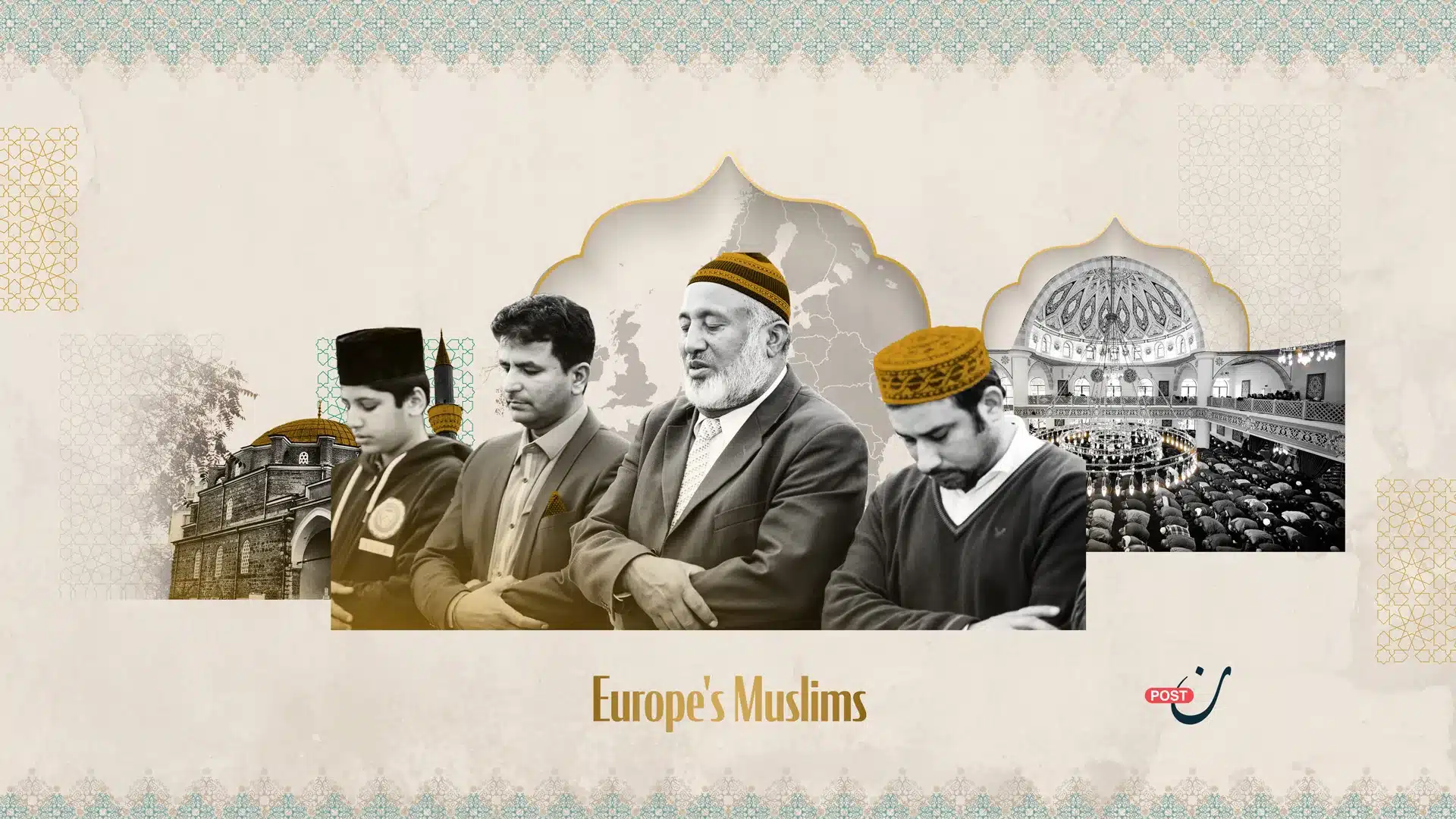
“Second-class citizens” that is how Ahmed Saadawi, 40, described the situation of Muslims in Italy after a full two decades of living in the country, noting that were it not for the Muslim community’s persistence and defiance, not a single Muslim would have remained on Italian soil.
Although Muslims are the second-largest religious group in Italy after Christians, there is a major problem in the relationship between the state and the Muslim community. Some attribute it to a historical legacy weighed down by bloodshed and painful memories, and perhaps to a historical complex that dominates the Italian mindset, which imagines that Muslims are plotting to revive the glories of the past, when they conquered parts of the country in the ninth century.
According to 2017 statistics, the Muslim community numbers about 1.7 million people, equivalent to 3.1% of Italy’s total population. Other unofficial estimates put the figure even higher, especially when accounting for Muslims who do not hold Italian citizenship, despite the restrictions they face from time to time.
Italy’s Muslims: a historical background
Italy first encountered Islam in the ninth century, when it arrived through three main gateways and from there spread to the rest of the country. The first was the island of Sicily, conquered by Ibrahim ibn al-Aghlab under the command of Asad ibn al-Furat in 827, marking the beginning of a new relationship between Europe and Islam.
The second gateway was through the island of Sardinia, whose rule the Fatimids inherited from the Aghlabids in 909. It remained under Muslim rule for nearly a full century until Muslim taifa kings in Andalusia took control of it, but it soon fell into the hands of the Christian alliance in 1015.
Islamic rule over Italian cities lasted for nearly 200 years
The third gateway through which Italy came to know Islam was the Italian Peninsula itself, when Muslims captured the city of Brindisi in 836 after a fierce battle with the Aghlabids, followed directly the next year by Naples, then Capua in 841, and eventually Rome in 846, when Muslims forced the pope to pay tribute in exchange for their protection.
Islamic rule over Italian cities lasted for nearly 200 years. But as a result of disputes that broke out among the rulers of the Islamic caliphate in the East and West, and the weakness that afflicted some of them, Christians succeeded in retaking those cities one after another. The last of them was southern Italy, which they seized from the Ottomans in 1481.
Those confrontations left behind an Islamic presence inside Italy, though not a large one. Matters changed completely after World War II (1939-1945), when waves of migration from Arab and Muslim countries in the Middle East, North Africa and Eastern Europe to Italy increased, laying the true foundation of the Muslim community there.
Islam on the state’s map
Before the Sept. 11 attacks, Muslims in Italy suffered from relative marginalization, but there was also a relative margin of freedom that made it easier for them to perform their religious rites and live their lives as a Muslim minority with its own rituals and customs. That quickly changed after those attacks, when the door was opened to blatant interference in Muslims’ daily lives and their reshaping according to a purely security-based vision.
Between 2005 and 2017, Italy’s politicians and ruling elite launched a new strategy for dealing with Muslims, one that leaned in part toward treating them with caution and suspicion. That meant imposing full surveillance over all their religious activities and political movements, including those who held Italian citizenship.
That strategy was reinforced even further with the 2015 migration wave. At that point, the Muslim community came to be treated as one of the priorities of security and counterterrorism, and Muslims were transformed from partners in the homeland into second-class citizens, and perhaps even internal enemies, in line with the policies of far-right parties whose influence has grown markedly over the past seven years.
Leonard Viter, a researcher in the European studies department at the CETA Center for Political, Economic and Social Studies, believes that the security policy pursued by the Italian authorities prevents the adoption of cooperative and participatory policies on Islam that would make Muslims allies with whom agreements and partnerships could be established for the public good.
Between 2005 and 2017, Italy’s politicians and ruling elite launched a new strategy for dealing with Muslims, one that leaned in part toward treating them with caution and suspicion
Viter’s view can be summed up as follows: there is an official state tendency to domesticate and ideologize Islam in a way that strips it of the fundamental character Italians see as a threat to their national security. The beginning came in January 2017, when a “new council for relations with Islam in Italy” was announced by former Interior Minister Angelino Alfano. It was an advisory body whose main task was to “improve the integration of Muslims in the country.”
At the time, the council consisted of a number of academics and experts in Islamic culture, some of them non-Muslims, in addition to some who were not qualified. They submitted monthly reports and recommendations on issues of integration and inclusion and on the most prominent files concerning the Muslim community inside Italy.
Former Italian Interior Minister Angelino Alfano was counting on this council to shape what he called “an Italian Islam that is more in harmony with the country’s Christian and human traditions,” in a way that would help increase the integration of Muslim immigrants and establish a timeline for training imams, preachers and religious figures on the basis of a domesticated religion, in addition to tightening oversight of mosque construction so that it would remain under the full control of state agencies.
The European studies researcher believes the main objective behind those systematic projects is to create a blueprint for Muslims that makes their worship and way of life conform to the way Italy wants, achieving its goals and preventing Islam from one day being used to pursue future political aims. All state institutions took part in this objective, especially educational, pedagogical and social institutions, in addition to local and executive bodies.
Official recognition of Islam
After a long marathon of debate between the community and the state, former Italian Interior Minister Marco Minniti signed a comprehensive agreement in February 2017 defining the parameters of the relationship between the authorities and Muslims, as a prelude to officially recognizing Islam in the country. The agreement was signed with the participation of nine Islamic institutions and the mosques of Rome and Palermo, as the two largest in Italy.
The agreement was met with a wave of criticism from some who said it did not represent all Muslims in Italy and that some of its provisions tightened the noose around followers of Islam. The minister, however, said the institutions that signed it represented 70% of the Muslims in the European country, estimated at about 1.7 million people.
Despite the pressure on them, Muslims achieved a major leap in size and influence, with their numbers rising from 100,000 in 1991 to 1.7 million in 2017
Ezzedine Elzir, head of the Union of Islamic Organizations in Italy, one of the institutions that signed the agreement, outlined in remarks to “Al Jazeera” the main provisions included in the agreement, which Muslims were required to abide by, as was the Italian state. The most important were “delivering Friday sermons in Italian, or accompanied by a translation if delivered in another language; opening the country’s mosques and prayer halls to non-Muslim visitors; Muslims’ support for government efforts to combat extremism; government intervention with local authorities to allocate places for mosques; and Muslims’ disclosure of foreign funding sources for mosques.”
Elzir considers the agreement the outcome of years of meetings and intensive discussions between Muslims and Italian government officials, and says it represents the first step on the path toward recognizing Islam as an official religion in the country. He noted that despite the pressure on them, Muslims achieved a major leap in size and influence, with their numbers rising from 100,000 in 1991 to 1.7 million in 2017.
Integration and the crisis of pluralism
Saadawi, the Egyptian man who has lived in Naples since 2000, believes the greatest challenge facing Muslims in Italy is the problem of integration — a problem shared by Muslims across Europe without exception. He told Noon Post that since leaving his native Egypt after completing his university studies in the Faculty of Mass Communication, he suffered greatly during his first five years in Rome and then Turin before eventually settling in Naples.
He explained that learning Italian is one of the most central problems, alongside education-related crises and the scarcity of Arabic and Islamic curricula, amid the state’s insistence on teaching its own culture and history, much of which, he said, conflicts in many of its events with the facts recorded in Arab and Islamic records.
To avoid that dilemma, many members of the community have turned to private schools and educational institutions specializing in teaching Arabic and Islam. But these institutions are not officially recognized, forcing young Muslims to enroll in formal universities to obtain a degree they can use for work, amid relative discrimination based on ethnicity and religion in some Italian workplaces.
The Muslim community in Italy is marked by cultural pluralism, as there is no single unified ideology dominating everyone. Despite the negative consequences of this lack of harmony for Muslim unity, its advantages outweigh its drawbacks, making integration easier and placing Muslims at the forefront of the map of social relations with all minorities and with Italians themselves.
Although Italy ranks fourth in Europe in terms of its Muslim population, the number of mosques and places of worship there is extremely small
If integration was a major obstacle for the first generation of Muslim immigrants, the situation has changed somewhat in recent years. With the emergence of youth as a core component of the community, the process of assimilation and coexistence has become relatively easier, as these young people entered the education system early and lived with all the details of the state until they absorbed its culture and became virtually indistinguishable from members of long-established Italian families.
It is worth noting that since Italy abandoned its “open borders” policy in 1981, the number of immigrants there has risen from 321,000, or about 0.5% of the population, to 625,000 in 1990, equivalent to 1.1% of the country’s population, reaching 5 million foreigners in 2016, making up 8.4% of the total population.
One in every three immigrants to Italy is Muslim, accounting for 2.6% of the population, and that percentage is expected to double by 2030, according to data from the Italian Ministry of Foreign Affairs.
Cemeteries and mosques: recurring crises
In July 2020, the Italian newspaper La Repubblica documented the lack of suitable cemeteries for burying Muslims, as voices within the community grew louder in demanding appropriate burial spaces after deaths increased because of the coronavirus pandemic, which claimed 33,000 lives and infected more than 200,000 people.
The absence of cemeteries equipped for Muslim burials is one of the crises facing the community there. The problem worsened particularly over the past two years against the backdrop of the closure of land and sea borders and the suspension of air travel, making it difficult for Muslims to transport their dead back to their home countries and leaving them to struggle to find cemeteries inside Italy in which to bury them. This was confirmed by Abdullah Radwan, director of the Islamic center affiliated with the Grand Mosque of Rome.
In her testimony about the crisis, Muslim journalist Hira Ibrahim, who lives in a town near the city of Brescia in the Lombardy region of northern Italy, said she was forced to keep her mother’s body at home for more than 12 days because she could not find a suitable place to bury her.
She said in press statements that burying Muslim dead had become a major problem: out of 8,000 municipalities, only dozens provide suitable burial spaces for Muslims, turning deaths into a real crisis for the deceased’s family.
In 2016, nearly 30 racist attacks took place, with Muslims bearing the brunt of them
Alongside the scarcity of cemeteries, Muslims also suffer from a shortage of mosques. Although Italy ranks fourth in Europe in terms of its Muslim population, the number of mosques and places of worship there is extremely small. There are only eight main mosques, in addition to about 800 cultural centers converted into prayer halls, usually located in unsuitable places such as garages, basements and warehouses, according to what was noted by Maria Bombardieri, a social sciences researcher at the University of Padua and author of the book “Mosques of Italy.”
Bombardieri attributed that scarcity to several reasons, including the fact that Islam is not considered a recognized religion in Italy like Christianity, in addition to the problem of funding and the difficulty of getting it to the relevant bodies, as well as strong Italian objections to building mosques in public areas with relatively high population density, not to mention the restrictions Italian authorities place on the construction of Muslim places of worship, given that they supervise and monitor them through every stage of construction.
Salvini: the most prominent face of racism
Beyond the security policies Italy pursues that negatively affect Muslims, some attribute the recent waves of racism to former Interior Minister Matteo Salvini, the far-right politician who created an atmosphere encouraging violence and hatred, according to social activist Ahmed Ghazi in Italy, who said the rhetoric adopted by Salvini reinforced racist feelings among Italians against the Muslim minority.
The former interior minister is associated with his famous phrase addressed to migrants: “Get ready to pack your bags,” while the social activist revealed that “we can only count the racist crimes we hear about, while there are many more similar crimes and attacks that go undocumented.”
It is worth noting that in 2016, nearly 30 racist attacks took place, with Muslims bearing the brunt of them, while the polling group Ipsos confirmed that the number was far higher, blaming media discourse alongside political rhetoric for spreading an anti-immigrant climate in Italy.
In 2019, the Euro-Mediterranean Human Rights Monitor expressed concern over the hard-line rhetoric adopted by Salvini, particularly with regard to tightening surveillance of the Muslim community following a stabbing carried out by a Moroccan Muslim near Rome’s Termini train station on April 23 of that year after a dispute broke out between the two parties.
The monitor noted that monitoring Muslims under the pretext of public security constitutes a violation of Article 5 of the International Convention on the Elimination of All Forms of Racial Discrimination, which protects the right to freedom of religion, assembly and association.
In light of the above, and despite all the restrictions and the suffocating policy pursued by the Italian authorities, Muslims are trying to coexist with society as much as possible through paths of integration and peaceful engagement, amid cultural richness and the absence of the kind of fundamentalist methodology that worries the Italian public.
But far-right rhetoric and the manipulation of Muslims as an electoral political card remain the most prominent obstacle facing the Muslim community in a country that presents itself as a homeland of freedoms and acceptance of the other.