






هذا التقرير متاح أيضًا بـ العربية
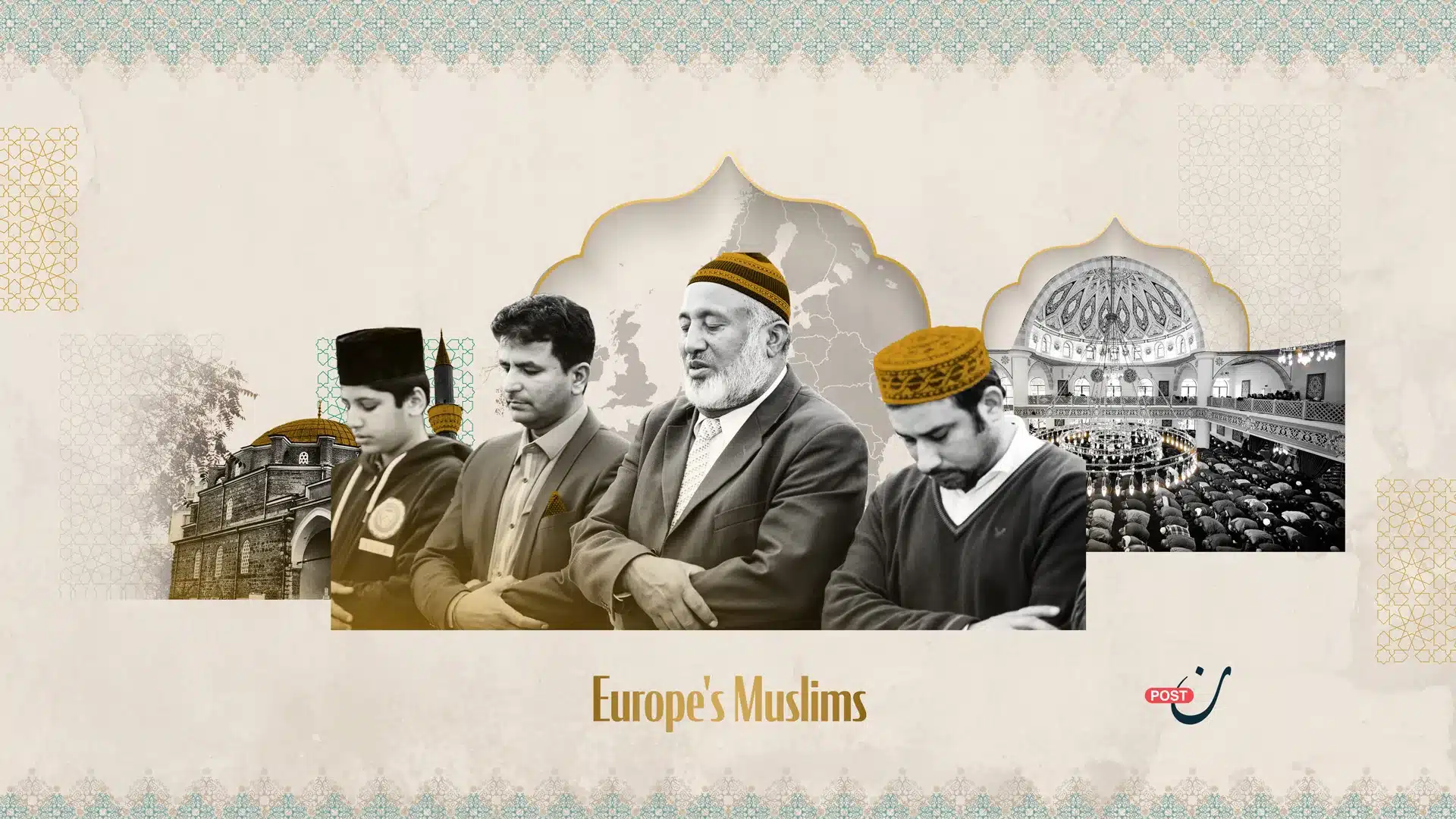
Islam is one of the most prominent issues commanding media attention in Belgium, having in recent years become the most frequently discussed topic, even though it ranks second among the most widespread religions in Belgian society.
Despite the steps Muslims have taken toward social integration there, especially after the Belgian government recognized Islam as an official religion in 1974, there remains a state of concern over the growing number of Muslims, who are viewed by populists as a threat looming over the country’s security and stability and therefore something that must always remain under scrutiny and watch.
Unofficial estimates indicate that Muslims number between 700,000 and 800,000, making up 7 to 8 percent of Belgium’s total population. The majority are concentrated in Brussels, where they account for 23.6 percent of the capital’s population, followed by Flanders in the north, where they make up 5.1 percent of the region’s population, and then Wallonia at 4.9 percent of the total population.
Muslims in Belgium
The relationship between Muslims as a community and Belgium dates back to the 1960s, when Brussels, like other European capitals, became a destination for Arab and Muslim migrants from Asia, North Africa and the Middle East after World War II (1939-1945). The main aim of migration was work and the search for better sources of income than those available in the migrants’ home countries.
Moroccans and Turks topped the list of migrants most drawn to Belgium, something evident in the demographic map of the Muslim community, which is dominated by people of Moroccan, Tunisian and Algerian nationality, along with Turks and then Egyptians, especially in the capital, Brussels, where Muslims form one of its main pillars.
Although Belgium abolished the “guest worker” program in 1974, preventing workers from staying for long periods and barring them from bringing over their relatives, many migrants took advantage of some family reunification laws to circumvent the measure, brought their families and settled in the country, forming the first nucleus of the Muslim community there.
In 1967, Belgium’s late King Baudouin I gifted Saudi King Faisal Al Saud a plot of land adjacent to the Museum of Antiquities in the center of the capital, just a few meters from the European Council, with the aim of establishing a cultural center for Muslims to oversee their affairs and serve the community.
After the events of Sept. 11, 2001, those relations were marked by some coolness as hate speech escalated, ultimately leading to tighter restrictions on some Islamic forms of dress, such as banning the niqab and hijab in public areas, while Muslim women were subjected to harassment because of their clothing, in addition to fines imposed on those who violated such laws.
The growth of Muslims … why the concern?
In 2013, sociologist Felice Dassetto published a study in which he said Muslims would make up the majority of Brussels’ population by 2030, and that the same could extend to other cities. He said the percentage would systematically double in the coming years compared with the growth rate among Christians, making the growth rate of Belgium’s Muslims one of the highest in Europe.
The study stirred concern and resentment among many Christian currents in Belgium, and populists saw it as a golden opportunity to attack Islam and clip Muslims’ wings. Dozens of reports soon surfaced warning of what they called the “Islamic tide” and the growing influence of the Muslim minority, in a way that threatened the future of Belgian social cohesion.
The Observatory of Religions and Secularism at the Free University of Brussels revealed in its 2015 annual report surveying the state of religion in the country that there was unprecedented interest in Islam within Belgian society. That interest, it said, stemmed from growing concern over extremism and terrorism, especially after reports that some people identifying with Islam had joined the Islamic State group, ISIS, in the wake of the 2014 attack on the Jewish Museum.
Researcher Caroline Sägesser, who helped prepare the report, denounced the Belgian media’s focus on the Islamic State group and its presentation as the sole face of Islam and Muslims, suggesting that all Islamic thought could be reduced to that organization. She said this ran contrary to reality and clearly ignored the fact that Muslims are diverse in their thinking and schools of thought.
The report also addressed the expanding social presence of Muslims through the growth of their associations, which manage the community’s affairs in a way that prompted questions about whether this could eventually create an Islamic pillar within Belgian society, similar to the Christian pillar that forms the most prominent component of society. The report noted, however, that it was still too early to answer that question.
The most integrated minority
“It is one of the countries that pays great attention to the Muslim community in terms of education, Islamic schools, support for mosques and da’wah in general, even though Christians are the majority,” said Sayed Moqbel, a Belgian Muslim doctor of Egyptian origin, commenting on the relationship between Muslims and Belgian society.
Moqbel told Noon Post that since arriving in Brussels in 1997, he had never once felt he was in a foreign homeland until 2016, when the influence of the far right grew because of some crimes attributed to Islamists. But overall, he said, Belgians stand out as among the most accommodating peoples in Europe toward minorities, with Muslims at the forefront.
He explained that all the areas Muslims need — education, schools, equality in employment, freedom of belief and worship — are available to a fairly good extent, and that periods of tension in the relationship between the state and the community are reactions to incidents and events, but matters soon return to normal.
Researcher Mohammed Al-Bataywi shares that view, noting that since the state recognized Islam in the 1970s, it has become an inseparable part of Belgian society. He told Al Jazeera that the government funds mosques and pays the salaries of imams and preachers. In fact — unlike most European countries it also allocates large burial spaces for Muslims.
He pointed to several indicators demonstrating strong integration, including the fact that many Muslims hold important positions in the country’s executive sphere politically, economically and culturally. Muslims were even allowed to establish an Islamic party under the name “Islam Party,” which, according to Al-Bataywi, succeeded in sending two members to one of Brussels’ municipalities. He stressed that “Islam is gradually taking root in Belgium despite some difficulties.”
Writer Yassin Rawashdeh, meanwhile, noted that nearly half the population of the capital, Brussels, is Muslim, and that integration has gone so far that one Muslim reached the post of deputy prime minister, in addition to Muslim and Arab lawmakers and governors in many state positions. He noted that one sign of Belgium’s respect for Islam is that it has borne the cost of 250 mosque imams whose salaries are paid by the Belgian Ministry of Justice.
This is in addition to the right of Muslim students to receive Islamic education classes in Belgian schools. The Ministry of Education there approved Islamic religion as a subject in public schools for Muslims at a rate of two hours per week, along with the presence of more than 300 mosques teaching in complete freedom and without restriction.
A strong political presence
In 2018, the Gatestone Institute for International Policy published a report examining the Belgian far right’s fears over the growing popularity of the “Islam Party,” whose influence had begun rising in a way that alarmed much of the elite. The institute cited what it described as party leaders saying they intended to turn Belgium into an Islamic state they called “Islamic democracy.” The warning was not merely theoretical: the report even identified the date for fulfilling that promise, setting it officially for 2030.
One-third of Brussels’ population is currently Muslim
The report’s author, Giulio Meotti, cultural editor of Il Foglio magazine, sounded a warning cry to secular parties to confront the Islamic party, claiming it was playing on the strings of extremism and threatening Belgium’s security and social stability. He concluded his warning by asking: “Has the time come, perhaps, for sleeping Belgium to wake up?”
Olivier Servais, a professor of social sciences at the Catholic University of Louvain, said that one-third of Brussels’ population is currently Muslim, and that given the higher fertility rate among Muslims, they will become the majority within 15 to 20 years. He also noted that since 2001, the name Mohammed has been the most common name for boys born in Brussels.
Muslims within the party succeeded in expanding their circle of influence year after year, and this is perhaps what worried the Socialist Party and the rest of the secular parties. In 2012, the party fielded candidates in only three municipalities; two won in Molenbeek and Anderlecht, while it lost the third municipality in Brussels by a narrow margin. In the 2014 elections, the party achieved unprecedented success, winning 9,421 votes — nearly 2 percent of the vote — and expanding its base in the cities of Brussels and Liege.
Racism and the rise of the far right
There was a clear shift in both the level and content of racist hate speech against Muslims before and after 2015. As the far right’s influence grew alongside waves of migration, followed by the 2016 Brussels bombings that killed 32 people and wounded 300 others events populists exploited Muslims found themselves in the crosshairs of ongoing abuses.
Mohamed Ouston, head of the Executive of Muslims of Belgium, says the body considered the most prominent entity representing the Muslim community in Belgium is under intense pressure. He noted that its members are being targeted by right-wing parties in the country for political gain, according to his remarks to Anadolu, and that efforts are underway, led by Belgian Justice Minister Vincent Van Quickenborne, to revoke the body’s recognition on the grounds that it does not represent Muslims.
In the same context, many imams and preachers have fallen into the mire of campaigns of suspicion and accusations by Belgian media steered by the far right, which has adopted racist language aimed at distorting Islam and Muslims and branding them with labels carrying accusatory overtones that further inflame hate speech, such as “mujahideen” and “fundamentalists,” among other terms the media there tries to link to extremist organizations. This resulted in some imams being assassinated, most notably Abdullah Mohammed Qassem Al-Ahdal, imam and director of the Islamic Center in Brussels, in 1989, and a Shiite imam in the city of Anderlecht in 2012.
Iels Keytsman, director of the Unia anti-racism center in Brussels, explained that Belgian society changed after the 2016 attacks, which affected everyone, with Muslims suffering the most. She added in remarks to Asharq Al-Awsat that Muslim students refused to go to school for fear of racist harassment after hate speech escalated from teachers and classmates of other faiths. Girls were also prevented from wearing the hijab, and restrictions were imposed on Muslims’ access to housing and job opportunities.
A report by the Belgian Observatory of Religions and Secularism revealed that the government received 4,627 complaints related to discrimination against Muslims in 2015, while 1,670 cases were opened for investigation the highest rate compared with other minorities. In 2018, meanwhile, complaints rose according to Keytsman to 7,500 complaints, 2,200 of which were officially opened for investigation.
In any case, Muslims are making strenuous efforts to reduce the intensity of the escalating hate speech directed against them since 2016, drawing on their political and social influence and their strong network of relationships embedded within Belgian society, which many members of the Muslim community see as the foremost guarantee of their presence.