









“Our American friends offer us money, weapons and advice. We take the money, we take the weapons, but we reject the advice.” — Moshe Dayan, as quoted by Avi Shlaim in “The Iron Wall.”
“Top Secret.” Those two words were written in Russian on an envelope sealed with red wax. Only seven copies were to be distributed, to the leaders of Albania, Bulgaria, Czechoslovakia, East Germany, Hungary, Poland and Romania. The letter was to remain within a tightly restricted circle: each party leader could allow only a small group of deputies to read it, without making copies.
Inside was Nikita Khrushchev’s speech. In it, he shattered the cult of Stalin within the Communist Party, listed his crimes and, for the first time, addressed the era of Red Terror. Meanwhile, on President Dwight Eisenhower’s orders, CIA director Allen Dulles had set aside $1 million to obtain the text. Western intelligence agents tried to get it in European capitals, but failed.
Fortunately for the Americans, the speech infuriated Edward Ochab, head of the Polish Communist Party. Shocked by its scathing criticism of Comrade Stalin and needing to unburden himself, he invited a few aides to read it. Word soon spread through Warsaw’s political circles that there was an important document worth seeing.
Amid these events, a young Jewish man named Victor Grajewski heard about the speech. He was involved with a woman who held a senior position in the Polish Communist Party’s extensive secretariat. Grajewski persuaded her to let him borrow the original Russian text from her office. He knew nothing of the $1 million, but was filled with Zionist enthusiasm for the fledgling state of Israel and decided to give it the document.

Within days, Khrushchev’s speech was on the desk of Shin Bet director Amos Manor. Manor was constantly trying to convince the United States that Israel was an integral part of the free world, rather than a haven for Soviet spies. American suspicion of him had gone so far that J. Edgar Hoover barred him from entering the United States in 1952 on suspicion of being a communist agent. In April 1956, Manor found on his desk a document that proved his innocence and loyalty, and rushed it to Ben-Gurion’s home.
Ben-Gurion saw an opportunity to strengthen the intelligence cooperation agreement he had concluded with Washington five years earlier. He knew that many American officials questioned the value of working with a small socialist state crowded with suspect new arrivals. The speech soon reached President Eisenhower’s desk, and his aides regarded Israel’s acquisition of it as a high-level achievement worthy of praise.
Eisenhower ordered the text leaked to several American newspapers and news agencies. Radio Free Europe and Radio Liberty broadcast all 20,000 words in full. For 20 years, the world did not know that an Israeli service to the United States, offered in the hope of strengthening relations, lay behind one of the Cold War’s greatest embarrassments. That hope was realised as the Mossad’s relationship with the CIA deepened.
Truman’s bet
After this episode, Truman’s bet appeared to have been right, at least up to that point. By 1958, the two countries had exchanged substantial intelligence. In an unusual move, Israel allowed the United States to inspect Soviet weapons systems it had captured and review reports submitted by immigrants from Soviet bloc countries.
Historian Michael Cohen argues in “Palestine and the Great Powers, 1945-1948” that Truman’s support for Israel reflected his sympathy for victims of Nazism, appeals from his Jewish friends and advisers, and his appreciation of the importance of Jewish voters and political funding. Another belief carried even greater weight among White House advisers: Israel could be a strategic asset for the West against the Eastern bloc in the Cold War.

As noted in the introductory article to this dossier, the US decision to recognise Israel followed a direct clash between President Harry Truman and his secretary of state, George Marshall. Marshall believed recognition would damage Washington’s oil and diplomatic interests in the Arab world. Working with State Department adviser George Kennan, he led a forceful but unsuccessful campaign to dissuade Truman from supporting Israel’s establishment.
Over time, the US-Israeli relationship grew beyond a conventional alliance between states whose interests sometimes coincided. It became a structural part of the American presence in the Middle East, shaping Washington’s strategic calculations for the region as a whole.
To some observers, examining that relationship seemed like opening Pandora’s box, given the accumulation of human sins and evils within it. In any case, a close bond had formed. It was sustained by lobbying groups such as AIPAC, whose influence exceeds that of comparable lobbies in American politics, and reinforced by the wider political and religious support of Christian Zionist thought.
These factors made the relationship resemble the “dangerous liaisons” of French writer Laclos: personal and objective interests became intertwined, sometimes in ways difficult to separate.
That raises the central questions of this dossier. Has American political decision-making become hostage to a double standard towards Tel Aviv, even when it conflicts with Washington’s direct interests? Have US administrations ever stood up to Israel for broader reasons? Does the relationship change with each occupant of the White House, or does it endure beyond individuals? And was it inevitable from the outset?
Before admiration became a religion
In “My Israel Question: Reframing the Israel-Palestine Conflict”, Australian journalist Antony Loewenstein examines the effect of the 1967 war on US-Israeli relations. Lyndon Johnson’s administration accepted Israel’s expansion with little meaningful internal opposition.
The administration recognised Israel’s strategic value to Washington’s regional ambitions. American commentator Norman Podhoretz wrote that, after the war, Israel had become “the religion of American Jews.” Israel’s display of power impressed the United States, which saw it as an ally capable of counterbalancing Soviet influence in the region and provided financial, military and political support. American Jews promoted the idea that they were now defending the United States against what they called “evil Arab invasions,” with Israel on the front line of that struggle.
Despite what the leak of Khrushchev’s speech had achieved, the relationship remained subject to several constraints. During the 1956 Tripartite Aggression against Egypt, Eisenhower compelled Ben-Gurion to withdraw fully from Sinai after threatening to cut US aid to Israel, then valued at $100 million.
Eisenhower’s handling of that crisis foreshadowed the approach that every US president who later decided to clash with the Israeli project would follow. The word clash can be misleading here. Such confrontations have resembled neither disputes between equals nor wars between adversaries, but a form of paternal authority exercised by an American president over a rebellious son.
Eisenhower took his position to protect US standing and the international order Washington had helped establish under the United Nations after World War II, in which it shared influence with the Soviets.
His rebuke to Ben-Gurion had a distinctive tone: “I need not assure you of the deep interest of the United States in your country, nor remind you of the various aspects of our policy supporting Israel in every way. I therefore urge you to comply with the resolutions of the UN General Assembly concerning the present crisis, and to announce your decision immediately. It would be a matter of regret to all my countrymen if Israeli policy, in a matter of such importance to the world, were in any way to affect the friendly cooperation between our two countries.”
The message showed that American and Israeli interests could diverge. The United States was pursuing its own interests while Nasser’s Egypt still stood ambiguously between the two Cold War camps.
Another divergence emerged under Eisenhower’s successor, John Kennedy. It also showed how a president’s character could sometimes decisively shape Washington’s policy towards Israel.
Documents released in 2016 show that Kennedy became more personally involved in Israel’s nuclear programme than any other US president. A sincere advocate of nuclear non-proliferation, he regarded it as his overriding concern, particularly after the Cuban Missile Crisis with the Soviet Union made its dangers concrete.
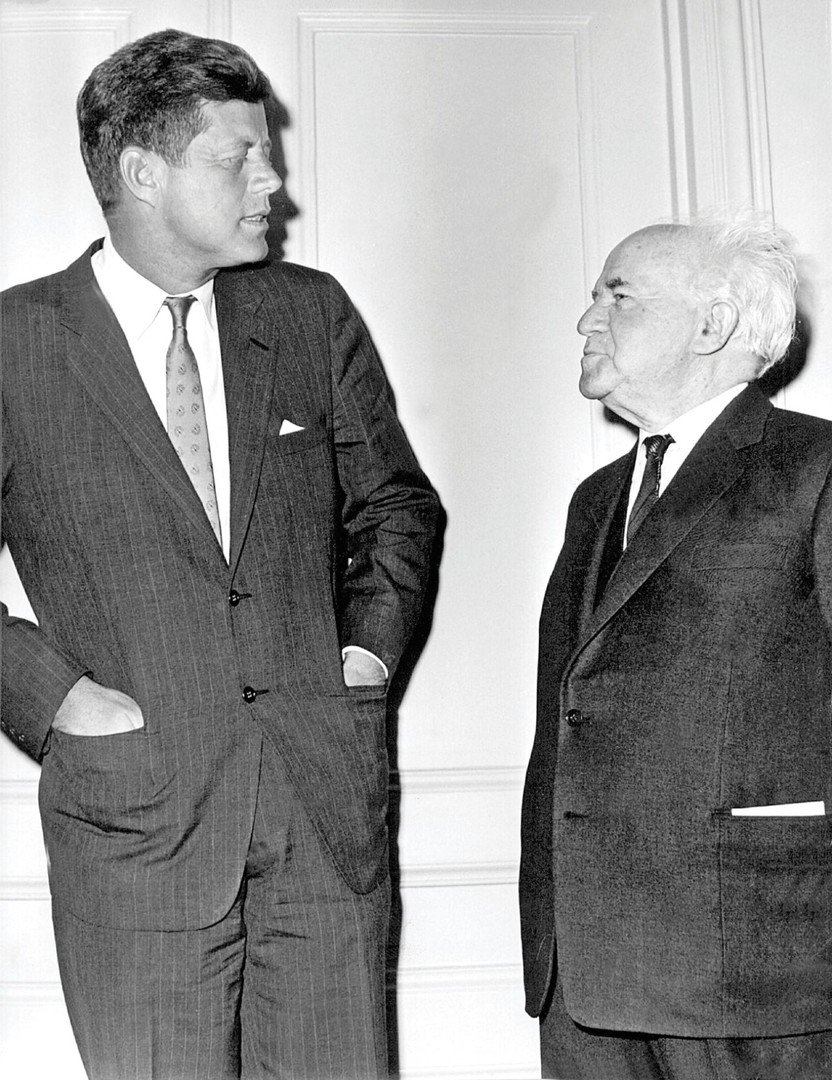
As US intelligence agencies grew suspicious that Israel was concealing military aims behind the Dimona reactor, Kennedy expressed concern and sought to expand and institutionalise US inspections of the facility. Israel’s nuclear programme was the focus of his 1961 meeting with Ben-Gurion in Manhattan. Ben-Gurion insisted it was intended solely for peaceful development.
Kennedy was unconvinced. He later escalated matters by sending stern letters to Ben-Gurion and then his successor, Levi Eshkol, demanding inspections twice a year in line with international standards. He warned that his government’s commitment and support for Israel would be gravely jeopardised if the United States could not allay its concerns about Israel’s nuclear ambitions.
Israel responded to the reprimand cautiously and shrewdly. In “The Israel Lobby and US Foreign Policy”, John Mearsheimer notes that Eshkol told his colleagues: “His man will come, and he will be told, in effect, that he can visit Dimona and go anywhere he wants.
But when he wants to open one of the doors somewhere, he will be told, no, not that door.” Israel followed this approach with the inspection teams. Kennedy was assassinated in late 1963, before he could test his resolve or show how far he would go.
Mearsheimer believes that neither Kennedy nor his successor, Johnson, was prepared to withhold US support if Israel rejected their demands. The Israelis could therefore set the terms of inspection visits. Johnson’s administration avoided a confrontation over the issue and accepted a brief visit roughly once a year instead of an inspection every six months.
The Johnson administration: the personal factor
In 1968, CIA director Richard Helms informed Johnson that Israel had acquired an actual nuclear capability. Johnson asked him to share the evidence with no one else, including Secretary of State Dean Rusk and Defence Secretary Robert McNamara.
In “The Samson Option”, his book on Israel’s nuclear project, investigative journalist Seymour Hersh explains the president’s position: “Johnson’s purpose in keeping Helms and the CIA at a distance was clear. He avoided knowing what the agency was trying to tell him, because once he accepted that information, he would be obliged to act on it.”
Personal factors again left their mark on the relationship. Johnson was the man who would reshape it. As Senate majority leader in 1956, he had opposed Eisenhower’s pressure on Israel to withdraw from Sinai and the Gaza Strip. Rashid Khalidi writes in “The Hundred Years’ War on Palestine” that Johnson knew little about the realities of the Middle East or international affairs more broadly.
His predecessor, Kennedy, by contrast, had extensive knowledge of world politics and the Middle East in particular. He visited Palestine in 1939 and wrote to his father with a firm grasp of the facts and a critically informed view of the main arguments on both sides of the conflict at the time.
Johnson surrounded himself with a wide circle of supporters of Israel, including Abe Fortas, Arthur Goldberg, McGeorge Bundy, Clark Clifford and the brothers Walt and Eugene Rostow. The circle also included prominent Democratic Party financiers Abraham Feinberg, Arthur Krim and Krim’s wife, Mathilde. Her commitment to Zionism went so far that she helped smuggle weapons across the French-Swiss border for the Zionist armed organisation Irgun during its struggle against the British in Palestine.
According to Khalidi, Johnson’s presidency broke with the approach of Truman, Eisenhower and Kennedy. Their administrations had strengthened ties with Israel and increased economic aid while keeping it outside the centre of US regional policy. Johnson’s change of course began a new phase of recalibration, establishing the familiar pattern of the US-Israel alliance that lasted from the 1967 war to the end of the Cold War.

Resetting the relationship
As noted earlier, the 1967 war amounted to a reset. In a pragmatic reading of US-Israeli relations, many observers, including international relations and Middle East scholar Stephen Zunes, argue that, if Israeli security had been US policymakers’ chief concern, aid would have peaked in the Jewish state’s early years, when its democratic institutions were strongest and its strategic position most fragile. It should then have fallen as Israel’s military and strategic strength grew. The opposite happened.
As Zunes notes, large-scale US military and economic aid began flowing after the 1967 war and rose steadily. Immediately after Israel’s striking victory, US aid increased by 450 per cent. That rise has been interpreted in part as the price of providing the United States with samples of new Soviet weapons captured during the war.
After Israel’s role in the events of Black September in 1970, and the ability it demonstrated to curb Palestinian revolutionary movements beyond its borders, US aid increased sevenfold again. Military aid then rose by 800 per cent after the 1973 war, and rose once more after the Camp David agreement with Egypt and the fall of the shah’s regime in Iran. Through the Lebanon war, the Gulf War, the 11 September attacks and the subsequent war on terror, Israel became, and remains, the largest cumulative recipient of US aid since World War II.
As Zunes explains, much as Loewenstein does in “The Palestine Laboratory”, the paradox is that US support for Israel increased as Israel grew stronger because it served as a laboratory for testing advanced American weapons and helped expose Soviet weapons technology captured in its wars. Israel also did the “dirty work” for the United States, dealing with regimes and movements so unpopular in America that Washington could not openly supply them with military aid.
Israel played that role in the Iran-Contra affair. While American society had yet to recover from the hostage crisis, Israel acted as an intermediary in supplying US weapons to the mullahs’ regime in Iran. Part of the proceeds from the deal was channelled to the Contra forces in Nicaragua. Israel also helped support South Africa’s apartheid regime and dealt with military regimes in Guatemala and El Salvador during the 1980s, as well as foreign occupation forces in Namibia and Western Sahara.
Moments of strain and their price
It would be a mistake to overlook the US-Israeli clashes during this period of recalibration. This two-sided relationship also came at a price.
These confrontations took place within particular limits, but they also exposed distinctive features of the relationship. The United States was often forced to cover up Israel’s misconduct or use both pressure and incentives.
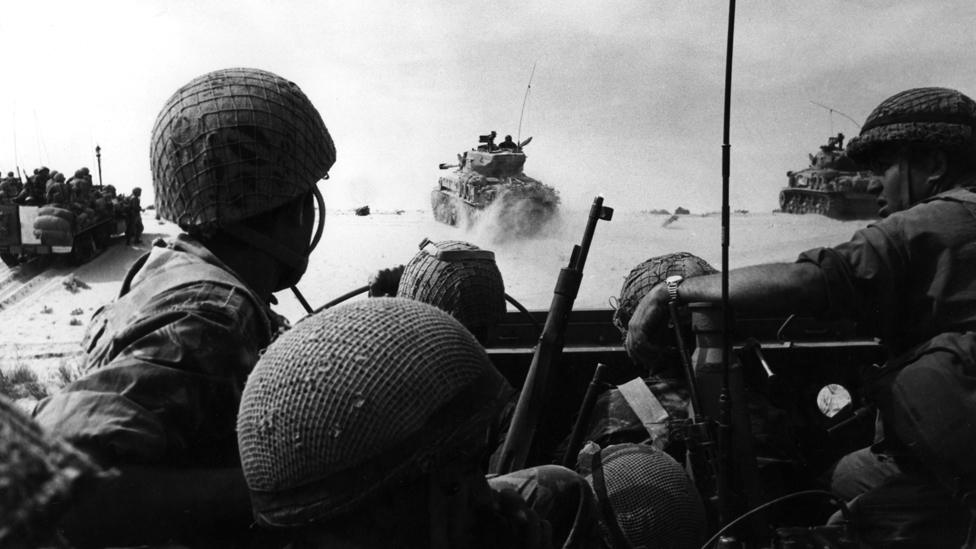
Crises date back to the close relationship that emerged in 1967. During the Six-Day War, Israeli aircraft and torpedo boats attacked the US intelligence ship USS Liberty in international waters off Sinai, killing 34 Americans and wounding 171 others.
Despite the seriousness of the attack, official investigations accepted the account that it was a case of mistaken identity. Congress never established an independent commission of inquiry. The issue remains alive: in 2026, Representative Thomas Massie introduced a resolution calling for the declassification and release of all documents relating to the attack.
US support for Israel in the October 1973 war caused the oil embargo and ensuing crisis, which many believe altered the course of modern American history. The crisis had long-term structural effects on US energy policy towards the Middle East. At home, it drained many families’ resources, contributed to the shrinking of the middle class and remained on presidential candidates’ agendas until the end of the 1980s.
While many events remained concealed, some came to light. One was the case of Israeli spy Jonathan Pollard, a US Navy intelligence analyst who spied for Israeli intelligence in 1984 and 1985. He leaked about 1,500 cables from current intelligence summaries and more than 800 other classified documents. They included information about the Palestine Liberation Organization’s headquarters in Tunisia and Tunisian and Libyan air defence capabilities, helping Israel in its operations against the organisation there.
The embarrassment was severe enough that Tel Aviv initially denied responsibility, depicting the espionage as a rogue operation by a group of zealots who did not represent the state. Under US pressure, it was forced to cooperate partially with the investigation and return some documents. In 1998, it formally acknowledged that Pollard had been its agent. The affair affected intelligence-sharing between the two countries for a time.
Attempts to reach a regional settlement were another persistent source of friction between the countries’ national security priorities. The clash resurfaced in the 1980s. During the Lebanon war, after the shocking scenes of Beirut under aerial bombardment, President Reagan called Prime Minister Menachem Begin. He wrote in his diary that he told him, “All of this must stop, or our entire future relationship will be in danger. I deliberately used the word Holocaust in front of him, and I said that the symbol of his war had become the image of a 7-month-old child whose arms had been amputated.”
US State Department documents show that Washington regarded the Israeli invasion as a direct threat to the regional stability it had sought to protect after Camp David. As a result of the invasion, Reagan’s administration halted shipments of cluster munitions to Israel.
It also declined on several occasions to block UN resolutions critical of Israel. During Reagan’s presidency, 21 resolutions directly or indirectly condemning Israeli conduct were passed. The Lebanon war was disastrous for Israel’s image in the West and the United States, and equally disastrous for the US settlement plan: Lebanon ultimately came under the dominance of Syria’s Baathist regime.
A confrontation a decade earlier showed another side of the relationship. In the mid-1970s, during his campaign of shuttle diplomacy, Kissinger tried to advance a settlement of the Arab-Israeli conflict. Israeli Prime Minister Yitzhak Rabin refused to relinquish strategic passes and oil fields that supplied about 60 per cent of Israel’s oil needs.
The dispute nearly derailed negotiations with Egypt. Kissinger told Rabin, “You don’t understand — I’m trying to save you, and you’re making me, the secretary of state of the United States of America, roam the Middle East like a Levantine carpet merchant. Have you lost your mind?”
The response went beyond Kissinger’s rebuke. President Gerald Ford wrote to Rabin: “I have given instructions for a reassessment of US policy in the region, including our relationship with Israel.” In practice, the United States suspended consideration of Israel’s request to buy F-15 fighter jets and slowed scheduled weapons shipments.
One ordinary man against a thousand lobbyists
Ford’s “reassessment” could not withstand opposition in the Senate, particularly after 76 senators signed a letter calling for military and economic support for Israel to continue. The president turned instead to incentives, offering Israel between $2 billion and $2.3 billion in economic and military aid to secure its withdrawal from the Mitla and Gidi passes in Sinai.
The Senate’s opposition helped define the limits of any US president’s ability to pressure Israel, regardless of personality.
Scholars John Mearsheimer and Stephen Walt describe the pro-Israel lobby, led by AIPAC, as an organised force in US politics. Through a loose coalition of individuals and organisations, it seeks to steer US foreign policy in Israel’s favour, sometimes, they argue, at the expense of wider American interests.
Pro-Arab pressure groups associated with oil interests also emerged and influenced several issues.
Oil interests and US relations with Arab states found a strong advocate in James Baker, secretary of state under George H.W. Bush. Baker and Bush confronted Israeli Prime Minister Yitzhak Shamir, insisting that $10 billion in loan guarantees be tied to a halt in settlement expansion.
The confrontation helped weaken Shamir before his election defeat by Yitzhak Rabin, regarded as a dove under American classifications of Israeli politics. The Madrid Conference took place under Shamir in 1991. Negotiations arising from it gained momentum after Rabin’s election, alongside the secret channel that led to the 1993 Oslo Accords.
During that battle, Bush Sr made one of the best-known remarks about the pro-Israel lobby’s influence. At a televised news conference, he said, “I heard today that there are something like a thousand lobbyists on the Hill working the other side of the question. We’ve got one lonely little guy down here doing it.”

The oil interests lobby also won a battle over AWACS aircraft. In 1981, Reagan’s administration fought a fierce political battle with AIPAC and the Israeli government to secure an arms deal with Saudi Arabia that included AWACS early warning planes. The deal gave Riyadh a new qualitative capability that raised Israeli concerns about the erosion of its military edge. It passed only after Reagan committed his full political weight to overcoming the lobby’s opposition.
In testimony to a House Appropriations subcommittee, Secretary of State Alexander Haig made an explicit statement that helped establish a principle from which Israel would later benefit more than the deal harmed it. He declared that guaranteeing Israel’s qualitative military edge had been a fundamental pillar of US policy since the October 1973 war.
The concept gradually developed until Congress codified it in a 2008 law. Whenever the US administration notifies Congress of an arms sale to a Middle Eastern country other than Israel, the law requires it to certify that the sale will not harm Israel’s qualitative military edge. It also requires the president to assess that edge continually and take the assessment into account when reviewing regional arms deals.
Every victory for the oil interests lobby, or for the logic of direct US interests in the region, seemed to be matched by a broader victory for the pro-Israel lobby. The alliance rests on shared strategic interests while also drawing strength from a genuine foundation of shared values and moral goals, as its proponents define them.
Israel’s friends and admirers
Stephen Zunes points to a striking trait among American politicians when he discusses the emotional attachment many liberals feel towards Israel, especially those from the post-World War II generation who went on to hold leading positions in government and the media.
Many Americans remain attached to an image of Israel shaped by its internal democracy for Jewish citizens, progressive social institutions such as the kibbutzim, relatively high levels of social equality and role as a safe haven for a persecuted minority that spent centuries in the diaspora.
Added to that are guilt over Western antisemitism, personal friendships with Jewish Americans who strongly sympathise with Israel, and fear that criticism might inadvertently encourage antisemitism. Together, these factors have produced considerable reluctance to acknowledge the gravity of Israeli violations of human rights and international law.
Zunes also points to pragmatic reasons associated with the arms industry. It spends five times as much as AIPAC and other pro-Israel lobbying groups on election campaigns and lobbying in Congress, and has a direct interest in continued large-scale arms shipments to Israel.
In Zunes’s example, a member of Congress can more easily oppose a $60 million arms deal with Indonesia than one worth more than $2 billion with Israel, because factories producing the equipment are located in many electoral districts.
Another factor is the roughly 44 million Americans who identify as white evangelical Protestants. They form a substantial demographic and electoral bloc, adding popular weight to conventional lobbying groups. Their support for Israel rests on theological interpretations of biblical prophecy. Earlier surveys compiled by the Pew Research Center found that 82 per cent of white evangelical Protestants believed God gave the land to the Jews, close to the 81 per cent recorded among Haredi Jews.
The ideological, electoral and financial strands of this relationship are particularly visible in AIPAC’s recent electoral influence. In the 2024 cycle, the organisation and its political arms spent more than $100 million, much of it in Democratic primaries seeking to unseat progressive lawmakers who had criticised the war on Gaza.

A report published in early 2025 said that 349 members of Congress, about 65 per cent of the total, received campaign support from AIPAC and its political arms during the 2024 election cycle alone. They included leaders in both parties. These figures show the institutional reach of the relationship and help answer the question of how much it depends on individuals: it extends beyond any one presidency into the legislature.
American history also contains occasions when Israel openly disregarded a president’s instructions. In 2003, George W. Bush’s administration opposed construction of the separation barrier, widely seen as an Israeli attempt to establish facts on the ground that would obstruct a future settlement. Bush expressed his displeasure at a press conference, saying “I think the wall is a problem, and I have discussed this with Sharon. It is very difficult to build trust between the Palestinians and Israel with a wall snaking through the West Bank.”
The dispute went beyond words. National Security Adviser Condoleezza Rice threatened to deduct the wall’s cost from a $9 billion loan guarantee package. That November, Washington announced a $289.5 million deduction from the first instalment because of Israeli spending on settlements and sections of the wall.
Israel’s supporters in Congress mobilised. They warned the White House that, if Bush sought to punish Israel under the pretext of its defending itself, Congress would do everything it could to prevent any interruption to the guarantees. A senior Israeli official indicated the limits of the pressure, saying “We are not subject to any pressure. The United States is a highly vibrant democracy, and this administration is highly sensitive to political calculations. Reality is sometimes shaped by political constraints.”
The penalty had limited effect. It stopped neither construction of the wall nor settlement expansion. Months later, Israel secured a broader political gain when Bush declared that a full return to the 1949 armistice lines was no longer realistic in light of what he described as new realities on the ground. He also said the Palestinian refugee issue should be resolved through resettlement in a new Palestinian state, rather than inside Israel. At the same time, Israel continued expanding settlements and building the wall.
The current moment
The repercussions of 7 October 2023 may appear to have reshaped the US-Israeli relationship, but it is too early to reach that conclusion. Currents have begun to emerge in both the Democratic and Republican parties that are more alert to the strategic harm Israel’s policies cause US interests.
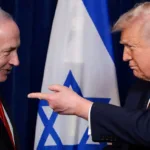
The current president, Donald Trump, also illustrates the role of personality in this relationship, particularly when a US president is enthusiastic about Zionism.
Over three years, the course of the war and the settlement negotiations has produced developments that do not seem unusual for a relationship sometimes marked by tension. Assessing its future requires attention to another factor.
The war on Gaza’s deepest impact has been the growing tendency among American Democrats to sympathise more with Palestinians than Israelis. By February 2026, Gallup polling showed that, for the first time, Americans’ sympathy for Palestinians had surpassed their sympathy for Israelis.
The shift was also apparent in Tucker Carlson’s rise within the MAGA movement and the current he represents, which places American interests at the centre of its worldview. It was apparent, too, in Zohran Mamdani’s victory as mayor of New York after he challenged the Zionist lobby’s influence and faced explicit hostility from the US president.
This historical account shows a relationship shaped by individuals and their moral and religious preferences, yet able to outlast their changing political moods. It has endured while the conditions sustaining it have remained in place.
For decades, it has maintained strategic continuity despite sharp confrontations between the two countries. Israel’s qualitative military edge is written into US law. Financial and electoral lobbies remain firmly established even as popular sympathy declines.
The extent to which a future US administration can confront its most difficult ally will be determined by the interplay of law and money on one side and changing public opinion on the other.
