

هذا التقرير متاح أيضًا بـ العربية
October opened with two major political developments in Egypt: the arrest of the editorial team of the fact-checking platform Matsda2sh, and the “October Movement”, a strike organised by detainees demanding their release and an end to prolonged pretrial detention. The strike came amid parliament’s approval of a one-year delay in implementing the new Criminal Procedure Law.
Coverage by Egypt’s state media and pro-government outlets used similar language to describe both events. It adhered to the official narrative and excluded alternative perspectives.
In this report, Noon Post examines that coverage through statements by the Interior Ministry and the Public Prosecution, and the way they were reproduced by Egyptian news websites and newspapers loyal to the regime and owned by it through United Media Services. It also examines episodes of Ahmed Moussa’s programme Ala Mas’ouliyati on Sada El Balad.
The channel is owned by businessman Mohamed Abou El Enein, which would in theory make it independent. Since 2013, however, it has devoted the largest share of its airtime to Moussa’s programme. He is considered one of the most prominent media figures loyal to the Sisi regime.
Two cases, one narrative
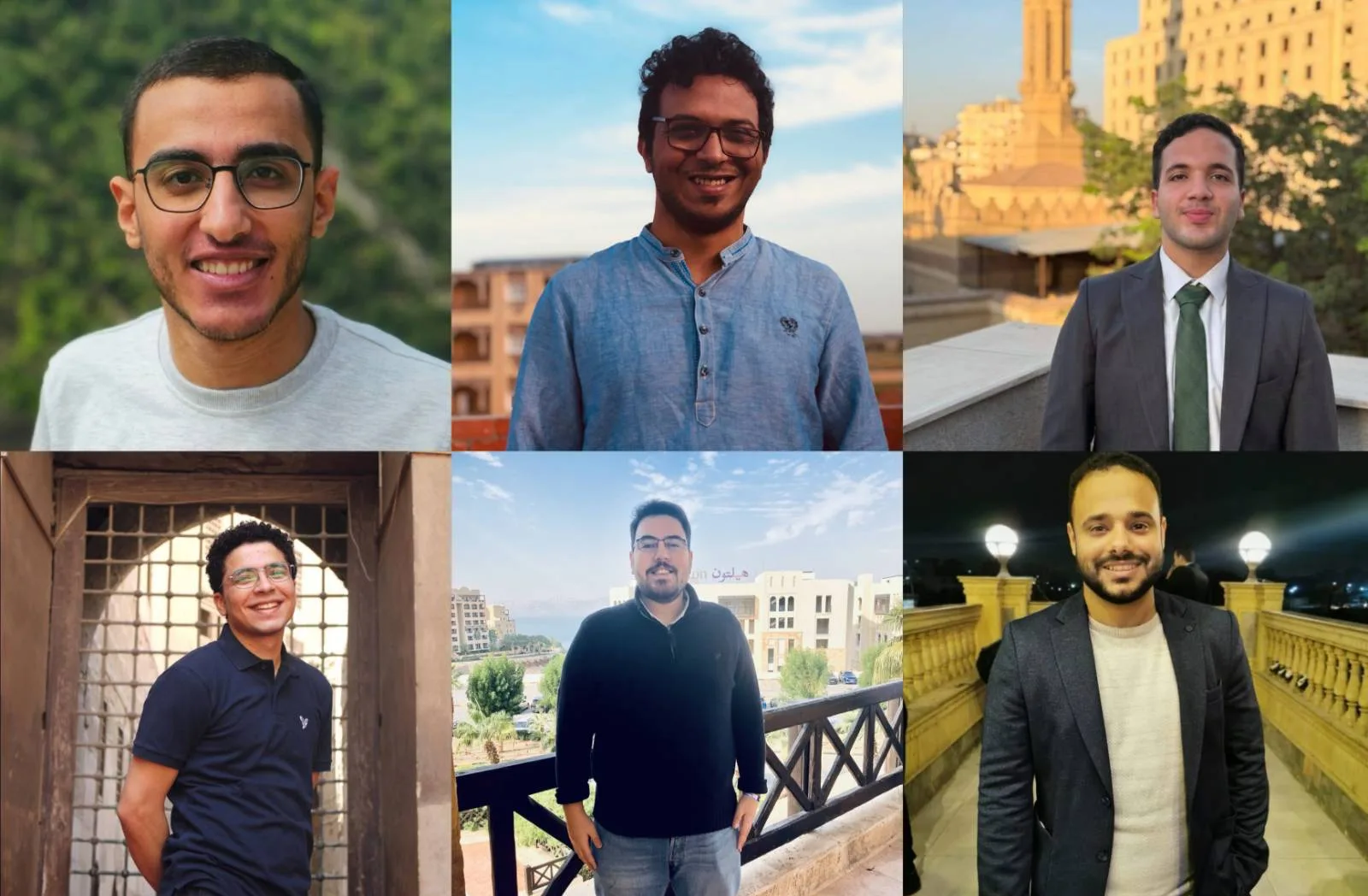
On 28 September, a security campaign against Matsda2sh began, ending with the arrest of six Egyptian journalists — its entire editorial team. The six were forcibly disappeared for five days before appearing before the Supreme State Security Prosecution, which charged them with joining a terrorist group, financing and spreading false news.
Before the journalists appeared before prosecutors, the Interior Ministry issued a statement announcing their arrest. Al-Masry Al-Youm reported that an order had been issued to detain them for 15 days, which the prosecution denied. After the journalists appeared before it, however, the prosecution did issue a 15-day detention order. During questioning, the journalists disclosed that they had been tortured and physically assaulted to force them to record confessions.
During the same period, detainees in several Egyptian prisons announced a hunger strike under the name “October Movement”. They said they would refuse to accept any “ta’yin” — prison food — on 7, 8 and 9 October, demanding an end to prolonged pretrial detention.
The Interior Ministry denied that any strike had taken place. But detainees’ families, posting through the “Enough Prisons” page, said their relatives had faced punitive measures, including bans on exercise, transfers to distant prisons, physical assaults and exposure to tear gas, particularly in 10th of Ramadan Prison.
“Everyone is Brotherhood”: framing coverage through accusation
Egyptian journalist Diana El-Dabaa’s appearance on the BBC, where she defended the Matsda2sh journalists against the accusations they faced, prompted a wave of personal attacks and questions about her political affiliations.
One allegation was that she had deliberately shared the biography of her grandfather, Rev. Gabriel, the first president of the Evangelical Theological Seminary, to rebut accusations that she belonged to the Muslim Brotherhood.
Although this allegation was merely part of an online campaign against her, it illustrates the approach pro-government media have taken since the Matsda2sh journalists were arrested. They were accused of belonging to the Brotherhood, as was the platform’s founder, Abdel Rahman Mansour, a political activist during the revolutionary period. Old videos of Brotherhood leaders were even used to reinforce the claim that Mansour — described in the Interior Ministry’s statement as a “fugitive Brotherhood member” — belonged to the group.
In a statement on 7 October, the Public Prosecution said one defendant had admitted that he and the other defendants had joined the group’s “media committee”, and that the page was overseen by a member who had fled abroad. It added that an examination of one defendant’s phone had revealed closed groups on an encrypted app and email correspondence from that member.
These statements by the Interior Ministry and the prosecution contain accusations, not judicial rulings or proof of a crime. Yet pro-government outlets publish them as established fact. On his programme, for example, Moussa said the Interior Ministry had “dealt a blow to the group backed by all the evidence”. He also said the page remained active because it was run from abroad. The same framing appeared in the state-owned Al-Ahram, as well as Al-Dostour, Youm7 and Al-Watan.
The danger of this narrative is its resemblance to the McCarthy era in the US: an accusation of Brotherhood affiliation overrides every other aspect of a person’s identity. Everything the accused says is assumed to be a lie except a confession, which may itself have been extracted under duress.
In a statement responding to the Journalists Syndicate on 5 October, the Interior Ministry described the Matsda2sh journalists as “Brotherhood elements”. It mentioned only in passing that one was a syndicate member — meaning that, by law, he was a “journalist”.
That professional identity was effectively denied to him and his five colleagues. The latter also practise journalism and are considered “trainees” under the law and, in the current syndicate chief’s definition, working journalists who are not yet covered by the union. In statements by the Interior Ministry and the prosecution, and in state media coverage, however, they are described as elements, defendants and members of the Muslim Brotherhood’s media committee. Defending them as journalists therefore becomes tantamount to defending the organisation.
The same approach is evident in coverage of the prison strike. Interior Ministry statements ignore the strikers’ demands and focus instead on “Muslim Brotherhood pages abroad” that “claimed” a strike was taking place. Simply being an opponent is enough for a person’s words to be attributed to the organisation. Any news about prisons can thus be ascribed to the group before it is even examined.
When criticism becomes “incitement”
Throughout its eight years of operation, Matsda2sh has focused on fact-checking. In pro-government media coverage, however, that role is turned on its head. Moussa says the platform aims to “inflame citizens against officials” and spread rumours.
To the Supreme State Security Prosecution..
Where is the false news? Where are our meetings with Brotherhood leaders?
15 days.. and no evidence
More than 15 days after they were arrested, our colleagues Mohamed Ashraf Abu Omeira, Abdullah Qadri, Islam Barakat, Mohamed Adel, Mohamed Mahmoud and Omar Helal appeared once again before the Supreme State Security Prosecution for investigation into accusations of “spreading false news, joining a terrorist group and financing it.”
Despite these accusations, last Tuesday’s questioning was limited to the same questions raised in the first round of investigations, concerning how they joined the team, editorial policy, day-to-day work mechanisms, salary management, and other matters related to the current and former team — all things our colleagues had necessarily already recounted voluntarily, and which we ourselves had previously published here on the same page in earlier statements.
So far, investigators have not confronted our colleagues with any evidence indicating the validity of the charges against them, and instead limited themselves to asking our editors about the sources of stories or the methods used to verify them, which our colleagues explained with full professionalism and honesty.
In this regard, we affirm that throughout our work we sought the truth to the best of our ability, and never strayed from the essence of our role: verifying facts and exposing false news. Because mistakes are possible and our audience has a right to an apology, we have never been arrogant when we erred; on more than one occasion, when it became clear that we had published an inaccurate report due to an unintentional mistake, we issued an apology accompanied by a correction.
So where is the false news we published? What evidence did the prosecution rely on in bringing its charges?
Is it normal that after all these investigations we have not been confronted with a single report, even by way of example, of false news we allegedly published?
We have never published a report without disclosing its sources. All our sources are known and published, and in our reporting we have relied on official documents and government reports whose accuracy was contradicted by officials in separate statements, making scrutiny and verification necessary. Have state documents and reports now become incriminating evidence and a charge?
Even in the reports we published exclusively, we followed a strict verification policy based on cross-checking sources and grounding the narrative in more than one reliable or relevant source. We possess documentation showing how every exclusive report we published was verified, while fully retaining our right to protect the identity of our sources and safeguard their legal and personal rights, in accordance with the constitution and the law.
Aside from the charge of spreading false news — the nature of which we still do not know — the prosecution has turned ordinary information about workflow into charges, chief among them “foreign funding,” which we have repeatedly said is entirely baseless. We all receive our monthly salaries into bank accounts at Egyptian banks under legal employment contracts registered with those banks, and those salaries are in line with the wages commonly paid to Egyptian journalists in independent media institutions.
As for receiving salaries in dollars, that is not in itself an accusation. As is well known, most international and Arab institutions and companies in Egypt have in recent years paid their employees in foreign currencies to avoid the fluctuations and repeated devaluations the Egyptian pound has experienced over more than 10 years, to a degree that makes it difficult for any institution to preserve the rights of its workers.
The question here is: Are the offices of Arab and foreign agencies in Egypt, whose journalists receive salaries in dollars, Saudi riyals or Emirati dirhams, accused of foreign funding?
Are technology companies, advertising firms and others whose employees receive salaries in dollars accused of foreign funding?
Is it unknown to the prosecution and state agencies that receiving money in foreign currencies has become ordinary, normal and routine in independent media institutions, in order to preserve the value of salaries amid the economic crises Egypt is experiencing?
And if that is a charge, and if we are truly funded, would it have been normal for all of us to submit copies of our employment contracts and proof of our salaries through Egyptian banks?
As for the accusation with which we have absolutely no connection, near or far, which the Public Prosecution included in a statement a week ago and which concerns “holding organizational meetings with Muslim Brotherhood leaders,” the prosecution has likewise offered no evidence for it.
Is there a single piece of proof — just one — that any real or virtual meeting took place, or even a passing conversation with any person whatsoever who has an organizational relationship with the Muslim Brotherhood?
The prosecution will not find a single piece of proof, because that simply never happened, categorically, and we are not in doubt on this specific matter, nor do we have anything to hide.
We are journalists known to everyone, and since this project was founded in 2018 until now, no journalist with any political affiliation whatsoever has worked in it. We were always keen for the first word to belong only to journalism and the truth. A blind truth that knows no authority, no party and no group. A truth people deserve in a country where real, honest journalism — free of any purpose other than amplifying citizens’ voices, conveying their complaints and carrying the truth to them in a foggy scene — has receded, though we all knew that no one on this earth deserved such a reality.
There is no evidence here, and no charge there. We never did anything we fear being confronted with. These are the steps we took toward the truth, and that led us to the people. And if today we are here, shackled and powerless, we were never merely telling the story of journalism; in truth, we were telling our own story — about ourselves, our inner lives, our families, our people, our neighbors, our problems, our dreams, our defeats, our fractures and our victories — and we do not regret what we did.
#Matsda2sh
— متصدقش (@matsda2sh) October 15, 2026
In another episode, Moussa said the platform had monitored several health projects and that the health minister had responded to its lies — an accusation for which no evidence was presented. Across the attacks published by various newspapers, none refuted the platform’s reporting over eight years or established that even one report was fabricated, false or misleading.
This recasts professional criticism — or, more plainly, the core journalistic work of scrutinising statements and reports for accuracy — as “incitement” deserving punishment. “Spreading false news” becomes a ready-made charge against any journalist, with no need to examine the published material.
Concentrated ownership and expanding censorship
United Media Services was established in 2016 to replace the Egyptian Media Group, which had been owned by Egyptian businessman Ahmed Abou Hashima. Although officially a private company, everyone in Egyptian media knows it is owned by Egyptian intelligence. Its first head was Lieutenant Colonel Ahmed Shaaban.
Over the past 10 years, United Media Services has taken control of most news and general-interest websites and channels in Egypt. It owns the newspapers Youm7, Al-Watan, Al-Dostour, Sawt Al-Umma, Al-Osboa, Amwal Al Ghad, Mobtada and Dot Masr, as well as two English-language publications.
Newspapers outside its control include Al-Bawaba, owned by Abdel Rahim Ali, a regime loyalist and media figure known for personal leaks; Al-Shorouk, whose editor-in-chief, Emad El-Din Hussein, is a member of parliament on the lists of the pro-regime National Front Party; and Al-Masry Al-Youm. Others include several weekly papers that appear irregularly, the Wafd Party newspaper and independent websites, most notably Al-Manassa, Fekra Tani and Mada Masr.
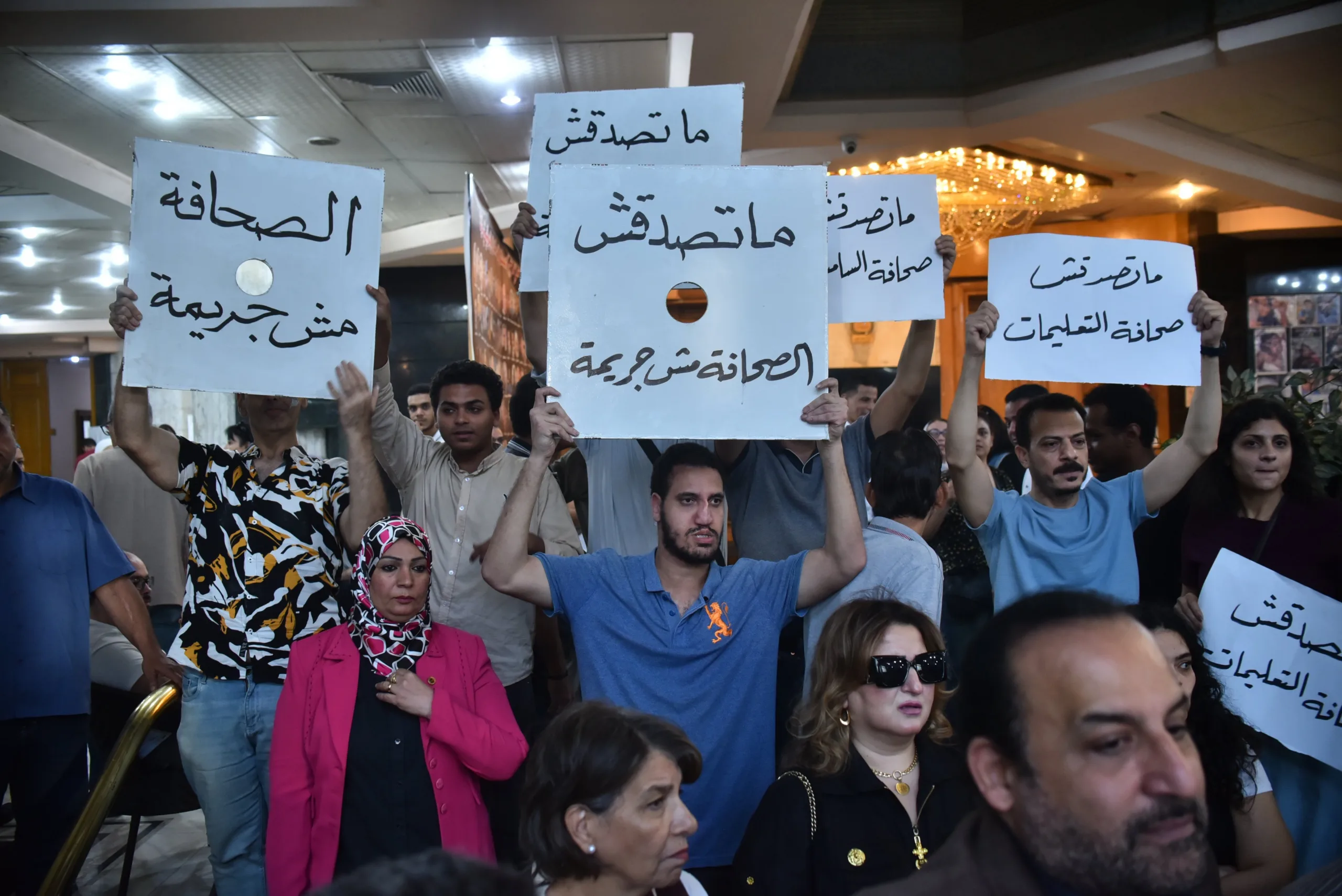
“They’re not alone … and until they get out, we’re here” … Journalists in Egypt announce a sit-in demanding the release of the detained journalists of the “Matsda2sh” platform. https://t.co/LTRbSvARQ0
— نون بوست (@NoonPost) October 3, 2026
Al-Manassa and Mada Masr have previously been raided, and their officials have been investigated on licensing-related charges. There are also the websites Cairo 24 and Telegraph. Although neither is directly affiliated with the state, their founders came from circles associated with state journalism.
To complete this control over the media, the 2018 media regulation law established the Supreme Council for Media Regulation and gave it broad powers to block news websites. The Association for Freedom of Thought and Expression says it has documented the blocking of at least 549 websites in Egypt since May 2017. Some remain blocked, while others have become accessible again.
These include news and media websites. The organisation has also documented the economic consequences for some outlets, including cuts to journalistic staff and the suspension of operations altogether. Together, these pressures create an uneven playing field between large media groups and independent websites.
Blocking does more than prevent the public from accessing particular content. It also undermines an outlet’s ability to attract readers and advertising and retain its journalists. Control over the media thus rests on a combination of economic influence, regulation and censorship, rather than solely on direct orders to close a newspaper or channel.
Official sources monopolise the narrative
Khaled El-Balshy, head of the Egyptian Journalists Syndicate, believes concentrated media ownership undermines journalistic pluralism by limiting opportunities to express different views and allowing a single narrative to dominate. Diverse ownership allows different parts of society to be represented, he added. Progress towards a free media requires coverage that reflects the breadth of Egyptian society rather than a narrow range of voices.
El-Balshy said diversity in ownership and coverage would help curb media campaigns and attempts to steer the public towards a particular position. It would also create room for different views and more objective discussion. A free media, he stressed, requires space for everyone to express themselves and participate.
Recent coverage of Matsda2sh and the “October Movement” clearly illustrates his point. Reports on both generally consist of a security statement or a prosecution statement, followed by commentary that simply restates it.
The Journalists Syndicate announced that it had filed a complaint with the prosecutor general about the Matsda2sh journalists’ testimony that they had been tortured. The Interior Ministry responded with a report, published by all outlets loyal to the regime, saying a security source had denied the claims.
– Egyptian authorities arrested 6 journalists from the “Matsda2sh” platform, and the Interior Ministry said in a statement that the platform is a “Brotherhood media committee” run from abroad and receiving foreign funding.
– The platform responded that over 8 years it had published hundreds of corrections to reports promoted by entities associated with the Brotherhood, most recently just days earlier on Sept. 27.
– It also confirmed that its entire team are Egyptians residing in Egypt, and that the site’s data on its Facebook and X accounts show that it is run from داخل the country.
– It denied that Abdel Rahman Mansour is a “fugitive Brotherhood member,” saying he left Egypt legally, is not wanted in any case, and took part four years ago in a political dialogue called for by the state.
– It revealed that 3 of those detained had undergone a security investigation three years earlier that concluded there was no evidence linking them to any political group or foreign funding.
– As for “foreign funding,” the platform said it consists of ordinary salaries paid through Egyptian banks under official employment contracts that any authority can verify.
— نون بوست (@NoonPost) October 1, 2026
The prosecution then announced that medical examinations of three defendants had found no evidence that they had been subjected to violence. Media coverage, meanwhile, excluded voices representing the detained journalists, their families or their lawyers.
Although the denial was attributed to an unnamed security source, the Interior Ministry posted it on its own page. This combination of anonymity and official status gives the statement institutional authority without accountability.
The same happened with the “October Movement”. Statements by detainees’ families about the strike, pretrial detention and the detainees’ demands were all ignored. Only the Interior Ministry’s denial that a strike had taken place appeared.
Ruqayya Hamed, a pseudonym for the wife of a detainee in 10th of Ramadan Prison, says she and other detainees’ families do not rely on the local press. When publicising the strike, the “Enough Prisons” campaign or other campaigns, they send their statements to journalists at independent outlets and publish them only on social media. They do not expect the Egyptian press to carry any related statement.
In coverage of the movement, too, the word “prison” is absent from Interior Ministry statements and pro-state reporting. Instead, they use terms such as “rehabilitation and correction centers”, “inmates” and “modern penal policy”. This reflects the growing power of terminology.
Adopting this vocabulary settles the debate in advance: someone held in a “correction center” is not on hunger strike over “prolonged pretrial detention”, but is asking for “privileges”. That was precisely what a security source said about a previous strike, claiming that the group fabricates such allegations to secure privileges for its members outside the legal framework. Demands for release and an end to pretrial detention are thus reduced to requests for perks.
Newsrooms wait for instructions
“The instructions in the company are to stick only to official statements, and not to publish any statements related to the Interior Ministry or the rehabilitation sector except through their official source. In important cases, such as ‘Matsda2sh,’ instructions are issued directly to editors-in-chief on how to handle them, whether by specifying the scenario to be used or by ignoring them.”
This is how Abeer Nader describes the way United Media Services directs coverage across its outlets and limits editors-in-chief’s authority. Nader, whose name is a pseudonym, worked as a journalist at one of those outlets before moving into the company’s management.
Scenes from the journalists’ sit-in against the detention and disappearance of the journalists of the Matsda2sh platform https://t.co/6Dt4BSKXTl
— الاشتراكيون الثوريون (@RevSocMe) October 3, 2026
Nader says the company has a unit that monitors everything published by its outlets to ensure it complies with instructions. It also holds regular meetings with editorial managers from different outlets to discuss those instructions.
Nadim Abdel Qader, also a pseudonym, heads the editing and review unit — known in Egyptian newspapers as the “desk” — at an Egyptian website. He agrees with Nader’s account. He describes his role as reviewing published content and its adherence to editorial policy. The editor-in-chief also alerts him to publishing restrictions and topics that are off-limits.
Security coverage is handled exclusively by reporters accredited to the ministry; no one else is allowed to report on it. No news — including fuel price rises or controversial decisions — is covered without first consulting the editor responsible.
Matsda2sh and the “October Movement” may seem like very different cases: journalists arrested for doing their work, and detainees fighting for their rights. What connects them is the way both are covered under Samsung media.
