










هذا التقرير متاح أيضًا بـ العربية
Benjamin Netanyahu does not need to win a Knesset majority to remain prime minister; preventing his rivals from forming an alternative government may be enough. That calculation looms large in the 27 October election. The two blocs are running close, and most polls suggest his camp will fall short of 61 seats. The opposition, led by Gadi Eisenkot, faces a similar difficulty unless it relies on the Arab parties.
Publicly, Likud insists it is aiming for a majority. According to the Jerusalem Post, however, party officials speak of settling for 55 or 56 seats, betting that they can turn those seats into a blocking bloc by exploiting leading opposition figures’ refusal to cooperate with the Arab parties. Deadlock would then offer Likud an opportunity to prolong its time in power, wear down its rivals and perhaps rebuild alliances under the banner of a “broad unity government.”
From winning a majority to blocking an alternative
Netanyahu is working to turn the opposition’s need for Arab votes from a matter of electoral arithmetic into a political liability. Likud’s campaign sums up its message in phrases such as “No government for Eisenkot without the Arab parties” and “No Gadi without Tibi,” targeting right-wing voters wavering between Likud and its rivals.
The campaign uses artificial intelligence to drive the point home. One advert depicts an imagined Eisenkot government in which Mansour Abbas smokes a hookah and rejects Eisenkot’s security proposals. The propaganda ends with the message that Abbas and the Muslim Brotherhood would run the government.
In another advert shared by Netanyahu, Eisenkot runs towards a young man resembling his son Gal, who was killed in Gaza, before turning to embrace Abbas instead. The aim is to portray Eisenkot as subordinate to Arab partners, cast doubt on his ability to manage security and suggest that, for the sake of electoral alliances, he would betray the memory of his son, who was killed in clashes with the Palestinian resistance in the Gaza Strip.
גדי, זה לא ישר https://t.co/awy47dINmq
— Benjamin Netanyahu – בנימין נתניהו (@netanyahu) July 20, 2026
The incitement has been accompanied by an effort to reduce Arab electoral participation. Coalition representatives on the Central Elections Committee voted to disqualify the United Arab List and the Joint List by 18 votes to five, despite the attorney general’s position that the evidence was insufficient. The Supreme Court subsequently overturned the decision unanimously. Although the disqualification failed in court, it retained its propaganda value by reinforcing the portrayal of Arab parties as illegitimate political actors.
Likud and Religious Zionism also announced plans to deploy about 2,000 activists at polling stations in Arab towns, citing unproven allegations of fraud. The move recalls Likud’s use of cameras in 2019 and Netanyahu’s 2015 warning of Arabs “streaming” to the polls. Efforts to reduce turnout serve a direct goal: reducing the number of seats that could enable the opposition to form a government or support one from outside the coalition.
Analyses suggest that portraying Eisenkot as beholden to Arab politicians is aimed specifically at the “soft right” that might drift away from Likud. The campaign’s effect, therefore, is not limited to lowering Arab turnout. It also puts pressure on Jewish voters who want Netanyahu removed but hesitate at the prospect of a government that needs Arab partners. The incitement thus combines an attempt to change the balance of seats with an effort to raise the political cost of using those seats to form a government after the election.
The campaign’s deeper purpose, however, is to bind right-wing opposition figures to commitments made before the vote. Netanyahu is invoking the Bennett-Lapid government of 2021, which included the United Arab List, and applying the label “Bennett 2” to Ofer Winter to win back right-wing voters drifting towards his party.
That pressure is reflected in the opposition’s own positions. Bennett has rejected reliance on Arab parties on the grounds that they are not Zionist, while Avigdor Lieberman has ruled out a minority government, even a transitional one. Yet Likud continues to accuse them of seeking power through Arab votes, turning their refusal to cooperate with Arab parties into proof that they cannot form an alternative government.
The trap extends to the Palestinian issue. Drawing on statements by Joint List leader Yousef Jabareen, Netanyahu has accused a potential Eisenkot government of undoing his achievements and paving the way for a Palestinian state. Eisenkot responded by rejecting the establishment of a Palestinian state under his watch and posting an old video of Netanyahu shaking hands with Yasser Arafat and endorsing a Palestinian state.
The contest thus shifts onto terrain defined by Netanyahu, where the opposition races to demonstrate its distance from Arabs, its rejection of a Palestinian state and its ability to answer his accusations. Every pledge its leaders make to protect their electoral standing also narrows their options after the vote. That brings Netanyahu closer to his goal: an opposition majority that exists on paper but cannot form a government.
Buying time with a caretaker government
If attempts to form a government fail, Netanyahu will remain in office for a period that could last months. Under the Basic Law: The Government, the president of the “state” appoints a candidate to form a government within seven days of the publication of the official results. The candidate has 28 days, extendable by a further 14. If the attempt fails, a second candidate may be given 28 days, or the process may be referred to the Knesset.
In either case, if no government can be formed, a 21-day period begins during which a majority of lawmakers may request that an agreed candidate be given the task. That candidate then has an additional 14 days. If this attempt also fails, the Knesset is deemed dissolved and new elections are held within 90 days. The failure of a second candidate to form a government does not mean parliament is dissolved immediately, nor does another election guarantee an end to the crisis.
Netanyahu is experienced at exploiting these stages. In May 2019, after failing to form a government, he pushed the Knesset to dissolve itself rather than allow another candidate a chance. In 2020, he drew Benny Gantz into a government with a rotating premiership. It collapsed in December because the budget was not passed, before Gantz could take his turn as prime minister, leaving Netanyahu in office as caretaker until June 2021.

A caretaker government allows Netanyahu to oversee security affairs and maintain a media presence from office, while continuing to influence the course of the war on the Iranian, Gaza and Lebanese fronts. It also gives him more time to face his trial while still in power, even as he pursues the pardon request he submitted last November, which remains pending. Herzog has announced that a decision will be postponed until efforts to reach an out-of-court settlement have been exhausted, amid repeated pressure from Trump to grant a pardon.
The wait, by contrast, puts the opposition’s cohesion under strain. Likud officials are betting that fear of another election could push Bennett into an agreement with Netanyahu without Lapid, and that Eisenkot’s failure to form a government could weaken his leadership of the opposition bloc.
Gantz and Gideon Saar provide two precedents for drawing rivals into Netanyahu’s camp. Gantz split from his partners in Blue and White after three rounds of elections. Saar left Likud and contested elections as part of an opposition bloc, only to return to Netanyahu’s government during the war and ultimately secure a guaranteed seat on the Likud list.
This strategy does not depend solely on attracting an entire party. Prolonged negotiations test the cohesion of alliances and the extent to which their leaders’ interests diverge. Netanyahu controls ministerial portfolios, posts and the ability to set the agenda, while his rivals face pressure to fulfil their promise to remove him. The longer the wait, the sharper their dilemma: preserve the bloc’s unity or accept a compromise justified by the need to end paralysis and presented as serving higher interests.
Meanwhile, Netanyahu can blame the opposition for repeated elections and present its inability to govern as proof that it has no alternative without the Arabs. He can also remobilise the right and reclaim votes from smaller parties. But his experience with Gantz makes it harder to attract new partners. It reminds them that a rotation agreement may collapse before the premiership changes hands and leaves no basis for trust, especially since most leading opposition figures have had negative experiences in Netanyahu-led governments.
The transitional period does not give Netanyahu unrestricted freedom. A caretaker government faces constraints, particularly on senior appointments and major decisions that can be postponed, while the elected Knesset retains its legislative authority. Lieberman is counting on replacing its speaker, Amir Ohana, and then passing a law barring criminal defendants from serving as prime minister. Bennett, meanwhile, proposes limiting a prime minister’s time in office to eight years. These measures, however, also require a majority that may depend on Arab votes, and could face judicial challenges.
A unity government and new alliances
A “national unity” government offers a possible way out of deadlock through a deal that keeps Netanyahu in power with some of his rivals’ votes. Likud has chosen the slogan “a broad national government,” which since August has fuelled Itamar Ben-Gvir’s fears that Eisenkot could replace him. Ben-Gvir also fears that the project of a “full rightward transformation of the state’s identity,” which depends heavily on achieving the goals of “judicial reform,” could be abandoned.
Those fears deepened after Netanyahu announced that the defence and national security ministries would remain in Likud’s hands. Ben-Gvir said he had information about promises made by the prime minister’s office to European countries to exclude him. He also said Likud officials had told him that Netanyahu wanted to end his final term with broad backing.
Netanyahu, however, confirmed that his broad government would include Ben-Gvir, while both Ben-Gvir and Eisenkot denied seeking a unity government. Right-wing commentator Amit Segal has suggested another possibility: Netanyahu could win a majority and then expand the government to reduce Ben-Gvir’s and the Haredim’s ability to blackmail him, without necessarily excluding them.

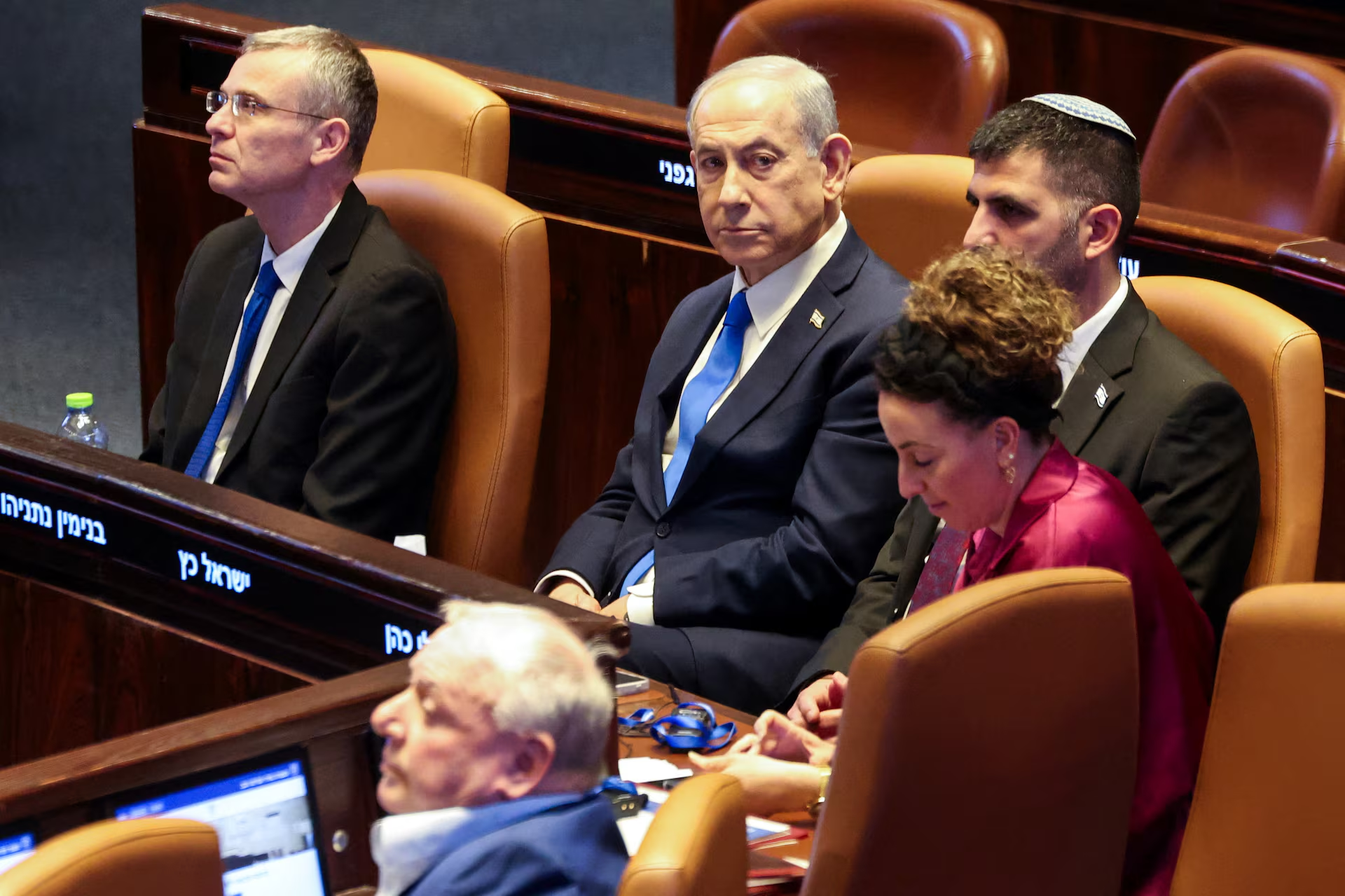
Netanyahu and Ben-Gvir in one of the Knesset sessionsOtzma Yehudit notes that talk of a broad government has overshadowed the slogan of a right-wing government, while Netanyahu has avoided joint appearances with Ben-Gvir. That does not, however, prove that he has decided on the coalition’s composition. Weakening his partner’s ability to dictate terms would also benefit Netanyahu if the election returned another right-wing majority, strengthening his bargaining position within it.
The ambiguity allows Netanyahu to keep his options open, reassure wavering right-wing voters that Likud will not be beholden to its partners and preserve the possibility of negotiating with the opposition after the vote.
A possible US role has also emerged through an Israel Hayom report about a push for a broad government comprising Likud and Eisenkot’s party. Netanyahu would lead it for up to two years before retiring from politics. During that period, the government would work to end the wars and advance regional agreements, especially with Saudi Arabia, as part of Trump’s project to expand the Abraham Accords.
US Ambassador Mike Huckabee denied the report, saying the administration does not dictate the composition of the next government. Trump then announced his “full and complete” support for Netanyahu and linked his continuation in office to finishing the mission in Iran. That support does not determine the fate of a unity arrangement. Press sources reported that the opposition’s hesitation over a broad unity government frustrated Trump and contributed to his backing for Netanyahu. An analysis in Yedioth Ahronoth, meanwhile, raised the possibility of an undeclared understanding on a broad government that would enable a breakthrough with Riyadh. Axios, by contrast, reported that some Trump advisers preferred a different government without Netanyahu, revealing differing assessments within the administration.
The proposal is linked to a view expressed by a foreign diplomat in the Israel Hayom report: that a narrow government would be unable to take major diplomatic decisions. Netanyahu’s need for a partner who would reduce his dependence on the far right thus converges with outside parties’ desire for a government better able to secure approval for regional arrangements.
Iran provides a security rationale for the call for unity. Netanyahu accuses a potential Eisenkot government of allowing Iran to acquire a nuclear weapon. He and his war minister, Israel Katz, also warn of Iranian attempts to influence the election through attacks. Netanyahu has denied wanting a strike before the vote, while Maariv reported an Israeli preference for beginning any military action after 27 October.
If that report is accurate, escalation could coincide with coalition negotiations or the caretaker period, providing a pretext for calls for “national unity,” much as Gantz and Eisenkot joined the emergency government after the attack of 7 October 2023.
Even so, a unity arrangement faces two obstacles: Eisenkot, Lapid, Golan, Bennett and Lieberman’s refusal to join a Netanyahu-led government, and Netanyahu’s responsibility for the failures of 7 October. Conditions attributed to Eisenkot’s camp also include guarantees of Netanyahu’s retirement, rolling back judicial legislation, stronger democratic checks and an official commission of inquiry into the failures.
An analysis in Yedioth Ahronoth argues that reviving the 1984 rotation model would require abandoning Ben-Gvir and Smotrich, freezing the judicial changes and launching an independent investigation. Those demands strike at the foundations of the current alliance. They explain why unity is easy to promote as a slogan but difficult to implement when it requires specific commitments and guarantees of Netanyahu’s departure.
The crisis of trust adds to the electoral cost. Lieberman is already describing Eisenkot as “Gantz 2,” while Ben-Gvir is vowing to torpedo any government Eisenkot joins. Netanyahu therefore needs concessions that persuade the opposition while keeping his allies in check. Yet accepting unity could break up Eisenkot’s bloc before the government itself has stabilised.
The limits of winning through obstruction
Netanyahu’s ability to manage deadlock remains dependent on the election results and his allies’ cohesion. Gantz’s withdrawal eight days before the election reduced the likelihood of opposition votes being wasted. Smotrich and Ofer Winter, meanwhile, are polling close to the electoral threshold, prompting calls from within the coalition for small right-wing parties to withdraw. In a close race, either list’s failure to cross the threshold could upset the balance on which a blocking bloc depends.
The Haredim’s support is not guaranteed either. Shas and United Torah Judaism are demanding a law enshrining exemption from military service. Channel 12 reported that United Torah Judaism would not oppose an Eisenkot-led government, out of anger at Netanyahu’s failure to pass the law. Such a split could open a route to power for the opposition that Likud had not factored into its calculations.
The opposition has other possibilities, too. Lieberman could drop his opposition to a minority government, or Eisenkot could pursue one rather than resign himself to new elections. The opposition could also outperform the polls, especially since a Kan poll showed that 30 per cent of voters remain undecided. The reversal of the decision to disqualify the two Arab lists also kept open the numerical possibility of such a government, however high its political cost.
The pardon request could also become part of a settlement. Bennett supports a pardon tied to Netanyahu’s retirement, while Lapid makes his support conditional on an admission of guilt and departure from politics. Negotiations over a government could thus intersect with the search for a personal exit for Netanyahu, allowing him to leave later and on better terms than immediate removal would offer.
The strength of Netanyahu’s strategy is that his rivals’ inability to form a government buys him time in power, even when he cannot secure a majority of his own. Turning that time into stable rule, however, requires him to win over opposition partners or reach a broad settlement that overcomes the crisis of trust. Blocking an alternative may be enough to postpone defeat, but securing another term through a stable coalition still depends on an alliance that electoral arithmetic alone cannot produce.
