







هذا التقرير متاح أيضًا بـ العربية
For decades, Türkiye has been a major military power within the North Atlantic Treaty Organization, or NATO, with a highly experienced army and a strategically sensitive position between the Black Sea, the eastern Mediterranean, the Middle East and the Caucasus. But the size of its military did not necessarily give it full control over its defence decisions.
At times of acute tension, Türkiye’s military faced problems with spare parts, equipment upgrades, licences governing their use, and access to engines, radars and precision munitions. These difficulties exposed the limits of relying on imported military equipment.
Türkiye’s defence industry emerged from this gap between military strength and control over its armaments. Its development was driven by a growing recognition that imported weapons, however advanced, provide only conditional power: they function as long as supply channels remain open, but falter when political crises strike.
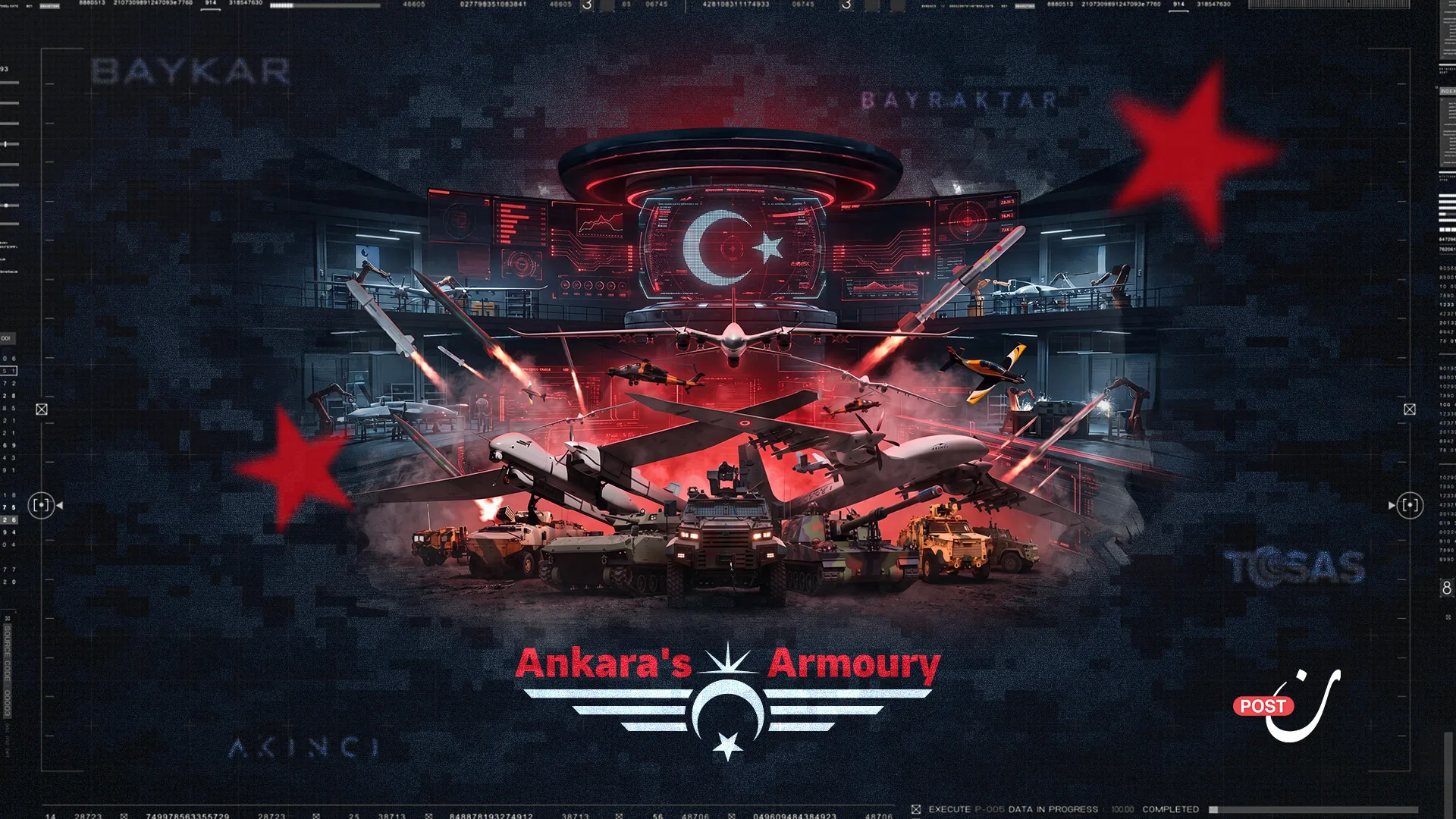
The rise of Türkiye’s defence industry is not the story of a single company or weapons system. It is a long process through which the state has sought to regain control over its defence decisions and reduce its dependence on foreign suppliers. Noon Post’s series “The Republic’s Arsenal” traces the sector’s development from its beginnings to its modern rise, examining its main milestones, national companies and role in redefining Turkish power in the region and beyond.
From dependence to domestic production: Milestones in Türkiye’s military development
1. 1923–1947: A new republic wary of relying on a single supplier
Between 1923 and 1947, Türkiye’s approach to arms procurement was shaped by three main factors: historical experience, the international arms trade between the two world wars, and the availability of favourable financing from arms suppliers.
The experience of the late Ottoman Empire had left the new republic with a clear lesson: relying on a single arms supplier opens the door to influence by major powers, while an alliance with a stronger power may cost the smaller partner some of its sovereignty. Ankara therefore initially avoided alliances or arms deals that could compromise its independent decision-making.
But the interwar arms trade constrained Türkiye’s options. Germany was formally excluded by the restrictions imposed under the Treaty of Versailles, while Britain and France were not interested in supplying Türkiye with weapons at affordable prices or on suitable credit terms.
Neither country yet regarded Ankara as a politically and economically reliable customer, so it increasingly turned to Italy and the Soviet Union to meet its needs.
Despite the formal restrictions on Germany, Berlin remained involved through indirect channels. In 1925, Türkiye ordered two coastal submarines from a Dutch shipyard established by German shipbuilders to circumvent the Versailles restrictions. Built in Rotterdam, the submarines entered service in the Turkish Navy in 1928 as Birinci Inonu and Ikinci Inonu.
In 1926, the German company Junkers established an assembly plant in Kayseri, Türkiye, to preserve German expertise in military aircraft production. The plant assembled military and civilian aircraft to meet Turkish orders, although the project ultimately failed.
At that stage, Türkiye’s defence industry was modest, consisting largely of factories producing small arms and ammunition. German involvement was evident in the companies manufacturing weapons and ammunition for Ankara. This industrial base was largely sufficient for an army dominated by infantry and cavalry.
The Turkish army was introduced to mechanised warfare through an experimental unit equipped with T-26B tanks and BA-6 armoured cars acquired from the Soviet Union in 1934. But the transition from an army dependent on manpower and horses to a mechanised force was difficult and costly, increasing reliance on foreign suppliers.
On the eve of the Second World War, Ankara found in Britain a European supplier willing to sell arms on generous credit terms. London also helped revive Türkiye’s aircraft manufacturing capacity through the licensed assembly of Miles Magister training aircraft in Ankara.
During the war, Turkish diplomatic manoeuvring enabled Ankara to obtain weapons from France, Germany and Britain. It ordered four submarines from the German company Krupp, two to be built in Germany and two in Türkiye.
But Türkiye’s signing of a tripartite alliance treaty with France and Britain in October 1939 accelerated deliveries of British and French tanks and aircraft, and prompted Nazi leader Adolf Hitler to suspend arms supplies to Ankara.
Türkiye remained neutral throughout the war, but became a recipient of the US Lend-Lease programme in 1942. This marked the beginning of its shift from a customer of arms manufacturers to a recipient of US military aid, a development that would later have a profound effect on domestic industry.
2. 1947–1964:Türkiye as a recipient of US military aid
The Cold War fundamentally changed the forces shaping Turkish foreign and defence policy. Following the announcement of the Truman Doctrine in 1947, under which Washington pledged to support Türkiye and Greece against Soviet pressure, the flow of US military equipment to Ankara accelerated.Türkiye’s focus shifted from domestic production to operating and maintaining US equipment.
In the 1940s,Türkiye had a limited capacity to manufacture training aircraft domestically, including the MKEK-4 Uğur, copied from the British Miles Magister. But these efforts declined as T-6 Texan training aircraft arrived from US stockpiles, making it easier to operate the incoming equipment than to develop domestic production.
The domestic political climate also discouraged investment in the defence industry. After Türkiye moved to a multiparty system in 1950, then-Prime Minister Adnan Menderes preferred to direct resources towards voters’ needs rather than long-term military investment.
Relying on US military aid in exchange for Türkiye’s accession to NATO was the easiest way to maintain a large army. But it came at the expense of domestic industry, creating extensive dependence on the US not only for equipment purchases but also for maintenance and logistics.

The scale of this dependence is evident in the quantities of US weapons that later reached Türkiye: 3,085 M48 and M48A2C Patton tanks between 1963 and 1970, and about 260 F-100C/D/F Super Sabre aircraft between 1958 and 1973.
The 1960 coup and Menderes’s execution did not change this course. His successors continued to rely heavily on US assistance. But the 1962 Cuban missile crisis and Washington’s decision to remove Jupiter nuclear missiles from Türkiye, despite Ankara’s initial reservations, exposed tensions in the relationship.
In the 1960s, Washington began changing its approach to military aid, turning recipients from grant beneficiaries into customers through credit arrangements and foreign military sales. At almost the same time, Ankara faced the harshest consequence of its dependence on Washington.
During the 1963–1964 Cyprus crisis, then-US President Lyndon Johnson sent a sharply worded letter to then-Prime Minister Ismet Inonu, dissuading him from military intervention on the island and reminding Ankara that it could not use US weapons and equipment in emergencies outside the NATO framework.
3. 1964–1973: Limited efforts towards strategic independence
As the Cyprus crisis developed, Turkish governments sought broader military capabilities to support their diplomacy. They diversified suppliers and began producing small-calibre rifles and support weapons under German and US licences.
They also established institutions for each branch of the armed forces to raise money from the public to produce equipment for national emergencies.
Türkiye began showing interest in joint projects with its European NATO allies. It proposed, for example, manufacturing wingtip rocket launchers for the F-104G Starfighter as part of a European consortium. The US rejected the proposal because the component was considered too advanced for Türkiye’s aircraft industry at the time.
In the 1960s and 1970s, the Turkish armed forces underwent a partial transformation in preparation for future crises in Cyprus. The navy began a programme to build a fleet of landing ships.
During this period, engines from decommissioned tanks were adapted to power locally built landing ships, and Turkish naval shipyards built two escort destroyers based on a US design. The Cyprus crisis thus pushed the navy to develop domestic solutions earlier than some other branches of the military.
4. 1974: A turning point in arms restrictions
Another decisive moment came in 1974, when Ankara launched a military operation in Cyprus in response to a coup orchestrated by the Greek military junta. The subsequent US arms embargo caused serious problems in supplying and maintaining the Turkish military.
Although Germany stepped in to fill part of the gap, Ankara concluded that building a strong national defence industry was the only long-term option.

Shortly after the operation, the Turkish Air Force bought 18 F-104S Starfighter fighter jets from Italy. Although the aircraft was of US origin, this version was the first new combat aircraft Türkiye had purchased from a European manufacturer since 1947.
Türkiye then explored options for jointly producing a European design, such as the SEPECAT Jaguar, Aermacchi MB-326/339 and Panavia Tornado. But the search for alternatives to US aircraft was short-lived, losing momentum after the embargo was lifted in 1978.
A new internal threat was taking shape with the founding of the Kurdistan Workers’ Party, or PKK, in 1978. The military implications of confronting it had not yet fully emerged. From the mid-1980s, however, the conflict would become one of the factors pushing Türkiye to seek capabilities beyond conventional heavy weaponry.
The US embargo left a deep scar on relations with Türkiye and made self-sufficiency in arms a long-term goal.
Ankara began prioritising domestic production of key components whose absence had left some weapons systems inoperable during and after the Cyprus operation. It also expanded its military repair and maintenance network to improve its ability to keep equipment operational.
These institutions were later brought together under the Turkish Armed Forces Foundation, or TSKGV, in 1987. The foundation would become one of the means through which Türkiye built a new industrial base for its defence sector.
The institutions provided the initial capital for companies such as ASELSAN, HAVELSAN, TUSAŞ and ASPİLSAN, which would later form the nucleus of Türkiye’s defence industry.
5. The 1980s: F-16 production comes to Türkiye
Despite the political and economic turmoil of the 1970s, reducing dependence on foreign powers remained a priority in Türkiye. After the 1980 coup, military leaders took this approach a step further, pushing for the domestic production of advanced military systems.
In the final years of the Cold War, Türkiye’s strategic value to Washington increased, particularly after the 1979 Iranian Revolution. This enabled Ankara to secure unprecedented industrial, technological and financial benefits from the US.
The most notable was the 1983 agreement with US defence company General Dynamics, then the owner of the F-16 programme, to produce F-16C/D Block 30/40 fighter jets under licence inTürkiye.
The work was divided between two facilities. The first, in the Akıncı/Mürted area near Ankara, handled the final assembly of aircraft fuselages. The second, in Eskişehir, formed part of a joint project with US aircraft engine specialist General Electric.
At the heart of this transformation was Turkish Aerospace Industries, or TUSAŞ/TAI. Founded in 1973 to reduce Türkiye’s dependence on foreign defence suppliers, its practical importance became clear with the F-16 programme in the 1980s.
Rather than simply buying finished aircraft, Ankara became involved in domestic manufacturing, assembly, systems integration and testing. Türkiye took an important step from direct procurement to licensed production, but remained far from controlling the full design, the engine or decisions on upgrades.
The F-16 deal was an important milestone. It showed that Türkiye could purchase major equipment of its own choosing while incorporating its emerging industrial and technological capabilities into the agreement.
Joint production also helped train a skilled workforce and introduce industrial management, process control, quality assurance and integrated logistical support. The effects extended beyond aviation to the wider defence industry and other technology sectors.
6. Özal and SSM: The state takes a larger industrial role
The Motherland Party’s election victory in 1983 and the appointment of its leader, Turgut Özal, as prime minister marked another turning point. With his background in liberal economics, Özal sought to open up the Turkish economy and reduce the military’s influence over politics and the economy. The defence sector was among the first to feel the effects.
Until then, Türkiye’s defence efforts had centred on military maintenance facilities, shipyards and a limited number of state-funded institutions, all controlled by the armed forces.
From 1985, however, Özal gave the private sector a greater role within a broader defence strategy. He encouraged domestic investors to work with foreign partners to establish “technology transfer” companies and “joint ventures” that would bring in skills, technology and capital.
Özal approached the defence industry in terms of economic costs and benefits, guided by the view that “if large sums must be spent on the military’s needs, it is better for them to be directed to local industry,” thereby reducing the impact of defence spending on the budget, boosting employment, attracting investment and technology, and supporting economic growth.
In 1985, a new government agency was established: the Undersecretariat for Defense Industries, or SSM. It was responsible for tenders, contracts for major programmes, and oversight of production and delivery. In practice, SSM was put in charge of managing, planning and financing the entire defence industry, including research and development, offset programmes and export promotion.

SSM’s staff were entirely civilian, bringing civilian expertise into defence technology and procurement for the first time. The agency also began taking its instructions from the Defense Industry Executive Committee, or SSİK, chaired by the prime minister, rather than directly from the military. This gave the political leadership primary authority over the sector.
Özal also introduced an off-budget funding mechanism for SSM through taxes on alcohol, tobacco, betting and football matches. These revenues accounted for between one-third and one-half of Türkiye’s defence equipment spending at the time, giving SSM a stable source of funding for multiyear contracts.
The shift led to the establishment of about six joint ventures, each dedicated to a joint production programme or a particular category of defence products. Some survive today, while foreign or private stakes in others were later transferred to companies controlled by the Turkish Armed Forces Foundation. Under this model, European defence contractors began entering a Turkish market previously dominated to a large extent by the US.
7. The PKK: A war that changed Türkiye’s weapons needs
After its founding in the late 1970s, the Kurdistan Workers’ Party spent years organising, mobilising and engaging in limited clashes. The confrontation widened when it launched organised armed operations in 1984. Ankara found itself fighting a long war in the country’s southeast, unlike the conventional wars for which armies built around heavy weaponry had been prepared.
In the mountains, along the borders and across rugged terrain, forces urgently needed constant surveillance, secure communications, vehicles that could protect soldiers from ambushes and mines, and the ability to move quickly through difficult areas. These requirements began shaping military demand, later reflected in drones, tactical armoured vehicles, radars and command-and-control systems.
While many NATO allies cut defence spending after the Cold War, Türkiye bought equipment to confront the PKK and respond to any threat from Greece amid tensions over the Aegean Sea and Cyprus.
The new international environment, however, made European and US allies more hesitant to supply Türkiye promptly. Citing a desire to reduce Turkish-Greek tensions and their lack of support for Ankara’s war against the PKK, they delayed or refused some orders.
Switzerland, Norway and Germany took positions that extended to withdrawing from contracts for rifles, missiles and ships. The administration of former US President Bill Clinton refused to sell attack helicopters and surplus frigates to Ankara.
These restrictions deepened Ankara’s sense of isolation. Türkiye had already felt this during the 1991 Gulf War, when some NATO allies questioned the extent to which Article 5, on collective defence, applied to it.
That sense of isolation strengthened the resolve of military leaders and policymakers to develop domestic production. Instead of relying on off-the-shelf purchases, Türkiye increasingly turned to joint projects and licensed production as a less vulnerable option. These brought some manufacturing and maintenance into the country, rather than leaving the entire weapons system dependent on a foreign supplier.
The European Stinger programme, which produced man-portable air defence systems, was an important example. Türkiye held the largest share, at 40.5 per cent, and established Roketsan to carry out its portion of the work. About 14,000 missiles were produced between 1988 and 2003, laying a strong foundation for Türkiye’s missile industry.
Türkiye’s participation in the European A400M transport aircraft programme provides another example of multilateral cooperation. Despite cost overruns and delays, it gave Turkish industry a larger role in aircraft design and development.
Even the F-35 programme, whichTürkiye joined in 1999 as a Level 3 partner, appeared for a time more resilient to fluctuations in US-Turkish relations. That lasted until Türkiye was removed from the programme in 2019 over its purchase of the Russian S-400 system.
Türkiye also sought suppliers outside Europe and North America. Israeli contractors benefited from Turkish defence programmes from the mid-1990s until cooperation ended abruptly after the clash between then-Prime Minister and current President Recep Tayyip Erdogan and then-Israeli President Shimon Peres at the 2009 World Economic Forum in Davos.
Ankara also moved closer to China to acquire expertise and materials related to ballistic missiles. In the 1990s, it obtained equipment from Russia through a barter deal to settle debts owed to Moscow.
Despite the growth of joint projects and the first export orders, the increasing involvement of private companies and foreign investors, alongside the expanding role of civilian institutions in defence procurement, provoked a backlash from the armed forces and the old defence establishment.
After Özal’s death in 1993, pressure on SSM increased. It peaked after the “postmodern coup” in 1997, when senior officers sought to return the agency to the military-controlled Defence Ministry.
Procurement decisions subsequently favoured off-the-shelf purchases, public and military institutions, and US and Israeli contractors. SSM’s fund also suffered during the economic crisis as governments used it to cover budget deficits. New projects involving helicopters, tanks, drones and electronic warfare equipment came to an almost complete halt.
8. After 2002: Recovery
Türkiye’s defence industry began recovering from the upheavals of the 1980s and 1990s with the Justice and Development Party’s victory in the 2002 elections. In its early years in power, the party pursued political and economic liberalism, sought European Union membership and remained committed to the strategic partnership with Washington.
At the same time, it worked to bring the armed forces under greater political control, giving the defence industry and SSM a new direction. This approach differed from the joint-project and technology-transfer model that had prevailed over the previous two decades.
In 2004, following the appointment of an SSM chief with direct experience in the defence industry, Ankara announced a new phase of “local solutions”. The aim was to support the development of new defence products in Türkiye by both public and private companies, with SSM funding research and development, to end dependence on foreign suppliers and their governments.
The process was difficult: domestic production meant delaying equipment deliveries that the military wanted quickly. But the 2000s provided favourable conditions.
The PKK threat had eased somewhat. Rapprochement with Greece began after the 1999 Izmit earthquake through what became known as “earthquake diplomacy,” Russia faced economic and political difficulties, the US had toppled Saddam Hussein’s regime in Iraq, and tensions with Syria had eased.
This relative calm gave Türkiye time to invest in domestic tank, drone and attack helicopter programmes. Economic growth in the 2000s helped finance these ambitions, while abundant liquidity in international markets and foreign investment inflows strengthened Ankara’s ability to invest in the sector.
Over time, the defence industry became more than a military necessity. Governments also used it for domestic political purposes, presenting it as evidence of independence, capability and industrial achievement.
The practical turning point came at the 14 May 2004 meeting of the Defense Industry Executive Committee, or SSİK. Programmes based primarily on off-the-shelf foreign purchases, including main battle tanks, attack helicopters and drones, were cancelled and replaced with programmes involving extensive domestic development. Projects such as the Altay tank, T129 ATAK helicopter, Anka drone and MilGem corvette later emerged from this approach.
9. Bringing the industry under national ownership and control
This phase also brought efforts to restructure the defence industry. SSM sought to reorganise the main contractors and other major companies, open the sector to small and medium-sized enterprises, and buy out foreign investors’ stakes in joint defence ventures.
In 2005, SSM and TUSAŞ purchased US defence company Lockheed Martin’s shares in TAI, which was renamed Turkish Aerospace Industries.
This period also saw stakes in joint ventures with foreign partners return to Turkish ownership. The French partner’s stake in Thomson Tekfen Radar was transferred to HAVELSAN, a Turkish-French company established in 1990 to produce long-range early warning radars under a technology-transfer arrangement. It was later restructured as Havelsan Teknoloji Radar.
ASELSAN similarly absorbed MİKES, which specialised in electronic warfare, radar and intelligence systems, including self-protection systems for F-16 aircraft.
These changes reflected the broader trend in the second half of the 2000s: strengthening national control and prioritising domestic solutions over reliance on foreign partners.
The ATAK project illustrates this approach. Türkiye selected the Italian A129 Mangusta helicopter but equipped it with ASELSAN avionics and Roketsan weapons systems, while TUSAŞ handled domestic manufacturing and development.
The programme later paved the way for indigenous helicopter projects such as Gökbey. The same approach shaped the MilGem naval project: the corvette was designed around the indigenous GENESIS combat management system, with domestic contributions to design, engineering and some subsystems. Major components, including sensors, propulsion plants and machinery, remained imported.
The share of domestic content increased in subsequent ships through the involvement of shipyards and small and medium-sized enterprises. The experience paved the way for later naval programmes, including the İstif frigate, Ufuk intelligence ship and Hisar patrol vessels, as well as export versions of MilGem for Pakistan and Ukraine.
10. Building the platform first, then its components
A central pattern emerged in Türkiye’s approach to domestic production: build the platform first, then develop its components. Türkiye would begin with a major military platform, such as a helicopter, ship or drone, and gradually increase the proportion of domestically produced systems within it.
This approach produced prominent defence projects such as ATAK, Anka and MilGem. But it did not end Türkiye’s dependence on foreign sensors, engines, propulsion systems and some subsystems.
These platforms also became domestic political symbols. With the memory of embargoes and dependence on foreign suppliers still strong, the government presented domestic defence projects as proof of self-reliance.
Figures on projects, revenues, exports, employment and domestic content also entered political debate. By the early 2010s, programmes such as MilGem, ATAK and Anka were beginning to deliver tangible results.

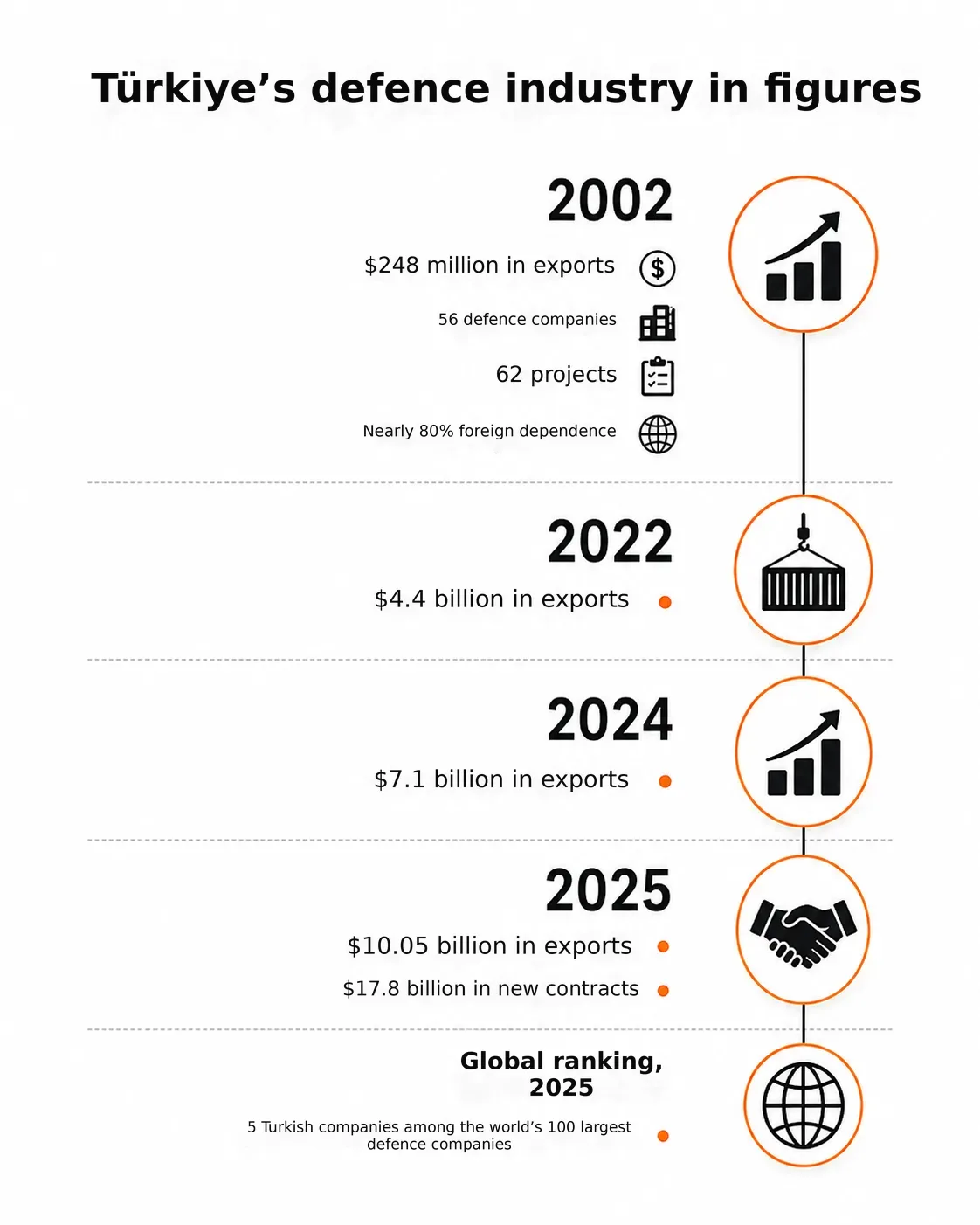
The growth is also evident at company level. Five Turkish firms appeared in the 2025 Defense News ranking of the world’s top 100 defence companies: ASELSAN in 43rd place, TUSAŞ in 47th, Roketsan in 71st, ASFAT in 78th and MKE in 80th.
ASELSAN’s defence revenue in the ranking was about $3.54 billion, reflecting the shift of some Turkish companies from a domestic focus towards a larger role in the global defence industry.
Private companies’ figures reveal another aspect of this transformation. Baykar’s revenue reached about $2 billion in 2023, according to its chief executive, with exports accounting for roughly 90 per cent of sales.
But the figures also reveal the limits of this growth. Türkiye still needed an agreement with the US to buy 40 F-16 Block 70 fighter jets. The deal was subsequently scaled back, with 79 modernisation kits cancelled. The upfront payment was $1.4 billion, and the reduced agreement was valued at around $7 billion.
Domestic industry has therefore expanded without ending the air force’s dependence on a US supplier for advanced fighter aircraft. In air defence, Türkiye signed contracts worth $6.5 billion to strengthen the Steel Dome project, which includes 47 components.
The domestic content ratio, often cited at around 80 or 82 per cent, measures the growing contribution of Turkish industry to systems and procurement. By itself, however, it does not resolve questions about engines, sensors, chips, propulsion systems, software and licensing.
The state and companies behind Türkiye’s defence industry
Past shocks and Western restrictions fuelled Türkiye’s determination to manufacture its own weapons. They also prompted it to reshape the relationship between the state and the defence industry, treating the sector as a project central to national sovereignty.
At the centre of this structure is the Presidency of Defense Industries, or SSB. It sets priorities, launches major programmes, manages procurement and translates military needs into viable industrial projects, connecting the parties involved.
The Turkish Armed Forces Foundation, or TSKGV/TAFF, plays an equally important role. It holds influential stakes in major companies including ASELSAN, TUSAŞ, Roketsan and HAVELSAN. This gives the military establishment and the state a direct presence in the companies producing radars, aircraft, missiles and military software.
The strength of this national model lies in ownership and the close relationship between manufacturing and military operations. The Turkish military does more than buy finished products: it uses and tests systems in domestic and overseas operations, then works to develop them into products that can be exported.
Alongside this state-linked group, companies with greater flexibility in innovation and marketing have emerged. Together, the companies operate within a single system, playing complementary roles.
Baykar: The most prominent name in Turkish drones, thanks to the Bayraktar TB2 and Akıncı, followed by newer models such as the TB3 and Kızılelma.
The TB2 has entered service, been exported and been used in the field. The TB3 and Kızılelma are still at a more advanced stage of development and have not yet reached the same level of operational maturity.
TUSAŞ/TAI: Its work spans military aviation, from the KAAN national fighter jet and Hürjet light attack trainer to the ANKA, Aksungur and ANKA III drones.
The company embodies Türkiye’s most ambitious aerospace projects. Its work extends beyond drones to building national capabilities in aircraft, helicopters and space.
TEI, TRMotor, Kale and BMC Power: These companies work in the more sensitive fields of engines and propulsion systems.
Türkiye’s ambitions in fighter jets, drones, helicopters, tanks and missiles ultimately depend on engines: the ability to power a system domestically rather than remain dependent on a foreign supplier.
Roketsan: The company provides Türkiye’s strike capabilities, from guided munitions to tactical and naval missiles such as ATMACA. Its importance lies in giving domestic systems precision-strike capabilities beyond transport or reconnaissance, so that a drone, ship or armoured vehicle is more than a platform for carrying equipment.
MKE and TÜBİTAK SAGE: MKE provides the traditional manufacturing base for munitions, artillery and weapons. TÜBİTAK SAGE specialises in research and development, guidance systems and advanced munitions.
ASELSAN: The company is close to the centre of Türkiye’s defence electronics sector, working on radars, communications, electronic warfare, sensors and air defence components. It gives Turkish systems the ability to detect, communicate and direct strikes.
HAVELSAN and Meteksan Defense: HAVELSAN works in military software, command and control, simulation and battle management systems. Meteksan Defense operates in radars, sensing and specialised systems. Together, they represent a less visible part of Türkiye’s defence industry: managing data during combat.
Otokar, BMC, FNSS, Nurol Makina and Katmerciler: These companies form Türkiye’s armoured and tactical vehicle sector, one of its most established defence export sectors, particularly in light and medium armoured vehicles.
STM, ASFAT, TAIS and Sedef: These companies work on programmes involving ships, frigates, warships, landing vessels and naval modernisation.
Türkiye’s ambitions extend beyond building hulls to integrating combat management systems, radars, weapons and software into a single naval capability. The sector’s importance is evident in Türkiye’s ambitions in the Black Sea and eastern Mediterranean.
The strengths and limits of Türkiye’s defence industry
Türkiye’s strengths today lie in five interconnected areas, shown in the following infographic.
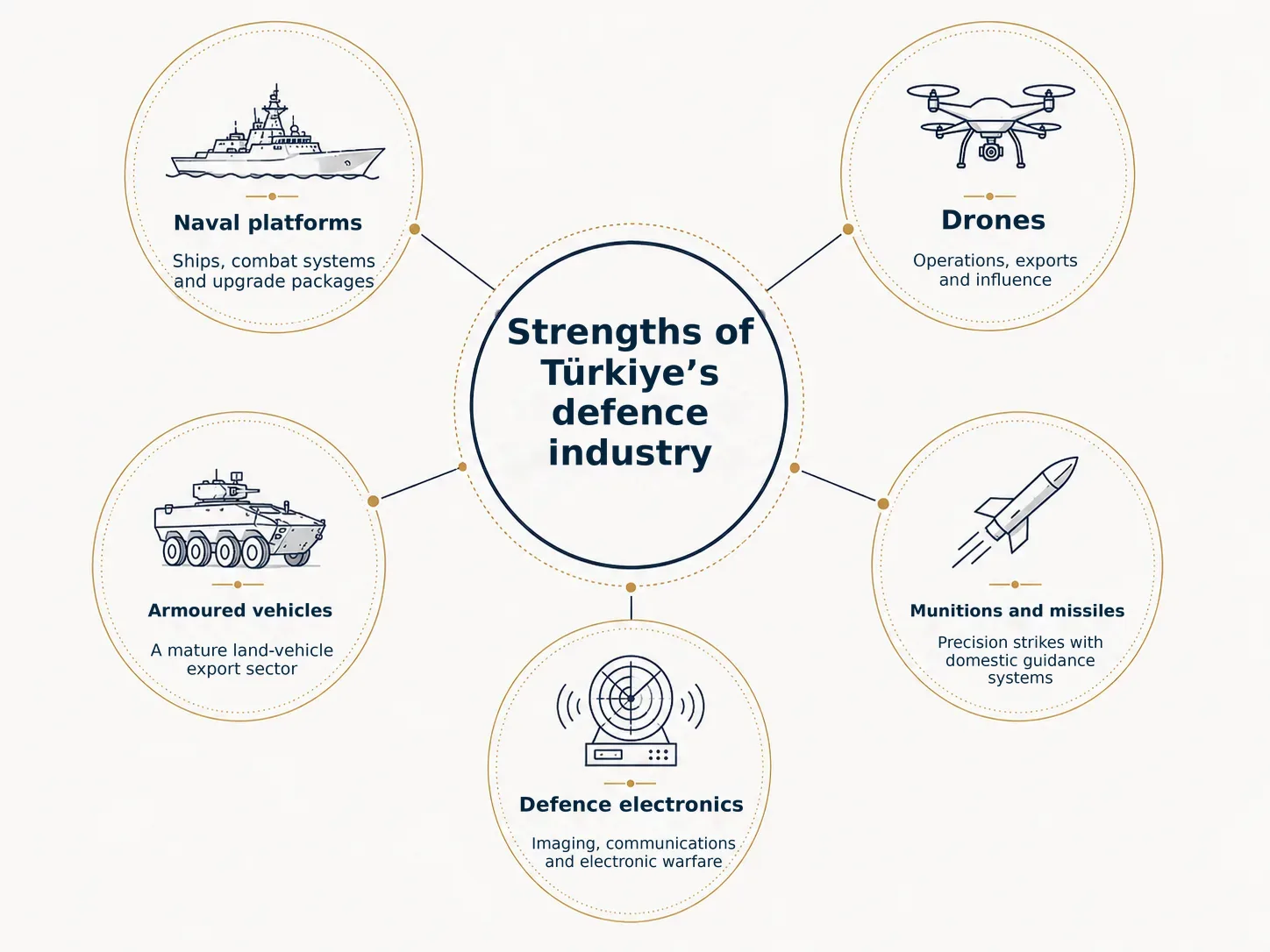
More significant than these sectors combined is Türkiye’s ability to sell more than individual components. It can now offer an integrated package that includes a product, its munitions, training and subsequent maintenance.
The value of the defence industry lies not only in what it provides to Türkiye’s military, but also in the relationships it helps establish, as developments in several countries show.
This influence first emerged in Azerbaijan, where Turkish weapons became part of a clearly defined military and political alliance after the Karabakh war. In Ukraine, Turkish drones gave Ankara a distinctive role, making it a security partner for Kyiv without severing its ties to Moscow.
In Pakistan, the relationship extends beyond a single product to naval projects, upgrades and industrial cooperation. Turkish companies also operate in Africa, the Gulf, Central Asia and the Balkans, offering a cheaper, more flexible alternative to Western weapons and competing with some Russian and Chinese products.
Türkiye is thus selling not only weapons but also training, maintenance and partnership, linking other militaries to its technical and political system. This makes the defence industry as much a foreign policy tool as an economic sector.
But the picture is incomplete without examining the gaps. The greatest test of Türkiye’s defence independence today lies not in the external structure of an aircraft, tank or ship, but in what makes it work: engines, propulsion systems, sensors, chips, and operating and guidance software.
In aviation, the KAAN programme remains the clearest example. The national fighter reflects a genuine Turkish ambition, but it does not yet provide a fully independent operational capability. Its domestic engine and mass-production line are still under development, and work towards combat readiness continues.
On land, the Altay tank illustrates the limits of Turkish independence in heavy systems. Although it has entered production, its initial versions still depend on a foreign powerpack comprising the engine and transmission. A shift is planned to the domestic BATU powerpack being developed by Türkiye’s BMC Power.
In air defence, the Steel Dome project reflects a clear ambition to build a multilayered Turkish network integrating radars, missiles and command-and-control centres. But it remains under construction.
A system may therefore be designed and assembled in Türkiye, yet restrictions on a single component, such as an advanced camera, chip or composite material, can disrupt its operation or delay production.
The production line presents the next, and hardest, test. Many projects attract attention through a prototype or successful trial. Real strength depends on producing sufficient quantities, delivering on schedule, maintaining consistent operational quality and securing customers abroad.
Türkiye’s advances in defence manufacturing do not mean it has achieved full independence. They do, however, confirm that Ankara now has more extensive production capacity, more alternatives and greater bargaining power.
Between these achievements and the remaining gaps, Anatolia’s long arm is taking shape. Türkiye’s transformation is incomplete, but it has already changed Ankara from a major arms buyer into an increasingly important manufacturer of the tools of military power.