











هذا التقرير متاح أيضًا بـ العربية
Qatar is the world’s fourth-largest arms importer, having spent billions of dollars modernising its armed forces with Western fighter jets, warships, and air and missile defence systems. Its domestic military industry has begun to expand in recent years but remains limited relative to the size of Doha’s arsenal.
Iranian attacks on Gulf states during the 2026 war have revived questions about reliance on foreign suppliers, particularly as energy facilities and shipping lanes faced widespread disruption.
On 19 October 2026, Qatar’s deputy prime minister and minister of state for defence affairs, Sheikh Saud bin Abdulrahman Al Thani, said his country was preparing to announce a domestic defence production hub. The project would involve a regional partner and companies from the US, Britain and France, with a focus on countering ballistic missiles, drones and cyberattacks.
The initiative follows years of Qatari investment in factories producing ammunition, small arms and military systems. It comes amid questions about Doha’s ability to expand production and reduce its dependence on foreign weapons, given the experiences of Saudi Arabia and the UAE. Both have made progress in defence manufacturing, although challenges involving technology transfer, personnel and supply chains persist.
Where does Qatar get its weapons?
Qatar was the world’s fourth-largest importer of major arms in 2021–2025, accounting for 6.4 per cent of global imports, behind Ukraine, India and Saudi Arabia, according to a report published by the Stockholm International Peace Research Institute in March 2026.
Qatar’s imports rose by 106 per cent compared with 2016–2020, following deliveries of large numbers of fighter jets and warships ordered in previous years. Imports across the Middle East fell by 13 per cent over the same period. Doha had been the world’s third-largest importer in 2020–2024 before moving to fourth place in the latest ranking.
The US accounted for 48 per cent of Qatar’s imports of major arms in 2021–2025, followed by Italy at 21 per cent and Britain at 17 per cent. France and Germany were important suppliers of other systems.
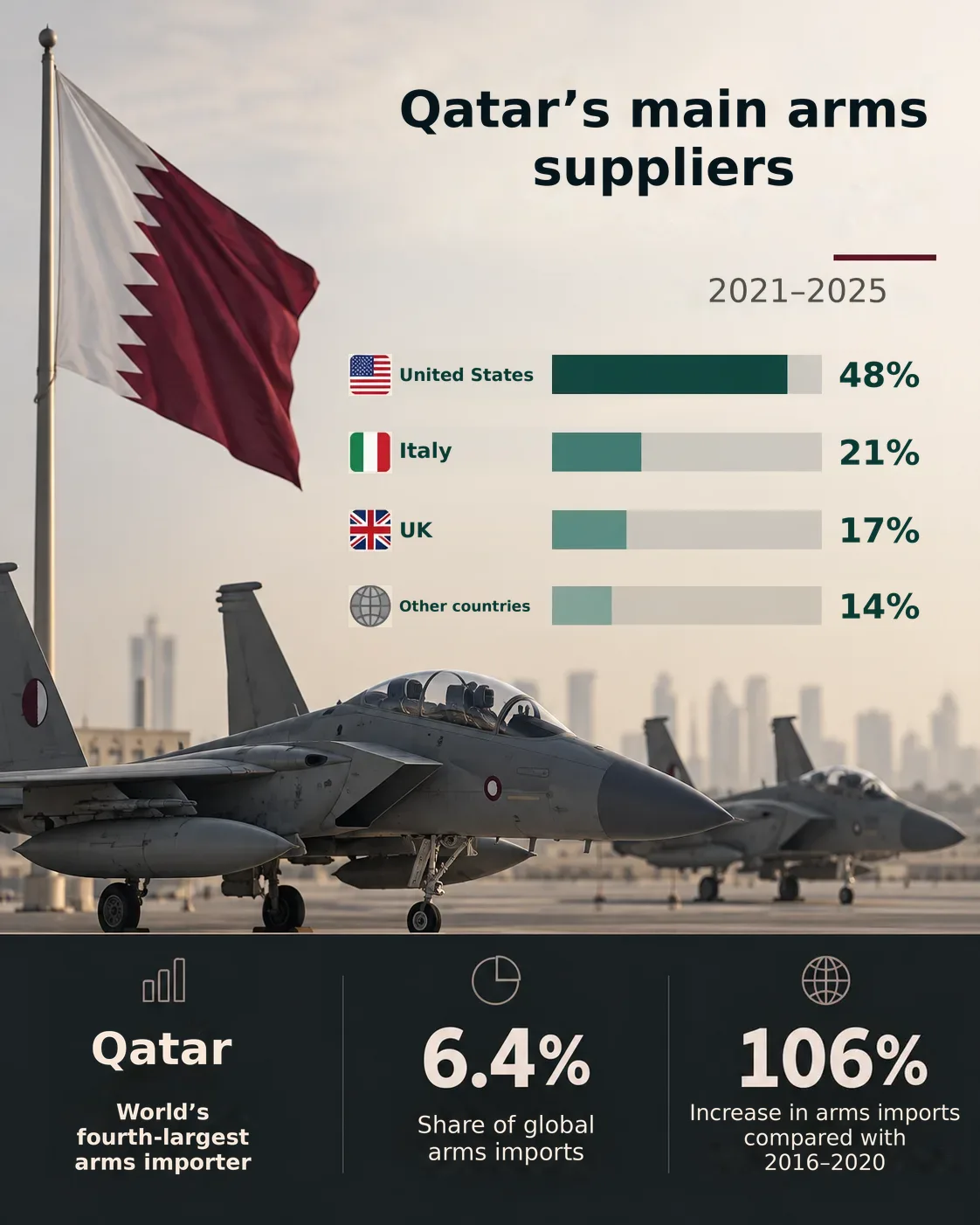
Over those five years, Qatar received 100 combat aircraft: 48 American, 33 British, 13 French and six Italian, as well as five major warships from Italy. Qatar also accounted for 7.4 per cent of total US arms exports worldwide during the same period.
Qatar’s modern air force relies on three main types of fighter jet: the F-15QA, produced by US aircraft manufacturer Boeing; the Rafale, made by France’s Dassault Aviation; and the European Typhoon, which Britain’s BAE Systems helps produce as part of a European consortium.
One of Qatar’s largest arms deals dates back to November 2016, when the US State Department approved a possible sale of up to 72 F-15QA fighter jets, together with weapons, equipment, support services and training, at an estimated cost of $21.1 billion. That figure was the estimated ceiling set out in the US approval, before the final value of the contracts was determined.
In May 2015, Qatar signed a deal to buy 24 French Rafale fighter jets for about €6.3 billion, including weapons and training. It exercised an option to purchase another 12 aircraft in December 2017, bringing its total order to 36.
Britain announced in September 2018 that a contract worth nearly £5 billion to supply 24 Typhoon fighter jets and nine Hawk training aircraft had come into force. The deal included support and training services.
Purchases also extended to the navy. In June 2016, Qatar signed a contract worth about €4 billion with Italian shipbuilder Fincantieri for seven warships: four corvettes, one amphibious landing ship and two offshore patrol vessels. The deal also covered technical support and maintenance services in Qatar.
Purchases of land systems included a German deal worth about €1.89 billion to supply 62 Leopard 2A7 tanks and 24 PzH 2000 self-propelled howitzers. For air defence, Doha contracted with Raytheon, part of RTX, for Patriot and NASAMS systems. In July 2019, the company announced that it had signed a contract worth about $1.8 billion to supply NASAMS.
Purchases from the US continued in recent years. On 26 March 2025, the US Defense Security Cooperation Agency announced approval of a possible sale of eight MQ-9B drones, together with weapons, sensors and technical support, at an estimated value of $1.96 billion. The letter of offer and acceptance was signed during President Donald Trump’s visit to Doha in May 2025.
In the latest deals, Raytheon said on 13 October 2026 that it had received contracts worth a combined $729 million to supply the US military, Qatar and Jordan with components of the LIDS counter-drone system, including KuRFS radars and Coyote interceptors. It did not specify the value of Qatar’s share.
These purchases mean that operating most of Qatar’s fighter jets, air defences and warships depends on foreign supply chains for spare parts, ammunition, training and technical upgrades. This dependence is particularly significant given Doha’s possession of advanced systems from several countries with different maintenance and armament requirements.
How far has Qatar’s military industry progressed?
Qatar began building an institutional framework for its defence industry in 2016 by establishing Barzan Holdings as the defence ministry’s investment and commercial arm. It officially launched the company at the Doha International Maritime Defence Exhibition and Conference, DIMDEX, in March 2018 to oversee industrial projects, foreign partnerships and military technology transfer.
During the 2018 exhibition, Barzan signed an agreement with Italy’s Beretta Holding, which specialises in small arms, to establish a joint venture called Benedge. The agreement included plans to manufacture pistols and rifles in Qatar’s Barzan Industrial Zone.
Bariq was established that same year in partnership with Turkish defence electronics company Aselsan and SSTEK, a Turkish company focused on developing military industries. The ownership stakes were 51 per cent for Barzan, 48 per cent for Aselsan and 1 per cent for SSTEK.
Bariq works on command-and-control systems, thermal and night-vision cameras, encryption technologies and remotely controlled weapon stations as part of projects to develop military electronics and systems in Qatar.
One of the most prominent examples of existing domestic production is the Barood Ammunition factory, wholly owned by Barzan Holdings. It produces NATO-standard ammunition in 9mm, 5.56mm, 7.62mm and 12.7mm calibres, including conventional, training and tracer rounds.
On its official website, the factory distinguishes between ammunition it manufactures and products it provides through external suppliers. The latter include sniper ammunition, some medium-calibre ammunition, tank and artillery ammunition, and hand and smoke grenades — categories beyond its publicly declared domestic production lines.
During DIMDEX 2022, Barzan Holdings vice-president and then head of strategic procurement Abdullah Hassan Al Khater said the company had displayed small arms, ammunition, and security and software systems made entirely in Qatar by Qataris, having previously imported them. He said international partnerships had helped transfer technology and establish domestic production.
Qatari projects have expanded into counter-drone systems. In October 2024, Barzan signed a memorandum of understanding with Italy’s Fincantieri to develop the Omega 360 radar. The project, estimated at about €100 million, aims to establish local production and supply of 40 radar units and integrate them into a Qatari counter-drone system. The first operational systems were expected to be produced by the end of 2026.
During DIMDEX 2026, Barzan unveiled a ground-based counter-drone system incorporating the radar. Its chief technology officer, Ahmed Ali Al Kuwari, said on 22 January 2026 that the radar could detect small drones more than 12 kilometres away and could be operated as part of a system housed in a standard container.
The company also displayed an unmanned surface vessel named Barzan, which Al Kuwari said was made entirely in Qatar and could be used for reconnaissance, surveillance and combat missions. It is equipped with a remotely controlled 12.7mm weapon station.
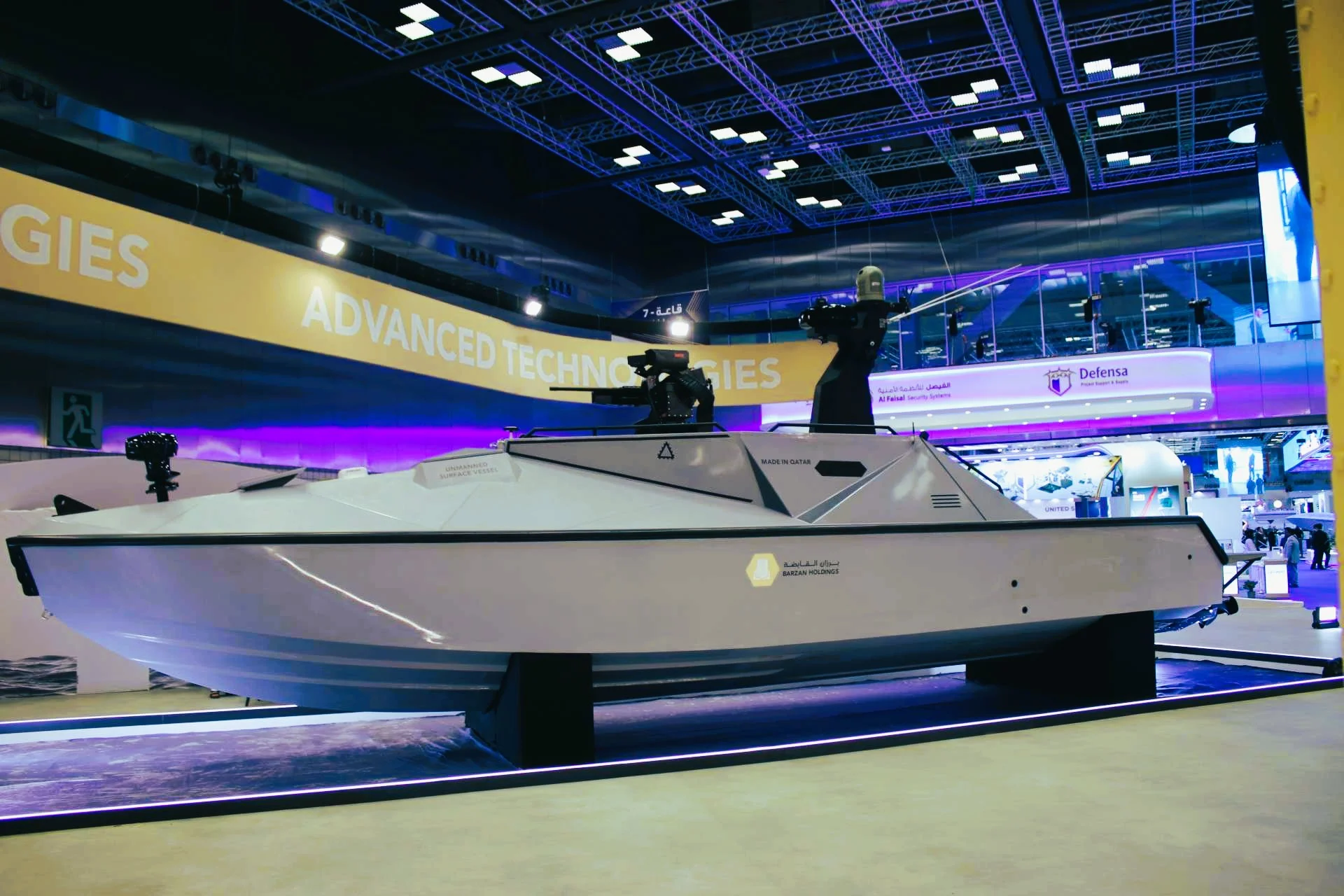
Barzan also announced the development of a domestic command-and-control system. Al Kuwari said more than 50 engineers had helped write about 250,000 lines of code to complete the system, which aims to integrate military information into a common operational picture. Assessing how far domestic manufacturing of these systems has progressed still depends on the scale of actual production, their entry into service and the origin of their main components.
At the same exhibition, Barzan’s chief commercial officer, Omar Al Qadi, said the company was moving to increase its focus on products it develops and manufactures in Qatar while continuing to expand into foreign markets. In previous years, it had focused on investing in international companies and projects.
Agreements signed in January 2026 aimed to expand domestic manufacturing. Barzan signed a letter of intent with French defence company KNDS to establish local production of medium- and large-calibre ammunition. It also signed a memorandum of understanding with Türkiye’s Mechanical and Chemical Industry Corporation, MKE, to establish a joint venture in Qatar to produce explosives, alongside arrangements to supply the Turkish Tolga short-range air defence system.
Barzan also signed agreements with Turkish defence technology company STM and Croatian drone manufacturer Orqa to explore joint production and development of drones and unmanned maritime platforms in Qatar.
Cooperation extended to US companies. Barzan signed a letter of intent with Boeing to strengthen domestic maintenance, repair and training capabilities for equipment including F-15QA fighter jets, Apache helicopters and C-17 military transport aircraft. It also signed a memorandum of understanding with US unmanned systems company General Atomics to develop military operations management software and integrate intelligence information.
Within the Gulf, UAE defence conglomerate EDGE said on 20 January 2026 that it had agreed with Barzan to establish a strategic joint venture in Qatar to develop advanced defence technologies. Cooperation between the two began with a memorandum of understanding in February 2025.
EDGE’s chief executive, Hamad Al Marar, said on 20 January 2026 that the cooperation covered missiles, unmanned systems and satellites. Albert Vidal, a researcher at the International Institute for Strategic Studies in London, said the partnership could extend to small arms and ammunition manufacturing, maintenance and drones. He suggested that EDGE would probably play a major role in providing technology and industrial expertise.
Alongside its domestic projects, Barzan expanded into foreign markets. In June 2025, it announced an agreement to supply rifles and ammunition to the Indonesian army, as well as partnerships with Indonesia’s Republikorp to develop the country’s ammunition industry.
On 20 January 2026, the Qatar News Agency announced the signing of procurement contracts worth 8 billion Qatari riyals between Barzan and Indonesia’s defence ministry. It also announced a trilateral agreement with South Korea’s Poongsan and Republikorp to establish an ammunition factory in Indonesia, and a services agreement worth 1.5 billion riyals with Singapore’s ST Engineering, which specialises in defence engineering and technology.
Barzan also announced four agreements with the Qatari armed forces worth a combined 3.3 billion riyals, covering products, support and maintenance services. In addition, it announced a $1 billion agreement with Turkish shipbuilder TAIS to supply two frigates to Indonesia, as part of its international defence procurement and partnerships.
This activity includes contracts with foreign manufacturers and production projects outside Qatar. The contribution of domestic factories to exports therefore depends on the products involved and where they are manufactured, particularly as the announced agreements did not specify the share of Qatari production in the overall deals.
The announcement of the new defence hub on 19 October 2026 followed these partnerships. The minister of state for defence affairs did not identify the regional partner or disclose the hub’s location, capital, production lines or timetable — details that will determine what it could add to existing industries.
What obstacles face domestic defence production in the Gulf?
Saudi Arabia and the UAE began developing domestic military industries before Qatar, establishing national companies, factories and joint projects with global producers. The two countries differ, however, in the size of their markets, industrial goals and progress.
In Saudi Arabia, efforts to develop domestic production gained a broader institutional framework with the launch of Vision 2030 and the establishment of Saudi Arabian Military Industries, SAMI, in 2017. The General Authority for Military Industries was established in the same year to regulate and develop the sector, attract investment and transfer technology.
The kingdom aims to direct more than 50 per cent of its military spending on equipment and services towards domestic products and services by 2030, up from about 4 per cent in 2018. According to the latest official figure published by the General Authority for Military Industries, that share reached 24.89 per cent by the end of 2024, following years of investment and partnerships with foreign defence companies.
In June 2026, the authority announced that the military industry’s contribution to GDP had risen from 2.2 billion riyals in 2021 to 6.6 billion riyals in 2024. More than 60 agreements had been activated under the industrial participation programme, which aims to direct part of defence spending towards domestic production and the transfer of expertise.
One of Saudi Arabia’s most prominent domestic manufacturing projects is an agreement signed by the defence ministry in December 2024 with Spanish military shipbuilder Navantia for three Avante 2200 warships. The first is to be delivered from Spain, with the second and third completed in the kingdom. The agreement includes local manufacture of parts of the third ship’s hull and training for more than 100 Saudi engineers.
The agreement provides for the transfer of intellectual property rights for the ship designs to the General Authority for Military Industries, allowing their use in future projects in the kingdom and for export. It also includes cooperation with Navantia on combat systems, technical support and training.
Saudi projects have also involved developing maintenance and military engine repair capabilities. Agreements with US industrial technology company Honeywell and the Saudi Middle East Propulsion Company aim to establish domestic repair and overhaul of tank engines, strengthening local capacity to keep equipment operational.
Despite these projects, Saudi Arabia was the world’s third-largest importer of major arms in 2021–2025, accounting for 6.8 per cent of global imports, according to the Stockholm institute. Its purchases of fighter jets and advanced military systems continued.
The UAE began developing its defence industry through the Tawazun programme, established in 1992, which linked part of foreign military deals to domestic investment and technology transfer.
According to an Emirates News Agency report, the programme helped launch more than 130 strategic initiatives and enabled more than 20 national companies to enter over 30 technological and industrial fields, with business packages worth 600 million dirhams.
Its projects include the development, manufacture and export of a coastal surveillance radar in cooperation with Swedish defence company Saab. They also include the establishment of a facility to produce remotely controlled weapon stations through a partnership between Emirati company Shielders and Australian military systems specialist EOS.
The UAE also announced a joint project with French defence electronics company Thales to develop a specialist radar centre in Abu Dhabi. It is expected to attract investment of 2.6 billion dirhams over 10 years and reach full operational maturity by 2035.
The establishment of EDGE in 2019 marked a new phase in the UAE’s defence industry, bringing together multiple defence and technology companies producing drones, guided munitions, radars, land and naval systems, and military software.
On 24 November 2025, the group announced that its sales for the year had reached $4.9 billion. Exports accounted for 76 per cent, or about $3.7 billion, while its international order book stood at about $21 billion. Its portfolio included more than 250 products and technological solutions.
EDGE expanded through acquisitions and international partnerships. During the Dubai Airshow in November 2025, it announced the signing of 21 agreements and joint projects with global companies, including US autonomous systems specialist Anduril, Italy’s Leonardo, US aerospace and missile company Lockheed Martin, and Türkiye’s Aselsan.
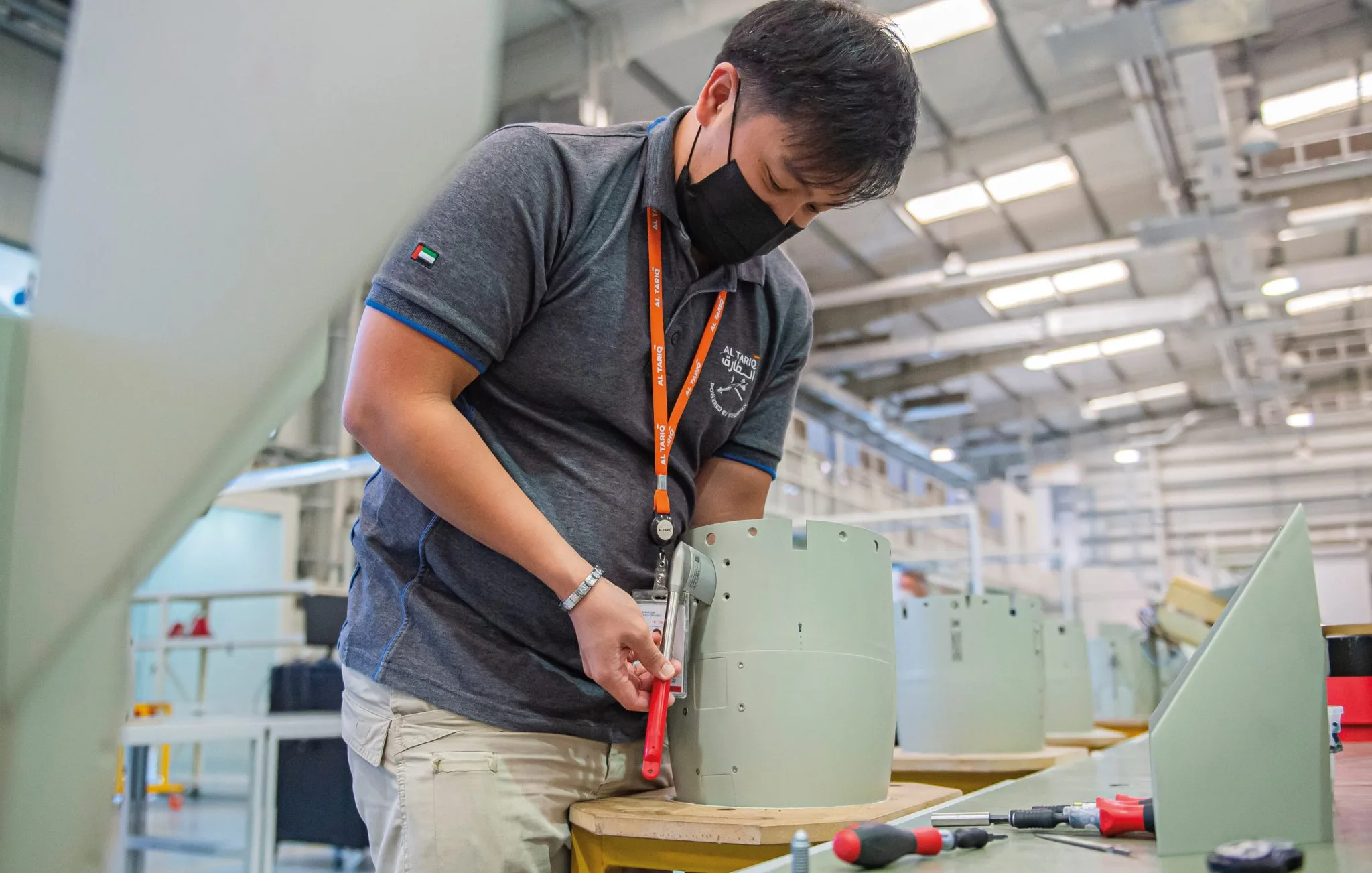
The reported export figure measures the share of EDGE’s sales made abroad, while the Saudi localisation figure measures the share of military spending directed towards domestic products and services. This is an important distinction when comparing the two countries’ progress in developing their defence industries.
Restrictions on technology transfer are among the main obstacles facing Gulf defence industries. A study published by the US Department of Commerce in February 2020 on the UAE’s offset programme identified cases in which US export controls prevented the transfer of technologies the UAE wanted to acquire. It also highlighted potential disputes over intellectual property rights and difficulties securing specialist national personnel.
These challenges are greater in advanced industries that depend on military engines, electronic chips, sensors, guidance systems and specialist industrial materials. Establishing domestic production requires a network of suppliers, technical expertise and engineering capabilities, as well as sustained demand to cover the costs of factories, testing and development.
The size of Qatar’s domestic market relative to Saudi Arabia’s poses a challenge, making exports and external partnerships more important to sustaining production lines. The UAE’s experience illustrates the role of joint projects and acquisitions in securing access to technology and markets, while Saudi figures show how long it takes to increase the share of military spending directed towards domestic products and services.
Qatar has opportunities to expand production of ammunition, small arms, some drones and counter-drone systems, as well as military software, maintenance and equipment repair services. Factories, joint ventures and development programmes already exist in these areas and offer a basis for further expansion.
By contrast, manufacturing fighter jets, military engines, advanced interceptor missiles and large combat ships requires an industrial base encompassing design, engineering, testing, component production and intellectual property rights. In these areas, Doha continues to need the global companies that supply its armed forces with core systems.
The anticipated defence hub’s ability to reduce dependence on foreign weapons will depend on what it can produce in Qatar, the extent to which technology and component production are established domestically, and the rights local companies obtain to maintain, modify and develop systems. This is particularly significant because keeping Qatar’s arsenal operational during crises depends on the availability of ammunition, spare parts and technical services that Doha currently imports.
