
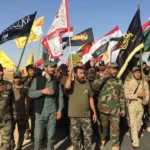


For the first time since the formation of the Popular Mobilization Forces (PMF) and the passage of its law by parliament in 2016, its members did not receive their salaries for June when Ki-Card, the company contracted by Mastercard, refused to disburse payments amid reports of U.S. pressure on the Iraqi government.
The suspension was far more than a simple administrative glitch—it amounted almost overnight to the gravest warning yet to an institution born over a decade ago under the auspices of the “fatwa of holy jihad.” Thousands of fighters, accustomed to receiving Ki-Card notifications mid-month, discovered zero balances after a terse statement citing “banking considerations and international pressures” for the halt.
Backstage, Washington was increasingly seen as the driving force. The new U.S. administration had returned to the White House under the banner: “All armed forces must operate under state authority,” even if that meant shutting off pay first.
PMF members were stunned when they did not receive June salaries after both banks and the Mastercard–Visa system refused to process payments, igniting widespread discontent.
MP Maeen al-Kadhimi of the Finance Committee attributed the halt to “political and economic pressure” exerted by the U.S. on Iraq’s government, central bank, and commercial banks, including electronic card firms, resulting in frozen payments.
Though PMF salaries are usually disbursed between the 20th and 25th of each month via Rafidain Bank and Ki‑Card, payments were delayed by ten days. The Iraqi government and finance ministry are reportedly exploring private banks to bypass U.S. restrictions.
PMF Numbers Surge
Accurate figures on PMF membership are unavailable. Previously cited estimates ranged from 150,000 to 160,000, but MPs claim numbers have swelled significantly, accompanied by notably increased budget allocations.
Independent MP Sajad Salem recently revealed a surprising surge in membership. In 2014, around 60,000 volunteered amid the ISIS war; by 2021, numbers approached 100,000; and by 2023, membership reportedly jumped to 236,000—an increase of 136,000 “in just two years.” Correspondingly, the budget for PMF increased from 1 trillion Iraqi dinars (with the official exchange rate at 1,320 dinars to the dollar) to 3 trillion dinars.
The PMF currently encompasses roughly 67 armed factions, many loyal to Iran. Significant contingents include the Iraqi Hezbollah Brigades, Asa’ib Ahl al‑Haqq, Badr, Saraya al‑Salam, al‑Nujaba, and Imam Ali Brigades. Shiite fighters make up around 85% of its ranks, with a few thousand Sunni tribal members integrated as well.
Senior PMF leaders acknowledge systemic issues similar to those in other ministries, and allegations of corruption—particularly concerning disputed fighter rosters and budgets—have been raised by PMF head Falih al‑Fayyadh himself.
Prospects for Integration
Following Donald Trump’s return to the White House, U.S. pressure on Baghdad has intensified, urging the dissolution of PMF factions, disarmament, and integration into official Iraqi security structures—or risk forceful action, according to Prime Minister Mohammed Shia’a al‑Sudani’s advisor, Ibrahim al‑Samaydi during a statement last December.
Legal adviser Ma’an al‑Juburi, a former consultant to the defense ministry, emphasized that both U.S. and domestic political pressures are targeting the PMF, particularly through salary suspension—impacting Iran-aligned factions within the PMF while shielding others.
He asserted that the U.S. regards PMF members as “unverified,” suggesting large sums are being illicitly diverted to entities on America’s terror watchlists. Attempts to shift salary distribution to private banks are stymied by this lack of transparency and forced integration demands.
Political analyst Riyadh al‑Ali warned that reliance on private banks could expose Iraq’s central bank and finance ministry to U.S. financial sanctions, potentially tying the Iraqi oil revenue mechanism to Federal Reserve control. Although parts of the salary have reportedly begun flowing via private banks, the American restrictions remain relentless, he told Noon Post.
Regarding militia integration, al‑Ali views it as unlikely before Iraq’s parliamentary elections in November. The factions are armed and embedded within state security structures, supported by powerful Shiite political factions and Iranian influence that persists despite setbacks in Lebanon and Syria.
Despite these obstacles, the U.S. appears determined to enforce its demands within the coming months. Baghdad is well aware of the political stakes—particularly with election campaigns intensifying and polarization nearing charged levels.
Former Nineveh governor Atheel al‑Nujayfi, writing on X, stated that the salary disruption marks the start of PMF dismantling and integration ahead of the elections. He dismissed proposed workarounds—such as alternative payment platforms or temporary cash disbursal—as impractical, given the threat of U.S. sanctions on any entity involved.
Only structural dissolution, barring sanctioned individuals, and the integration of eligible fighters into the state army and police—as individuals, not factions—can offer a viable path forward, he argued. He expects this process to unfold quickly, coinciding with the election timeline.
Iraq’s security, political, and economic landscape remains deeply constrained—still under American oversight and enmeshed in regional power plays. Tehran’s influence endures, complicating all reform efforts and exposing Iraq to further pressure or potential sanctions.