







هذا التقرير متاح أيضًا بـ العربية
Over six years, Amir Gross Kabiri has gone from an Israeli businessman leasing and operating parts of the struggling Aluminij plant in Bosnia and Herzegovina to a figure involved in industry, energy, gas, sport, and commercial and political relations.
His businesses operate in a country with an exceptionally complex political system. The Dayton Agreement, which ended the war in 1995, divided Bosnia and Herzegovina into two main entities: the Federation of Bosnia and Herzegovina, where the Bosniak and Croat majority is concentrated, and the Serb-majority Republika Srpska. Bosniaks, Croats and Serbs share state institutions under an extensive system of shared power and authority.
Within this structure, Kabiri expanded from a factory in Mostar, the centre of Croat political power, into Zrinjski football club, cultural institutions, the Jewish community and chambers of commerce bearing Israel’s name. Alongside this expansion, he developed closer relations with the Israeli embassy, Foreign Ministry and occupation government. His ties then extended to Banja Luka and the leadership of Republika Srpska.
He came to move between two of the country’s most important centres of nationalist power, raising a question that goes beyond the scale of his investments: how did his private businesses become a channel for Israel’s presence in Bosnia?
The failed factory behind Kabiri’s rise in Bosnia
Before arriving in Bosnia, Kabiri was known in “Israel” as a businessman and art collector. He entered football in July 2015, becoming the owner of Hapoel Tel Aviv, one of Israel’s best-known clubs. About a year and a half later, the club entered court proceedings with debts exceeding 100 million shekels, worth about $26 million at the time.
The Times of Israel reported on 6 December 2016 that the proceedings would end Kabiri’s control and place the club’s assets under a court-appointed trustee. Kabiri said he had put tens of millions of shekels of his own money into the club and could no longer finance it.
Outside football, his name was associated with the M.T. Abraham Group, which operates in industry, energy and art, and an art foundation of the same name. He also chaired the Hermitage Museum Foundation in “Israel.”
His connections with Israeli diplomatic circles in the Balkans predated his arrival in Bosnia. The Hermitage Foundation’s 2019 annual report said Dan Oryan, then Israel’s ambassador to North Macedonia and later the official responsible for the Western Balkans portfolio at the Foreign Ministry, introduced Kabiri to a project sponsored by “Tel Aviv” to restore the historic Jewish cemetery in the Macedonian city of Bitola and turn it into a memorial and cultural space.
His biggest economic opportunity arose in Mostar, the largest city in the southern region of Herzegovina and the centre of Croat political power in Bosnia. The Aluminij plant halted production on 10 July 2019 after accumulating huge debts, most of them related to electricity, leaving more than 900 workers without jobs.
The plant had been a mainstay of the city’s economy. The Federation of Bosnia and Herzegovina government owned 44 per cent, small shareholders drawn from the workforce held another 44 per cent, and the Croatian government owned the remaining 12 per cent. Its fate was therefore a sensitive economic and political issue for Mostar, Sarajevo and Zagreb.
Aluminij Industries was established in Mostar in February 2020 to manage the new operation. Commercial records list the Panama-registered M.T. Abraham Group as its owner and Kabiri as its director.
Negotiations ran from late 2019 to spring 2020. In February, the Federation government rejected an earlier version of the M.T. Abraham Group’s offer because of conditions concerning electricity prices and obligations the government was being asked to assume.
After the offer was revised, the government authorised its representative on 3 April 2020 to vote for the new agreement on behalf of its 44 per cent stake in Aluminij d.d. Mostar. Three days later, the company’s shareholders’ assembly approved the lease contract with overwhelming support.
The agreement did not transfer ownership of the plant to Kabiri. Aluminij d.d. Mostar retained ownership of the assets and signed a lease with Aluminij Industries. The latter began by operating the smelter, with scope to expand into other parts of the complex.
The contract set an initial term of 15 years, divided into phases, with the option of a further 15-year extension. Progression between phases depended on operating and employment levels. It also allowed Kabiri’s company to develop energy projects within the complex, a provision that would become increasingly important as his business expanded from aluminium production into gas and energy.
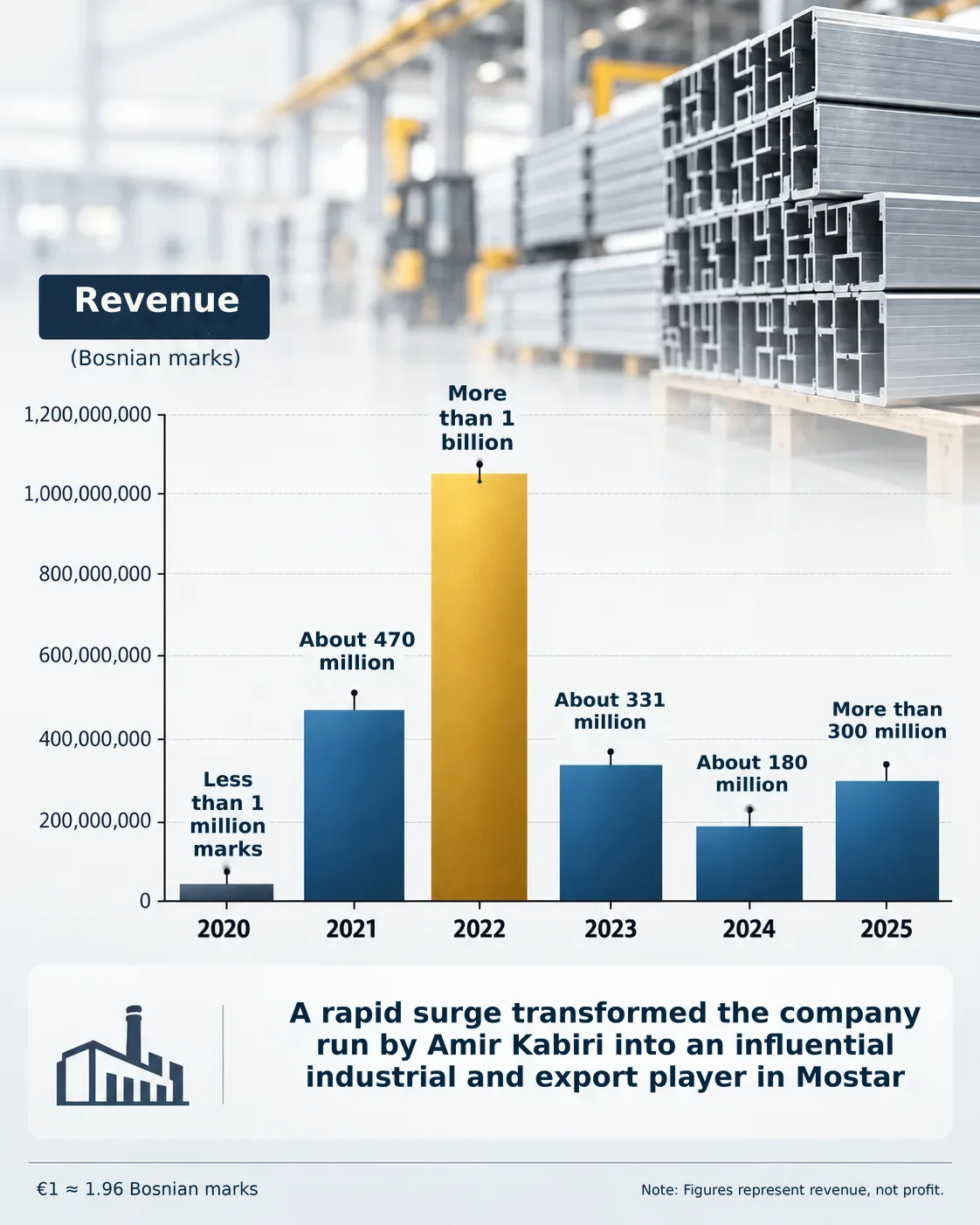
The smelter resumed production in November 2020. Just two years later, Aluminij Industries had become one of the country’s largest exporters. Revenue rose from less than 1 million Bosnian marks in its founding year to about 470 million in 2021, then exceeded 1 billion in 2022, with net profit approaching 56 million marks. One euro equals 1.96 Bosnian marks.
Revenue fell from that peak to about 331 million marks in 2023 and 180 million in 2024, before recovering to more than 300 million in 2025, when the company employed nearly 300 workers.
The revival gave Kabiri influence that is difficult to separate from Mostar’s balance of power: he now ran a company employing hundreds of workers and exporting to foreign markets.
When Kabiri’s group announced in 2025 that the contract had entered its next 10-year phase, small shareholders challenged the way the extension had been carried out. They said the conditions for moving to the next phase had not been met. Aluminij Industries maintained that the process complied with the original contract.
Against this backdrop, Kabiri’s relationship with Dragan Covic, head of the Croatian Democratic Union of Bosnia and Herzegovina, or HDZ BiH, and the country’s most prominent Croat leader, came to the fore. The party has considerable influence in Mostar’s institutions and Croat-majority areas of Herzegovina.
Kristina Peric, editor-in-chief of the local outlet Istina Media, which had covered developments at the factory, said Covic’s team played an important role in helping Kabiri establish himself in local economic and political circles. Her comments appeared in an investigation published on 5 December 2025 by Detektor, the journalistic arm of the Balkan Investigative Reporting Network in Bosnia.
Investigative journalist Amarildo Gutic, who had spent years following the relationship between politics and Aluminij’s management, offered a more explicit assessment of the party’s role. He argued that Kabiri would have found it very difficult to establish his current position without the support of the HDZ BiH network, which had long maintained a presence within the plant’s structures.
In the years that followed, the relationship extended beyond Aluminij into cultural, sporting and commercial institutions. Mostar became the base from which Kabiri built most of his influence.
From sport and culture to diplomacy
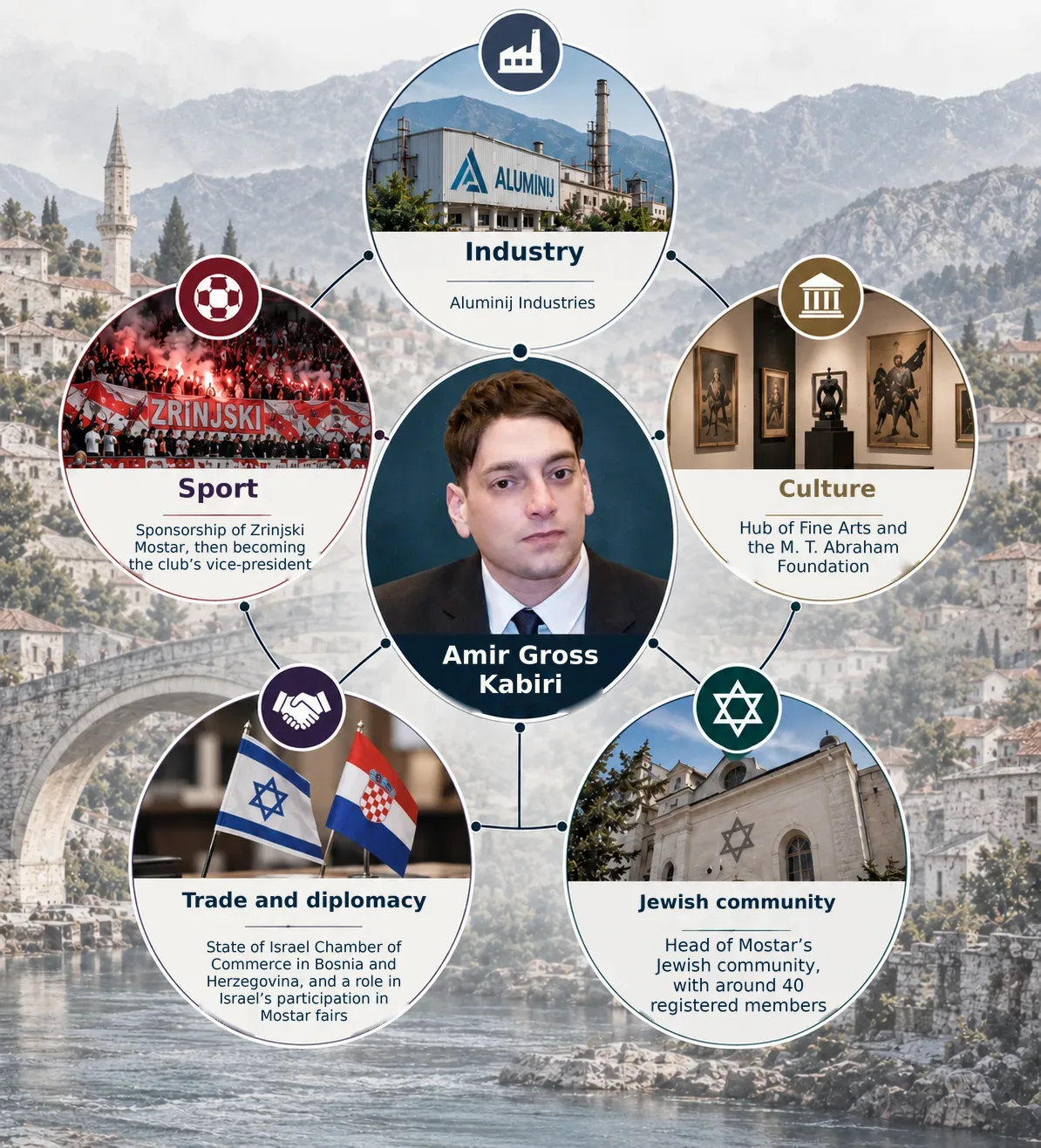
In December 2021, Kabiri’s group began sponsoring Zrinjski Mostar, one of Bosnia’s biggest football clubs and the sporting institution most closely associated with the city’s Croat community. He later became its vice-president.
Football gave him a social presence beyond the factory. Several months later, he expanded into culture, opening the Hub of Fine Arts with Covic in May 2022 to display works from his group’s art foundation.
At the opening ceremony, Covic said the two sides had been discussing new projects for some time. Mario Kordic, Mostar’s mayor and an HDZ BiH leader, spoke of the city’s support for Kabiri’s investments. By then, Kabiri’s activities had extended from the factory into football and culture, while his relationship with the city’s leadership had grown.
A more important platform followed in September that year, when the Chamber of Commerce of the State of Israel in Bosnia and Herzegovina opened in Mostar, with Kabiri as president. Covic and the then non-resident Israeli ambassador, Noah Gal Gendler, attended.
Its name and launch gave it the appearance of something close to an official commercial representative body for “Tel Aviv”. Bosnia’s Justice Ministry records show that it was established on 31 May 2022 as an association under the law on associations and foundations.
The ministry clarified in December 2023 that its powers did not extend to registering an official chamber of commerce for a foreign state. Bosnia’s Foreign Trade Chamber also confirmed that it had not established an institutional relationship with Kabiri’s organisation.
The presence of the Israeli ambassador and Covic at the opening, followed by the association’s role in organising delegations and economic events, nevertheless gave it political weight beyond its legal status as a local association. This became particularly clear during preparations for the 2023 Mostar Economic Fair, when “Israel” became the fair’s “partner country.”
On 14 April, Kabiri met Dan Oryan, director of the Israeli Foreign Ministry’s Western Balkans Department, at the chamber’s headquarters to discuss delegations, the Israeli pavilion and agreements due to be signed. The chamber said preparations for “Tel Aviv” to participate had begun about a year earlier, in cooperation with the ministry and the fair’s management.
Israeli companies working in technology, security and the military industry participated in the fair’s opening in early May. They included Israel Aerospace Industries and Elta Systems, which specialises in radar and electronic systems, alongside cybersecurity and medical technology companies.
At a conference organised by Kabiri’s chamber, Oryan said Israeli capabilities had never before been displayed on this scale in the Balkans. Ambassador Galit Peleg spoke of interest in the Bosnian market among companies from the occupation state.
The institution Kabiri founded had thus become a channel through which the Israeli Foreign Ministry brought companies and officials to Mostar. The strength of that relationship became even clearer after the assault on Gaza.
In November 2023, another dimension of Kabiri’s relationship with the occupation government emerged, months after a bitter dispute with Benjamina Karic, then Sarajevo’s mayor.
The dispute began when Karic rejected a request connected to the commemoration of the so-called “State of Israel Day”. The request called for a plaque at the entrance to Sarajevo City Hall, Vijecnica, to be covered. The plaque commemorates the burning of the National Library by Bosnian Serb forces in 1992. Karic said the request was intended to satisfy members of the Serb Alliance of Independent Social Democrats, or SNSD, who objected to its wording.
The dispute escalated over Karic’s pro-Palestinian positions during the assault on Gaza. Kabiri accused her of supporting Hamas, while she filed a police complaint accusing him of harassment and threats.
After a package from Kabiri arrived at city hall containing a scarf bearing the “Israeli” flag and a message connected to the events of 7 October, Ambassador Peleg formally intervened. She wrote to the Federation government and the Foreign Ministry, stressing that the embassy would monitor the authorities’ treatment of Kabiri and that the occupation state stood behind him.
In February 2024, Aluminij’s headquarters hosted a meeting between Kabiri, the Israeli ambassador and Croatia’s ambassador to Bosnia and Herzegovina, Ivan Sabolic. They discussed diversifying energy sources, future investment in the plant and bringing companies from “Tel Aviv” into Bosnia through Kabiri’s chamber.
The meeting came as Kabiri expanded into energy, alongside efforts by Washington and the Croat leadership to advance the Southern Interconnection project. The strategic gas pipeline is intended to link Bosnia and Herzegovina to Croatia via Mostar, providing an alternative route to Russian supplies, which currently arrive through Serbia and Republika Srpska.
The project had been stalled for years by disagreement over who would manage it. Covic and his party had pushed for a new company to be established rather than assigning the project to Sarajevo-based BH-Gas. Washington later stepped up its involvement and proposed a US role in developing the pipeline. In this context, Kabiri began moving closer to the project through his plans for a gas plant at Aluminij and, later, his contacts in the US.
Kabiri also expanded his presence through his presidency of Mostar’s Jewish community. An academic study of Jewish communities in Bosnia estimates its registered membership at about 40, compared with more than 740 in Sarajevo. His political interventions in this capacity drew objections from older Jewish figures and longer-established Jewish institutions in the capital, particularly as the assault on Gaza escalated and disagreements grew over statements made in the name of the country’s Jews.
Jakob Finci, former president of Bosnia’s Jewish community, said Kabiri spoke only for himself and did not represent the country’s Jews on the assault on Gaza.
The dispute with Vladimir Andrle, head of the Jewish cultural and charitable society La Benevolencija in Sarajevo, deepened after Andrle accused Kabiri of casting doubt on the history of Jewish-Bosniak coexistence. Andrle subsequently accused him of threats and harassment and filed a complaint with Bosnia’s federal police in July 2024.
That month, Menachem Rosensaft, honorary general counsel of the World Jewish Congress, accused Kabiri of damaging relations between Jews and Bosniaks. He argued that leading Mostar’s small community did not entitle Kabiri to speak for the country’s Jews.
At the same time, Kabiri expanded his businesses into energy, a crucial concern for an aluminium plant that consumes large amounts of electricity. This also drew him into one of the country’s most sensitive strategic projects.
His plans began with solar energy and a gas-fired power station inside the complex. In February 2026, he appeared in Washington and signed a memorandum with Atlantic-SEE LNG Trade as a preliminary step towards securing long-term US supplies for his projects in Mostar through the planned Southern Interconnection pipeline between Croatia and Bosnia.
Elmedin Konakovic, Bosnia’s foreign minister and leader of the People and Justice party, told Detektor on 27 February 2026 that he was surprised to see Kabiri at the summit where the memorandum was signed. He described him as someone with “special relationships,” “lobbies,” and access to certain circles.
Peric, Istina Media’s editor-in-chief, viewed his involvement in the project as evidence of substantial lobbying. Lawmakers questioned how a private company had reached this stage in a strategic project while Bosnian institutions were still negotiating the arrangements.
The Federation’s Ministry of Energy, Mining and Industry later set out the legal framework. It confirmed that Energoinvest, in which the Federation government holds a controlling stake, has the legal basis to import natural gas, while Kabiri’s group could participate as a consumer or buyer. Signing the memorandum in Washington had nevertheless given his company a place in the debate before arrangements for implementing the project had been finalised within Bosnia.
In September 2026, his group announced plans to develop a data centre for artificial intelligence and cloud computing in Aluminij’s industrial zone. Capacity would start at 50 megawatts and could exceed 200 megawatts in subsequent phases. The site Kabiri entered in 2020 to lease a smelter had become a base for proposed projects in aluminium, energy, gas and digital infrastructure.
From Mostar to Banja Luka
Kabiri’s connections to Bosnian Serb leader Milorad Dodik became more visible in 2024. But the leadership of Republika Srpska, the Serb-majority entity that forms Bosnia and Herzegovina alongside the Federation, had established its relationship with “Israel” years before his arrival.
Dodik and HDZ BiH leader Covic had also maintained a close political alliance within the Bosnian system. Kabiri’s move from Mostar to Banja Luka, the administrative centre of the Bosnian Serbs, was therefore more an expansion within an interconnected political network than a move between separate camps.
Vuk Vuksanovic, a lecturer in foreign policy and grand strategy in the Department of War Studies at King’s College London, traces the relationship between Republika Srpska’s leadership and “Tel Aviv” to 2012, when the then Israeli foreign minister, Avigdor Lieberman, visited Dodik.
In an analysis published by Deutsche Welle on 11 September 2026, Vuksanovic argued that the occupation government was expanding its network of partners in the Western Balkans to influence European positions on Palestine and counterbalance the presence of Türkiye and Iran. He pointed in particular to Türkiye’s growing influence through defence industry cooperation and diplomacy, alongside “Tel Aviv’s” strengthening military partnership with Greece and Cyprus in the eastern Mediterranean.
The researcher believes Republika Srpska’s political value to “Tel Aviv” exceeds its economic weight because it can influence the Bosnian state’s positions. He cited its role in preventing an internal consensus in support of Palestine’s bid for non-member observer state status at the United Nations in 2012.
Banja Luka, meanwhile, benefits from the relationship by strengthening its position relative to the central government and Western capitals. This dynamic explains the importance of institutions linked to Kabiri despite the modest volume of trade.
Peric said Kabiri’s relationship with Covic had weakened somewhat over the years, while the businessman began expanding his ties in Banja Luka in search of new opportunities and interests. In October 2024, he appeared alongside Dodik and Ambassador Peleg at an event marking the anniversary of the 7 October attack.
Kabiri then expanded his presence in Banja Luka through a cultural event organised by his foundation and attended by Dodik and Peleg. The relationship broadened politically in the following months. In March 2025, Kabiri and Dodik appeared together in occupied Jerusalem at a conference on combating antisemitism, and their relationship deepened over the following year.
Dodik congratulated Kabiri in February 2026 after the signing of the US gas memorandum and described him as a “proven friend of Republika Srpska,” before their ties took on a more explicitly institutional form that summer.
On 27 August 2026, an organisation called the Chamber of Commerce of the State of Israel in Republika Srpska was registered at the Basic Court in Banja Luka.
The court later confirmed that it was an independent citizens’ association founded by Kabiri, Adam Danon, one of his leading aides and executive director of the M.T. Abraham Foundation, and Bosnian lawyer Davorin Marinkovic, who specialises in energy and infrastructure. Kabiri became its president and legal representative. Despite its similar name and stated role, it is legally distinct from the organisation he founded in Mostar in 2022.
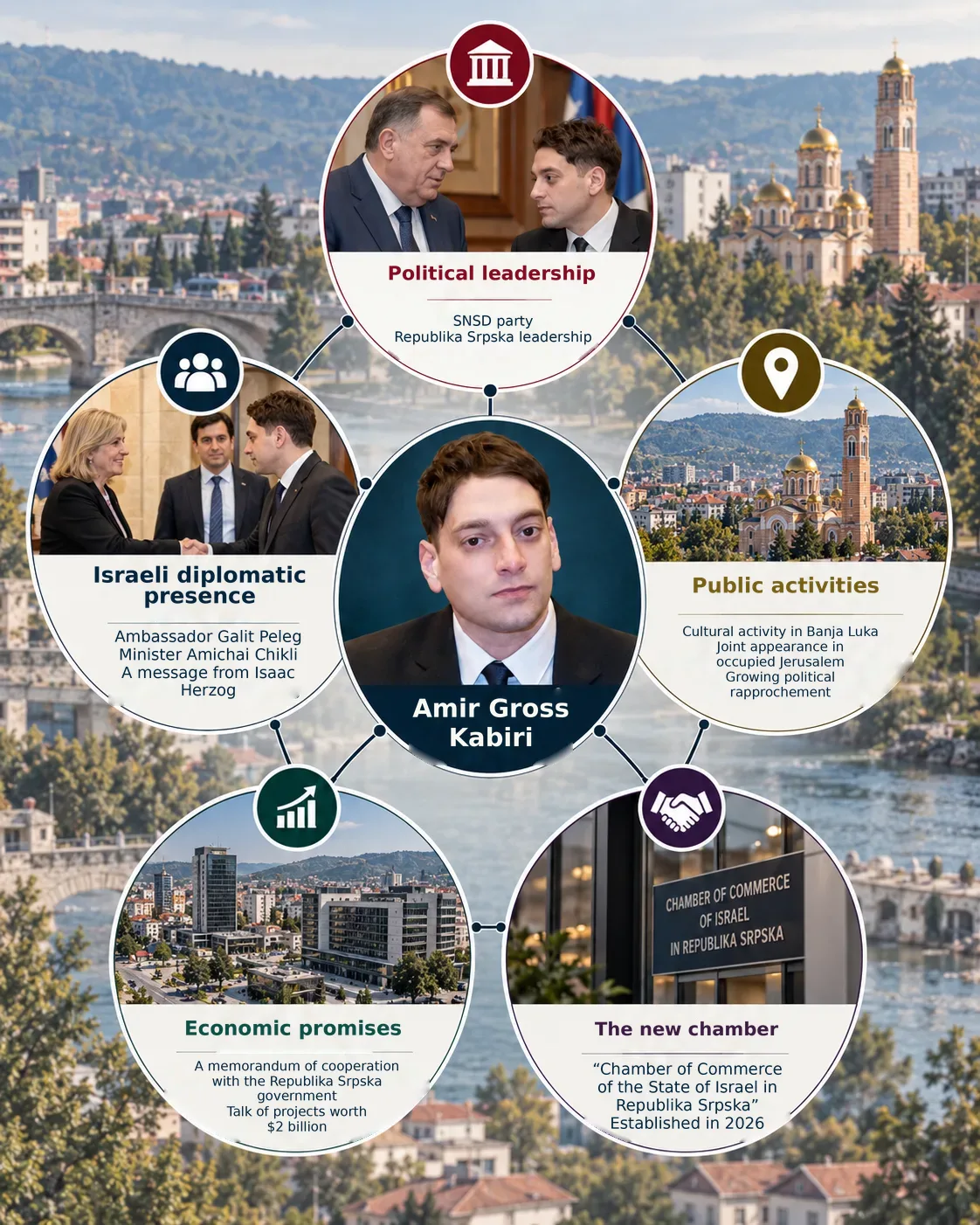
A week later, on 3 September, the Republika Srpska government’s headquarters hosted the association’s launch and the signing of a memorandum of cooperation between Kabiri and Ana Trisic Babic, acting director of the government’s Office for International Cooperation.
Those attending included Siniša Karan, president of Republika Srpska; Savo Minic, its prime minister; Zeljka Cvijanovic, the Serb member of Bosnia and Herzegovina’s presidency; and Dodik. They were joined by Amichai Chikli, minister of diaspora affairs and combating antisemitism in the occupation government, and Ambassador Peleg.
Chikli said the launch followed a process lasting about two and a half years and called for political friendship to be translated into investment. President Isaac Herzog of the occupation state sent a message describing the association as a driving force for stronger relations and thanking the entity’s government for supporting it.
Dodik presented the opening as the first organised institutional framework for relations with “Tel Aviv”. He said the two sides intended to develop projects worth around $2 billion in the economy, technology transfer and other fields.
The economic figures were far more modest than the political fanfare suggested. The occupation state ranked 36th among investors in Republika Srpska, and bilateral trade in the first half of 2026 did not exceed a few million marks.
This gap gives the relationship political significance beyond its economic scale. Banja Luka benefits from appearing alongside Israeli ministers and ambassadors and opening additional channels abroad, while Republika Srpska’s leadership gives “Tel Aviv” an ally inside Bosnia capable of influencing policy on Palestine and the state’s foreign relations.
Kobi Michael, a senior researcher at Israel’s Institute for National Security Studies and Misgav Institute, describes the relationship with Republika Srpska as “warm and pragmatic,” while identifying Serbia as Israel’s most important military, industrial and economic partner in the Balkans. From this perspective, the Bosnian Serbs’ value lies in the entity’s political position within a state deeply divided over Palestine and relations with the occupation.
Kurt Bassuener, an analyst at the Berlin-based Democratization Policy Council, sees the relationship with “Tel Aviv” as giving Banja Luka access to US political circles linked to the Israeli right. Such access is particularly important to the Bosnian Serb leadership amid sanctions, disputes with the high representative and the continuing debate over the state structure established by the Dayton Agreement.
Records under the US Foreign Agents Registration Act, or FARA, show lobbying groups working in Washington on behalf of Republika Srpska institutions on issues directly connected to Dodik’s political project.
In September, days after the association’s launch, a delegation from Republika Srpska arrived in “Tel Aviv” ahead of a meeting with Israeli Prime Minister Benjamin Netanyahu. Trisic Babic said the political rapprochement must be translated into economic cooperation and tangible projects, citing the new commercial organisation as part of the framework intended to advance the relationship.
Kabiri’s position became clearer as these connections developed. Aluminij gave him an economic base in Mostar, while Zrinjski and his cultural activities opened doors within the Croat community. The Israeli Foreign Ministry and embassy then gave his institutions a presence beyond business, before his network extended to Banja Luka and intersected with Dodik’s political interests.
Sarajevo, by contrast, remained the centre of the greatest tensions surrounding his influence, arising from his disputes with Bosniak political figures and Jewish institutions’ objections to his positions being presented as representative of the country’s Jews. His success remained concentrated in Croat Mostar and Serb Banja Luka.
This pattern overlaps with what Vuksanovic describes as a broader Israeli strategy in the Balkans: building relationships with different local partners according to the political or economic influence each can offer within their countries.
