

هذا التقرير متاح أيضًا بـ العربية
For many centuries, art in human societies has played a role that goes beyond aesthetics to become a living testimony to the lives of peoples and their defining events. In wars throughout history, art has served as a tool for recording suffering, commemorating victims, and reclaiming the collective memory threatened by the machinery of destruction and oblivion.
In the Syrian context, the exhibition “Detainees and Disappeared,” which includes dozens of paintings and photographs documenting the stories of detainees and the missing during the years of war, comes not only as a visual record of pain, but also as an attempt to resist forgetting in a country that has lived through decades of conflict.
From the era of the French occupation to the Hama massacre in 1982, through the 2011 revolution and the war that followed, up to the present moment after the fall of the Assad regime, Syrian artists have continued to carry art as a weapon in the battle for documentation and freedom of expression. Here, the question presses itself urgently: What role did Syrian art play in documenting the war and the revolution? And how did the painting and the photograph become a living archive resisting attempts to erase crimes?
The “Detainees and Disappeared” Exhibition… A Visual Testimony
The “Detainees and Disappeared” exhibition is an advanced model of artistic action documenting the profound collapse that the war inflicted on Syrian society, bringing together individual and collective memory to present a layered picture of the human reality over the past years. The title itself contains the tragedy of tens of thousands of Syrians who disappeared in the prisons of the former regime.
The exhibition opened at the National Museum in Damascus on May 5, 2024, organized by the Creative Memory of the Syrian Revolution platform under the patronage of the Ministry of Culture and the Directorate-General of Antiquities and Museums. It then moved to Aleppo, then Homs, and finally reached Idlib, in a step aimed at making it a traveling event across different Syrian cities so that it becomes a shared national space. The exhibition includes works spanning the years of the revolution and the war, arranged according to the sequence of the conflict’s stages and historical events.

The exhibition is the first organized Syrian attempt to gather visual memory related to enforced detention in one place. The project drew on more than ten years of artistic archiving before later expanding to become, as stated in its official description, “a project that traces people’s memory through the years of revolution and war through their artistic and cultural productions on a subject that is among the most important common threads in the conscience of Syrians today.”
Today, the exhibition includes more than 1,700 documents and is the sixth project of Creative Memory of the Syrian Revolution. Sana Yazigi explains, the platform’s director, that the exhibition includes around 200 works from all forms of popular creativity covering the subject of detention and disappearance, making its structure closer to a visual archive spanning roughly 10 years, from 2011 to 2020. Yazigi adds that “the memory of detention and disappearance is, unfortunately, the only memory that unites all Syrians.”
In a broader cultural reading, the exhibition is seen as a step resisting the process of normalizing forgetting, as it does not merely display pain, but also presents documents and visual testimonies that contribute to building the case for justice. In her statements to Rozana Radio, Yazigi stresses that the importance of the exhibition is tied to the issue of justice, whether transitional or permanent, noting that society needs a clear discourse indicating that the new state recognizes this crime as an entry point for building any social contract.
The Entry of Political Cartoons into Syrian Journalism
Visual art and cartoons in Syria were not merely a means of aesthetic expression; for decades they became a visual weapon and a parallel historical record of facts. In a country that suffered under decades of repression and censorship, where the written and spoken word was subject to strict control, Syrians found in art an alternative space for expression and documentation—capable of conveying feeling and facts with direct, shocking sharpness, and in a language understood by all regardless of their tongues.
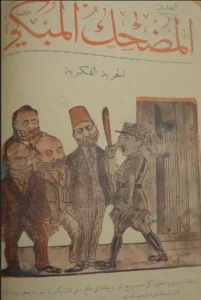
In 1928, Habib Kahaleh founded the magazine “Al-Mudhik Al-Mubki,” which was considered the first Syrian space to grant political cartoons the authority of open criticism and place them at the forefront of the cultural scene. The magazine was an act of daily resistance against the French Mandate authorities and against the local political elites allied with them.
“We pledge to the reader that the magazine will be frank and truthful, even if it angers some… We will strive to fear God in our frankness; as for the servants of God, if they are angered while we speak the truth, let them drink the sea.”
With these words, Kahaleh opened the first issue of his magazine, declaring that cartoons would not be visual luxury or journalistic ornament, but rather a direct tool of confrontation with authority. Kahaleh believed that cartoons should be “a weapon in the hands of the people against tyranny.” As its circulation expanded, the magazine became a burden on the Mandate authorities, who repeatedly tightened restrictions on it, suspended its publication more than once, and even arrested Kahaleh himself because of drawings that exposed what was being plotted against Syrians during one of the most sensitive phases in the formation of national identity.
Although the magazine did not last long, it laid new foundations for the relationship between art and authority in Syria, as cartoons became a tool of direct political criticism. This trend continued over the following decades, with the emergence of magazines such as “Al-Jarida” and “Al-Hayat,” which provided broader spaces for political cartoons, especially during the post-independence period. The magazine continued to be published until 1966, when its license was permanently revoked after Kahaleh’s death in the early years of Baath rule.
With the outbreak of the Arab-Israeli wars, Syrian art became a distinctly nationalist tool of expression, and many artists found in the Palestinian cause an outlet for political engagement despite censorship restrictions. Among them, Naim Ismail stood out, carrying the feeling of exile throughout his life and embodying it in his famous painting “The Fedayeen,” in which he rendered the Nakba visually. Along the same path, Mahmoud Hammad introduced the Arabic letter as a visual element in his abstract paintings, culminating his engagement with the cause through his massive mural “Palestine… From the Nakba to Liberation,” which he exhibited in the Palestinian pavilion at the Damascus International Fair in 1962.
This engagement was not limited to major names; at the age of eighteen, Louay Kayyali painted a work depicting the 1948 war, expressing a whole generation’s sense that the battle for Palestine was a natural extension of the battle for independence from the Mandate. As for Burhan Karkoutli, he lived the cause up close when, beginning in 1948, he met Palestinian soldiers who had taken refuge in Damascus at his father’s hotel, and he entered politics early through the lectures of the parties of that era, according to a report by Al-Araby Al-Jadeed, making this contact with the world of exiles foundational to his visual language and later political works.
In 1982, the Hama massacre marked a turning point in modern Syrian history, after Hafez al-Assad’s regime bombarded the city and killed tens of thousands of civilians. Under the tight censorship and severe repression of that period, artistic works that dealt directly with the Hama massacre were extremely rare, and most came decades after the event.
Even so, later attempts emerged to document the massacre, most notably the mural by Aziz Asmar in the city of Binnish in rural Idlib, where in 2021 the artist redrew the chapters of what happened in Hama. But resistance through art took forms deeper than direct documentation; researcher Zaher Omareen transformed collective pain into a digital work titled “Faceless 82” in 2014, bringing together ninety blurred faces recovered from victims’ identity cards and family records, embodying through the very technique of blurring the forced erasure practiced by the regime. The British Museum acquired the work in 2016 as a visual archive of a tragedy that had remained suppressed for decades.
From the 2011 Revolution to the Post-Liberation Period
With the outbreak of the Syrian revolution in March 2011, art became a weapon of mass resistance, using multiple methods to break the official narrative from direct political satire, to exposing daily violence, to turning internet pages into open spaces of confrontation. Ali Ferzat, who had exposed corruption through his drawings since the 1970s and founded the newspaper Al-Domari before it was shut down by political decision, had his fingers deliberately broken in August 2011 by men loyal to the regime, becoming a global symbol of freedom of expression.
As for Akram Raslan, he was arrested in 2012 from his workplace and killed under torture, leaving behind a visual legacy that exposes systematic violence and embodies how an artist pays with his life. Other artists such as Mowaffaq Qat found in social media a space without restrictions. Qat believes that cartoons “have participated, and continue to participate very effectively, in exposing the terrorism and brutality of the Assad regime,” something reflected in the exhibition he organized in several European countries with the participation of more than forty Syrian artists, carrying the Syrian visual testimony to international public opinion.
As the revolution turned into an armed conflict and Syrians were scattered into exile, art did not lose its political function but rather developed it; instead of direct confrontation with the regime, it became a tool for recovering what the war had destroyed and resisting the erasure of collective memory. Mohamad Hafez, the Syrian-American artist and engineer, offered one of the most prominent examples of this transformation through his miniature sculptures, in which he reconstructs scenes from shattered Syrian cities with their popular details of alleys, lanes, and ornamentation. In the “Baggage” series, he used the suitcase the symbol of the refugee who carries his entire life in his hand to visually reframe the suffering of those fleeing war.
Perhaps what proves that art has not lost its political function after the fall of the regime is the newspaper “The Syrian Revolution,” relaunched on December 1, 2025, under the slogan “The punctuation of truth, raising construction,” after the old version of the paper which bore only the name “Al-Thawra” had been one of three official newspapers through which the Assad regime entrenched its dominance over the media since the 1970s, before halting all print newspapers in 2020.
This month, the newspaper reached its 100th issue, opening its pages to works by artists addressing the current Syrian political scene freely. Today, the paper publishes artworks dealing with the issues and challenges of the transitional period, from reconstruction to justice and accountability, in a space that Information Minister Hamza al-Mustafa described as “a mirror of people’s pain, their daily lives, and their hopes in a space of free discussion.”

A Global History of Documentation and Resistance
Since ancient times, visual art has been linked to wars as a primary tool for documenting victories and immortalizing leaders, as in the reliefs of the Battle of Kadesh on the walls of Egyptian temples, or on commemorative columns such as Trajan’s Column in Rome, which narrates a complete panorama of military campaigns. But with the development of publishing tools such as the printing press and mass posters in the nineteenth and twentieth centuries, art shifted from mere historical record to a sharp political weapon.
During the two world wars, all the warring parties produced propaganda posters in the millions, designed to incite the masses to enlist and to transform fear and anger into directed collective energy. Then, in the second half of the twentieth century, the equation was reversed, and art became a weapon against propaganda rather than in its service. These posters demonstrated the power of visual art to simplify complex ideas and turn feelings of fear and anger into politically directed collective energy.
Today, art in Syria has become a living archive of national memory; Syrian artists, inside and outside the country, are working to document decades of repression and war with creative boldness. The exhibition “Detainees and Disappeared” stands as a contribution to shaping the historical narrative, transforming stories into visual testimonies that cannot be erased, so they may serve as a fundamental pillar in building Syrian collective consciousness.