




هذا التقرير متاح أيضًا بـ العربية
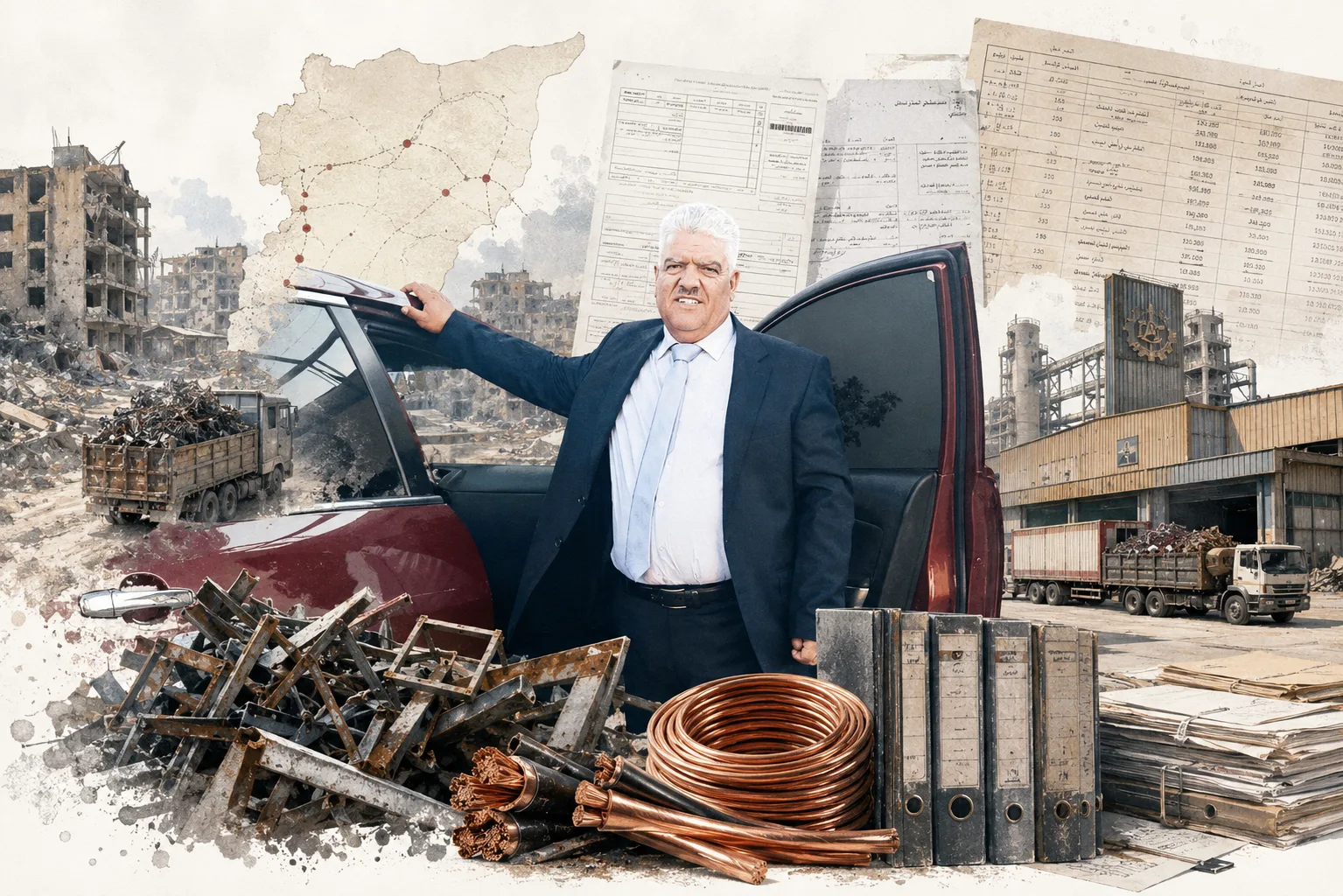
NoonPost has obtained exclusive documents containing supply records and tracking tables for the movement of iron and copper in Syria, revealing the routes and quantities of scrap extracted from destroyed areas, the names of its suppliers, and their eventual destination at factories linked to Syrian businessman Mohammad Hamsho, a close associate of the former regime.
These documents add new details to the file of the scrap trade linked to Hamsho, which appeared in press reports since 2019 on the extraction of doors, windows, and iron bars from destroyed buildings in areas recaptured by the former regime’s forces, including eastern Aleppo, Daraya, Yarmouk camp, and eastern Ghouta.
Those reports, citing local sources, said Hamsho International sold quantities of scrap and transported them by truck to the company’s iron factory in Adra Industrial City.
Other reports focused on Daraya, describing the entry of machinery to extract metals from the city’s rubble after the former regime’s forces took control of it in 2016, in what research and media reports described as organized scrap-trading networks linked to the Fourth Division under Maher al-Assad.
The file on the scrap trade linked to Hamsho returned to the spotlight after the regime’s fall in January 2024, particularly amid controversy over his settlement with Syria’s new government, and then after activist and filmmaker Hassan Akkad published in August 2026 a set of documents that he said were being published for the first time, shedding light on the activities of companies linked to Hamsho in collecting, transporting, and smelting large quantities of iron scrap during the war years.
According to media reports, the documents published by Akkad include correspondence from Hadeed company about a project to collect, extract, and transport scrap during 2013 and 2014. They indicate receipt of more than 16,000 tons of iron scrap from the Daraya project and about 75,000 tons from suppliers in other areas, in addition to producing more than 91,000 tons of billet during the same period.
The documents also include a $1 million payment linked to scrap transported from the Daraya project, another payment worth $600,000, and sums in Syrian pounds tied to commissions, purchases, and transport costs.
The documents NoonPost obtained allow it to trace the movement of iron and copper between 2019 and 2024, using supplier names, quantities, and dates, and to identify the sources of the largest quantities before they reached smelting plants.
Iron scrap
Mission tables available for the period between Sept. 29 and Nov. 8, 2019, show that iron scrap was transported for Hamsho Iron Factory in Adra Industrial City by vehicles carrying 23 different numbers across 36 separate missions.
The 2019 mission tables do not include data on the weight of the iron scrap supplied. Still, they document 50 vehicle movements related to iron transport, in which “Ahmad al-Tawil” appears as the supplier, with shipments headed to Hamsho’s factory.
These movements do not represent the total volume reaching the factory, as it relied on more than one scrap supplier, making the documented number for “Ahmad al-Tawil” only part of a broader supply flow during the same period. The limited time span covered by the records also prevents these data from providing a complete accounting of the quantities the factory received.
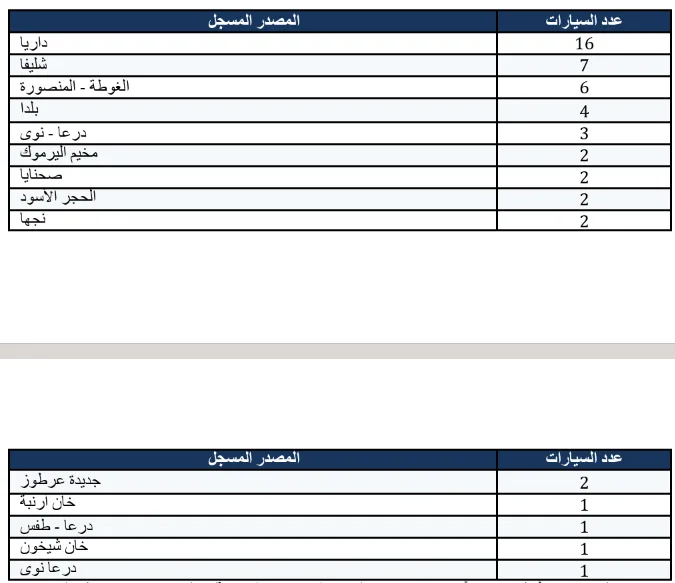
Geographically, the largest supply operations, according to the recorded sources, were concentrated in the city of Daraya with 16 vehicles, followed by the town of al-Mansoura in eastern Ghouta with six, then Yalda in southern Rural Damascus with four, and then the city of Nawa in Daraa province with three vehicles.
The records also show Yarmouk camp and al-Hajar al-Aswad in the capital, Damascus, and Sahnaya, Najha, and Jdeidet Artouz in Rural Damascus, each with two vehicles, followed by Khan Arnabeh in Quneitra province, Tafas and Nawa in Daraa, and Khan شيخون in Idlib, each with one vehicle.
Ahmad al-Tawil … a key supplier
The supplier name “Ahmad al-Tawil” appears beyond the 2019 records. His name recurs, sometimes as “Ahmad Mohammad سعيد al-Tawil,” in different sets of documents spanning September 2019 to November 2024.
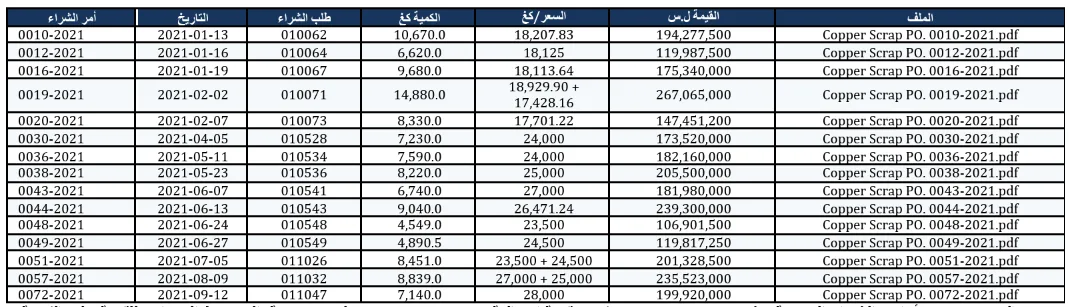
In 2021, the name appears in its expanded form, “Ahmad Mohammad سعيد al-Tawil,” in 15 internal requests/purchase orders for copper scrap bearing the Al-Ittihad Cables logo, with the purpose listed as supplying “copper scrap.” Many list the payment method as cash within 10 days and the delivery period as immediate.
The shortened name “Ahmad al-Tawil” then reappears in scrap delivery statements for 2022 and 2024, and also appears repeatedly in 2023 statements.
Copper scrap
In 2021, the total quantities approved in purchase orders linked to the full name amounted to about 123 tons of copper scrap, with a total nominal value of 2,750,071,450 Syrian pounds, or about $800,000.
In 2022, the recorded weight in delivery statements under Ahmad al-Tawil’s name reached about 118 tons. But the records are not limited to copper scrap alone; they also show weights listed under the description “cables” and others under “insulation,” indicating the supplier was linked to different materials within the cable chain, not just one type of scrap.
Documents from 2023 show delivery statements for external scrap, copper scrap, for Al-Ittihad Cables, with “Ahmad al-Tawil” as the supplier and a supplied weight of about 220 tons.
The name “Ahmad al-Tawil” is repeated in 2024 documents, in which the weight of copper scrap is about 248 tons.
The documents show that the shift from iron mission tables in 2019 to copper purchase orders in 2021, then copper delivery statements in 2022, 2023, and 2024, along with the large and repeated supply operations recorded in the 2022 and 2024 statements, reflects sustained supply activity over a period of years, rather than a one-off supply operation.
But this sequence alone does not prove that the materials in each year came from the same source, or that a single contractual relationship continued uninterrupted.

NoonPost could not verify whether “Ahmad al-Tawil” is the same person as “Ahmad Mohammad سعيد al-Tawil.” Still, the documents show that the records most likely treat them as the same supplier because of the match in the core name and the continuity of his role as a scrap supplier to the cable and iron system over successive years.
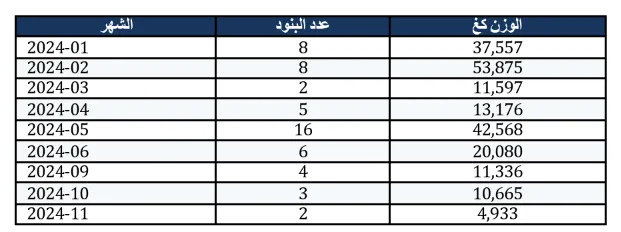
The records also contain nothing showing any link between Ahmad al-Tawil’s 2024 shipments and turbines, transformers, the Ministry of Defense, missiles, or tanks.
Two parallel supply routes within the same network
The transport of iron and copper scrap was not limited to a single supplier. The documents show another supplier, “Fadi Butrus,” appearing in 15 vehicle movements between Sept. 29 and Nov. 4, 2019.
Fadi Butrus’ geographic route is concentrated in Deir Ezzor, al-Mayadeen, al-Bukamal, and the Baqrus crossing, a main river crossing on the Euphrates linking the town of Baqrus in eastern Deir Ezzor countryside with the town of al-Shuhail. His work intersects with Ahmad al-Tawil’s in the same destination system: Adra Industrial City, Hadeed company, and the same client, “Hamsho Factory – Hadeed.”
Hamsho’s companies
The documents, in addition to supplier names, shipment quantities, and sources, reveal two Hamsho-owned facilities linked to the movement of iron and copper as shipment destinations: “Hamsho Iron Factory” and “Al-Ittihad Cables Company.”
Hamsho Iron Factory (HADEED MMC)
According to information published on HADEED MMC’s LinkedIn account, Hamsho Iron Company was founded in 2012, and its main site is in Adra Industrial City, while its activity is classified under the mechanical or industrial engineering sector.
The company describes itself as operating in iron and steel production, metal smelting and rolling, in addition to providing industrial engineering solutions. It says its activity includes smelting metal scrap and producing steel billets in accordance with international standards, which are used to produce reinforcing steel bars for various construction works.
Al-Ittihad Cables
Al-Ittihad Electricity Group describes itself, according to information published on its LinkedIn account, as a group specializing in the electrical industry, comprising five factories headquartered in Adra Industrial City and founded in 2016.
Its activities include producing power cables at various voltage levels, control cables, winding wires, and distribution transformers, as well as copper rods, copper and aluminum cables, and PVC materials.
Activists and media figures called for expanding the popular boycott of the products and companies of businessman Mohammad Hamsho, targeting his economic conglomerate known as the “Hamsho International Group,” which was founded in 1989 and expanded to include dozens of companies operating in contracting, real estate, communications, industry, and tourism, in addition to projects… pic.twitter.com/i75r6J2Q5F
— Noon Syria (@NoonPostSY) August 8, 2026
The group says its production capacity reaches about 1,500 tons of copper and aluminum cables per month, underscoring the link between its industrial activity and copper use.
Hamsho … a businessman in the regime’s orbit
Mohammad Saber Hamsho, who began his economic activity in the 1990s, emerged as one of the businesspeople linked to Syria’s former regime, and his business expanded over the following years to include multiple sectors.
Hamsho served as chairman of the board of Hamsho International Group and held positions in several economic institutions, including the Syrian-Chinese Business Council and the Federation of Syrian Chambers of Commerce.
Hamsho’s business network expanded to include companies and projects active in multiple sectors, including metal and electrical industries, contracting and construction supplies, communications and technology, real estate, tourism, hotels and resorts, and food industries and services.
During the former regime, Hamsho’s name was associated with close ties to circles of power, particularly Maher al-Assad, brother of deposed President Bashar al-Assad and then commander of the Fourth Division.
“Hamsho was part of financing the Fourth Division and the main person responsible for stealing iron from destroyed homes in Daraya” … Syrian activist Hassan Akkad speaks during a commemoration event about the importance of pursuing those who committed crimes against the city’s residents during the years of the الثورة. pic.twitter.com/LkZ93Xxphl
— Noon Syria (@NoonPostSY) August 26, 2026
The United States placed Hamsho under sanctions in August 2011, and later included him in sanctions tied to the Caesar Act in June 2020, along with his wife, Rania al-Dabbas, and his children. US sanctions also included the Fourth Division among the targeted entities on the same list.
After the former regime’s collapse, Hamsho’s name returned to the spotlight in January 2026, when the National Committee for Combating Illicit Gain announced that it had completed a settlement with him under a voluntary disclosure program, after investigations that the committee said included examining his assets and financial disclosures.
The committee said the settlements aimed to recover public funds and return money resulting from illicit gain to the formal economic cycle, but the official statement did not disclose the amount the treasury received from the settlement with Hamsho.
