






On December 17, 2024—just nine days after the fall of Bashar al‑Assad’s regime—Israeli Prime Minister Benjamin Netanyahu stood atop Mount Hermon in southern Syria and declared: “We are here to assess the situation and make a decision regarding Israeli deployment in this strategic location until another arrangement ensures Israel’s security.”
On March 5, 2025, he returned and announced openly: “We have changed the face of the Middle East.”
Neither Netanyahu nor his far-right allies in Israel, nor conservative hawks in the White House, nor the pro‑Israel lobby in Washington, has concealed their intentions to install a reimagined Middle East—one dismantled from its roots and rebuilt on firmer, deeper foundations in harmony with a renewed Israeli‑American axis.
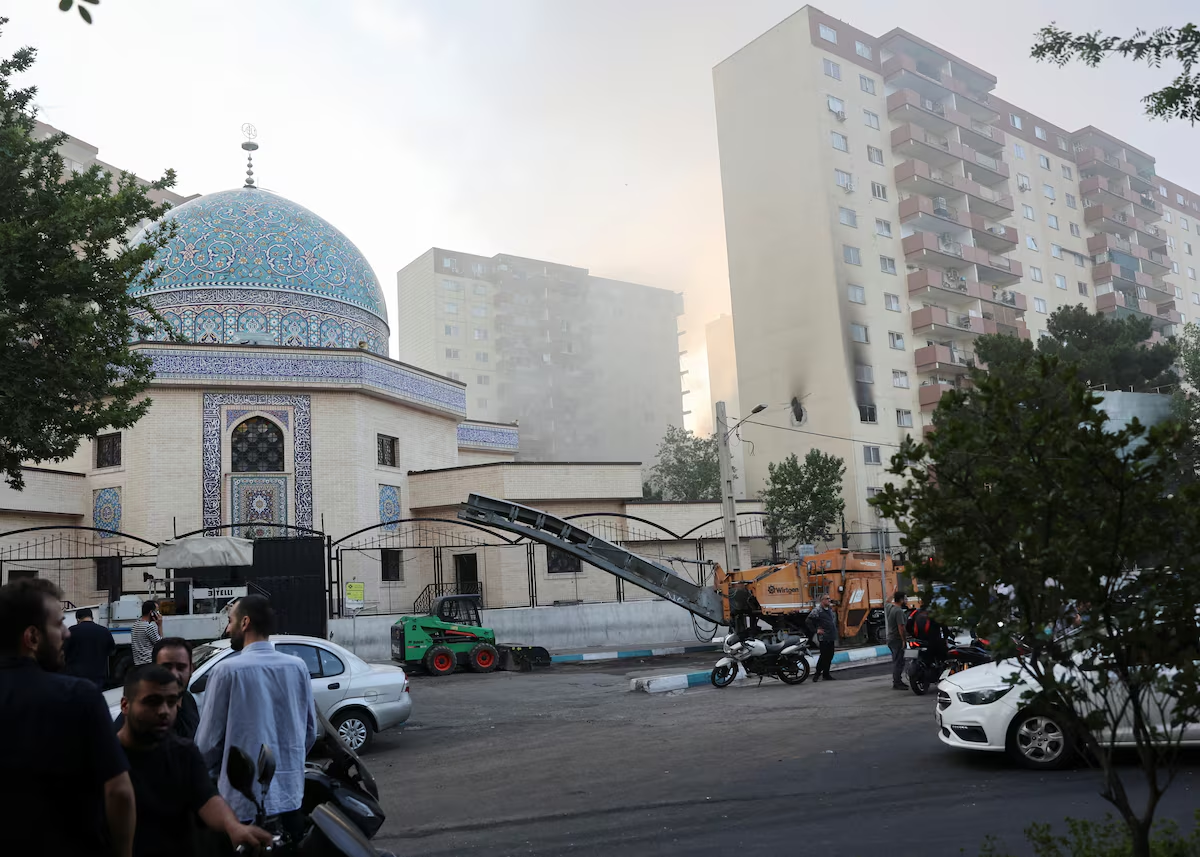
The current round of Israeli–Iranian escalation—regardless of its surface motivations—appears as the final act in preparations for this new Middle East. Architected by Zionist planners over decades, the outcome of this confrontation may determine whether the “Zionist‑American dream” is formally inaugurated or indefinitely postponed.
“Israel 2.0” – Reframing National Security
In April, Israel’s prestigious Meisgav Institute—founded in 2023 and headed by former national security advisor Meir Ben-Shabbat—publicly unveiled a strategic blueprint titled “Israel 2.0”. The detailed plan aims to catapult Israel into undisputed regional dominance, neutralizing both current and future adversaries.
The institute asserts that the October 7, 2023 attack served as a wake‑up call for Israel. It argues for a rapid recalibration: a comprehensive national reorganization, transformation of the Zionist-national myth, and a reboot of Israeli identity in preparation for coming decades.
The project outlines strategic objectives to be pursued in close coordination with the United States:
-
Eliminating the Iranian nuclear threat
-
Reaching agreements with Turkey on the new Middle Eastern geopolitical order and shared interests in Syria
-
Reinforcing peace accords with Egypt
-
Leveraging the moment for greater autonomy and initiative in shaping Israel’s northern region
-
Maintaining military pressure to dismantle the remnants of the Syrian army and expanding Israel’s presence along the Syrian border
A Clean Break: Blueprint for a New Middle East
In 1996, the seminal think‑tank memo A Clean Break: A New Strategy for Securing the Realm—drafted by leading American neoconservatives under the patronage of the U.S. Defense Department’s Richard Perle—laid the early groundwork for this vision.
Endorsed by major U.S.–Israeli experts, the plan pushed for absolute Israeli hegemony through the weakening, containment, or neutralization of regional powers.
Far from theoretical rhetoric, A Clean Break offered concrete policies: dismantling Iraq’s centralized systems, curbing Syria’s influence over Lebanon and Palestine, fragmenting strong Arab states, building Sunni alliances to counter Iran, and transforming the Arab–Israeli conflict into an administrable local dispute.
The ensuing U.S. interventions in Iraq (2003) and attempts to reshape regimes in the Middle East echoed its recommendations—contrasting sharply with earlier visions of peace-led cooperation.
Iran: The Final Obstacle
According to the Clean Break doctrine, Israel must abandon traditional peace negotiations with Palestinian or Arab states, including Iran. Soft diplomacy should yield to hard power—military, political, and subversive—to pressure hostile regimes into submission or irrelevance.
This shift became manifest with the October 7 Awakening operation, regarded by Israeli and Washington policymakers as a turning point. What followed were rapid, coordinated moves—militarily neutralizing Gaza’s capacity; sidelining Egypt, Jordan, Hezbollah, and a fragmented Syria through military operations and international instruments; and consolidating normalization through the Abraham Accords.
The stage was set to eliminate all regional opposition except for Iran and its Yemeni allies.
The recent escalation targeting Iran goes well beyond its nuclear ambitions. Israeli strikes have exposed vulnerabilities in Iran’s air defenses, making its skies a testing ground for Israeli aerial power. Netanyahu himself has called for an Iranian intifada and encouraged protests aimed at regime change—signaling a shift from containment to active regime subversion.
Strategically, this escalation also bolsters Israel’s negotiating position on Gaza, strengthening its hand as it crafts a new regional power balance favoring Israeli‑American will.
Regional Unease and Uncertainty
Despite the ideological gulf between Israel and the Arab states, leaders from Gulf countries to Islamabad are voicing concern. They argue that Iran serves as a key pillar of regional stability and deterrence.
A complete collapse of Iranian influence, they warn, would create a geopolitical vacuum rapidly filled by an emboldened Israel—shifting the balance of power irrevocably.
Saudi Arabia condemned the June 13 Israeli strike on Iranian targets; Pakistan officially backed Tehran, with its prime minister calling for unity among Muslim nations and its defense minister urging solidarity.
Chinese and Russian officials, meanwhile, have voiced economic concerns—warning that further escalation could jeopardize shared energy projects and threaten a multipolar world order.
This latest Israeli–Iranian escalation must be viewed as a defining moment in the Middle East’s evolution—a logistical and geopolitical inflection point. Far from merely a show of force, it represents the unfolding of a re‑engineered Middle East built on Israeli‑American hegemonic aspirations.
How regional powers and global actors respond in the coming weeks will determine whether this vision becomes reality—or is forced to retreat into the confines of ideological brinkmanship.