












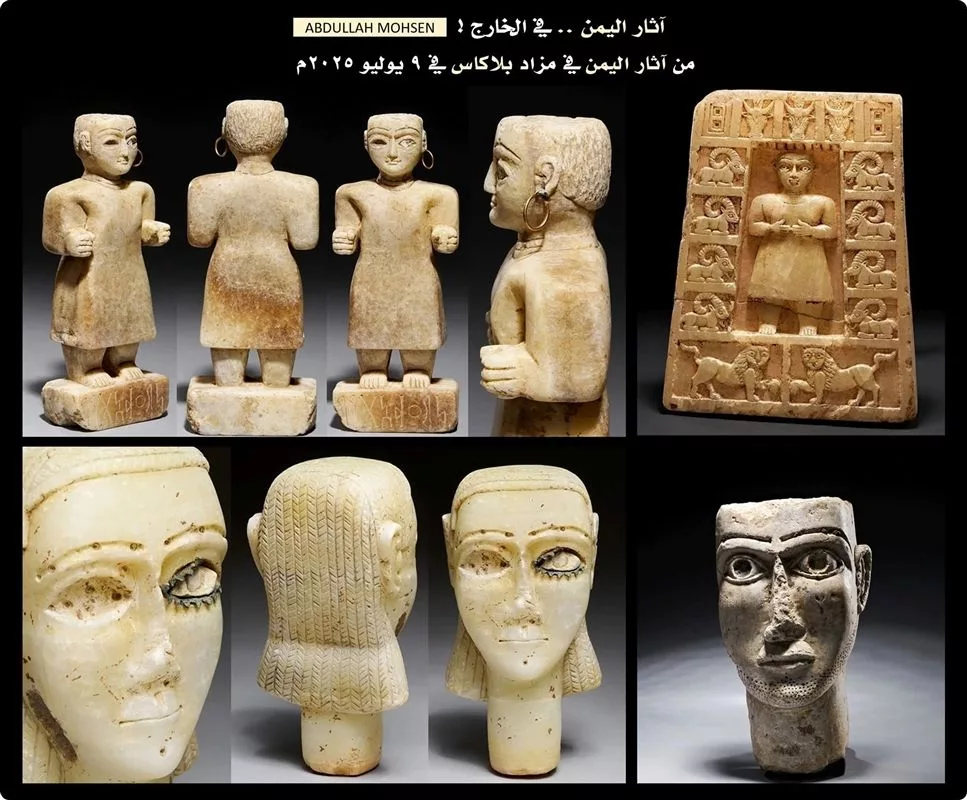
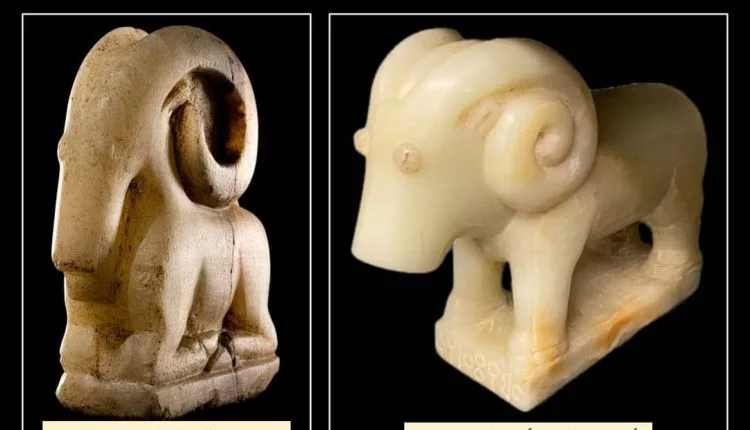
On June 26th, a Yemeni artifact dating back to the first century BCE was put up for auction in Barcelona, Spain, after having been smuggled out of Yemen at an unspecified time.
On July 13th, a rare bull statue from ancient Yemen, made of calcite and inlaid with green glass, was featured in a global auction held by the American auction house “Artemis.” Earlier this year, on January 13th, Yemeni antiquities researcher Abdullah Mohsen revealed that a statue from Yemen was on display in Tel Aviv among a private collection owned by Jewish businessman Shlomo Moussaieff.
Such discoveries are not rare. From time to time, Yemeni artifacts appear in auctions across Europe and the United States. The smuggling and sale of Yemeni relics and manuscripts have surged since the start of Yemen’s ongoing war a decade ago.
According to a Yemeni Ministry of Culture official who spoke to Noon Post, over 3,200 artifacts have been smuggled out of the country—figures that align with a report by the Malcolm H. Kerr Carnegie Middle East Center, which noted that more than 2,000 smuggled Yemeni artifacts, valued at $12 million, are currently in the United States. An additional 1,000 artifacts are housed in museums around the world.
Yemeni relics are now openly listed in online auction catalogs, visible to all. Experts in antiquities have described the war years in Yemen as a “golden age” for artifact smuggling networks.
Why the Surge?
The illicit trade in Yemeni antiquities is not new. In 1862, British officer Sir William Marcus donated 27 bronze tablets from Ma’rib and 13 stone inscriptions from Shabwa and Ma’rib to the British Museum—pieces smuggled out of Yemen via trafficking routes.
During the 1994 civil war over Yemeni unification, hundreds of artifacts were looted and smuggled. Provinces like Al-Jawf, Ma’rib, and Shabwa—rich in archaeological heritage—served as key departure points for the stolen items. Several foreign archaeological missions were implicated in the trafficking.
Since 2014, Yemen’s archaeological sites have been bombarded by both the Saudi-led coalition and the Houthi movement. According to Abdullah Mousa of the Hudhud Center for Archaeological Studies, Saudi-led forces have bombed 100 archaeological sites.
Activists also accuse the Houthis of looting and destroying antiquities. Marwan Dammaj, cultural advisor to Yemen’s Presidential Leadership Council, told Noon Post that five museums across Yemen have been damaged in the crossfire between government forces and the Houthis, prompting the internationally recognized Yemeni government to move many valuable pieces into bank vaults for safekeeping.
Meanwhile, unregulated excavation by civilians has become common in historic regions like Al-Jawf, Ma’rib, and Hadhramaut. Many items have also disappeared from museums, including the Military Museum in Sanaa, according to Yemeni antiquities researcher Adnan Al-Qayz.
Al-Qayz notes that the largest smuggling operations during the war have involved high-ranking officials, tribal leaders, and influential figures working with organized crime syndicates, a claim corroborated by the Ministry of Culture and the General Authority for Antiquities.
Abdulbasit bin Sariyah, Deputy Minister of Culture, told Noon Post that his ministry is not solely responsible for the looting of Yemeni antiquities. The ministries of security and commerce, along with local organizations, must also be held accountable.
Bin Sariyah attributes the rise in theft and smuggling to several key factors: rampant insecurity across the country, the high profits that antiquities fetch, competition among locals to trade in artifacts, and the complicity of officials who facilitate smuggling operations.
“The gravest problem,” he said, “is that those involved in these crimes know they will face no consequences. Security agencies fail to arrest or prosecute them.”
Who Is Tracking the Looters?
A group of Yemeni researchers—among them Dr. Ameeda Shaalan, researcher Riyadh Al-Farah, antiquities expert Abdullah Mohsen, and archaeologist Dr. Yusuf Mohammed Abdullah—have taken it upon themselves to track and expose artifact smuggling using personal resources.
Some of these experts monitor international auctions and collections for smuggled Yemeni artifacts, publishing their findings on social media. Abdullah Mohsen argues that Yemeni diplomatic missions abroad should play a vital role in halting or at least curbing the smuggling—but they largely remain inactive.
The Yemeni government, he adds, turns a blind eye to the fact that the UAE, Djibouti, and Oman are key transit points for smuggling Yemeni heritage.
According to Mohsen, artifacts are transported from archaeological sites to hidden storage spaces across various provinces. From there, they are smuggled overland, or through seaports—and in fewer cases, through airports.
Many of these pieces make their way to the UAE and neighboring countries like Djibouti and Somalia, with Europe and the US as final destinations for this stolen heritage. This was confirmed in a joint article by Deborah Lehr, Director of the Antiquities Coalition, and Yemen’s former ambassador to the US, Ahmed Awad Bin Mubarak.
Trading Blame
The Houthis and the Yemeni government routinely accuse each other of enabling artifact smuggling.
According to the Houthi-controlled Ministry of Culture and Tourism in Sanaa, “the legitimate government is orchestrating the organized looting, destruction, and sale of archaeological sites and artifacts, as well as legitimizing the bombardment of these sites by the aggression’s airstrikes [referring to the Saudi-Emirati coalition]. It is part of a broader scheme to erase Yemen’s cultural and historical identity.”
Conversely, the internationally recognized government accuses the Houthis of being the main perpetrators. Yemen’s Minister of Information and Culture, Muammar Al-Eryani, said the Houthis are “systematically looting and smuggling Yemeni antiquities as part of a criminal scheme to erase the Yemeni identity and enrich their leadership while funding their terrorist operations.”
What Can Be Done?
On September 22, 2023, Yemen’s Ambassador to the US, Mohammed Al-Hadhrami, and Max Hollein, Director of the Metropolitan Museum of Art, signed an agreement to cooperate in recovering Yemeni artifacts and protecting the country’s cultural heritage. However, according to Yemeni researchers who spoke to Noon Post, the smuggling of artifacts to the United States continues.
Wadie Aman, head of the Heritage Protection Authority in Aden, says that finding a comprehensive solution to artifact smuggling during wartime is extremely difficult. However, he stresses the need for cooperation among all relevant agencies—including Yemen’s customs authority and the ministries of defense, interior, culture, and commerce—along with tribal leaders and local community figures to help prevent smuggling.
On the diplomatic front, Yemen’s UNESCO ambassador, Mohammed Jumeh, is working to compile a comprehensive database of missing Yemeni artifacts. This database could serve as a reference for UNESCO in reaching out to countries and institutions harboring smuggled Yemeni antiquities.
UNESCO announced an emergency plan in July 2015 to preserve Yemen’s cultural heritage, but the plan has stalled due to funding shortfalls.
Yemeni antiquities experts are also calling for reform of the country’s antiquities law. Law No. 21 of 1994, which remains in force, is widely criticized for imposing lenient penalties on smugglers and traffickers. Researchers urge the revitalization of the Antiquities Authority to facilitate the recovery of looted items both inside and outside Yemen.


