











هذا التقرير متاح أيضًا بـ العربية
In recent years, the issue of settlement goods has moved beyond the category of “product labeling” to outright bans and prohibitions, with moves adopted or approved by several European countries, including Spain and Slovenia, and most recently Ireland, against importing goods from Israeli settlements.
The significance of these steps lies not only in the volume of trade, but also in the question they raise: What exactly do the settlements produce? And how do goods grown or manufactured on occupied Palestinian land become products that enter global markets as though they were ordinary trade?
What is meant by settlement goods?
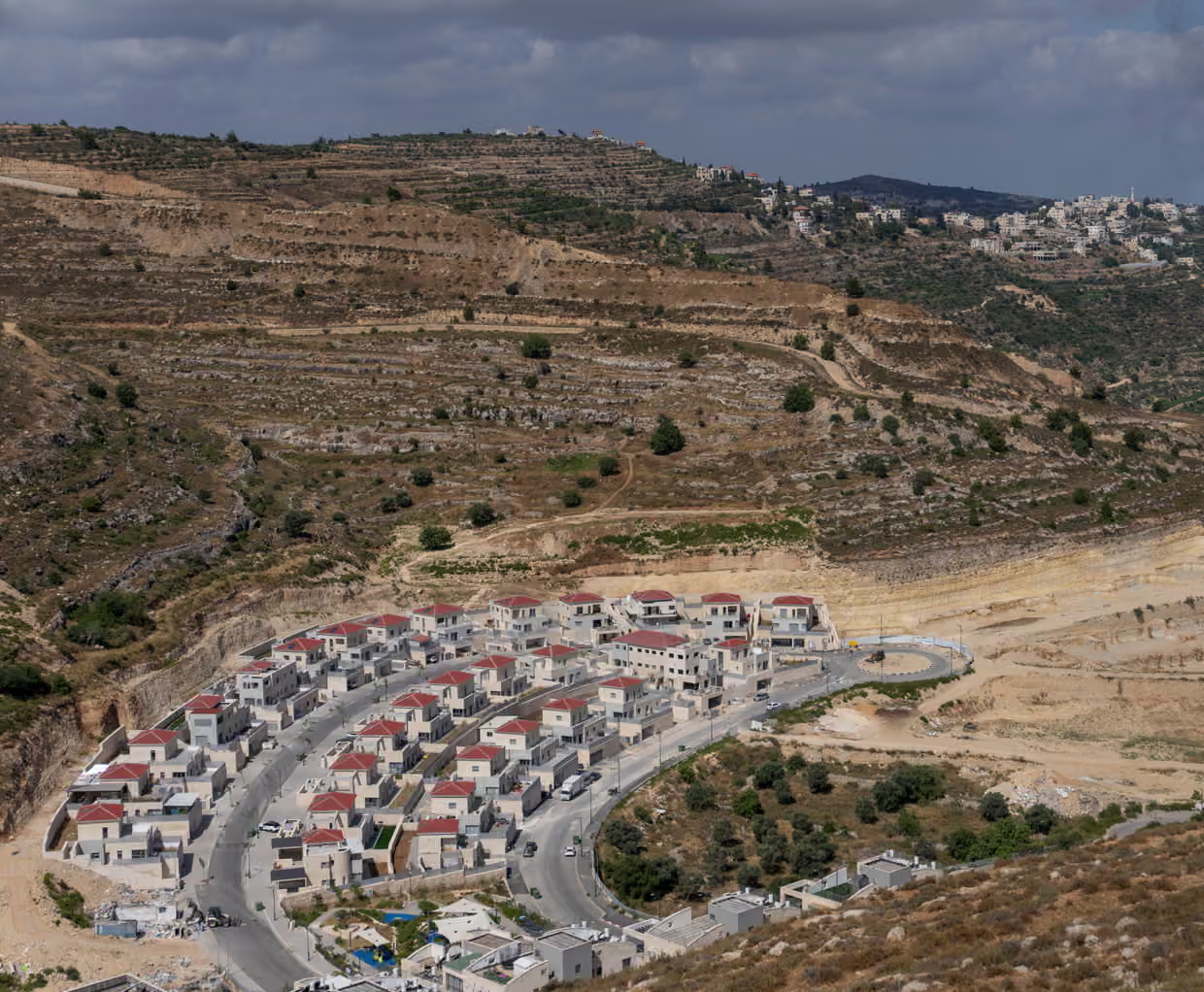
These are goods that are grown, manufactured, extracted, or packaged inside Israeli settlements established on Palestinian territory occupied since 1967, meaning the West Bank, including East Jerusalem.
When it comes to the broader European rules on labeling, the occupied Syrian Golan is also included among the territories that “Israel” occupied in the same year and where Israeli settlements have been established. The key distinction, then, is not the nationality of the company, but the origin of the product that comes out of a settlement.
That is why it is not enough for a product to leave from the port of Haifa or Ashdod (Palestinian territories occupied in 1948) for it to become an “Israeli product” in the European customs and legal sense.
In 2015, the European Commission issued guidelines for labeling products coming from territories occupied by “Tel Aviv” since 1967, so that settlement goods would not be marketed under the label “Made in Israel.”
In 2019, the European Court of Justice confirmed that food products coming from an Israeli settlement must state not only the territory they came from, but also that they come from a settlement, because concealing that could mislead consumers about the product’s origin and its ethical and legal context.
That is why defining settlement goods is as much a political matter as it is a commercial one. They carry within them the imprint of the place where they were produced: occupied land, resources under the control of the occupation, and a supply chain that seeks to erase that origin behind a generic phrase such as “Made in Israel.”
What do the settlements produce agriculturally and industrially?
The settlements produce far more than the conventional image of settlement housing units and walls. They are part of a production system that includes agriculture, industry, quarries, packaging, and marketing.
Agriculturally, products include dates, grapes, vegetables, aromatic herbs, flowers, and some fruits and export-oriented crops.
Medjool dates are among the most prominent products associated with this economy, because they leave settlement farms and then enter broader marketing chains that may conceal their true origin.
Industrially, the settlement areas include food factories, packaging plants, plastics, metals, construction materials, and chemical and light industrial products.
Quarries are also part of this economy, as stone and raw materials are extracted from West Bank land, while Dead Sea products such as mud, salts, and cosmetics are included in the same debate when they are tied to the extraction of resources from occupied land or marketed through an Israeli system.
A report by Human Rights Watch on settlement companies offered a clear picture of the physical scale of this system:
- About 20 industrial zones run by “Israel” in the West Bank, covering roughly 1,365 hectares.
- About 9,300 hectares of agricultural land overseen by Israeli settlers.
This means that commercial activity in the West Bank is not limited to settlement housing units, but includes factories, farms, quarries, service companies, and infrastructure.
Where are settlement production areas located?
Settlement production areas are distributed across two main clusters: an agricultural cluster in the Jordan Valley and the northern Dead Sea, and an industrial cluster in various parts of the West Bank and East Jerusalem.
The agricultural areas extend from the vicinity of Jericho northward and southward toward the Dead Sea and the Jordanian border, and include settlements and farms that benefit from the warm climate and from water and road networks controlled by the occupation. In this area, dates, herbs, vegetables, and fruit appear as export products.
The industrial areas, meanwhile, are spread across several locations , most notably Barkan near Salfit, Ariel to the west, Mishor Adumim east of Jerusalem, Atarot north of Jerusalem, Maale Efraim, Gush Etzion, and Nitzanei Shalom near Tulkarm.
These areas do not operate as isolated facilities, but are linked to bypass roads, the Israeli market, and export ports.
Barkan, for example, includes dozens of factories and is connected to external export chains, while Mishor Adumim benefits from its location between East Jerusalem and the roads leading to markets and ports, and Atarot benefits from the reality of East Jerusalem’s annexation and the occupation’s control over its administrative and economic infrastructure.
In this sense, the map of settlement production is not random. Agriculture is placed where there is land and water, and industry where there are roads, crossings, and proximity to the Israeli market. Between the two, Palestinian villages are isolated and their movement restricted, while the settlement is transformed into a node in a network of production, transport, and export.
What is the settlement economy built on?
The settlement economy rests on five interconnected elements:
First, land: The settlements and their industrial and agricultural zones were established on Palestinian land that was confiscated or declared “state land,” or placed under military orders or planning restrictions that prevent Palestinians from using it. This means that the factory or farm does not operate in a vacuum, but atop an accumulated structure of confiscation.
Second, water: In the Jordan Valley and other agricultural areas, settlers enjoy water supplies and irrigation infrastructure that enable export-oriented agricultural production, while surrounding Palestinian communities face scarcity, restrictions, and high costs of access to water. So the question is not only “Who farms?” but also “Who owns the water and the permit?”
Third, roads and crossings: Settlement trucks transport their goods via bypass roads and transport networks integrated into the Israeli market, while checkpoints and military gates sever internal Palestinian connectivity, increasing costs for local producers and delaying their access.
Fourth, privileges and infrastructure: Human Rights Watch documented that settlement companies benefit from low rents, government incentives, infrastructure, permits, and facilities for which Palestinians receive no equivalent.
This is evident in industrial zones presented to investors as offering lower operating costs than inside “Israel,” yet they are built on occupied land and at the expense of a besieged Palestinian economy.
Fifth, Palestinian labor: Historically, settlement factories and farms relied on Palestinian workers whom impoverishment and restrictions forced to work in the very settlements for which their land had been confiscated.
After Oct. 7, 2023, the labor market changed dramatically with the cancellation or restriction of most work permits inside “Israel,” but the settlements remained an outlet for part of the workforce.
The Israeli rights group Gisha said in 2025 that about 48,000 work permits in settlements had existed before the war, and that the occupation authorities allowed about 32,000 workers to return to their jobs there, while most West Bank workers remained barred from working inside “Israel.”
How do settlement goods reach the market?
The supply chain often begins at a farm, factory, or quarry inside a settlement or settlement industrial zone, then passes through a packaging center, distribution company, or Israeli commercial intermediary before reaching the Israeli market or export ports, and from there to Europe or other markets.
This is where the problem lies: The product’s origin may be a settlement, but its route abroad usually passes through an Israeli company, address, or port.
Settlement goods may also be packaged together with goods from inside “Israel,” or enter mixed supply chains, making it difficult for consumers, or even some importers, to know their true origin.
Historically, European and British discussions revealed cases of mixing or shortcomings in certificates of origin, and the difficulty of verifying whether a product came from inside “Israel” or from a settlement.
The European Union tried to address this problem through rules of origin and labeling. Settlement products are not supposed to benefit from the customs preferences granted to “Israel” under the association agreement , which does not cover the occupied territories.
That is why European governments used lists of postal codes and areas of origin to exclude settlement goods from preferential treatment. But labeling alone does not break the chain: A consumer may see wording clarifying that the product is from the “West Bank – Israeli settlement,” recognize its origin, and make a decision.
A ban, however, as a number of European countries are now pursuing, moves from informing the consumer to preventing the goods from entering in the first place. That is why tracing origin becomes the core of the trade battle.
Why are countries moving to ban these goods?
Countries are moving to ban settlement goods for three overlapping reasons: international law, consumer protection, and preventing the normalization of the settlement economy.
The first reason is legal: In July 2024, the International Court of Justice said in its advisory opinion that Israel’s continued occupation of Palestinian territory is illegal, and that states must neither recognize the unlawful situation nor aid in maintaining it.
The Irish government linked its new bill to that opinion, stating that states are obliged to refrain from entering into trade or investment relations concerning the occupied Palestinian territory if they help entrench the unlawful situation.
The second reason is consumer protection: The European Union’s 2015 guidelines and the 2019 ruling by the European Court of Justice were based on the principle that consumers should not be misled.
A product coming from a settlement must not be allowed to hide behind a generic description such as “Israeli product,” because that conceals the truth of its origin and the context of occupation.
The third reason is political and rights-based: The United Nations database of companies linked to settlements, updated in September 2025, includes 158 companies from 11 countries tied to activities in settlements, after 68 new companies were added and seven that were no longer involved in the activities of concern were removed.
This update broadened the discussion from “goods on the shelf” to a network of companies, construction, real estate, tourism, quarries, and resources.
In the end, the ban is not only about a package passing through or a cosmetic product. It is about breaking the route that makes the settlement economy appear to be ordinary trade.
When these goods are banned or clearly labeled, their origin becomes visible: occupied Palestinian land, resources under control, and a production chain that cannot be separated from the settlement system.