




هذا التقرير متاح أيضًا بـ العربية
At a time when Greeks raise slogans of a civilization rooted deep in history and play on the strings of democratic leadership worldwide, they present one of the most racist experiences in history, as their relationship with Muslims has seen waves of oppression and abuse that have draped their history in black shrouds of shame.
Muslims in Greece
Muslims in Greece have gone from being a majority approaching 70 percent in the early 19th century to becoming one of the neglected minorities on the radar of official concern by the Greek authorities, which have used everything at their disposal to make life difficult for Muslims in their daily lives and in the practice of their religious rites and rituals.
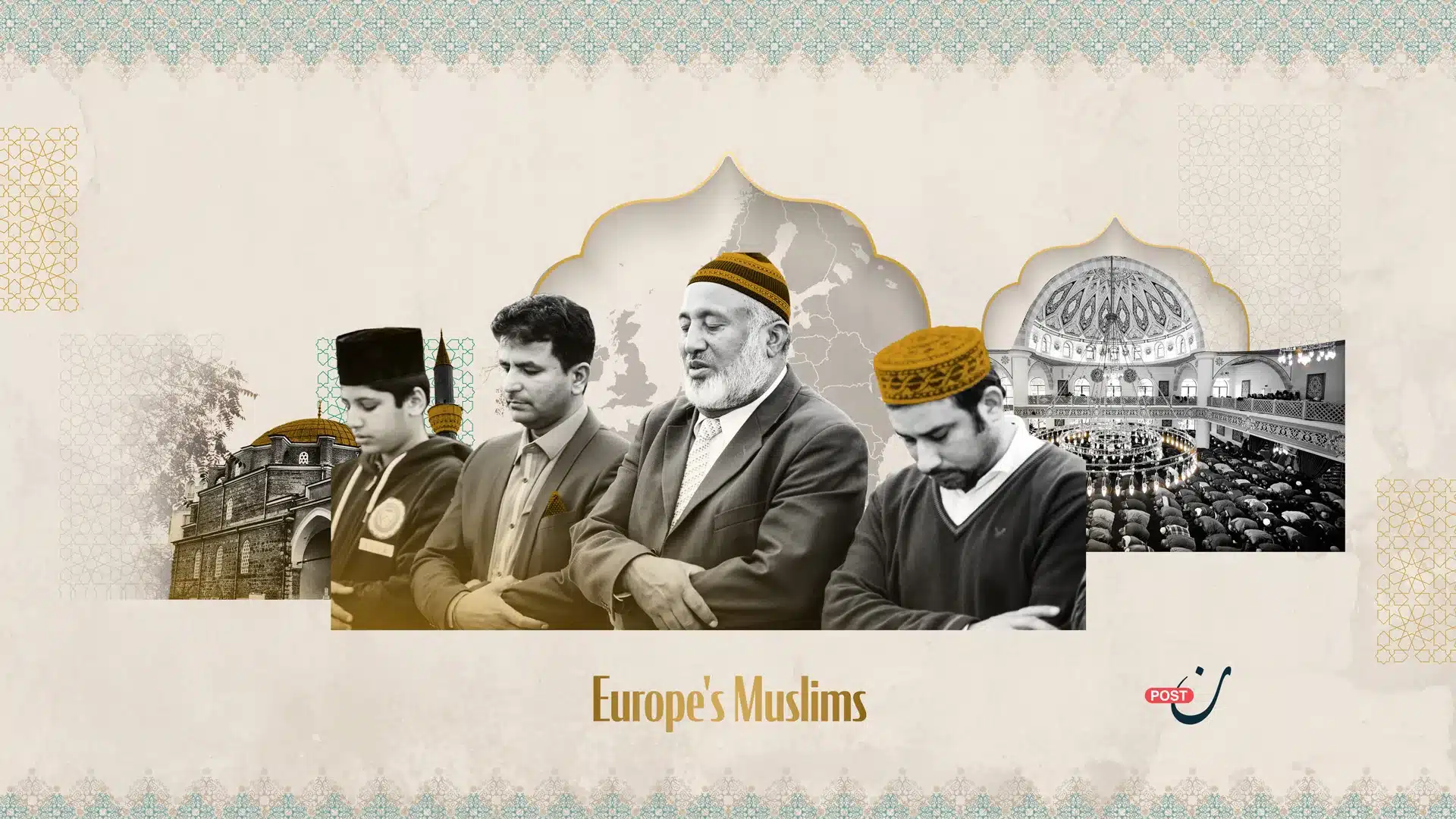
Despite differing views and statistics regarding the number of Muslims in Greece, the figures closest to accuracy indicate that the current number is about 650,000 people, including 500,000 in the capital, Athens, among them 50,000 to 60,000 of Greek origin, and about 150,000 in the rest of the cities. They make up about 5.7 percent of Greece’s population, according to statements by Naim Elghandour, head of the Muslim Association of Greece.
Muslims in Greece are considered one of the oldest Islamic communities historically in the non-Islamic world, which explains their commitment to coexistence despite an atmosphere that is often unfavorable, amid a plan to erase Islamic identity and uproot it from its social foundations. Muslims thus fall victim to the historical complex Greece suffers from after having been under Ottoman rule for long decades.
One of the oldest Islamic communities
Greece was among the first European countries to know Islam, when the Muslim army conquered the island of Rhodes in 654, then Crete was conquered at the hands of the Umayyad Andalusians in 827. By the 10th century, the majority of the populations of the two islands had become Muslim, marking the beginning of the Muslim community in Greece.
In 961, Crete fell into Byzantine hands and Muslims were expelled from it, while Christian kings practiced abuse and oppression against Muslims, leaving them with only two choices: convert to Christianity if they wished to remain on the island, or leave it. This led to the island being emptied of most of its Muslim population until the arrival of the Ottomans.
With the Ottoman conquest of Macedonia in 1380 under Sultan Murad I (1326-1389), Islam began to spread throughout Greece and from there into Europe. The country came under Islamic Ottoman rule for several centuries, during which it witnessed a refined civilization and a major flourishing in science, translation and architecture, until Greece became a strong launching point for illuminating European capitals with the light of Islamic civilization. At that time, Muslims made up about 68 percent of Greece’s total population.
After Ottoman rule in the country ended in 1830, the vast majority of Muslims left Greece, and only a small number remained, suffering unprecedented Christian persecution in retaliation for the period of Islamic rule.
The situation remained as it was until the Lausanne agreements were established in 1923, one of the outcomes of the Greco-Turkish wars that lasted from 1919 to 1922. Population exchanges took place, as a result of which more than 450,000 Muslims left Greece for Turkey. Only 92,000 remained in Thrace and 26,000 in Epirus, and they were later forced to flee to Albania after World War II.
A comprehensive distribution map
Muslims in Greece come from several backgrounds, most notably Turkish, Balkan, Pomak and Albanian, as well as Greek origins. They are concentrated in five main groups spread across different regions, most importantly the capital, Athens, which is home to more than 150,000 Muslims, most of them dating back to the Ottoman era, while some Arabs have migrated there more recently.
Another group of Muslims in Greece is concentrated in Thrace in northeastern Greece, where the overwhelming majority of the Muslim community lives, with numbers ranging between 120,000 and 150,000. This city, which covers 8,758 square kilometers and has a population of about 400,000, remained under Turkish control until the end of World War I. Although the Treaty of Lausanne guaranteed them freedom to practice their rituals, the tightening pressure on them pushed many to leave.
Among the historic areas where Muslims tend to reside is Macedonia in the north, home to more than 15,000 people of different origins Albanian, Greek, Pomak and Roma although they face major problems because of fragmentation and lack of cohesion. There is also the Aegean region, especially the islands of Kos and Rhodes near Turkey.
Finally comes the region of Chameria on the Albanian-Greek border, which covers 15,000 square kilometers and is considered one of the concentrations of Muslims in Greece. According to Turkish sources in 1910, it was home to about 83,000 Muslims, while Greek statistics estimated them at only about 26,000.
Stripping away identity
On Jan. 9, 2018, Muslims in Greece received a painful blow, perhaps the harshest in the past five decades, when parliament abolished the system applied to the community under which Islamic law was the primary reference for personal status matters, including marriage, divorce, inheritance and others.
This system had been granted to Muslims under the Treaty of Athens signed between the Ottomans and the Greek state in 1913, which included Muslims’ freedom to manage their affairs according to Islamic law, including choosing the mufti, noninterference in their religious affairs, and guarantees for the practice of rites and rituals. But the situation changed somewhat in 1991, when the government intervened in the selection of the Muslim mufti, in violation of the treaty.
In light of the latest parliamentary decision, civil courts subject to Greek law have become the sole reference for settling any disputes related to Muslims’ personal status matters, while Islamic law has been removed from the scene, unless both parties to the dispute agree to resort to it in an amicable, unofficial manner.
This decision angered some Muslims who rejected Athens’ interference in choosing the mufti, prompting them to choose their own mufti, as Turkish Muslims in the country did in 2020. But this move was met with a harsh response, as some were subjected to severe penalties and the new mufti was put on trial.
Ahmed Mete, the mufti of the city of Xanthi in the Western Thrace region of northeastern Greece, was sentenced to 15 months in prison by a Greek court in mid-June 2021 over previous statements dating back to 2016, when he said that the Greek government had prevented the Muslim Dar al-Ifta from restoring and renovating Muslims’ mosques and had imposed penalties on a number of its affiliates.
Challenges of integration
Despite the long history of Muslims in Greece, which may predate the presence of many Greeks themselves, the integration of the Muslim community into Greek society has not reached the hoped-for or expected level, according to what noted by Lebanese journalist Shadi Ayoubi, who has lived in Athens for years. He attributed this weakness to several reasons, chief among them the lack of Muslim unity and the absence of institutions or competent leadership to represent them before the ruling authorities there.
This is in addition to the bureaucratic nature of government institutions in Greece, especially the slowness and procrastination in granting residency and citizenship, which causes many Muslims to leave the country for others that are more flexible and less bureaucratic, according to Ayoubi.
Among the most prominent issues hindering the path of integration is the education system. Although most Muslims there speak Turkish and a minority speak Pomak, a Bulgarian dialect, and although there is an education agreement between Turkey and Greece signed in 1951, the government remains obstinate in establishing schools that teach the Turkish language, except for a few. This is in addition to the recent closure of many Turkish schools on the pretext of weak enrollment.
The schools attended by Muslims in Greece are divided into two types. The first concerns local residents who have held Greek citizenship for years; these are schools that teach Islam, and some also teach the Turkish language, and they are called “minority schools.” As for incoming migrants from abroad, they have only one official school, the “Libyan schools,” alongside other unofficial ones.
Muslims in Greece also suffer from a shortage of mosques and cemeteries. Although there are about 300 zawiyas and places designated for prayer in northern Greece for the resident Muslim minority holding citizenship, migrant areas suffer from a relative scarcity of mosques. It is enough to note that the Greek capital, home to about 150,000 Muslims, has only one large official mosque, opened in 2020, with capacity for just 400 people.
Participation in political life
While Muslims in Greece suffer severe difficulties in integration, they have nevertheless managed to establish a political presence despite the restrictions imposed on them regarding candidacy in parliamentary elections and the establishment of political parties. This has pushed many of those seeking political work to join existing Greek parties.
Konstantinos Tsitselikis, a writer specializing in the conditions of Muslims in Greece, notes in an article cited by the “Al Jazeera Center for Studies” that members of the Muslim minority, especially in Thrace, participate regularly in political life, noting that two of them were elected to parliament in 2007 as candidates for the opposition PASOK party.
In the preceding elections in 2002, Muslims won about 250 representative positions in local administrations and institutions, in addition to the election of a Muslim to serve as deputy governor of Rhodope, according to Tsitselikis, who pointed to the weakness of Muslim political representation at the higher levels of power, which have become the preserve of Christians.
To support Muslims’ involvement in political and social work, they established a number of associations and entities through which they act in service of their interests and defend their rights and privileges. Among the most prominent are the Association of University Graduates in Thrace, the Turkish Union of Xanthi, and the Greek-Pakistani Cultural Association, although these associations face legal problems from time to time.
A history of racism
Modern and contemporary history records dozens of massacres committed by Greeks against Muslims, massacres that lay bare a hateful racism against the Muslim minority and Islam in general. Much of the motive behind them stems from the historical complex resulting from Islamic rule over them, giving them the unmistakable odor of revenge.
Historians have divided these massacres into two categories according to the historical period in which they occurred. The first includes those committed during the War of Independence, the war waged by the Greeks against the Ottoman state from 1821 to 1832. Among its most prominent crimes was the massacre of the Peloponnese Peninsula, in which more than 20,000 Muslims were killed in a wave of mass executions blessed by the priests of the region’s churches.
There were also the massacres of Tripolitsa, which claimed the lives of 35,000 Muslims, during which Russians and Greeks threw children from the tops of minarets, according to historians, in addition to the massacre of Navarino in 1821, in which the entire population of the city of Navarino, numbering 30,000, was killed, with only 160 managing to escape.
The catastrophe also occurred during the massacres of the Aegean islands in March 1821, in which hundreds of Muslims were killed when Greeks attacked Turkish ships passing through the area on their way to the Hajj pilgrimage.
The 20th century was no less bloody than the 19th, as ethnic exterminations carried out under European patronage destroyed dozens of villages in their entirety between May 16 and July 10, 1921, in addition to the massacre committed by the Greeks in the Yalova region, where they burned nearly 27 Muslim villages and killed about 10,000 people.
In the aftermath of World War II, the Greek authorities launched campaigns of genocide against the Albanian inhabitants of the Chameria region, killing 5,000 residents, displacing another 35,000, destroying 68 villages, burning 5,800 homes and demolishing more than 100 mosques.
In the modern era, despite the disappearance of the phenomenon of mass massacres and full-scale extermination crimes, racism against Muslims still enjoys a popular and political incubator that enables it to continue and endure, especially after the rise of the far-right Golden Dawn party in the first decade of the current millennium.
The influence of this party has grown over the past 10 years in an unprecedented way, allowing it to impose itself as a key player in the scene inside parliament, within parties and within government formations, until it has become one of the tools shaping Greek foreign policy in recent times.
Notably, the attacks launched by this party against Muslims in Greece and migrants in general in recent years drew no attention from police circles, as researcher Mohammed Yousch pointed out in his study titled “Muslims in Greece: Pluralism and the preservation of identity,” noting that in the latest elections, police officers’ votes for the extremist party reached 50 percent.
Thus, Muslims in Greece are paying the price of the historical complex that dominates the mentality of the ruling authorities and their rising populist base, while the minority struggles to strengthen the system of integration despite the challenges, believing in its right to a dignified life in this country where it once represented the overwhelming majority.