












هذا التقرير متاح أيضًا بـ العربية
On July 16, Reuters revealed Reuters, citing two senior Iranian sources and a well-informed regional source, that Tehran had asked the Houthi group in Yemen to prepare to close the Bab el-Mandeb Strait if the United States moved to target energy infrastructure inside Iran.
The disclosure came a day after a report by the British newspaper The Telegraph said the Houthis were laying the groundwork to open a new front in Iran’s war by controlling the strait in coordination with Somalia’s al-Shabab movement. With the Strait of Hormuz effectively closed to shipping traffic, this threat places the world before a scenario unseen in modern history: the simultaneous paralysis of the Middle East’s two most important arteries for energy and trade.
In previous crises — from the Tanker War in the 1980s to Houthi attacks on shipping since the end of 2023, and even during the previous months of the US-Israeli war on Iran — tensions in the Gulf and tensions in the Red Sea were always separate. Today, however, the two theaters are linked in a single deterrence equation managed by Tehran.
The Red Sea: Iran’s second front
Since the outbreak of the US-Israeli war on Iran on Feb. 28, 2026, maritime geography has become a central weapon in Tehran’s hands. The Islamic Revolutionary Guard Corps has effectively closed the Strait of Hormuz to ship traffic since March 4, 2026, through today. That period included a fragile and brief opening that did not last long, from June 17 to mid-July, leading about 90 percent of traffic to divert away from the strait, before the figure exceeded 95 percent as Iranian threats against passing vessels escalated.
That closure pushed Gulf states, led by Saudi Arabia, to reroute their oil exports toward Red Sea ports, to the point that the corridor now carries about 7 percent of global energy supplies after Riyadh redirected nearly 70 percent of its exports through the port of Yanbu. In this way, Bab el-Mandeb has risen from an important shipping lane to the only remaining alternative outlet for Gulf oil.
With US strikes on Iran resuming, especially after US Central Command targeted Iranian road networks and bridges, Tehran appears to be pursuing its clearest tactic yet of distributing the battlefield by shifting the cost of strikes on its geographic depth onto international waterways through its proxies. In this way, the losses of war are spread across the global economy instead of being concentrated on Iranian territory, and pressure on Washington and its allies is multiplied without Tehran having to expand the direct confrontation.
Platforms affiliated with the Revolutionary Guard stated this approach explicitly. As The Telegraph reported, Fars News Agency, which is linked to the Guard, published a doctrine calling Bab el-Mandeb the “second front” in any wider war, saying the strait would be closed alongside Hormuz to cut off funding and logistics to what it described as “Iran’s enemies” and choke global trade.
That is consistent with the Revolutionary Guard’s declaration, through the official IRNA news agency, that regional energy exports “must either be for everyone or for no one.” In that formulation, the region stretching from the Red Sea to the Horn of Africa is transformed from a mere trade corridor into an advanced line of defense and attack for Iran in confronting international alliances.
The scenario of dual maritime paralysis
Modern history has never witnessed the closure of both straits at the same time. The Telegraph explicitly underscored that fact when it noted that Bab el-Mandeb and Hormuz have never been closed simultaneously. Here lies the essence of the disruptive power Tehran possesses today, one that exceeds the capacity of any other regional power in contemporary history.
At Hormuz, about 20 million barrels of oil per day passed through the strait in 2024, equivalent to roughly one-fifth of global petroleum liquids consumption and more than a quarter of seaborne oil trade, in addition to about one-fifth of global liquefied natural gas trade, most of it Qatari, according to the US Energy Information Administration.
At Bab el-Mandeb, about 4.2 million barrels per day passed through in 2025, according to the International Energy Agency, down from about 8.7 million barrels per day in 2023. That decline was caused by Houthi attacks that have rerouted shipping since the end of 2023, along with about 10 to 12 percent of global seaborne trade and about 30 percent of container traffic along the Suez Canal route.
The most dangerous aspect of this equation is that alternatives are nearly nonexistent. While Saudi Arabia and the UAE have pipelines that partially bypass Hormuz such as Saudi Arabia’s East-West Pipeline, extending to the oil port of Yanbu on the Red Sea with a capacity of about 5 million to 7 million barrels per day, and the Habshan-Fujairah pipeline, which carries part of Abu Dhabi’s oil overland to the port of Fujairah overlooking the Gulf of Oman and the Arabian Sea oil headed to Asia via Yanbu still has to pass through Bab el-Mandeb.
As for container trade, it has no alternative at all except to go around the Cape of Good Hope. In this way, a dual closure seals off both energy and trade outlets.
This scenario poses a structural challenge to Western maritime security strategies: operational dispersion between two theaters that are geographically distant but strategically connected. The Prosperity Guardian coalition launched by Washington in December 2023 with the participation of more than 20 countries focused its efforts on the Red Sea and was described by the Center for Maritime Strategy as the longest US naval engagement since World War II.
Even so, it failed at the time to stop Houthi attacks. That means asking Western fleets now to cover the Gulf, the Gulf of Oman, the Red Sea and the Gulf of Aden all at once, amid documented depletion of interceptor missile stockpiles, amounts to spreading limited assets across two fronts whose ignition timing Iran gets to choose.
How did the Red Sea bring two rivals together?
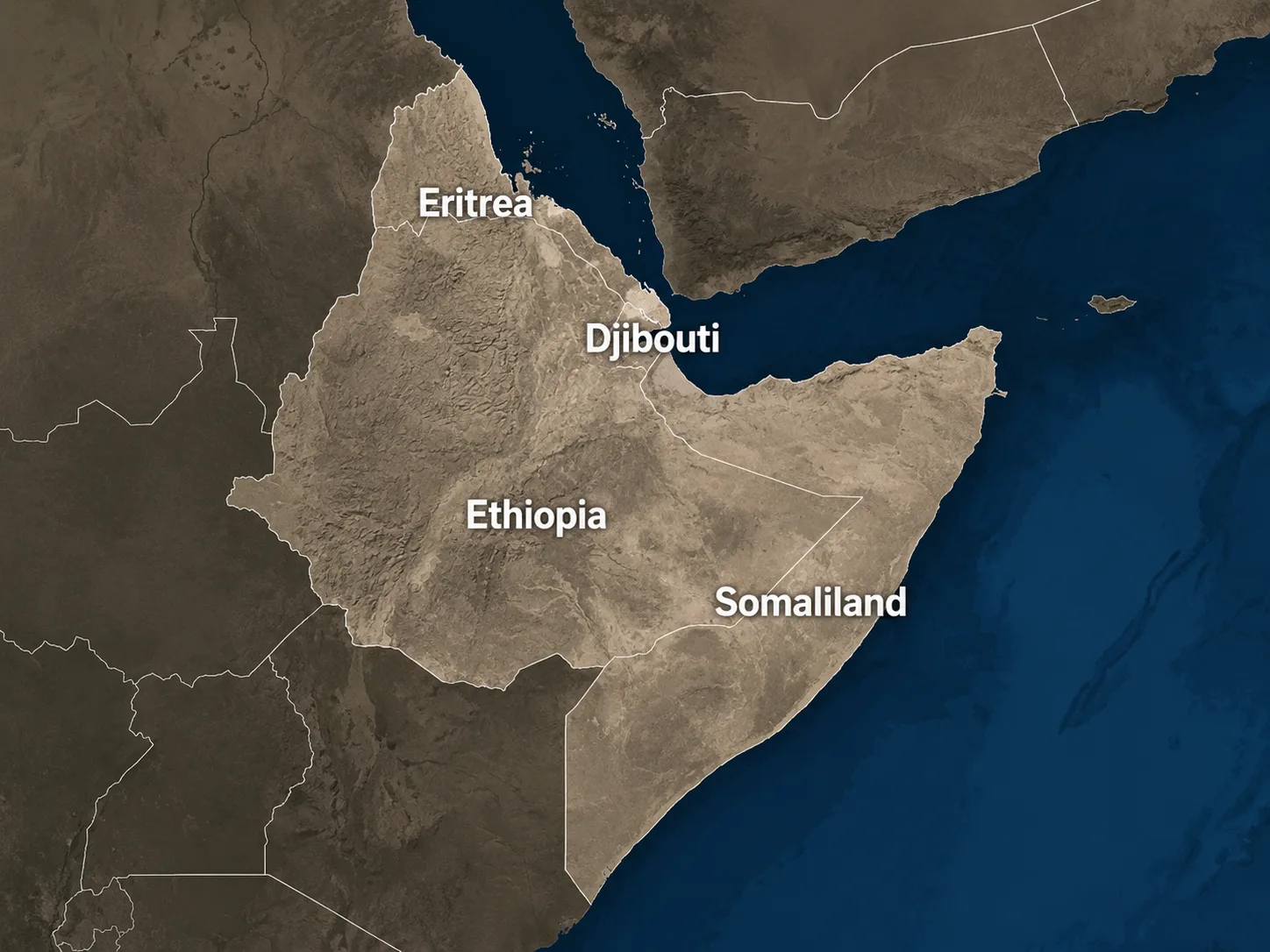
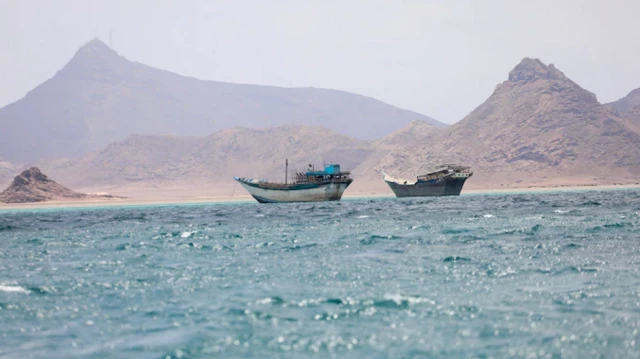
On both shores of the southern entrance to the Red Sea, the interests of two non-state actors that are ideologically opposed converge: the Houthis on Yemen’s western coast and al-Shabab on the opposite Somali coast across the Gulf of Aden. Several intelligence sources had previously reported many indications of coordination between the Houthis and al-Shabab.
But The Telegraph in its latest report added that this coordination is aimed at full control of the Bab el-Mandeb Strait and closing it whenever Iran decides to do so. The British newspaper explained that the Houthis are transferring drone technology to the movement on Iran’s behalf, making them the region’s leaders.
At first glance, this alliance may seem illogical. Al-Shabab is a Salafi-jihadist movement that has pledged allegiance to al-Qaida since 2012, and its doctrine is fundamentally based on declaring Shiites apostates. The Houthis, meanwhile, are a Shiite Zaydi group that revolves in Iran’s orbit and draws from it both weapons and political doctrine. In each side’s ideological lexicon, the other is a religious adversary before it is anything else.
But recent history teaches us that doctrinal hostility often recedes before calculations of interest. Iran itself has previously been documented in US and UN reports as facilitating the transit of al-Qaida members through its territory when that served its goals, and al-Qaida accepted that facilitation despite its declared hostility toward Tehran. The logic here is simple: a common enemy creates temporary friendships. The Houthis and al-Shabab stand together in the same trench against the United States and its allies.
Both are designated terrorist organizations by Washington, and both live off the war economy and smuggling in the same body of water: the Gulf of Aden.
The Houthis need an arm on the African shore to extend their influence beyond Yemen, while al-Shabab needs advanced weapons, especially drone technology, that it cannot find in traditional smuggling markets. Thus, the relationship has become closer to a business deal than an ideological alliance: weapons and training in exchange for a foothold and knowledge of the Somali coast.
A UN report summed up this equation by describing cooperation between the two groups as going beyond purely transactional exchange to serve a broader Houthi strategy of influence, without that meaning the dissolution of their doctrinal differences.
A report by the UN Security Council Panel of Experts on Yemen dated Oct. 15, 2025 (document S/2025/650) revealed that cooperation between the two groups is not purely reciprocal, but part of a Houthi strategy to expand growing regional influence. It cited sources saying the Houthis are assessing options for carrying out maritime attacks from the Somali coast in order to widen their area of operations.
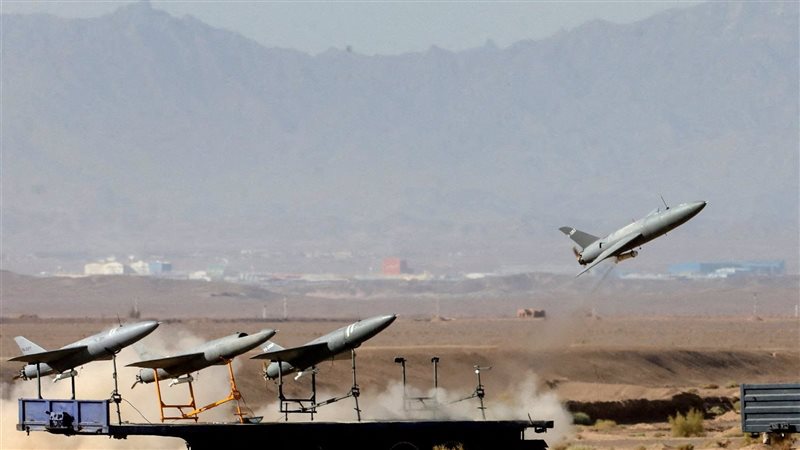
This emerging alliance is built on a clear complementarity of capabilities. The Houthis possess an arsenal of anti-ship ballistic and cruise missiles, including the Asef and Tankil models derived from Iranian designs, with a range of about 450 to 500 kilometers and warheads exceeding 300 kilograms, according to the International Institute for Strategic Studies, in addition to suicide drones from the Samad and Shahed families, naval mines and unmanned explosive boats.
A source close to the group told Reuters that the Houthis have in fact completed their preparations by deploying missiles and drones in the highlands overlooking Hodeidah and the Gulf of Aden and are now waiting for the order, and that Revolutionary Guard representatives present in Yemen will control the timing decision. Al-Shabab, meanwhile, provides what the Houthis lack on the opposite African shore: field knowledge of the Somali coast, the ability to carry out specialized ground operations, and expertise in piracy and control of maritime smuggling routes.
The UN panel of experts documented the support networks between the two sides in striking detail: training al-Shabab members in Yemen on drone technology and the manufacture of advanced explosives, dispatching Houthi military engineers to Somalia, sending hundreds of Somali fighters for training in Houthi camps, and tracking movement cells in Hadramout tasked with buying weapons from traders linked to the Houthis and smuggling them by traditional boats to Somali ports such as Qandala, Alula and Ras Asir.
Somali security forces have already intercepted shipments of explosives and drones on their way from Yemen to Somalia. Matthew Bryden, director of Sahan Research and a former UN official, estimates that the movement recruited and sent hundreds of young Somalis to Yemen for training in ground and maritime combat.
The assessment is that these networks, if fully matured, would create a security pincer encircling the entrance to the Red Sea from both shores, making it impossible to secure navigation by striking the Yemeni coast alone.
The Red Sea drags the Horn of Africa into war
The fragility of the Horn of Africa provides an ideal environment for the confrontation to spread. Over the past year, 2025, al-Shabab regained most of the territory it had lost to the Somali government between 2022 and 2023. The International Crisis Group described the situation as strategic stalemate: a federal government unable to prevail and a movement unable to topple the capital.
This coincides with the downsizing of the African mission and its funding crisis, leaving a security vacuum that can be exploited for sabotage and blowback pressure serving the Iranian equation without carrying its direct fingerprint.
At the heart of this geography lies Djibouti, the small state directly overlooking the strait, which hosts the largest concentration of foreign military bases in the world. Foremost among them is Camp Lemonnier, where more than 5,000 US military personnel and civilians work. It is the only permanent US base in Africa. Djibouti also hosts French, Chinese, Japanese and Italian bases.
This concentration of bases may place Djibouti and its partners in the line of fire via the opposite African coast, especially if Houthi drone technology is transferred to al-Shabab on an operational scale. In that case, threatening the bases becomes possible from within the region itself, without launching a single missile from Yemen.
The humanitarian cost, meanwhile, goes beyond military calculations. Somalia, for example, imports all of its oil and most of its grain by sea. In June 2026, the World Food Program warned that an additional 2.5 million Somalis may be unable to afford the basic food basket, with 6.5 million people expected to face crisis levels of hunger during 2026. Djibouti also imports about 90 percent of its food, while Ethiopia, with a population of 130 million, depends on the port of Djibouti for 95 percent of its import and export traffic.
On a broader level, the program estimates that continued escalation and oil remaining above $100 could push about 45 million additional people into acute hunger globally, with a projected increase of about 17 percent in the number of people suffering food insecurity in East and Southern Africa. In other words, turning ports on the African shore into unsafe zones would not only threaten global supply chains, but also trigger humanitarian crises in some of the world’s poorest regions and those most dependent on maritime imports.
The cost of a war over waterways
If the dual closure is carried out, ships will be forced to go around the Cape of Good Hope, adding between 3,500 and 4,000 nautical miles to the journey and extending travel time by 10 days to two weeks, with an estimated increase of about $1 million in fuel costs for each round trip between Asia and Europe.
The US Energy Information Administration indicates that the journey between the Arabian Sea and Northern Europe takes about 19 days via the Red Sea, while it stretches to about 34 days when going around Africa. With annual trade worth about $1 trillion passing through the Bab el-Mandeb Strait, any simultaneous closure of it and the Strait of Hormuz would redraw the map of global trade and energy and inflict broad disruptions on supply chains and shipping markets.
Previous experience offers a measured, not hypothetical, indicator. In April 2025, Suez Canal Authority Chairman Osama Rabie announced that canal revenues had fallen 61 percent to about $4 billion in 2024, down from a record $10.25 billion in 2023, while the number of transiting ships dropped by half. Egyptian President Abdel Fattah el-Sissi said the crisis had cost Egypt about $800 million per month and that cumulative losses had reached about $10 billion.
If those figures are accurate, all of that resulted from a partial threat to a single corridor so what about a full closure of both corridors at the same time?
As for marine insurance, war-risk premiums in Hormuz jumped from about 0.125 percent of a ship’s value before the crisis to a peak of 2.5 to 5 percent in March 2026 — about $5 million for a very large crude carrier in a single transit — before settling at about 1 percent, the same level premiums also reached in the Red Sea after attacks resumed.
Oil prices, meanwhile, saw Brent crude jump from about $71 before the war to a range of $112 to $120 in late March 2026, with actual trades touching $130 to $150 at the peak, before falling back to about $85 in mid-July as the fronts stagnated. Estimates indicate that a simultaneous dual closure would push prices into the $150 to $200 per barrel range.
The Houthi discourse itself has adopted that figure, as a senior Houthi official, on July 15, 2026, warned that the two straits would be closed in an “operational alliance” that would drive oil prices to $200. It is worth noting here that the figure comes from a party to the equation through an official in the Iran-linked Houthi group, meaning it is part of a war of psychological deterrence before it is an economic forecast.
In short, the world today stands before a situation it has never experienced before. When the US-Israeli war on Iran broke out on Feb. 28 and Tehran closed the Strait of Hormuz to shipping traffic, it tested in practice, not theory, the danger of the new weapon now in its hands a weapon that is not intercontinental missiles or nuclear warheads, but simply the threat to a narrow waterway, enough to shake the global economy, raise oil prices and send ships fleeing the entire region.
That experience whetted Tehran’s appetite to repeat the same formula elsewhere. If closing one strait gave it all these cards, then possessing a second strait means doubling both its negotiating power and its destructive power. That is why it urged its Houthi proxies, along with their new allies in al-Shabab, to prepare to use a similar weapon: closing the Bab el-Mandeb Strait.
Thus, the lesson drawn from Hormuz has become a ready-made plan for execution at the entrance to the Red Sea, backed on the African shore by an unexpected partnership that brought together two opposites driven by interest and a common enemy.
The danger of this development lies in the fact that it abolishes an old rule that governed all the region’s crises: the rule of the alternative outlet. In the past, if shipping in the Gulf was disrupted, the Red Sea remained open; and if the Red Sea was disrupted, the Gulf kept operating. But if both straits are closed together, oil, gas and goods shipments coming from the Middle East and Asia will find no short route to Europe and the world.
Ships will have no choice but to sail around the entire African continent a journey that adds weeks of time and millions of dollars to every shipment. The Suez Canal experience, which lost more than half its revenues because of limited attacks on a single corridor, offers a miniature picture of what could happen if the threat is fully carried out.