











هذا التقرير متاح أيضًا بـ العربية
The UAE is moving toward Germany as German industry undergoes broad restructuring. Europe’s largest industrial base still boasts globally competitive companies, advanced engineering capabilities, valuable patents, research expertise and customer networks built up over decades.
Key sectors of the German economy -including chemicals, automobiles, mechanical engineering and energy-intensive industries -are struggling with weak investment, high energy costs and declining competitiveness against China. These conditions are creating an opening for foreign capital to acquire assets and capabilities that would be difficult and costly to build from scratch.
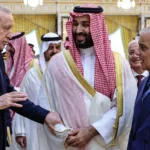
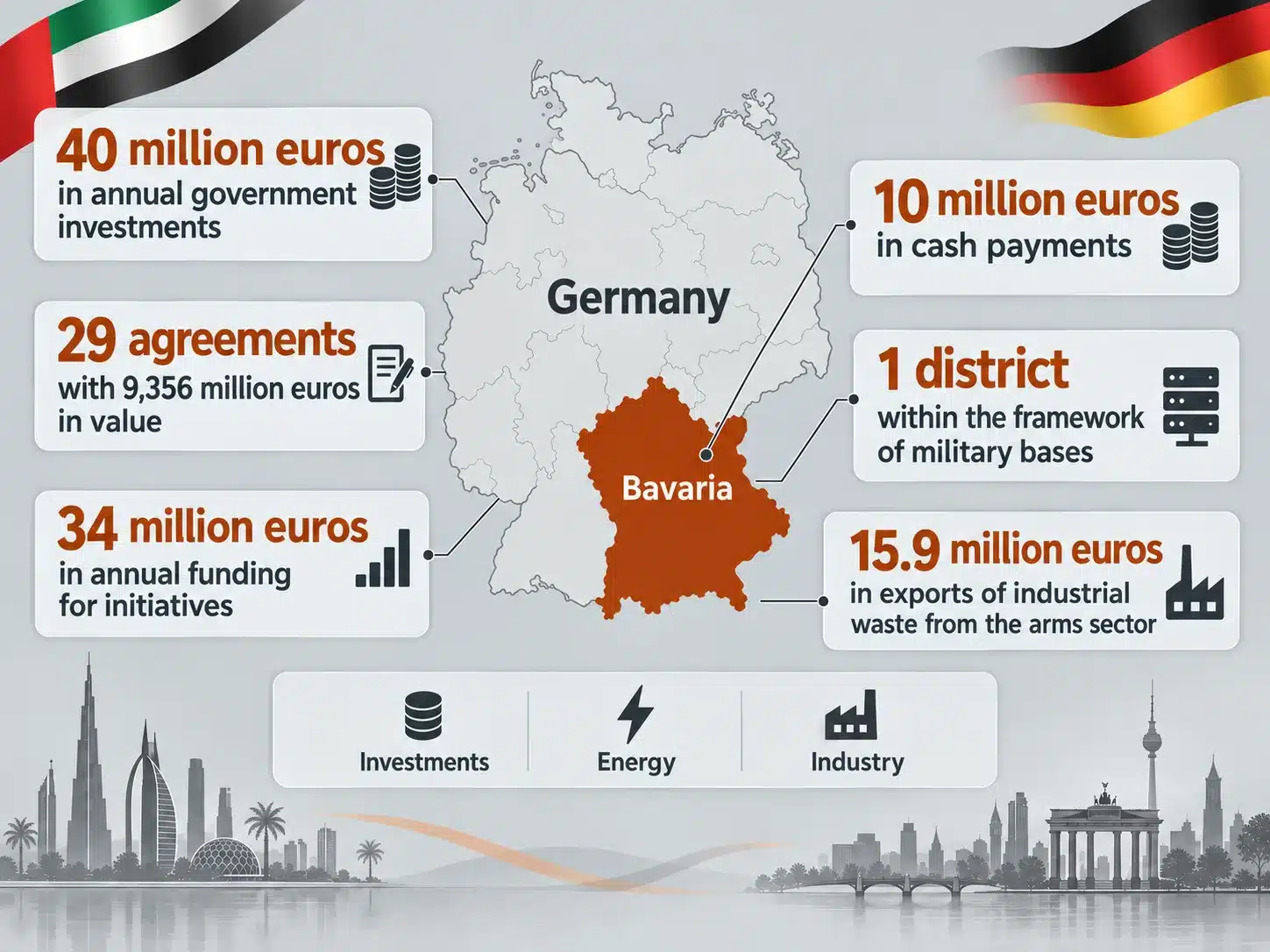
In September 2026, announced UAE President Mohammed bin Zayed Al Nahyan and German Chancellor Friedrich Merz a 40 billion euro Emirati investment package over the coming years, alongside the signing of 29 memorandums and commercial agreements worth more than 9.356 billion euros.
Bin Zayed’s visit to Germany launched a strategic dialogue between the two countries and established a German-Emirati Investment Council, providing an institutional framework that goes beyond one-off deals and opens the door to new investments in industry, technology, energy, and digital infrastructure.
The direction of the money reveals an important aspect of the Emirati bet: Abu Dhabi is targeting sectors that can provide the industrial and technological expertise it needs to build an economy more reliant on manufacturing and technology.
The move also comes amid intensifying Gulf competition over Western companies and technology. Qatar has spent years building influential stakes in major German companies, while Saudi Arabia is expanding its European investments and pressing global companies to move more of their headquarters and capabilities to the kingdom.
In this environment, the relationship with German industry is also important to Abu Dhabi in protecting the position the UAE has built as a regional business and technology hub — a position now facing sharper Saudi competition.
Where is the UAE putting its money in Germany?
Recent agreements clearly show that Emirati investment is heading toward industry, technology, energy and digital infrastructure. Allocated 10 billion euros to Bavaria in southern Germany, whose capital is Munich and which is one of the country’s leading industrial and technological centers, alongside the signing of 29 memorandums and commercial agreements worth more than 9.356 billion euros, as well as plans to establish data centers with a combined capacity of about 1 gigawatt.
Covestro, the German company specializing in advanced materials and chemicals, offers the clearest example of the kind of assets Abu Dhabi is targeting. Acquired by XRG, a subsidiary of Abu Dhabi National Oil Co. (ADNOC, at the end of 2025 in a deal estimated at 15.9 billion euros, including debt, accompanied by a capital increase of about 1.17 billion euros.
Covestro has a global production network and expertise in specialty materials, polycarbonates, and polyurethane components, along with decades of research and development and industrial process technologies.
In an interview published by the German business daily Handelsblatt in December 2025, Rainer Seele, who was leading XRG’s global chemicals business, said Covestro had brought “technological leadership” to the group’s portfolio.
The Financial Times also described the company during the acquisition process as a strategic asset combining research and development capabilities with advanced materials expected to remain in demand, placing expertise and technology at the heart of the deal’s value for the Emirati buyer.
The Emirati presence is also expanding in the energy sector through ADNOC, XRG and Abu Dhabi Future Energy Company, Masdar, which has deepened its cooperation with RWE, one of Germany’s largest energy groups, and SEFE, the energy trading company owned by the German state.
The agreements span liquefied natural gas and low-carbon ammonia, as well as offshore wind and electricity storage. At the same time, ADNOC estimated that the energy and industrial agreements could unlock more than €5 billion in investment.
These investments give Abu Dhabi a stake in the transformation through which Berlin is rebuilding its energy system after the shock of Russian gas supplies. The Emirati presence is tied to both the supplies German industry needs today and the assets expected to power factories and data centers in the future.
As Germany gradually shifts toward a greater reliance on electricity and low-carbon energy, the UAE is seeking to maintain a foothold in a major industrial market by investing in the very infrastructure underpinning that transition.
The package also includes data centers with a capacity of about 1 gigawatt, as well as cooperation in artificial intelligence, emerging technologies, research and development, and data hosting. It also encompasses partnerships with Siemens, the major German industrial and technology group, and Bosch, the German engineering and technology company.
This strategy brings Abu Dhabi closer to automation technologies, energy and control systems, and industrial AI — technologies that have become increasingly integral to the operation and efficiency of modern factories.
The €10 billion allocation to Bavaria adds another dimension to the Emirati strategy. The state is home to major clusters in the automotive, aviation, engineering, software and energy sectors. The Emirati announcement linked the funds to advanced technology, artificial intelligence, data centers, energy security and knowledge exchange.
This focus positions Emirati capital within an ecosystem that brings together research and development, manufacturing, suppliers, and companies ready to participate in new projects across Europe and the Gulf.
Why is Abu Dhabi moving now?
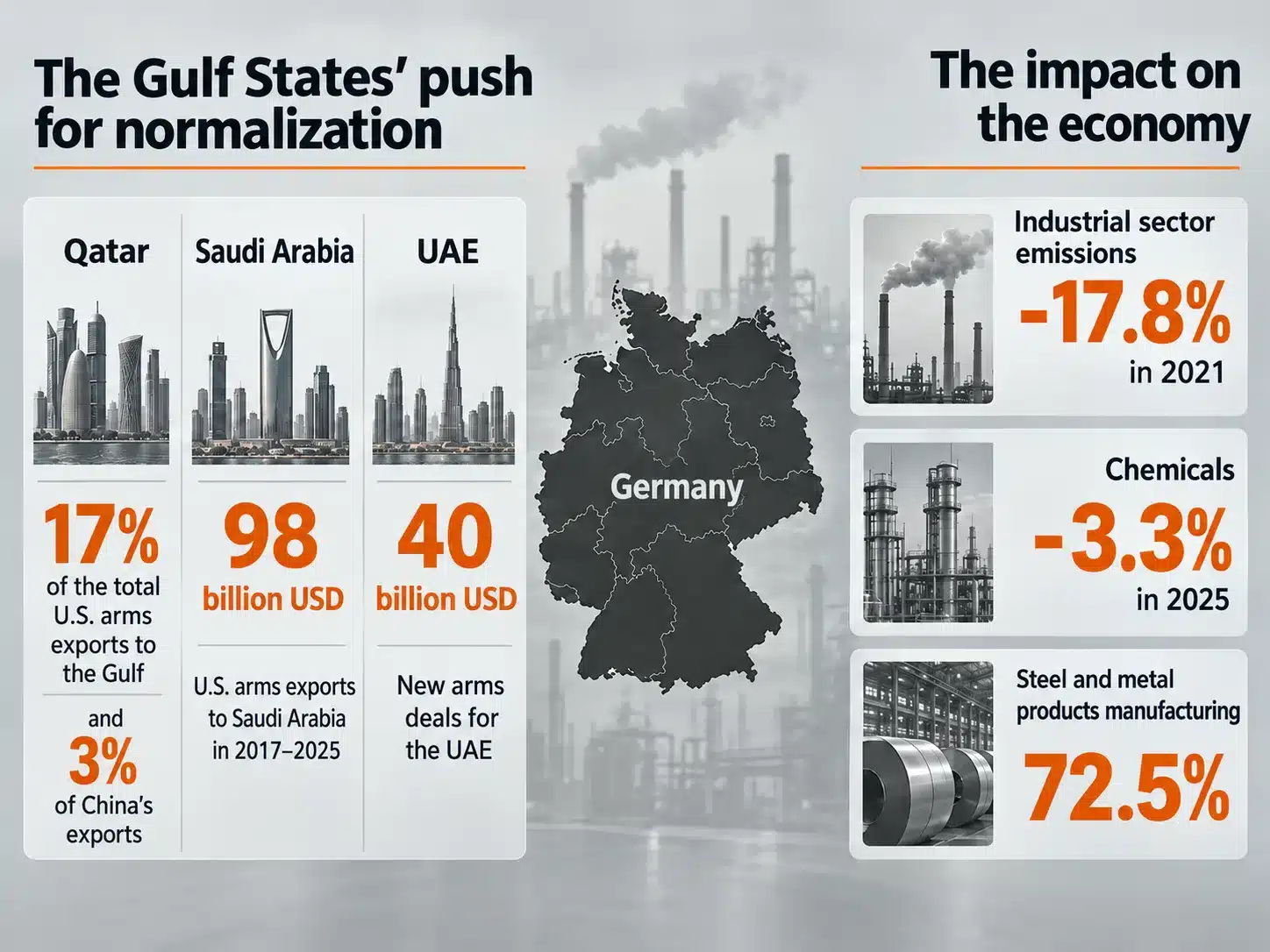
The Emirati push comes as German industry faces prolonged pressure on investment, energy and competitiveness. Data from Germany’s Federal Statistical Office showed that the real value added of manufacturing fell in 2025 for the third consecutive year, while output in energy-intensive industries was about 17.8 percent below its 2021 level.
In the chemicals sector, where Covestro operates, the German Chemical Industry Association said production fell 3.3 percent during 2025, while average capacity utilization at factories reached 72.5 percent amid pressure from production costs, competition and imports.
Oliver Falck, head of the Center for Industrial Organization and New Technologies at Germany’s Ifo Institute for Economic Research, described weak investment as a structural problem in industry. In an assessment published July 24, 2026, he noted that the decline in investment in automobiles and mechanical engineering exceeds the expansion recorded in pharmaceuticals and semiconductors, while industrial investment intentions remained limited during 2026.
This environment gives investors who can inject large amounts of capital over long periods a greater opportunity to enter projects and assets that local companies find difficult to finance at the required speed.
The same gap appears in the green transition. Research by Germany’s development bank showed that climate-oriented corporate investment fell by about 8 percent to 80 billion euros in 2024, while the decline among large companies reached 18.5 percent amid financing pressures, lengthy licensing procedures and international competition.
At the same time, the energy crisis since 2022 has raised the operating costs of energy-intensive industries, making Emirati money more attractive to an economy trying to modernize its factories, expand energy networks and build new capabilities in data and artificial intelligence.
China, meanwhile, is pressuring the German industrial model from another direction. In 2025, it regained its position as Germany’s largest trading partner and remained in the lead during the first half of 2026, while its trade surplus in the bilateral relationship widened.
Germany’s central bank links part of the decline in Germany’s share of external markets to the rising competitiveness of Chinese manufacturers, increasing German companies’ need for growth markets and partners that can open doors beyond Europe. At the same time, the UAE presents itself as a platform linking the Gulf with India, Asia and Africa.
This German need intersects with an intensifying Gulf race for the same assets that provide technology, expertise and market access.
In a study published in February 2026, Stephan Roll, a senior fellow at the German Institute for International and Security Affairs, said the funds of Saudi Arabia, the UAE and Qatar expand their states’ room for maneuver through investment in industry, technology, defense and economic relations. He noted that the three states’ interests differ and that competition among them can clearly emerge in their investment activity.
Qatar moved ahead of its rivals in building a long-term presence inside major German companies. The Qatar Investment Authority, the state’s sovereign wealth fund, holds about 17 percent of voting rights in Volkswagen, Germany’s largest carmaker, and about 3 percent in Siemens, in addition to other investments in technology, industry and finance.
By contrast, Saudi Arabia’s Public Investment Fund is expanding in European transport, industry and technology through stakes in Hapag-Lloyd shipping, Thyssenkrupp Nucera hydrogen, TK Elevator and other mobility and technology companies.
Saudi PIF Gov. Yasir Al-Rumayyan said in June 2026 that the fund had injected 98 billion euros into the European Union and the United Kingdom between 2017 and 2025, with more than 10.4 billion euros in expected European opportunities through 2030.
These figures place the Emirati package within a broader race for influential positions in European companies and industry, as each Gulf state seeks to build a network that gives it the technology, markets and relationships its domestic economic plans require.
Saudi-Emirati competition takes on a more direct dimension. Saw Cinzia Bianco, a visiting fellow at the European Council on Foreign Relations, that the relationship between Riyadh and Abu Dhabi has evolved into a competition that includes economic resources and critical technologies such as artificial intelligence.
Since 2024, Saudi Arabia has been working to attract multinational companies by linking part of its government contracts to the presence of a regional headquarters inside the kingdom. This policy pressures a model that has made Dubai and Abu Dhabi the main centers for managing global companies’ business in the region.
The UAE Foreign Ministry says about 2,000 German companies have offices in the UAE, many using the country as a platform to serve the Middle East, Africa and Asia. German ties therefore carry added value in the competition with Riyadh over the regional business hub.
The deeper the ownership, investments and joint projects between German and Emirati companies become, the stronger the links binding those companies to the Emirati market and platform, supporting Abu Dhabi’s ability to retain the position Saudi Arabia is trying to take part of.
Doha offers a similar model for turning foreign investment into domestic gains. In February 2026, the Qatar Investment Authority raised its venture capital fund investment program to $3 billion.
Its CEO, Mohammed Al-Sowaidi, said several participating fund managers are encouraging their portfolio companies to establish regional headquarters in Doha. This experience shows that the value of sovereign investment extends to the companies, skills, technologies and decision-making centers it can attract into the local economy.
How does it transfer investment from Germany to the Gulf?
The more far-reaching value of Emirati acquisitions becomes clear when looking at where the next industrial investment might go, and the clearest example came from Covestro months after its ownership changed hands.
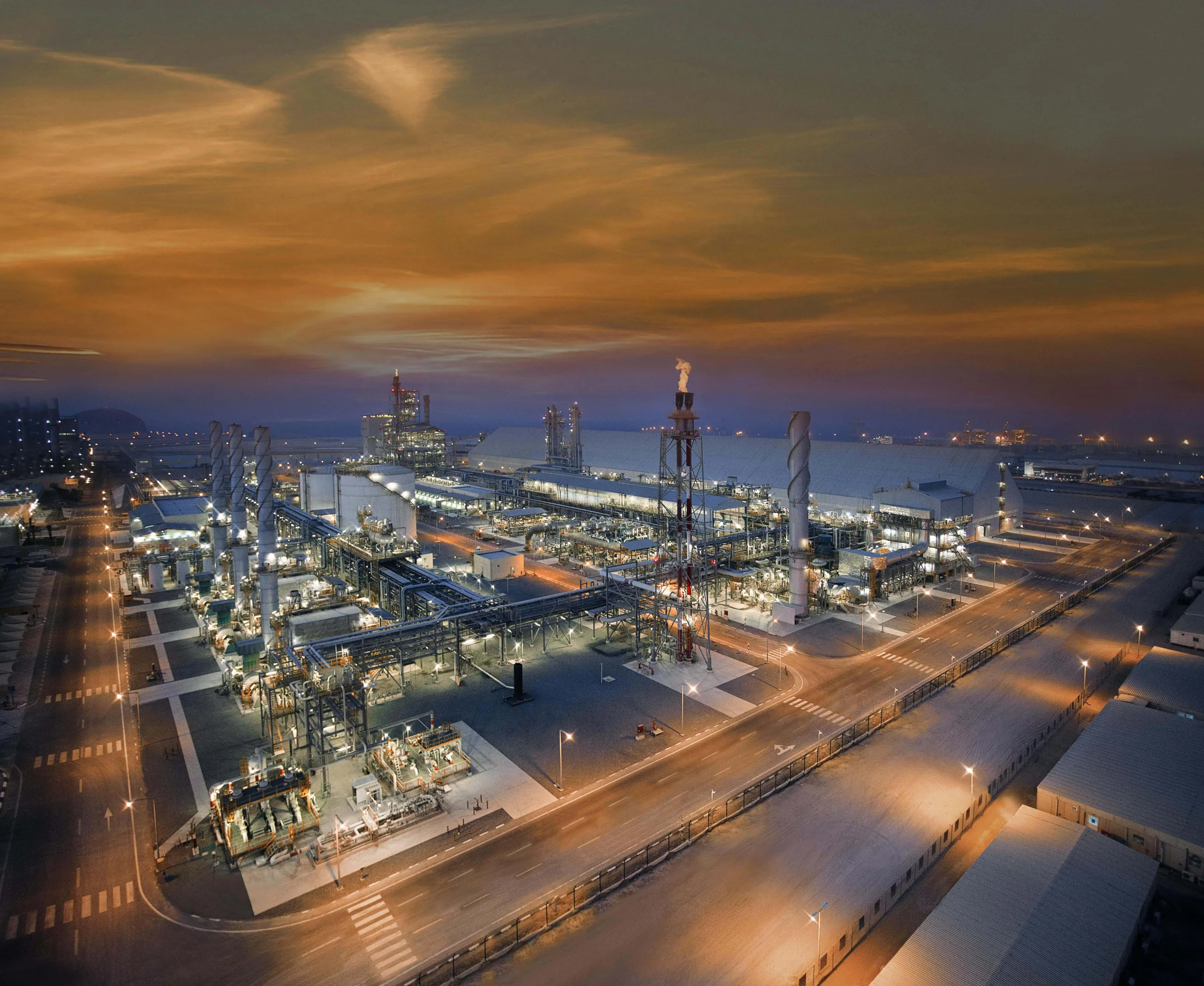
On June 30, 2026, CEO Markus Steilemann said Covestro plans to expand its business in Asia and the Gulf, and had begun a feasibility study for a world-scale methylene diphenyl diisocyanate plant in Ruwais, the coastal industrial zone west of Abu Dhabi city, taking advantage of industrial infrastructure and the availability of feedstocks and lower-cost energy — factors he said could make the facility among the most competitive plants for this product globally.
Covestro is studying new investments that could reach about 4 billion euros split between China and the UAE. At the same time, the proposed Ruwais facility would rely on expertise and operational technologies the company developed across its global industrial network.
Here, the practical value of Emirati ownership becomes clear: the engineering expertise, plant designs, and customer networks accumulated inside a German company can be brought to building new production capacity inside the UAE, benefiting from energy, feedstocks, and ports, and targeting global markets.
This path aligns with the UAE’s Operation 300bn strategy, which aims to raise the industrial sector’s contribution to the economy to 300 billion dirhams by 2031, as owning a company with existing technology, markets, and products gives Abu Dhabi a faster route into high-value industries.
Covestro’s potential investment in Ruwais thus becomes a model for what Abu Dhabi can achieve by buying a position inside European industry and then linking the company’s new growth to its own industrial base and external markets.
This bet is tied to a broader effort to diversify technology sources. In an analysis published in 2026, the European Council on Foreign Relations argued that Europe and the Gulf states could use cooperation to reduce exposure to pressures from the technological conflict between the United States and China.
The UAE maintains technological and economic ties with Washington and Beijing. At the same time, Europe provides an additional source of engineering, intellectual property, industrial companies, and regulatory frameworks, making the European relationship a third pillar that increases Abu Dhabi’s ability to maneuver among the major technological blocs.
The model appears even more explicitly in defense industries. Albert Vidal Ribé, a researcher on defense industries and procurement at the International Institute for Strategic Studies, observed that Gulf-European relations are shifting from buying ready-made products to investment, partnerships and local production.
In a joint project between the Emirati defense group EDGE and Italy’s Leonardo, design, development, production and training operations to the UAE to serve the domestic market and selected export markets, in a model that shows how a relationship with a European company can turn into building industrial capacity inside the Gulf.
In this case, competition becomes tied to where new industrial capacity is built, from production lines and engineering teams to skills training and access rights to Asian and African markets.
Covestro’s acquisition gives this issue particular weight because the UAE, shortly after the transfer of ownership, became a candidate site for one of the company’s next major growth investments, opening the door to shifting part of future industrial expansion to the Gulf. In contrast, the German asset and industrial network remain in place.
Abu Dhabi aims to make this movement permanent through the German-Emirati Investment Council, which connects the two governments and the private sector, identifies implementable projects, and removes obstacles, alongside a direct investment channel with the Bavarian government.
This framework gives Emirati companies a regular path to new opportunities in industry, energy and technology, rather than leaving expansion dependent on isolated deals that appear from time to time.
By contrast, Europe is tightening scrutiny of the effects that can accompany the entry of state-backed capital into strategic sectors. Stephan Roll wrote in February 2026 that direct ownership of companies and access to technology, economic infrastructure and relationships with influential actors increase the room for maneuver available to capital-owning states.
This sensitivity appeared in the Covestro deal, as the European Commission concluded that an unlimited state guarantee and advantages linked to ADNOC affected the acquisition terms and competition.
The review ended with changes to the guarantee arrangements and commitments to license a set of Covestro sustainability-related patents on market terms. Commission Executive Vice President Teresa Ribera said the measures aimed to restore competitive balance within the European single market.
These developments place the 40 billion euro package in a broader context than simply buying German assets or seeking a financial return. Abu Dhabi is entering a European industry that needs capital at a time when Gulf competition over companies, technology and business centers is intensifying, then working to connect the knowledge and industrial networks it acquires to its domestic project and regional markets.
Do the investments give Abu Dhabi influence in Berlin?
The expansion of the Emirati presence in German companies, energy, and technology raises a question that goes beyond economic returns: the degree of influence these interests may generate over time.
Stephan Roll believes Gulf sovereign wealth funds expand their states’ ability to act in foreign policy, especially when they own strategic assets or enter infrastructure that is difficult to replace, because this creates the ability to influence corporate decisions or raise the cost of political disagreement through financing and investment.
Among the risks Europe faces, Roll referred to the possibility of access to critical infrastructure, leakage of sensitive technology and the “risk of political influence” from Gulf states. This type of influence becomes more sensitive when state capital becomes part of a broader network that includes technology, energy and markets.
In her analysis of Saudi investments, argues Cinzia Bianco, a visiting fellow at the European Council on Foreign Relations, that some Gulf economic engagements seek returns beyond financial profit, potentially including a larger role in designing projects or advances in political and strategic interests.
She therefore calls for managing interdependence and setting clearer restrictions around critical technologies, an approach that reflects broader European concern over the power that may accompany ownership and long-term sovereign investment.
In the Emirati case, Peter Salisbury, a former researcher in the Middle East and North Africa Program at Chatham House, offers an important explanation of Abu Dhabi’s decision-making structure. He describes a tightly interconnected network that links foreign policy and security circles with the leadership of sovereign investment institutions, placing leaders of major economic institutions within the circle implementing the state’s broader vision.
This structure helps explain the difficulty of treating Emirati sovereign capital as entirely separate from the state’s goals of strengthening its economic and political position, protecting trade routes and consolidating its role as a regional hub.
These questions become more pressing in Germany as the relationship expands beyond investment. Launched in Berlin and Abu Dhabi during bin Zayed’s recent visit, a strategic dialogue covering investment, energy, technology, defense and security, alongside a joint investment council that will work to expand projects between governments and companies.
As Emirati investments expand in sensitive sectors, Berlin faces the challenge of balancing its need for capital, energy and technology against avoiding a situation in which that dependence over time becomes a source of pressure on political decision-making or a wider gateway into strategic assets.
Stephan Roll believes that dealing with Gulf funds should be part of foreign policy and economic security calculations, placing the 40 billion euro package in a broader framework than its financial value and tying it to the question of how much influence may accumulate as ownership and shared interests expand.