








هذا التقرير متاح أيضًا بـ العربية
Many owners of units in the Marassi resort on Egypt’s North Coast never imagined that owning a chalet or villa worth tens of millions would not guarantee them the freedom to enjoy their country’s beach, or to engage in the simplest forms of recreation there. Over time, they could find themselves more like inmates in a hospital or a maximum-security prison, moving according to strict administrative regulations that strip them of a large share of the privileges they believed they had secured in exchange for the enormous sums they paid.
Hardly any issue in Egypt today is louder than the debate over what is happening inside Marassi, owned by Emaar Misr, the company belonging to Emirati businessman Mohamed Alabbar. Between feelings of extortion, inferiority and anxiety over expanding foreign influence on Egypt’s beaches and coastlines, a broad wave of anger has surged across social media platforms one that media and advertising campaigns appearing on some websites, in newspapers and on television channels have failed to contain or soften.
Those practices have transformed the Emirati company from a mere real estate investor into a partner with broad influence inside the Egyptian market — even into something resembling a “state within a state,” given the scale of its investments and the breadth of its impact. Others have warned that this model of coastal development carries deeply dangerous social dimensions, as its societal cost may exceed its economic returns by entrenching gated communities, class isolation and sharp social hierarchies that could damage the social fabric and deepen feelings of discrimination and exclusion.
In this overview, we attempt to shed light on the true scale of the Emirati company’s investments in Egypt and how it managed to build this growing influence, which some believe has become a noose that has left segments of Egyptians feeling alienated in their own country, unable to enjoy its natural resources and beaches even after paying exorbitant prices. The most important question remains: Who enabled Mohamed Alabbar and his company to achieve this degree of expansion and influence in the Egyptian market, amid all the controversial question marks surrounding them?
Guests, not owners
The complaints from Marassi owners, documented in videos circulating on social media platforms, have gone beyond what is popularly acceptable and sparked a broad wave of debate in which anger mixed with sarcasm. Many saw the practices described as illogical, turning one of Egypt’s most expensive resorts into something like a closed camp, subject to a strict system of surveillance and restrictions that constrains residents and limits their freedom inside the compound.
Among the most prominent complaints was the imposition of restrictions on guest entry, requiring them to be registered through a QR code. According to the circulating complaints, owners are also required to pay nearly $1,000 a day for access to the beach, despite owning a property unit inside the resort.
ابنة أحد قيادات الجيش المصري السيدة حنان شعراوي مندهشة كيف يكلمها ضابط الساعة 2 بالليل طالبًا منها حذف بوست قالت فيه أن الشرطية المصرية ممنوعة من دخول مراسي وتؤكد كلامها أنه صحيح وأنها لا تكذب pic.twitter.com/puYTbHMvP9
— الجورنالجي (@Gournalgii) July 25, 2026
Owners also spoke of steep fines they described as excessive, including one reaching 15,000 Egyptian pounds for entering the sea while the black flag is raised a flag that some say is sometimes raised without clear justification. There are also penalties for parking in undesignated areas or hanging clothes on balconies, in addition to the sharp rise in fees and maintenance differentials, which, according to some complaints, have reached about 100,000 Egyptian pounds annually.
As a result of these restrictions, which owners described as unfair, about 22 owners of units in Marassi turned to the courts on July 10, filing a lawsuit against Emaar Misr and demanding compensation worth 100 million Egyptian pounds. They also accused the company of imposing regulations and restrictions that diminish their right to full use of their real estate units and the facilities associated with them, despite the large sums they paid to own them.
A partner, not an investor
Emaar Misr was founded in 2006 as an Egyptian joint-stock company through a partnership between the UAE’s Emaar Properties, chaired by Alabbar, with a 40 percent stake, and Egyptian businessman Shafik Gabr, with a 60 percent stake. This legal structure enabled it to benefit from a number of investment privileges and incentives, including some exemptions in force at the time, under Companies Law No. 159 of 1981 and the Investment Guarantees and Incentives Law No. 8 of 1997.
A short time after the company began operating in the Egyptian market, disputes between the two partners escalated, ending the partnership with Gabr. Emaar Properties then acquired the larger stake in Emaar Misr in 2007. Since then, the company has become almost entirely owned by the parent company listed on the Dubai Financial Market, with an estimated 89 percent of the shares.
The company’s first project in Egypt was Uptown Cairo, launched in 2006 on an area of nearly 5 million square meters on the Mokattam Plateau. The following year, the company won the bid to develop the Sidi Abdel Rahman area on the North Coast, covering nearly 6 million square meters a deal that stirred broad controversy at the time because such a vast area had been allocated to a single foreign investor.
The company’s projects then continued, including Mivida in New Cairo on an area of about 3.8 million square meters, Cairo Gate in Sheikh Zayed City on nearly 558,000 square meters, and then Belle in 6th of October City on about 2.1 million square meters, in a strategic location near the 26th of July Corridor and the Cairo-Alexandria Desert Road.
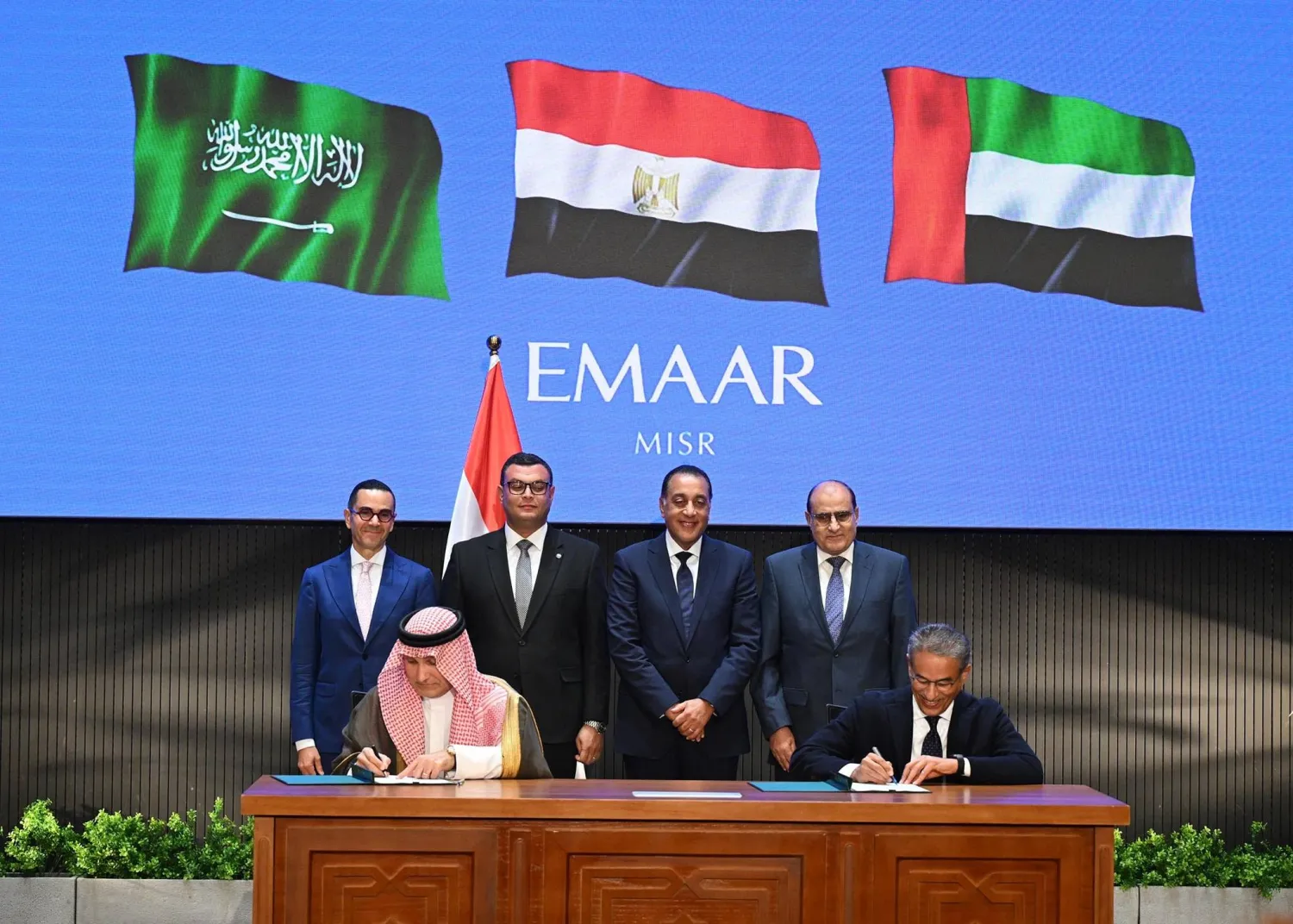
In 2025, the company announced the signing of a partnership agreement with Midar for Investment and Urban Development to implement the “New Mivida” project in New Cairo, on an area of nearly 2 million square meters, in a strategic location on the Cairo-Suez Road.
Some estimates indicate that the areas the company owned or was developing in Egypt had reached, by 2021, about 10.9 million square meters, spread across a number of major projects, most notably Uptown Cairo in Mokattam, Mivida in New Cairo, Cairo Gate in Sheikh Zayed, in addition to Marassi on the North Coast.
By 2025, the volume of land and projects linked to the company’s investments had risen, according to other estimates, to about 17 million square meters, in addition to nearly 12 million square meters it is developing in partnership with other entities and investors.
Such rapid expansion in the scale of Alabbar’s and his company’s influence inside the Egyptian market, and with these troubling and controversial figures, has transformed him from a foreign investor into a partner in the Egyptian state and one of the influential players on the scene, in a way that has alarmed many especially those who have begun reviewing the Emirati businessman’s biography and his close relationship with the Israeli entity.
Marassi will not be the last
It appears that the Marassi model, surrounded by question marks and complaints whose owners believe touch, in some respects, on the sovereignty of the Egyptian state and its control over its beaches and coastlines, will not be the final stop in Mohamed Alabbar’s path of expansion inside Egypt something the Emirati businessman himself has hinted at.
Although he has confirmed that the size of his investments in the country exceeds $35 billion, he is still looking to achieve another ambition that would move his presence from Egypt’s eastern and northern coasts to the heart of the capital. During the signing of the Marassi Red Sea project contract in September 2025, Alabbar revealed that he was searching for a new investment opportunity in Egypt, repeating his passion for historic Fatimid Cairo, saying: “I want downtown; I love this area because it reflects the greatness of Cairo. It is not only out of love for investment, but out of love for Cairo itself.”
This statement, with the clarity of its direction, is raising growing concerns among segments of Egyptians, especially amid reports that the government intends to offer properties and buildings in historic downtown Cairo for investment, alongside the evacuation of a number of government headquarters and their transfer to the New Administrative Capital, as well as amendments to the old rent law that stripped many owners of their units in that area.
In the final analysis, Egypt’s turn toward selling state assets, with the aim of covering the deficit caused by years of misguided financial and economic policies and the unprecedented accumulation of debt they have left behind, is no longer merely an investment path or a tool for providing liquidity. It has become a source of mounting political and cultural threats that could gradually strip the Egyptian state of its assets and strategic resources, threatening its ability to control its economic capabilities and perhaps in the future extending to its national identity, sovereignty and security.