









هذا التقرير متاح أيضًا بـ العربية
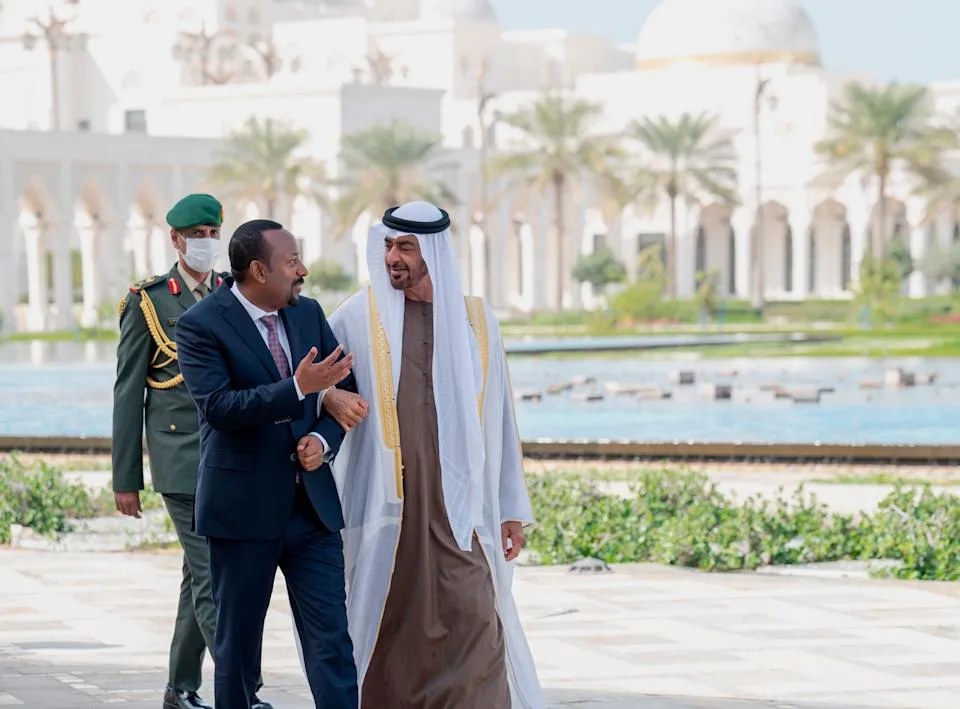
Just two months after Ethiopia’s House of Peoples’ Representatives approved the appointment of Abiy Ahmed Ali as prime minister in 2018, succeeding Hailemariam Desalegn, who resigned as head of the ruling coalition and government amid sweeping popular protests, observers of Ethiopia’s turbulent political scene were surprised to see the plane of Abu Dhabi Crown Prince Mohammed bin Zayed land in Addis Ababa in mid-June 2018. The surprise was not merely the visit itself, but the fact that it was the first time bin Zayed had visited a sub-Saharan African country.
Although Abiy Ahmed had been in office for only two months, the visit ended with the announcement of a UAE support package worth $3 billion. Of that, $1 billion was deposited directly into Ethiopia’s central bank to rescue foreign currency reserves that had fallen below the value of a single month’s imports, while the remaining $2 billion was allocated to investment in agriculture, tourism, renewable energy, and real estate.
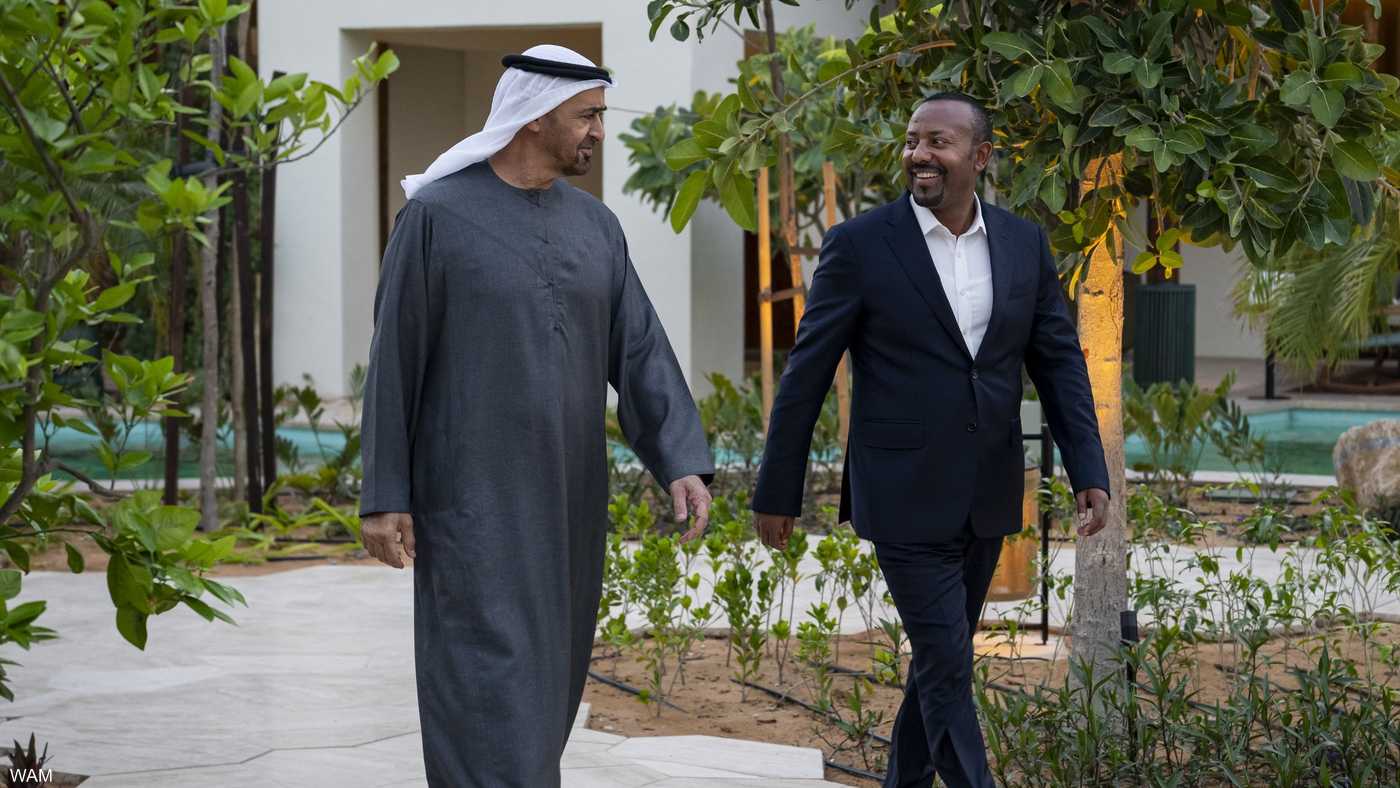
Notably, the photos and video clips documenting the visit showed the new Ethiopian prime minister and his Emirati guest as though they shared a close personal relationship stretching back many years. From that moment on, Abu Dhabi no longer appeared to be merely a financier or economic partner; it became a political patron that accompanied Abiy Ahmed’s rise through all his major turning points, from his multiple wars in Tigray, Amhara, and Oromia to his ambitions toward the Red Sea, as well as his management of a complex web of regional alliances and tensions with Eritrea, Somalia, and Sudan.
The largest financial injection in Ethiopia’s history
The significance of that visit went far beyond protocol. Abiy Ahmed personally made a point of driving the white car that carried bin Zayed on a tour through the streets of Addis Ababa, in a symbolic expression of handing over the keys to the country’s new strategic orientation to the Emirati capital. This immediate cash infusion allowed Abiy Ahmed to avoid the shocks of the political transition period and begin selling stakes in key state monopolies such as the telecommunications sector and Ethiopian Airlines, creating a favorable climate for consolidating his rule.
The UAE support package for Abiy Ahmed, which came immediately after he took power in 2018, was not an isolated event. It was the largest single financial injection Ethiopia had received in its post-Cold War history, and it came at an exceptionally sensitive political moment: a new leader, a fragile power base, and an economy on the brink of a currency crisis.
The support package later expanded into a broader economic relationship encompassing trade, investment, and military and political assistance. In 2023, the UAE rose to become the fourth-largest destination for Ethiopian exports, while Ethiopia, with a market of more than 126 million people, became a growing recipient of Emirati exports. This entanglement made the Ethiopian economy more closely tied to Abu Dhabi and gave it influence that went beyond money to dominance over decision-making, as this report will show.

The real value of this cover becomes clear in its timing. The $1 billion deposit came when reserves were at rock bottom, and the support was later renewed at the height of the Tigray war, when the treasury was exhausted, Western pressure and sanctions were mounting, and Tigray Defense Forces had reversed the balance and advanced toward Addis Ababa. At that point, Abu Dhabi provided Abiy with what the West was unwilling to offer: liquidity without human rights conditions, military support in the form of hundreds of shipments, and cover that allowed him to continue his course without submitting to the dictates of traditional donors.
In November 2021, Abiy Ahmed’s rule appeared to be on the verge of collapse. Tigrayan forces were advancing toward Addis Ababa and had come within less than 200 kilometers of the capital. Foreign embassies began evacuating their nationals, and Ethiopian army losses were estimated in the tens of thousands. At that existential moment, Abiy Ahmed moved to strengthen his drone arsenal through a network of suppliers led by the UAE, alongside Turkey, Iran, and China, in order to save the capital from falling into the hands of the Tigray People’s Liberation Front.
UAE support saved Abiy Ahmed’s regime from collapse
Investigative reports, based on satellite imagery and flight-tracking data, documented an intensive air bridge between military bases in the UAE and the Harar Meda base south of Addis Ababa. Reports spoke of more than 90 flights between the Al Dhafra and Sweihan bases on one side and Ethiopia on the other during September and October 2021, and more than 50 cargo flights in 53 days between August and September.
A large portion of these intensive military supplies was carried out by Ilyushin-76 cargo aircraft operated by a company linked to the UAE. According to experts and eyewitnesses who spoke to The New York Times, Chinese-made Wing Loong drones supplied through this channel shifted the balance of the battle and halted the advance of Tigrayan forces toward Addis Ababa by targeting their supply lines, leading the forces to retreat to their main strongholds in the north of the country.
The conclusion shared by many military analysts, including those who spoke to The New York Times, is that without the drones and the Emirati air bridge, the government in Addis Ababa would most likely have fallen in late 2021. In other words, Abiy’s survival in power — the cornerstone of Abu Dhabi’s project in the Horn of Africa — was decided in those weeks, which is why the UAE fought so hard to provide him with every form of support.
Notably, the drones had already been launched in an early phase of the war, at the end of 2020, from the UAE’s Assab base in Eritrea the same base used for operations in Yemen before it temporarily disappeared under pressure from the Biden administration and then returned. This reveals the interconnectedness of the UAE’s theaters of operation, from Yemen to the Horn of Africa through the Red Sea gateway.
Backing Abiy Ahmed’s moves toward Somaliland, Eritrea, and Sudan
On Jan. 1, 2024, Ethiopian Prime Minister Abiy Ahmed signed a memorandum of understanding with Somaliland President Muse Bihi Abdi granting Ethiopia sea access and the right to lease about 20 kilometers of Somaliland’s coastline for 50 years to establish a naval base, in exchange for an Ethiopian promise to recognize Somaliland and grant it a stake in Ethiopian Airlines.
This deal directly serves Abu Dhabi. DP World is the largest shareholder in the Port of Berbera, with an investment of about $442 million and a 51 percent stake, while the Abu Dhabi Fund for Development is among the leading financiers of the Berbera Corridor linking the port to the Ethiopian interior. In other words, Abiy’s desired maritime outlet effectively runs through Emirati infrastructure.
But the Ethiopia-Somaliland memorandum of understanding, backed by the UAE, was later derailed under heavy pressure from the African Union through a firm diplomatic rejection grounded in the continent’s founding laws and charters. The AU stressed its unequivocal commitment to the “principle of respect for borders existing on achievement of independence,” adopted in 1964. It considered any attempt to recognize “Somaliland” as an independent entity a blatant violation of the sovereignty and territorial integrity of the Federal Republic of Somalia.
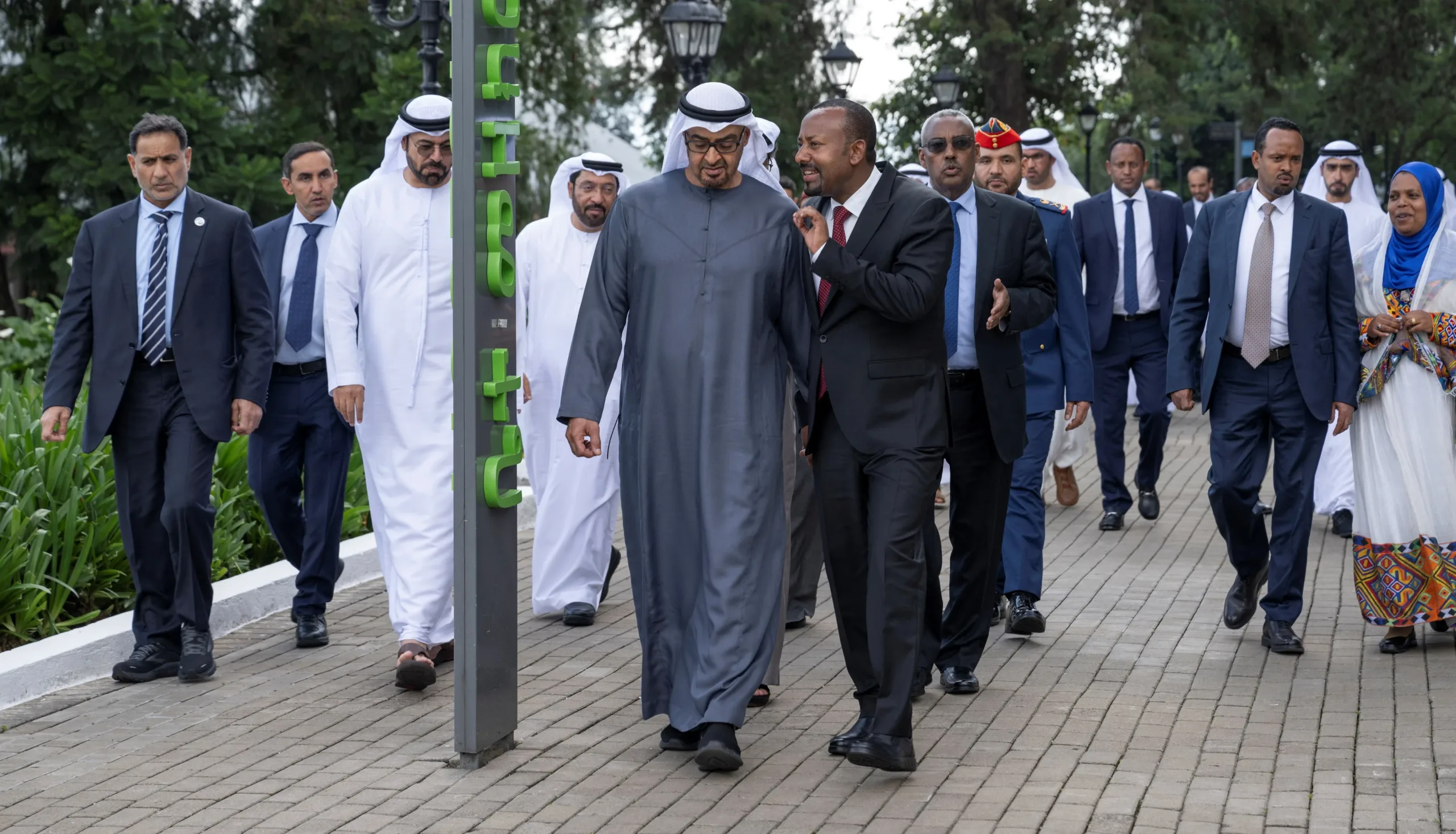
The UAE also sponsored the 2018 Ethiopian-Eritrean peace agreement for which Abiy won the Nobel Peace Prize. But the relationship with Asmara later soured. Since late 2023, Abiy has escalated his rhetoric about Ethiopia’s historic “right” to the port of Assab, which lies only about 70 kilometers from the border between the two countries, describing the loss of maritime access as “a mistake that must be corrected” and portraying access to the sea as an existential issue.
Although Abiy Ahmed later stepped back somewhat and told parliament that his country did not intend to wage war or invade Eritrea and was seeking diplomatic and peaceful solutions to the issue of maritime access, the British website Middle East Eye published in February an exclusive report citing high-level sources saying that Ethiopian Prime Minister Abiy Ahmed had been on the verge of launching a war to seize the Eritrean port of Assab last year, with support and encouragement from the UAE.
The regional picture becomes complete when the UAE-Ethiopia alliance is placed in the context of Sudan’s war. The UAE, widely accused of supporting the Rapid Support Forces, is building through the Horn of Africa a network of ports, corridors, and bases stretching from Assab to Berbera, and Ethiopia — Sudan’s southern neighbor — represents the cornerstone and the most central regional power in this web.
Journalistic investigations backed by satellite imagery have confirmed that Ethiopia is hosting a secret camp in the Benishangul-Gumuz region, near the Sudanese border, to train thousands of fighters affiliated with the Rapid Support Forces. The reports said the construction of these camps, their logistical management, and the provision of military trainers are being fully financed by the UAE and driven by pressure from Abu Dhabi.
which has come to control Ethiopia’s sovereign decision-making as a result of Abiy Ahmed’s government’s near-total reliance on Emirati financial aid and massive investments to avoid economic collapse, alongside its need for Emirati military support in internal wars.
More recently, the Sudanese army formally accused Ethiopia of allowing advanced drones to launch from its territory to target Khartoum International Airport and other vital facilities, before announcing on May 23, 2026, that it had shot down a hostile drone that violated national airspace coming from the Ethiopian border.
Ethiopia’s Foreign Ministry denied the Sudanese accusations, describing them as “baseless,” and tried to shift attention by accusing Khartoum of supporting the Tigray People’s Liberation Front.
Why is the UAE betting on Abiy Ahmed?
The UAE’s comprehensive bet on Abiy Ahmed is based on a careful assessment of interests and opportunities compared with other available alternatives in neighboring countries. Ethiopia offers Abu Dhabi a package of strategic advantages that other countries in the region lack:
- Market and scale: Ethiopia is Africa’s second-most populous country, with more than 126 million people, making it a vast market for Abu Dhabi’s investments and exports and a pillar of its food security through Ethiopian farmland.
- Location and corridors: Ethiopia is the inland depth that gives Emirati ports — especially Berbera — their economic viability. Without an Ethiopian hinterland, the Berbera Corridor loses its value.
- An ally indebted for survival: Abiy understands that his rule survived because of Emirati support at a moment of collapse, making him a partner unlikely to turn against Abu Dhabi and that is the most valuable thing it can buy.
- Positioning on the Red Sea: This fits into a broader Emirati strategy to control shipping chokepoints and ports from Bab el-Mandeb to the Gulf of Aden, in competition with Turkey, Saudi Arabia, Qatar, and Egypt.
Most important of all is the “strong leader” model. Abu Dhabi prefers dealing with a central leader who decides unilaterally through personal deals and that is Abiy’s style, built on bilateral arrangements far removed from state institutions that he has reduced to his own person, as well as from the political party he founded in 2019 on the ruins of the historic Ethiopian People’s Revolutionary Democratic Front coalition.
He dissolved it and merged its parties into a single centralized entity he called the Prosperity Party, a party with no known leaders or political theorists other than Abiy Ahmed himself.

After dissolving the coalition and founding his political party, he succeeded in hollowing out parliament and judicial institutions of their independent value, while major state projects, such as developing the capital Addis Ababa and building resorts, were transformed into personal projects he personally oversees and launches in the name of his vision of “prosperity.”
Abiy Ahmed has shaped his politics around the idea of the “savior leader.” Those close to him say he grew up with a prophecy from his mother that he would become Ethiopia’s “seventh king,” something reflected in his style of rule, which blends digital modernity with an imperial monarchical tendency based on absolute loyalty to his person.
He seeks to reshape Ethiopia and dominate the Horn of Africa through an imperial vision, using the launch of national projects to tighten his grip on power, according to The Economist in its latest report on the Ethiopian elections held on Monday, June 1, which observers agree were a sham designed to grant formal legitimacy to Abiy Ahmed’s authoritarian system after he suppressed the opposition, jailed its leaders, and drove many of them into exile.
For all these reasons combined, the UAE will not find anyone better than Abiy Ahmed to serve as an agent for its project. He also gives it strategic depth that encircles the Red Sea and strengthens its position in the Horn of Africa and the wider East African region. Abiy Ahmed’s Ethiopia is the UAE’s grand prize, the piece that gives the rest of the pieces meaning through its size, market, and inland depth, turning ports and bases from isolated points into an integrated system.
For Abiy, meanwhile, the UAE is not just one partner among others, but a multifunctional safety valve: cash liquidity that rescues a troubled economy without human rights or political conditions; weapons shipments, especially drones, to settle his internal wars when the West cannot or will not; diplomatic cover that eases his international isolation at the height of accusations over Tigray and Amhara; and a maritime outlet through Berbera that fulfills his foremost strategic ambition. In short, Abu Dhabi gives Abiy what Western partnerships burdened by conditions cannot: fast, flexible, and ostensibly unconditional support.
Risks of the UAE-Ethiopia alliance
Despite all the mutual advantages enjoyed by the two close allies, the UAE’s bet on Abiy Ahmed carries structural fragility that makes him not only its strongest ally, but also its most dangerous. Abiy is fighting multiple-front wars: the Amhara Fano movement’s insurgency since 2023, which controls vast rural areas and periodically attacks government forces in major cities in the Amhara region; ongoing clashes and tensions with the Tigray People’s Liberation Front and regional forces; and the violence of the Oromo Liberation Army and its attacks on areas around the capital, Addis Ababa. These tensions and internal conflicts threaten the UAE’s investment in Abiy Ahmed’s entire system.
This is in addition to the Assab port trap. The sweeping electoral mandate expected for Abiy Ahmed in June could accelerate his rush toward war with Eritrea to seize the port of Assab. Nor should it be forgotten that the “Somaliland” deal angered Somalia, Egypt, and Djibouti, and tied Abu Dhabi to a party that destabilizes the Horn of Africa and fuels regional rivalries intersecting with the Grand Ethiopian Renaissance Dam and Nile file.
The UAE has also become linked to the issue of war crimes in Tigray through its support for the Ethiopian army, and then to Sudan through its backing of the Rapid Support Forces. All of this accumulates an ethical and legal cost that could turn into an international political burden.
Finally, the Emirati project is built around Abiy Ahmed personally, not state institutions, making the entire system hostage to his political fate — a highly volatile form of investment, especially in light of the tensions and conflicts noted above.
Port imperialism in coordination with “Israel”
In a video clip, former Ethiopian diplomat Mohammed Hassan reveals what he describes as a project of “port imperialism” led by Mohammed bin Zayed, portraying it as a carefully designed geopolitical strategy aimed at dominating vital maritime arteries in Africa and the Middle East.
In an interview with Sovereign Media on X — a platform that describes itself as focused on “media from the perspective of national sovereignty” — Hassan outlines a broad Emirati plan to control strategic maritime corridors. He says the UAE is seeking to extend its influence over major African ports stretching from Port Sudan in the east to Dar es Salaam in Tanzania.
The project also extends across the Gulf, in his account, to include control over all Yemeni ports as far as the city of Mukalla. Hassan, who previously served in Ethiopia’s Foreign Ministry and is known for his anti-imperialist and anti-“Israel” positions, argues that the ultimate goal of this strategy is to enable Dubai to surpass Singapore and become the world’s leading maritime hub
The former Ethiopian diplomat links the UAE’s “port imperialism” project to the Abraham Accords on normalization with “Israel,” saying that the Mossad’s second office is located in Dubai and works in coordination with Israeli and US interests to ensure regional dominance. On that basis, Mohammed Hassan argues that if the UAE succeeds in tightening its control over the coasts, it will be able to cement its position as the gateway controlling the movement of three continents.
In conclusion, we note again that the Ethiopian elections held on June 1, 2026, will strengthen Abiy Ahmed’s grip on power, as it has become all but certain that they will result in a sweeping victory for the Prosperity Party in an electoral scene described as predetermined, amid a fragmented opposition of about 40 nominal parties, constituencies contested by the ruling party without competition, and the exclusion of voting in Tigray and large parts of Amhara under the pretext of “unfavorable conditions.”
Such a sham victory may formally entrench Abiy and keep the Emirati gateway open, but it does not address the sources of fragility it deepens them. This legitimacy may encourage Abiy to seek an external achievement, driven by the euphoria of victory, such as maritime access, raising the possibility of a gamble toward Assab and the ignition of a confrontation with Eritrea that could cause turmoil and instability threatening the Emirati system itself.
From his mother’s prophecy to ballot boxes carefully tailored to size, Ethiopian Prime Minister Abiy Ahmed is reproducing his personal rule in the June 2026 elections, crowning himself once again as the country’s absolute ruler for another five years, surrounded by full Emirati financial and military patronage that has transformed him from a would-be national leader into a regional proxy carrying out Abu Dhabi’s agenda and destabilizing policies in the region, especially toward Sudan, Eritrea, and Somalia.