








هذا التقرير متاح أيضًا بـ العربية
In Turkish politics, major crises rarely remain confined to their original point of departure. They may begin in a courtroom, then spread to a party headquarters, send shock waves through the street and the markets, and eventually settle into parliamentary calculations and the balance of power.
From this angle, the crisis that struck the Republican People’s Party after the decision to annul its 38th general congress, and temporarily return Kemal Kilicdaroglu to the scene, appears to be about far more than an internal dispute over the leadership of the republic’s oldest party. The crisis is taking shape at the intersection of three overlapping battles: the battle between the government and the opposition, the battle among factions within the CHP, and the battle over a new constitution, which President Recep Tayyip Erdogan and his allies insist on keeping at the center of Turkish political debate.
An internal crisis with national repercussions
On May 21, a Turkish appeals court issued a ruling that sent tremors through the political landscape, annulling the CHP leadership election held in November 2023, removing its current leader Ozgur Ozel, and restoring Kilicdaroglu to his former post. The ruling came 30 months after the congress that ended Kilicdaroglu’s era as party leader following his defeat to Erdogan in the 2023 presidential election, and paved the way for Ozel’s rise as the face of a new phase within the Turkish opposition.
Interpretations of the ruling diverged from the outset. The CHP leadership and its supporters saw it as judicial interference that challenged the party’s internal will and opened the door to reshaping the opposition from outside its own organizational ballot boxes. By contrast, official and judicial circles treated the matter as a legal case involving allegations about the integrity of the party’s internal procedures, the fairness of its congresses, and whether the electoral process had been conducted in accordance with the frameworks set out in the law and party bylaws. Between these two narratives, the crisis expanded from the legal sphere into the broader political arena.
The impact of the ruling was quick to appear. Thousands of Turks gathered outside the party’s headquarters in Ankara, carrying signs denouncing the verdict, while Ozel described the decision as a judicial coup targeting the will of party members. In response, official bodies stressed that judicial independence required allowing the legal process to take its course, and that internal party disputes should be resolved within the appropriate institutions rather than through political pressure or the street.
At the same time, the aftershocks reached the markets, where the Istanbul stock exchange saw a sharp drop in the trading session following the announcement of the ruling, reflecting the Turkish economy’s sensitivity to any development that raises the level of political uncertainty.
The crisis draws its importance as much from its timing as from its substance. It came at a stage when the CHP was already facing a series of legal cases involving a number of mayors affiliated with it since October 2024, including influential municipalities in Istanbul and other major areas, on charges ranging from financial corruption and abuse of power to links with banned organizations.
While the opposition sees these cases as a pressure campaign aimed at weakening it after its gains in the municipal elections, the government and state institutions insist that fighting corruption and pursuing security and administrative violations should not automatically be interpreted as political targeting, and that party affiliation does not grant immunity from legal accountability.
From this perspective, reading the annulment of the CHP congress as an isolated legal event is incomplete, just as treating it as conclusive proof of premeditated political engineering lacks the necessary caution. Since the 2023 elections, the party has been undergoing a genuine internal reckoning tied to Kilicdaroglu’s legacy, Ozel’s rise, Ekrem Imamoglu’s growing influence, and the dispute over the best way to confront Erdogan and regain voters’ trust.
At the same time, it cannot be overlooked that any disruption within the largest opposition party has a direct impact on the balance of Turkish politics and on the opposition’s ability to fight its coming battles with a united front.
The sensitivity of this crisis increases with the return of the new constitution file to the forefront of political debate. President Erdogan and his allies have for years argued for the need for a new civilian constitution that moves beyond the legacy of the 1982 constitution, saying Türkiye needs a text that lays the foundation for a more stable phase better suited to the transformations the political system has undergone since the shift to an executive presidency.
The opposition, by contrast, fears that this path could become an opportunity to entrench the gains of the current presidential system and expand the powers of the executive, especially if constitutional debate takes place while the opposition is divided or preoccupied with its internal crises.
In this sense, the hypothesis that the CHP’s division could be used in the constitutional battle remains a political possibility that requires scrutiny, not a final judgment that can be adopted without direct evidence. There is no public document proving that the court ruling was designed to clear the way for specific constitutional amendments, and the roots of the party’s internal conflict run deeper than the recent judicial intervention. Still, the coincidence of legal pressure on the party, escalating disputes among its factions, and the renewed push for a new constitution makes it necessary to examine the relationship among these tracks and measure the extent to which each affects the others.
The constitutional hypothesis
The hypothesis that the CHP crisis is being used in the path toward a new constitution draws its strength from the overlap of three main elements: the ruling alliance’s need to expand its parliamentary base, the coincidence of legal measures with the return of constitutional debate to the forefront, and the assessments of a number of analysts who believe that turmoil within the main opposition could open wider room for political maneuvering.
Even so, this hypothesis still requires a cautious reading, because it rests on intersecting indicators rather than direct evidence proving the existence of a fully formed plan to reshape the opposition in a way that serves the constitutional project.
The issue begins with the constitutional text itself, as the Turkish Parliament consists of 600 lawmakers, and the thresholds for amending the constitution are calculated on that basis. Under Article 175, a constitutional amendment proposal requires the signatures of at least 200 lawmakers, or one-third of Parliament’s members. Passing the amendment requires 360 votes to send it to a popular referendum, while reaching 400 votes gives Parliament a broader majority that allows it to pass the amendment internally, while leaving the president with the authority to submit it to a referendum.
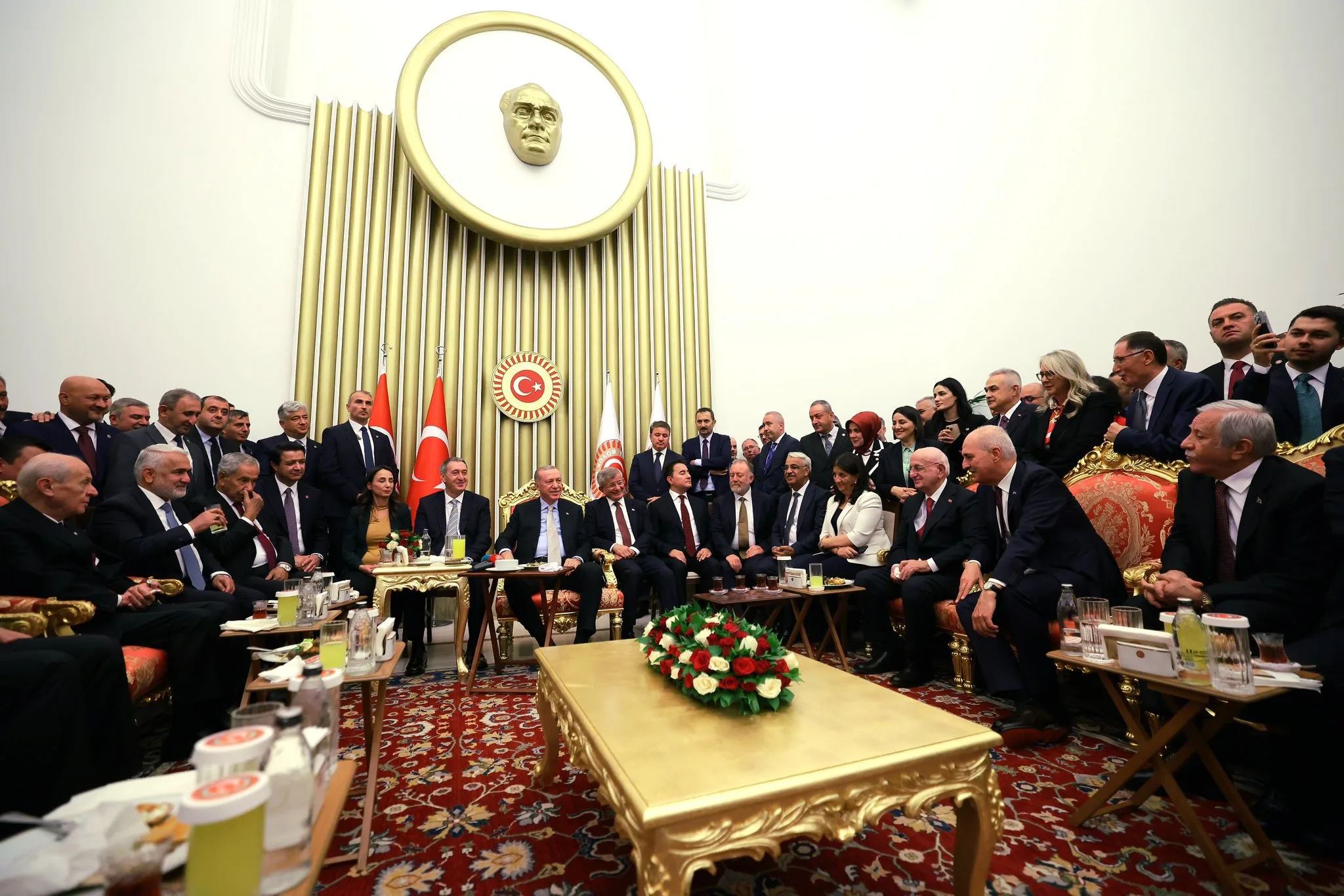
These figures mean that any project for a new constitution requires understandings that go beyond the People’s Alliance, which includes the Justice and Development Party, the Nationalist Movement Party, and their allies. The ruling alliance does not on its own hold the 360-vote threshold, let alone the 400-vote threshold, making the search for votes from outside its bloc a parliamentary necessity if it wants to turn the constitutional project from political rhetoric into an actual legislative path.
In theory, those votes could come from small parties, independent lawmakers, the Good Party, the Peoples’ Equality and Democracy Party, or from within the CHP itself in the event of a real split within its bloc.
This parliamentary need does not necessarily mean there is a single plan targeting the CHP. Over the past several years, the AKP has presented the new constitution project as a national issue that transcends partisan alignment, arguing that Türkiye needs a civilian constitution that moves beyond the legacy of the 1982 constitution, which is tied to the post-coup period following Sept. 12, 1980. Supporters of this argument believe the current constitution has undergone so many amendments that it has lost its coherence, and that the political and social transformations Türkiye has experienced require a new text more in harmony with the nature of the existing system.
The opposition, however, views the constitutional path from a different angle. It does not reject the principle of a civilian constitution in itself, but it harbors deep doubts about the timing of the project and the side leading it. It believes opening this file under the current balance of power could become a means of entrenching the presidential system in its current form, or an entry point for rearranging the rules of political competition ahead of the 2028 elections. The dispute over the constitution thus becomes a crisis of political trust before it is a technical disagreement over legal articles.
Indicators of advantage
This is where the sensitivity of the crisis inside the CHP comes from. The party occupies a central position in the opposition equation and holds a significant parliamentary bloc, and it emerged from the most recent municipal elections in a way that strengthened its standing against the ruling party. Any internal disruption in its leadership, or any split among its factions, could therefore directly affect the balance in Parliament and the opposition’s ability to negotiate, object, or mobilize popular support against the constitutional project.
Within this context, the judicial crisis related to the party’s congresses has brought Kemal Kilicdaroglu’s name back to the forefront of debate. The man who lost the presidential election to Erdogan in 2023 and left the party leadership after Ozgur Ozel’s rise still represents a current within the CHP that believes the opposition failed as much because of poor management of the previous phase as because of the imbalance in the conditions of competition.
Ozel’s leadership treats Kilicdaroglu’s possible return as a threat to party unity and the project of internal renewal, while his supporters argue that the dispute is about the legitimacy of internal congresses and the integrity of organizational procedures, not about serving an external agenda.
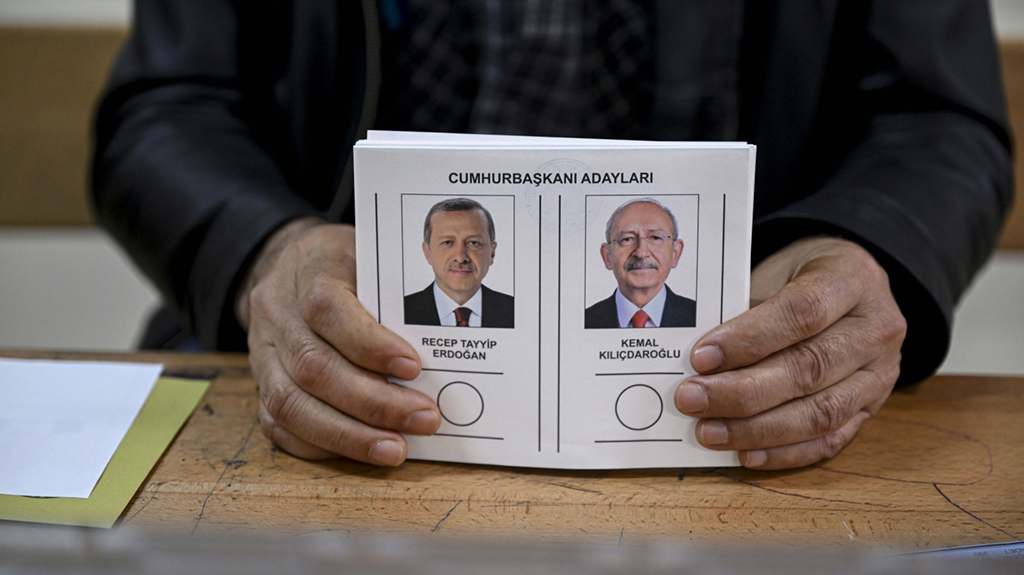
This point in particular prevents the reading from slipping into oversimplification. The crisis inside the CHP has real roots that predate the judicial intervention, tied to the results of the 2023 elections, the struggle between the old and new leaderships, Ekrem Imamoglu’s place within the party, and the dispute over the best strategy for confronting Erdogan. But the internal dimension of the crisis does not erase its broader political impact, because a split in the largest opposition party gives the ruling alliance an opportunity to test new negotiating paths, whether on the constitution or on other issues linked to the balance ahead of the next elections.
These calculations become more important when looking at the parliamentary map, where the People’s Alliance holds around 330 seats, a figure that leaves it below the 360 threshold needed to send a constitutional amendment to a referendum, and below the 400 threshold needed to pass it with a broad parliamentary majority. Even if small blocs or independent lawmakers were to join, reaching the minimum remains difficult without broader support from the opposition or shifts within its parliamentary blocs.
In this framework, talk of a split inside the CHP becomes part of political calculation, not conclusive proof that this scenario will materialize. The defection of a limited number of lawmakers, or their abstention from voting, could partially alter the government’s room for maneuver, but it would not necessarily be enough to reach the required constitutional thresholds. A broad split within the party, meanwhile, remains a politically costly scenario, because CHP lawmakers understand that any move closer to a constitutional project led by the government could put them in direct confrontation with their electoral base, especially if the step is understood as contributing to prolonging the life of the current presidential system.
Alongside the CHP, other parties remain present in constitutional calculations. The Good Party has a margin that could make it the subject of attempts at attraction or negotiation, while the Kurdish Peoples’ Equality and Democracy Party represents an influential bloc that is difficult to bypass in any serious constitutional path. As for centrist parties grouped in smaller blocs, such as Felicity, Future, and DEVA, they may add limited votes, but they are not enough on their own to change the equation unless accompanied by a broader understanding within Parliament.
Thus, the road to a new constitution does not appear easy for the government, even if it benefits from opposition turmoil. Reaching the 360-vote threshold requires a significant additional political bloc, while reaching the 400-vote threshold appears even more difficult under the current polarization. And if the amendment is referred to a popular referendum, the battle will shift from Parliament to the street, where numerical calculations alone are not enough. Voters’ views on the economy, freedoms, the presidential system, and trust in institutions will become decisive factors in determining the outcome.
From this perspective, the hypothesis linking the CHP crisis to the new constitution project is reasonable in terms of its potential political effect, but it does not by itself rise to the level of a definitive judgment. The government has a clear interest in an opposition that is less cohesive and more open to negotiation, and the opposition has understandable reasons to worry about the timing and scope of the legal measures. By contrast, the state relies on a legal discourse stressing the need to investigate allegations of corruption, organizational irregularities, or electoral violations within parties and municipalities, and rejects the idea that every judicial process amounts to political targeting.
A delicate equation
The closest thing to a balanced reading is that the crisis gives the constitutional project an additional political opportunity, without explaining the entire project or guaranteeing its success. If the CHP emerges from its crisis united, presents a clear position on the constitution, and is able to speak to voters beyond its traditional base, the 360-vote threshold will remain difficult, and going to a referendum will remain a gamble fraught with major political risks.
But if the split drags on, and legitimacy is contested between a judicial or temporary leadership and a political leadership with popular presence, the government may find in this confusion an opportunity to push its project to a more advanced stage, or at least to test the limits of division within the opposition.
The future of the new constitution does not depend on the government’s intentions alone, nor on the CHP crisis alone, because the path will be decided by the interaction of three interconnected elements: the ruling party’s ability to build understandings outside the People’s Alliance, the opposition’s ability to protect its political and organizational unity, and the nature of the constitutional text that will ultimately be put forward.
If the text is limited and persuasive, and carries clear reform guarantees related to freedoms, the separation of powers, and judicial independence, it may find support beyond the government camp. But if it appears aimed at re-entrenching the presidential system in its current form, it will be difficult to pass without a deep split within the opposition or a highly polarized referendum.
The sensitivity of the moment lies in the fact that the crisis is moving within a gray zone between containment and confusion. The government may benefit from a weakened opposition, but it still does not have a guaranteed parliamentary path toward the constitution. The opposition may invest the legal and political pressure in mobilizing its base, but it risks losing that advantage if leadership and legitimacy disputes drain it.
As for the Turkish voter, watching the scene amid economic pressure and sharp political polarization, they may become the decisive factor if the constitutional debate moves from Parliament to the referendum ballot box.
The crisis reveals a difficult test for Turkish democracy and its institutions. The wider the gap grows between legal discourse and the political reading of judicial measures, the more public trust in the neutrality of institutions declines, and the more likely the street is to interpret every decision as an extension of the struggle for power. Conversely, any serious constitutional process requires a minimum degree of mutual trust, a clear text, convincing guarantees, and broad political participation that turns the constitution from one camp’s project into a sustainable national contract.
Therefore, the possibility that a split in the CHP could help facilitate the passage of a new constitution remains politically plausible, but it is still contingent on many factors. Division alone does not create a 360-vote majority, does not guarantee public acceptance, and does not remove the sensitivity of relations between the parties of the ruling alliance and the rest of the parliamentary blocs. Nor is cohesion alone enough for the opposition if it fails to present an alternative constitutional discourse that convinces voters that rejecting the project does not mean rejecting reform.