







هذا التقرير متاح أيضًا بـ العربية
Political parties competing for seats in Israel’s Knesset have placed artificial intelligence at the center of their election campaigns, using it to generate fabricated images and videos that associate rivals with Palestinian and Arab figures, or depict them alongside scenes evoking the Israeli army, fallen soldiers and the war in Gaza.
The 27 October election is taking place amid a fierce political battle over responsibility for Israel’s security failures, the conduct of the war and the country’s future leadership. Against this backdrop, imagery invoking security, Gaza and Palestinians has taken on a prominent role in election propaganda.
Who is behind the fake images in Israel’s election campaign?
The ZeBeAI project led by Anat Ben David, a professor of digital communication at the Open University in Israel, tracked the use of AI in posts by parties and politicians on Facebook, Instagram, X and TikTok.
The project’s data on Aug. 17 showed the right-wing Likud party far ahead, with AI-generated or AI-edited material among opposition parties, the religious right, and the center, illustrating how AI manipulation influences political narratives.
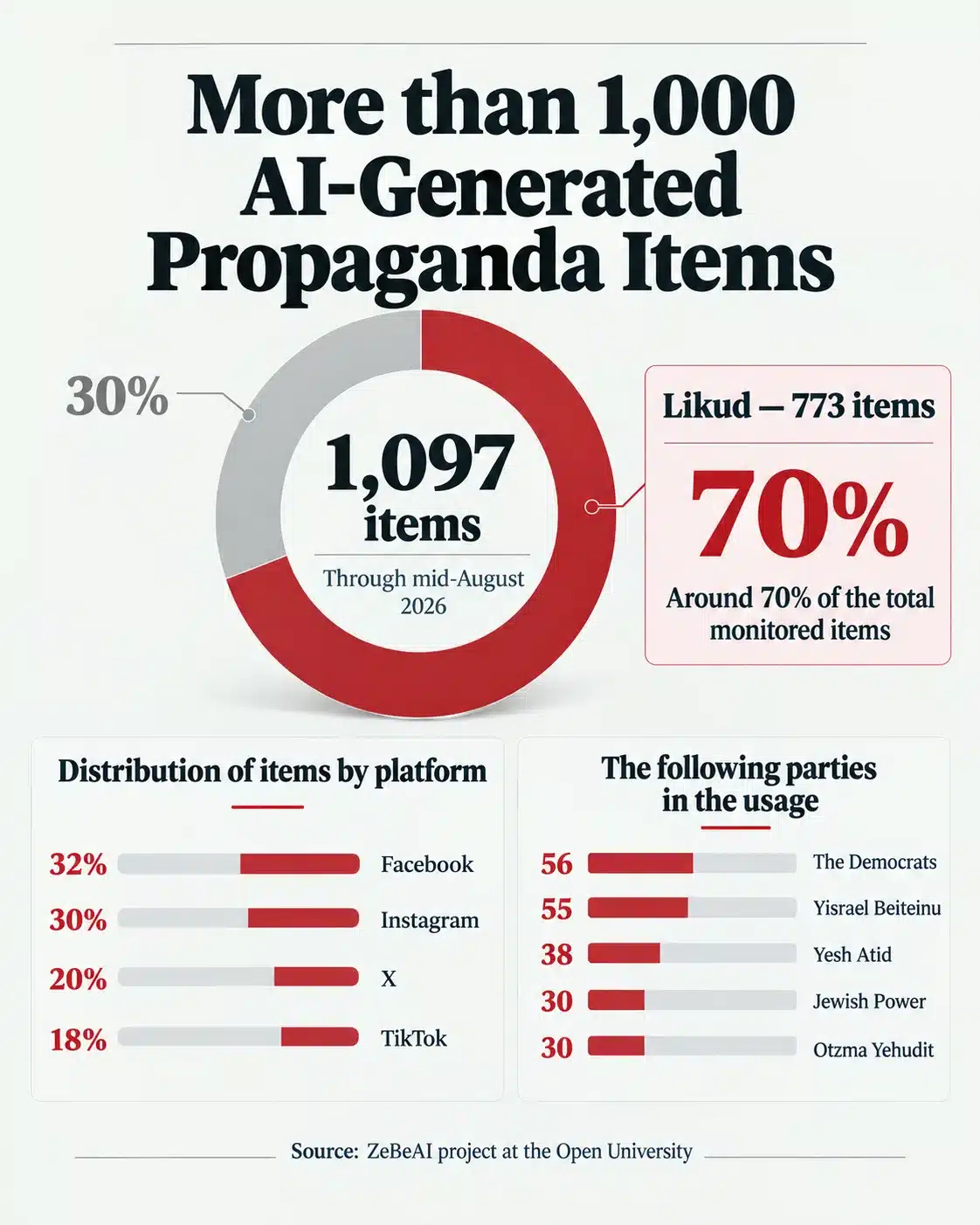
Among individual politicians, Likud lawmaker Ariel Kellner topped the list with 179 AI-generated items, followed by fellow lawmaker Hanoch Milwidsky with 79, Minister Dudi Amsalem with 66, and lawmaker Avihai Boaron with 61. Netanyahu himself published 20 items featuring AI-generated content during the monitoring period.
Since the beginning of the year, Palestinians and Arab political parties in Israel have repeatedly featured in this type of campaign material. AI-generated images have been used to portray right-wing opponents as part of alliances, meetings and political relationships that never took place, or to turn real political ties into more striking and misleading visual scenes.
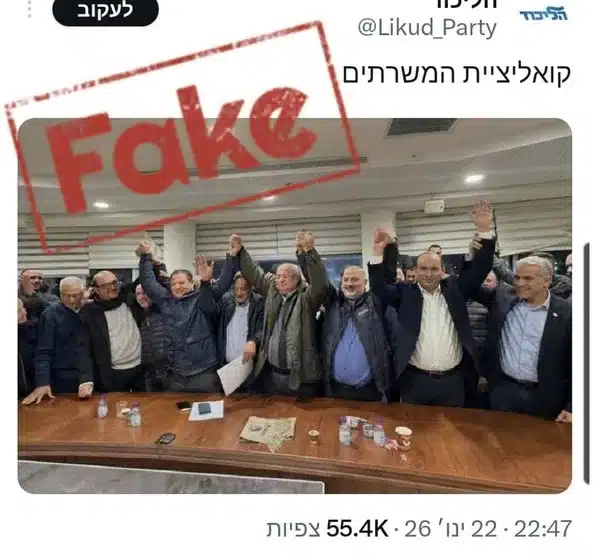
In January, Likud published a composite image showing former Prime Minister Naftali Bennett and opposition leader Yair Lapid alongside leaders of Arab parties, with the two appearing to raise their hands with them in a fabricated scene.
In February, Central Elections Committee Chairman Justice Noam Sohlberg ordered the image removed and awarded Bennett’s party 8,500 shekels in legal costs. He found that the image was realistic enough to lead viewers to believe it documented a genuine political partnership between Bennett, Lapid and Arab parties.
The same message appeared in a series of clips showing Bennett’s and Lapid’s faces apparently falling away to reveal the faces of Mansour Abbas, leader of the United Arab List, and Ahmad Tibi, leader of the Ta’al party.
Likud minister Idit Silman also published a video depicting Bennett waking from a “nightmare” while embracing Abbas. Lieberman, meanwhile, used the technology in the opposite direction, posting an AI-generated image showing Netanyahu alongside Abbas.
On 23 June, the tactic took on a more documentary-like appearance when Finance Minister and Religious Zionism leader Bezalel Smotrich published a video combining real footage with an AI-generated scene. The clip depicted Gadi Eisenkot, a former Israeli army chief of staff and leader of the Yashar party, apparently shaking hands with Palestinian Authority President Mahmoud Abbas before Abbas was joined by Mansour Abbas.
The shot suggested a political relationship through a handshake that never happened. On July 26, Sohlberg ordered the video removed, saying the scene’s realism and the way the AI warning was displayed made it seem like a recording of a real event.
By July, the war in Gaza, along with images of Israeli soldiers and those killed in combat, had become more direct elements of AI-generated campaign material. Eisenkot’s party published an election video depicting him alongside soldiers fighting and stationed in a military zone. The video also included a simulated scene of soldiers arriving at a family home to inform relatives that a family member had been killed.

On 6 August, Sohlberg ordered the video removed from the party’s social media accounts, ruling that the prohibition on using soldiers in election propaganda also applied to AI-generated depictions of military personnel. He also ordered the party to pay Likud 5,000 shekels in legal costs.
Likud responded later that month with a clip showing Eisenkot running through a field of flowers towards a young man before passing him and embracing Mansour Abbas. Some viewers interpreted the young man as an apparent reference to Gal Eisenkot, the former army chief’s son who was killed during the war in Gaza. Following the backlash, Likud replaced the character with a woman.
Benny Gantz’s Blue and White party responded with a video showing Netanyahu walking past a soldier before embracing Haredi politician Yitzhak Goldknopf. Religious Zionism, meanwhile, placed politicians from the Democratic Party in AI-generated images surrounded by Palestinian flags, communist symbols, pride flags and dollar bills.
The use of assault imagery also extended to materials published by Yonatan Urich, Netanyahu’s close adviser and a member of Likud’s campaign team, which included scenes linked to Tehran, Khan Younis and Beirut’s southern suburbs, as well as a video making US President Donald Trump speak in Hebrew with fabricated remarks against Eisenkot.
This was in addition to a clip showing former Hezbollah Secretary-General Hassan Nasrallah, former Iranian Supreme Leader Ali Khamenei, and the late Hamas leaders Yahya Sinwar and Ismail Haniyeh playing backgammon in hell.
The use of AI in these materials expanded from fabricating political meetings to reconstructing scenes of destruction and placing political rivals in synthetic campaign settings. Aidan Ring, a researcher and writer specialising in disinformation and digital policy, described the phenomenon as “Slopaganda” — low-cost, rapidly produced synthetic propaganda.
By September, AI-generated campaign material had spread into judicial, religious and domestic political disputes. The newspaper Globes documented campaigns by Shas, Ben-Gvir and Gantz featuring AI-generated characters and children. Religious Zionism also sparked controversy after publishing scenes depicting judicial figures being dragged away by security personnel.
In September, the use widened to judicial, religious and internal conflict issues, and the newspaper Globes documented campaigns by Shas, Ben-Gvir and Gantz that used AI-generated characters and children, while Religious Zionism stirred controversy after publishing scenes depicting judicial figures being dragged away by security personnel.
How AI-generated images can shape voters’ views
These materials are reaching voters in an electoral environment already saturated with disinformation. With 71 percent of respondents saying they frequently encounter false election-related information, the prevalence of fabricated content makes it increasingly important for voters to scrutinise what they see and the sources behind it.
Results from a poll conducted by the Israel Democracy Institute on Sept. 8 clarify the political context in which these materials are received. It found that 68 percent of Jews and 32 percent of Arabs consider the events of Oct. 7 a central factor in choosing a party, while security and foreign policy topped Jewish voters’ priorities, with their weight rising among right-wing voters.
Propaganda invoking Palestinians, the Israeli army or fallen soldiers therefore taps into issues that are already central to voters’ political choices, giving these symbols a political charge before campaigns reassemble them through AI.
The cases reveal two patterns in the use of AI for political propaganda. The first relies on realistic-looking scenes that can be mistaken for genuine events, such as the image of Bennett and Lapid alongside Arab party leaders or the fabricated handshake between Eisenkot and Mahmoud Abbas. This was the basis for Sohlberg’s decisions to order the removal of such material, amid concerns that viewers could interpret the images as documenting events that had actually taken place.
The second pattern is more overtly caricatured, as in images of Eisenkot running to embrace Mansour Abbas or politicians portrayed against Palestinian flags. Ring argues that this type of material benefits from cheap, high-volume production, allowing the same political association to be repeated across different images and clips until it becomes familiar to audiences.
Research cited by Anat Ben David, a professor of digital communication at the Open University of Israel, suggests that warnings and corrections can reduce belief in false information. But they may not fully erase the impression or doubt created when people encounter the material in the first place.
Political communication research points to another consequence, known as the “liar’s dividend”: as fabricated political content becomes more widespread, politicians can use the existence of deepfakes and other synthetic media to dismiss genuine but damaging recordings or images as fake. During an election campaign, when such material can circulate rapidly, that effect can complicate voters’ ability to distinguish between what is fabricated and what is real.
Indeed, a poll by the Israel Democracy Institute found that 59 percent of the public see a high likelihood of illegitimate attempts by Israeli political actors to influence the result. In comparison, 51 percent saw a high likelihood of foreign interference.
AI extends beyond visual propaganda. The Israel Internet Association found that 25 percent of the public are considering using an AI tool or online service to help determine how to vote.
How do fake images evade oversight?
The widening use of AI-generated material prompted changes to election rules. In July, the Knesset approved provisions specifically for the 2026 elections requiring propaganda to be labelled when it depicts a person, place, event or document that has been created or digitally altered to appear as an original recording. The provisions also gave the chairman of the Elections Committee authority to determine the disclosure requirements.
The labelling rules took effect on 26 July. Images and printed material must carry a prominent notice measuring at least 5 percent of the content’s height, while videos must display the notice throughout their duration. Audio material must include the disclosure at both the beginning and end.
The rules focus on what they define as a “deep appearance” – content capable of presenting a fabricated scene as if it were original documentation. This covers a narrower category than the full range of AI uses tracked by the Open University project.
Early enforcement suggested that much of the oversight takes place only after material has been published. Yonatan Urich, a Netanyahu adviser and member of Likud’s campaign team, published a series of AI-generated images and clips without the required disclosures. After receiving legal warnings, he deleted six items and republished a video featuring Donald Trump with an AI-use notice.
The Smotrich-Eisenkot case showed that adding a disclosure does not necessarily resolve the issue. Sohlberg ruled that the notice’s placement and presentation on Facebook were insufficient to dispel the impression that the fabricated handshake between Eisenkot and Mahmoud Abbas had actually taken place.
The gap becomes wider when campaign material moves beyond official party accounts to influencers, supporters and individual users. In August, the Movement for Freedom of Information called for content creators and influencers paid by political parties to be required to disclose the propagandistic nature of their posts. Sohlberg, however, has treated disclosure as a matter to be determined according to the circumstances of each case, leaving a gray area between the party, its campaign advisers and the influencers or supporters who distribute the material.
The rules also face a practical problem once content leaves the account where it was first published. A user can download an image or video, crop out the disclosure label and upload it again. Other versions can circulate through closed WhatsApp and Telegram groups, which fall outside the public online spaces monitored by the Open University project.
Even the technical verification layer faces the same problem. The ZeBeAI project checks the publisher’s disclosure, platform labels, and digital source data such as the C2PA standard, then uses detection tools and human review.
The team’s experiments also showed that original metadata can be stripped from files. Once uploaded to social media, hybrid videos that combine real footage with AI-generated segments can also receive a low score from automated detection tools when analysed as a single file.
To address this, two independent reviewers watch every suspicious video identified by the project before its classification is finalised. The process highlights the amount of human verification required to assess content that political campaigns can produce, modify and redistribute at a much faster pace.
Platforms are attempting to narrow this gap through different measures. TikTok, for example, announced a dedicated centre for Israel’s elections, an election integrity team, and cooperation with the Elections Committee and fact-checking organisations.
TikTok told Yedioth Ahronoth on 29 July that its policy allows it to remove AI-generated content intended to mislead voters even when it carries a disclosure label. The platform also said it limits recommendations for unverified material and displays a warning before users share it.
Google, meanwhile, requires election advertisers to verify their identities and disclose realistic synthetic content used in political advertising. YouTube applies disclosure and labelling requirements to organic content, provided the material does not breach another platform rule.
For Meta, which owns Facebook and Instagram, and the X platform, publicly available measures have so far largely remained within their broader policies on synthetic media and manipulated content. Neither has announced a local election framework comparable to the dedicated election centre introduced by TikTok.
Omer Kabir, a technology analyst at the Hebrew-language business newspaper Calcalist, argues that labelling provides only a partial remedy in an environment where an image designed to provoke anger or disgust can achieve its political effect before viewers stop to question it.
The 27 October election therefore presents a broad test of a campaign environment in which political parties can manufacture a scene and put it into circulation within minutes, while oversight may take considerably longer to identify, examine and act on it. That gap can give a fabricated image time to spread its intended message before any correction or removal takes effect.
