











The Horn of Africa has long been associated with poverty, civil war and humanitarian crises. That picture reflects much of the region’s history, but it can obscure its growing importance to global trade and security — particularly after the crisis triggered by the US-Israeli war on Iran and the subsequent closure of the Strait of Hormuz. Geography has made the Horn a focus of international competition: its shores face shipping routes between Asia and Europe, while ports, military bases and regional conflicts crowd its coastline.
In its narrowest definition, the Horn comprises Somalia, Ethiopia, Eritrea and Djibouti. A broader discussion of the region also encompasses Sudan, Kenya and Somaliland. The Horn connects the Red Sea to the north, the Gulf of Aden and Indian Ocean to the south and east, and Africa’s interior to the west. Its position gives coastal states opportunities to influence maritime trade and draws outside powers seeking access and security.
At Bab el-Mandeb, the passage between Djibouti and Yemen narrows to about 30 kilometres. Ships carrying millions of barrels of oil, as well as liquefied gas and commercial goods, pass through the strait each day on their way between the Indian Ocean and the Mediterranean via the Suez Canal. Disruption there can quickly raise shipping costs and affect supply chains, as Houthi attacks on vessels the group described as linked to “Israel” have demonstrated. The attacks have also made the waterway a focus of military deployments by competing powers.
Under normal conditions, the Suez–Red Sea–Bab el-Mandeb route carries an estimated 12 per cent of global trade and about 30 per cent of container traffic between Europe and Asia. Sailing around South Africa’s Cape of Good Hope instead adds an estimated 10 to 14 days and nearly $1m in fuel costs to a vessel’s round trip.
Two further factors add to the Horn’s importance. Its Red Sea coast lies close to the war in Yemen, Sudan’s conflict — shaped in part by regional intervention — and tensions between Ethiopia and Eritrea. Relatively secure locations can therefore acquire greater strategic value. Oil and gas shipments also pass through the same narrow corridor as commercial goods, allowing a local security crisis to affect energy markets as well as trade.
Geography and access to the sea
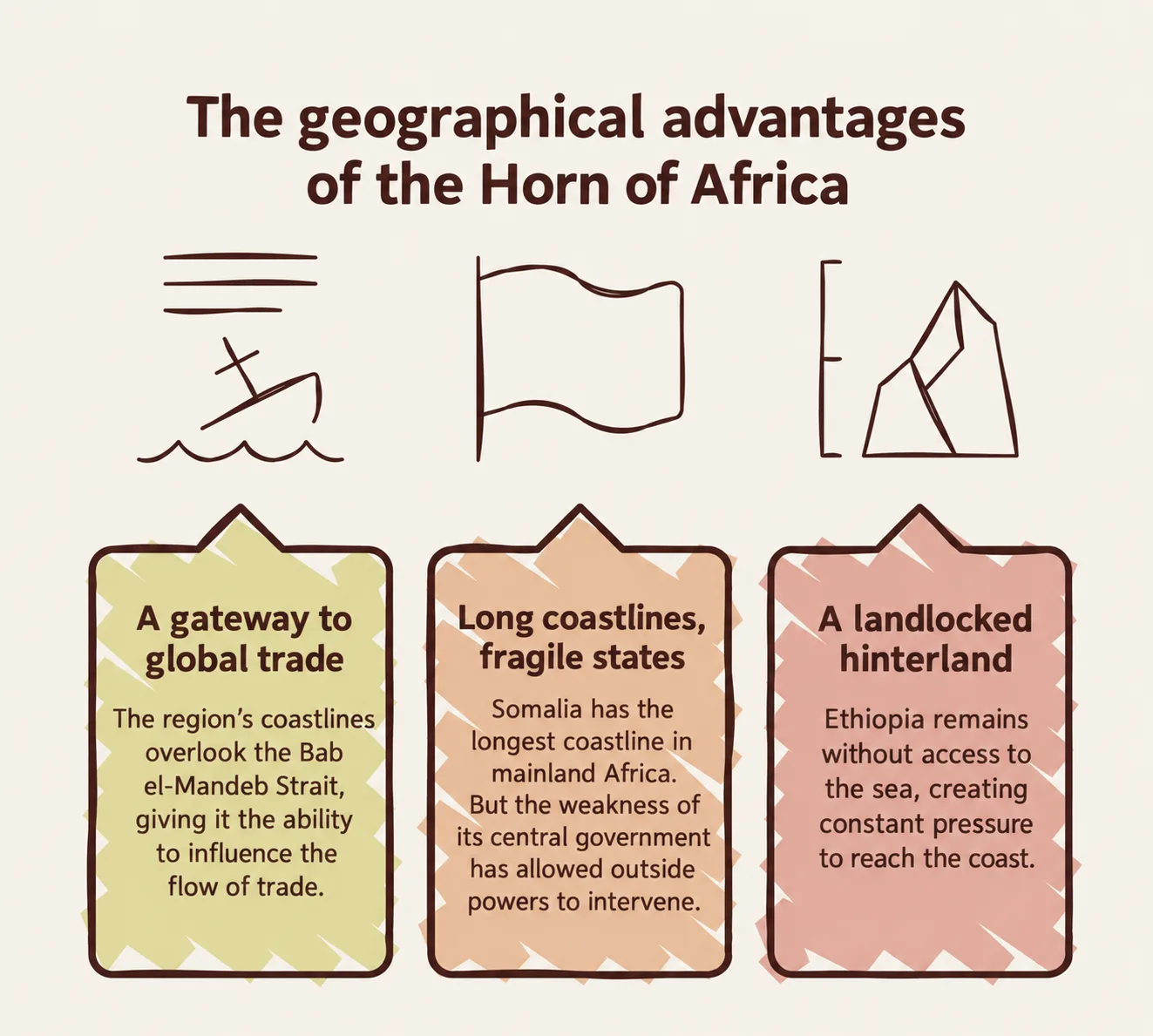
The Horn’s coastline is valuable because it faces the southern approach to Bab el-Mandeb. Control of ports and coastal facilities can provide a means of influencing shipping and access to the strait, though geography alone does not confer control over vessels passing through it.
The region also combines long coastlines with fragile states. Somalia has the longest coastline in mainland Africa, but its central government has struggled to exercise authority across it. Outside powers have been able to build relationships with local actors and invest in ports and security facilities where central authority is weak.
Behind the coastal states lies Ethiopia, with a population exceeding 130 million, a growing economy and no coastline. Its dependence on other countries’ ports creates pressure for more secure access to the sea — a central source of tension in the region.
Colonial borders and internal divisions
The Horn’s present conflicts are closely tied to a colonial legacy of borders that divided communities and left unresolved territorial disputes. The conflict between Ethiopia and Somalia illustrates the continuing force of those claims.
In the 1977–78 Ogaden War, Somalia’s president, Siad Barre, sought to realise the ambition of Greater Somalia by taking the Ogaden region. Britain had handed the territory over to Ethiopia under Haile Selassie in 1954, a transfer Somalis regarded as “an occupation completing European colonialism.”
The war killed tens of thousands and displaced millions. The hostility it entrenched contributed to the pressures that preceded the collapse of Somalia’s central state in 1991 and Somaliland’s unilateral declaration of secession. Decades of factional and clan conflict followed, creating opportunities for armed groups such as al-Shabab to expand. Competition over scarce water and pasture also became more destructive in the absence of effective central authority, driving polarisation and displacement.
Federalism was intended to address Somalia’s divisions. Since its adoption in 2012, however, the formation of regional states along clan lines has also generated disputes over power, resources and territory, both among those states and between them and the federal government in Mogadishu.
Weak institutions and unclear constitutional boundaries have enabled some regional leaders to make security and economic arrangements directly with outside powers, including the UAE and Kenya. These relationships can strengthen local authorities while deepening disputes over Somalia’s sovereignty and the federal government’s role.
Washington is seeking to eliminate sanctions on both Eritrea and Ethiopia and to establish a dual balance that transforms the historic hostility between the two neighbors into a rivalry managed under its own auspices and in line with its interests.
Details in the report. @Moh_Gamea @Moh_Gamea 👇https://t.co/0bdaaaBt46 pic.twitter.com/DTOzUOfrPN
— (@NoonPost) May 21, 2026
Ethiopia’s system of ethnic federalism, adopted in 1991 to accommodate major groups including the Oromo, Amhara and Tigray, presents a different version of the problem. While it initially offered protection to minorities, its administrative boundaries have also hardened distinctions between groups and encouraged the idea of “indigenous ethnicities and outsider ethnicities.” Disputes between regions contributed to the conditions in which the Tigray war, which killed hundreds of thousands, unfolded. Armed rebellions by Amhara Fano militias and the Oromo Liberation Army followed amid opposition to Prime Minister Abiy Ahmed’s attempts to centralise power and weaken regional ethnic structures.
In Ethiopia’s Somali region, divisions between Ogaden and non-Ogaden clans continue to shape disputes over political representation and the region’s identity. Authorities have used local security bodies known as “Temir” committees to monitor the area and suppress armed movements such as the Ogaden National Liberation Front.
Internal divisions have given outside powers multiple points of entry. Instead of dealing solely with national governments, they can cultivate regional authorities, clan leaders or armed actors. Support for a local actor against a central government has become a recurring means of gaining influence.
Ethiopia’s search for maritime access
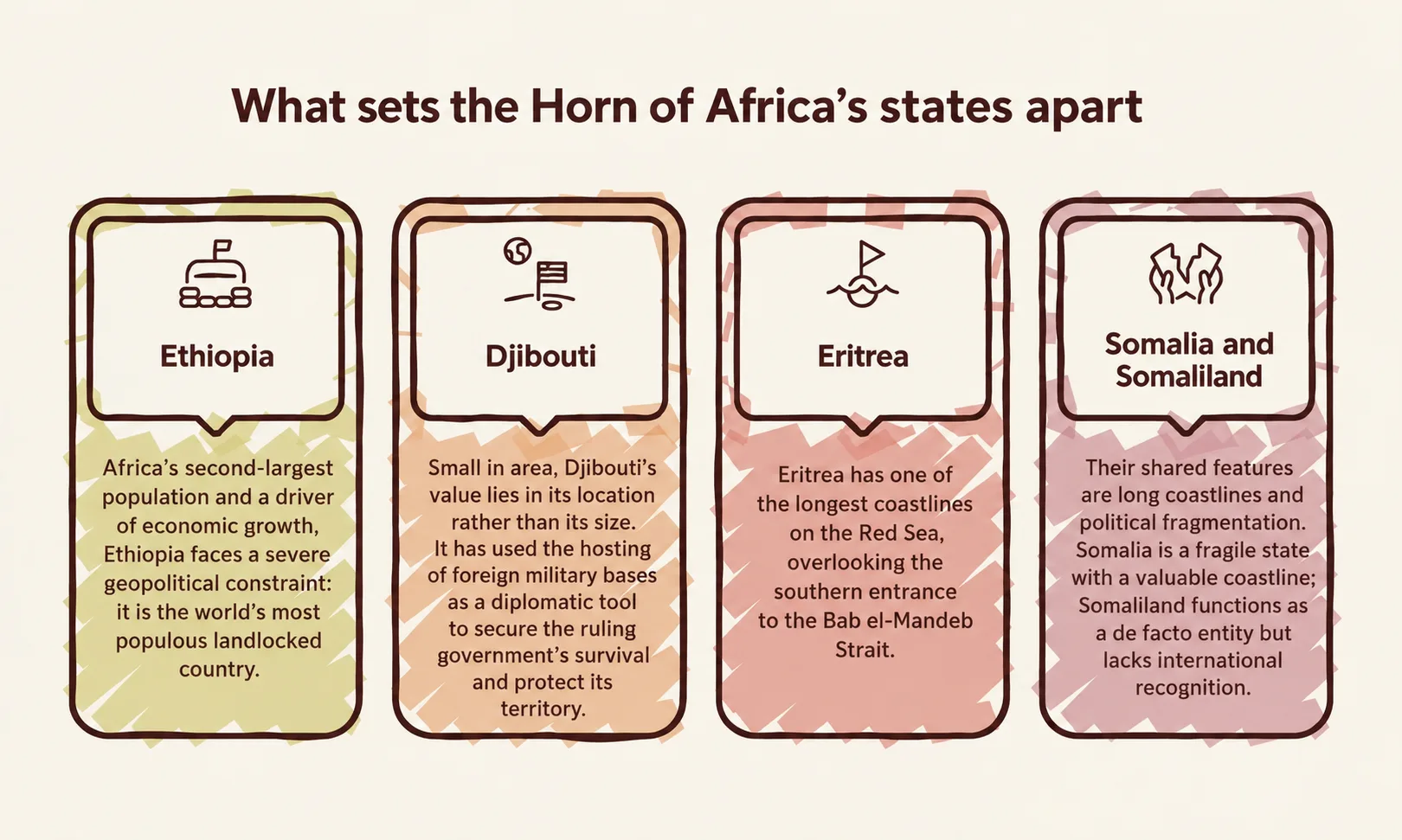
Ethiopia combines a large population and considerable economic weight with dependence on its neighbours for access to the sea. Since Eritrea gained independence in the early 1990s, it has been the world’s most populous landlocked country.
More than 95 per cent of Ethiopia’s imports and exports move through Djibouti’s ports, at an annual cost in port fees exceeding $1bn. That dependence has made maritime access a prominent issue in Ethiopian politics. Abiy Ahmed has described access to the Red Sea as an “existential issue” for his country and has hinted at the possibility of military force, alarming neighbouring states, particularly Eritrea.
Addis Ababa also pursued a diplomatic route. On 1 January 2024, Ethiopia signed a controversial memorandum of understanding with Somaliland. Under its proposed terms, Ethiopia would lease a 20-kilometre coastal strip on the Gulf of Aden for 50 years to establish a naval base and commercial port along the Berbera corridor. In return, Ethiopia would formally recognise Somaliland’s independence from Somalia and offer it a stake in Ethiopian Airlines.
Mogadishu regarded the memorandum as an assault on Somalia’s sovereignty and territorial integrity. It sought to nullify the agreement and called for international intervention. Somalia subsequently strengthened defence ties with Egypt and Eritrea, raising the stakes of a dispute over maritime access, sovereignty and regional security.
Other states have distinct advantages, though none combines Ethiopia’s size and economic weight with the same lack of a coastline. Djibouti’s principal asset is its location. Under President Ismail Omar Guelleh, in power since 1999, it has hosted foreign military bases both for revenue and as protection against regional threats.
Djibouti hosts permanent bases for the US, China, France, Japan, Italy and Saudi Arabia, making it one of the world’s most concentrated sites of foreign military presence. The arrangements provide substantial income: Washington pays $65m a year for its counterterrorism base, France $30m and China $20m for its first overseas naval support base. China’s fortified facility lies only a few miles from the US base, bringing the two powers’ military presence into unusually close proximity.
Eritrea, by contrast, has a long Red Sea coastline and the ports of Massawa and Assab. It possesses the maritime access Ethiopia seeks and treats its ports as a matter of sovereignty, while remaining politically isolated under authoritarian rule. Somalia has an extensive coast but a fragile central state. Somaliland has established effective local institutions but lacks broad international recognition.
Ethiopia’s combination of power and confinement remains one of the region’s most volatile dynamics: its demand for an outlet to the sea brings it into direct tension with coastal neighbours.
From local disruption to a global crisis
Houthi attacks in the Red Sea since late 2023 have demonstrated the global consequences of insecurity along this route. Estimates for the period indicate that transit through Bab el-Mandeb fell by about 70 per cent from its pre-attack level, while the corridor’s share of global maritime trade dropped from about 10 per cent to around three per cent at the height of the crisis. Shipping companies including Maersk, MSC and CMA rerouted vessels around the Cape of Good Hope, incurring additional annual costs estimated in the billions of dollars.
A still more disruptive scenario would involve problems at Bab el-Mandeb and the Strait of Hormuz at the same time. Some estimates suggest that a crisis at both chokepoints could disrupt about 30 per cent of global container shipping and threaten nearly 22 per cent of global oil supplies, putting an estimated $10bn in daily trade at risk.
In the most severe escalation scenarios, Brent crude could rise to around $140–$150 a barrel or more. Delays at Bab el-Mandeb can affect European retailers, Asian production lines and marine insurance costs. The ability to disrupt this passage gives actors operating near the Horn influence that extends far beyond the region.
Competing powers
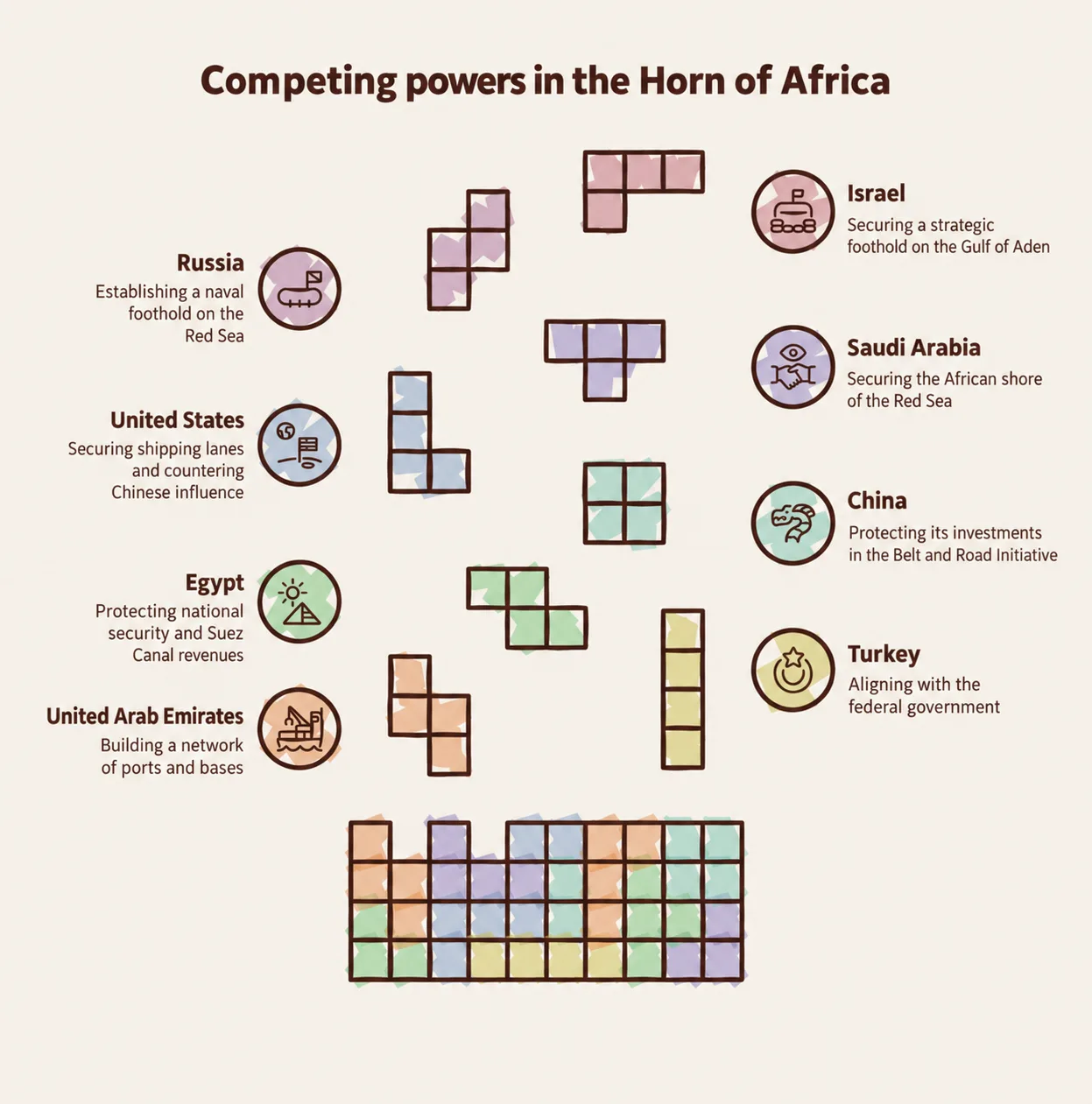
Seven main powers are competing for influence in the Horn of Africa, sometimes pursuing overlapping aims and sometimes working against one another.
The UAE has built a network of ports and security facilities along the coast. It operated a military and naval base at Eritrea’s Assab port until its closure in 2021, has pursued a port project and naval base at Berbera in Somaliland through DP World, and holds development rights at Bosaso port in Puntland.
The UAE has also been widely accused of continuing to support Sudan’s Rapid Support Forces. Some observers interpret that alleged support partly through Abu Dhabi’s interest in Sudan’s Red Sea coast, including Port Sudan and Suakin, as well as fertile agricultural land such as al-Fashaga on the Ethiopian border.
Satellite images have shown a nearly completed facility at Berbera, including a runway about four kilometres long that could accommodate heavy transport aircraft and fighter jets. Abu Dhabi appears to be seeking a chain of maritime facilities from which it can protect trade routes, influence the Gulf of Aden and the Red Sea’s southern entrance, and strengthen its position against regional rivals. Its dealings with Somaliland and Puntland have caused persistent friction with Somalia’s federal government.
Turkey’s presence rests chiefly on its alliance with that government. Ankara opened TURKSOM in Mogadishu in 2017, its largest military base abroad, and has trained more than 16,000 Somali soldiers there. It has also signed a defence agreement to help build Somalia’s navy, while a Turkish company manages Mogadishu’s port and airport.
#Ethiopia wants a sea port, #Egypt raises a banner of rejection, and Turkey is trying to manage the clash calmly.. The Horn of Africa is turning into an open diplomatic arena
How does #Ankara manage the compass of relations with its allies?https://t.co/4WpSa7Q66r
— (@NoonPost) February 19, 2026
Reports in April 2026 documented Turkish F-16 fighter jets flying over Mogadishu. Ankara seeks to remain the Somali federal government’s principal security and economic partner, strengthen its place in supply chains linking Africa and the Middle East, compete with Gulf powers, and support Somalia’s territorial unity.
Egypt’s concerns include Nile waters, Suez Canal revenue and the security of shipping routes to the canal. Cairo regards Ethiopia’s memorandum with Somaliland and its ambition to establish a naval base on the Gulf of Aden as threats to those interests.
In August 2024, Egypt signed a military cooperation agreement with Somalia and began sending weapons and equipment. By 2026, it had begun deploying a force estimated at about 1,100 troops for the African Union Support and Stabilisation Mission in Somalia, known as AUSSOM, including operations in the troubled Middle Shabelle region.
Egypt is moving to encourage Saudi Arabia to deepen its security ties with Eritrea in an effort to counterbalance growing Emirati influence in the Horn of Africa, particularly given the expanding military cooperation between Abu Dhabi and Ethiopia.
Egypt is moving to encourage Saudi Arabia to deepen its security ties with Eritrea in an effort to counterbalance growing Emirati influence in the Horn of Africa, particularly given the expanding military cooperation between Abu Dhabi and Ethiopia.
Egypt’s motivation stems partly from a defense agreement concluded between the Sudanese military and Pakistan earlier this year, and it is believed that…pic.twitter.com/S8GDWEw25F
— (@NoonPost) February 7, 2026
The Egyptian deployment includes BAE Caiman and Nimr Ajban armoured vehicles, Mi-24 Hind attack helicopters, and reconnaissance and counterinsurgency aircraft. It is Cairo’s most prominent military presence in the Horn for decades. Egypt aims to deter Ethiopia alongside Somalia, Eritrea and Djibouti while securing the southern approach to the Red Sea.
Its presence also faces complications within Somalia. Reports indicate that some Egyptian military aid intended for national defence has instead been used by the federal government to arm local militias in its political conflict with South West State.
China’s involvement is more deeply embedded in the region’s infrastructure. It opened its first overseas military base in Djibouti in 2017, financed the Addis Ababa–Djibouti railway linking landlocked Ethiopia to the coast, and acquired a stake in Doraleh port after the Djiboutian government expelled the UAE in 2018.
Chinese Foreign Minister Wang Yi visited Addis Ababa in 2026, while Chinese envoys have made repeated visits to Asmara. Beijing’s priority is to protect its Belt and Road and Maritime Silk Road investments, including by preventing a war between Ethiopia and Eritrea that could endanger them.
The US maintains Camp Lemonnier in Djibouti as its principal base for counterterrorism operations in Africa. In June 2026, the State Department submitted a memorandum to Congress describing Somaliland as part of Somalia and reaffirming US recognition of the federal state’s sovereignty and territorial integrity. Washington seeks to preserve its position in counterterrorism and maritime security while countering Chinese influence. Its current approach has also been described as a series of gradual agreements on critical minerals, energy and maritime security rather than a comprehensive long-term strategy.
Saudi Arabia has increasingly acted as a coordinator and financier in Red Sea arrangements. The kingdom concluded a maritime agreement with Mogadishu, involving the Saudi Public Transport Authority, that directs investment towards Las Qoray port in Puntland as a federal counterweight to Berbera, where Emirati influence is strong.
A major Saudi company also acquired the Bagamoyo port project in Tanzania. Last year, Red Sea Gateway International, affiliated with Saudi Arabia’s sovereign wealth fund, signed a memorandum of understanding with Djibouti to manage Tadjourah port for 30 years. Other reports have described prospective Saudi investment in Eritrean’s Assab port.
Riyadh seeks to make the African shore of the Red Sea part of its wider security arrangements. Its preferred role has been that of coordinator and financier more than a power establishing its own military bases there. The kingdom’s earlier absence from this competition gave the UAE greater room to expand its regional role.
From Bagamoyo to Tadjoura and Assab… Why has Riyadh made a strong return to East Africa? And are we witnessing a feverish Saudi-Emirati race to control strategic ports?
A report by @Moh_Gamea examines the shifts in influence, the clash of interests, and the battle for maritime corridors in the Horn of Africa. https://t.co/FBIkGs3a7W
— (@NoonPost) January 13, 2026
Russia has long sought a maritime foothold on Sudan’s Red Sea coast. It has used security and economic ties in an effort to extend its global reach and challenge Western influence along the corridor, though its position there remains less established than those of China or the Gulf powers.
Israel’s recognition of Somaliland on 26 December 2025 changed the diplomatic balance around the Red Sea. Israel seeks a position on the Gulf of Aden near Bab el-Mandeb from which to monitor shipping and counter what it regards as the Houthi-Iranian threat. Recognition could open the way to a security presence on Somaliland’s coast, while provoking direct threats from the Houthis.
Somaliland intends to join the Abraham Accords, seeing them as a strategic step in its relationship with Israel. Israel is also said to be working closely with the UAE to develop military airstrips, radar and aerial surveillance facilities on Yemen’s Mayyun Island and the Socotra archipelago. Together, these facilities are intended to monitor Iranian missiles and drones and protect maritime trade bound for Israeli ports.
The Ethiopian-Eritrean frontier is where many of these rivalries meet. Abiy Ahmed has called maritime access an “existential issue” and noted that the port he seeks is only 60 kilometres from Ethiopia’s border. His government’s rhetoric has rallied Ethiopians around the view that losing direct access to the sea was a national tragedy.
Eritrea rejects Ethiopian demands concerning the port as a threat to its sovereignty. In February 2026, Addis Ababa demanded that Eritrea withdraw forces from Ethiopian territory and invited talks on their disputes, including Ethiopia’s access to the sea. Asmara rejected the accusations that it was occupying Ethiopian land as “false and fabricated.”
Observers disagree over whether Ethiopia might attempt a broad invasion of Eritrea in 2026 to seize Assab. Others see a greater risk of proxy clashes along the border escalating into a wider war. That danger has prompted efforts by Saudi Arabia and China to prevent a confrontation.
Last February/April, a Saudi delegation led by Deputy Foreign Minister Waleed Elkhereiji travelled between Asmara and Addis Ababa, meeting Eritrean President Isaias Afwerki before seeing Abiy Ahmed.
Who will prevail in the Horn of Africa?
The contest for influence raises a question about which assets matter most: military bases, commercial ports, infrastructure investment or political and security alliances. The strongest position may belong to powers able to combine them.
Bases provide a military presence and deterrent capability, but they are costly, can provoke objections over sovereignty and depend on relations with a host government. Ports can generate commercial revenue while giving their operators a place in supply chains. Competition involving Berbera, Las Qoray, Bosaso and Doraleh therefore lies at the heart of the current struggle.
Railways, roads and electricity networks can create longer-lasting economic ties. The Addis Ababa–Djibouti railway shows how infrastructure can bind a landlocked economy to a coastal neighbour. Political alliances help sustain those investments: a base needs a cooperative host, and a port concession needs political support.
China’s relationship with Djibouti and Turkey’s with Somalia combine several of these elements. The UAE has concentrated on a network of ports and bases, while Saudi Arabia has emphasised financing and coordination.
Internal conditions will nevertheless shape what outside powers can achieve. Ethiopia’s stability, its relations with Eritrea, the cohesion of the Somali state and the course of Sudan’s war will determine whether bases, ports and investments can endure. The Horn’s governments and communities are not simply the setting for an external contest; their decisions and conflicts can reshape trade, energy flows and influence far beyond the region.
Two broad scenarios emerge. The first, and more likely in this analysis, is continued structural tension and polarisation, with proxy conflicts between a camp comprising Ethiopia and Somaliland, backed by the UAE and Israel, and another comprising Somalia, Egypt and Eritrea, backed by Turkey.
The second is a direct military confrontation driven by Abiy Ahmed’s determination to secure maritime access, amid what the article describes as the euphoria of an electoral victory. Whether it arose from the Somaliland memorandum or an Ethiopian move against Eritrea, such a conflict could draw in regional and international powers with forces stationed nearby. Disruption to shipping would then turn a regional war into a much wider economic crisis.