








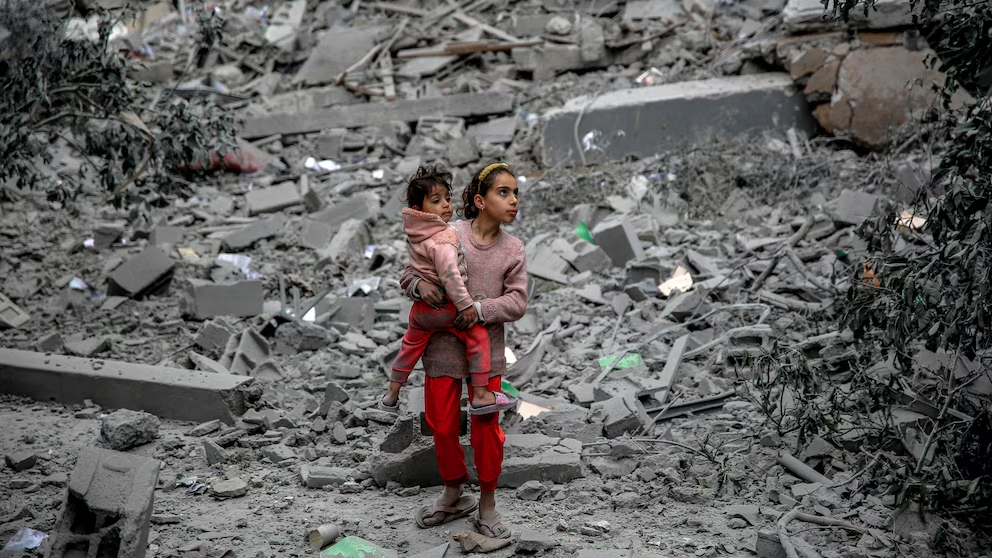
In a home that no longer exists in Tel al-Hawa, Zahra Sarsour, 37, left behind a lifetime of memories when news of its destruction reached her as she sheltered in southern Gaza in November 2023. That moment, she says, felt like an irreparable internal fracture.
With a voice heavy with sorrow, she recounts: “I’ll never forget the moment I lost my home. I got married there, gave birth, and lived for thirteen years everything that resembles me was there.”
But the loss of her home was only the beginning. Within days, Zahra began to lose loved ones—relatives, friends, even her longtime physician. She sighs, “I didn’t get to say goodbye to any of them. They were gone in an instant… and what hurts most is that I never told them how much I loved them.”
Each name lost meant a new part of her was gone. “Grief doesn’t fade,” she says, struggling to describe the indescribable. “It just changes shape. It becomes quieter, more silent, heavier on the heart. Photos and places hurt. They awaken my memory, so I avoid them.”
Every corner reminded her of laughter, of small celebrations, of beautiful details that no longer exist. It’s as if the place, though destroyed, continues to live inside her.
Today, she tries to return to life through small acts: tidying up her tent, cooking meals, caring for her three children. But she confesses, “There’s a broken part inside me. I try to live, to smile, but the numbness doesn’t go away. The part that shattered hasn’t healed. It lives with me like a heavy shadow that never leaves.”
Despite the weight of loss, her children’s laughter offers a fleeting kind of hope and a brief reprieve from the pain. “They’re the reason I resist my emotions. Joy, for me, is just a moment it can come in a smile or a simple scene. Those we’ve lost would want us to live a good life.”
At the end of her reflections, Zahra sums up mourning as she feels it, not as it’s conventionally defined: “I haven’t stopped living I’ve just started living beside the grief. I treat it as a part of me. I don’t try to escape it. That’s the mourning that lives inside me.”
When Grief Becomes Routine
From Gaza City’s al-Sabra neighborhood, journalist Hani Abu Rizq, 31, recalls the early days of the war, when he lost three colleagues during a bombing raid. His voice is tinged with longing: “It was a huge shock. Even though many colleagues were martyred after that, the first time hurt the most. It remains vivid their faces, their final words.”
He was unable to say goodbye due to the siege and the difficulty of moving between north and south Gaza. Instead, he spoke to their families, remembered them, and wrote about them. “They may be gone in body, but their souls live on in us and in their work. We’ll never forget them.”
For Hani, grief in Gaza has transformed into a daily routine, one that’s hard to escape. “We’ve gotten used to grieving. We mourn someone for two days, then carry on because every day brings new loss. Maybe this is the hardest kind of survival when pain becomes a habit.”
Everything around him evokes life before October 7. “The place, the smell, the sound… every little detail takes me back. To the days we dreamed of small, simple things that now feel out of reach.”
He pauses, then adds: “Even ordinary things have become painful the streets we used to walk, the sound of laughter, even the smell of morning coffee. They make me feel as if time stopped in that moment and never moved again.”
Hani believes this wasn’t a war with an end date it’s an open wound. “It will take decades to recover even a fraction of what we had. The war is over, but inside us, it’s still raging a war of memory, of loss, of surviving the echoes of what was.”
He draws strength from the small hopes offered by people’s words and his mother’s prayers. “The positivity of others, and my mom’s prayers, keep me going—even in the darkest times. Maybe that small faith in life is what keeps us from completely breaking.”
When asked what mourning means to him, he doesn’t hesitate. He offers a bitter smile and says: “Mourning? It’s pain. But pain that never ends.”
A Birthday Turned into a Day of Martyrdom
Though loss takes many forms, its pain is universal across Gaza. For Rasha Kaheel, 29, a single moment shattered her sense of safety her birthday became the day she lost her father.
On December 19, 2023, an Israeli sniper shot her father three times in the head. Rasha recalls the moment with trembling: “We were under siege. I couldn’t reach him. We had to break through neighbors’ walls and jump from house to house. When we finally got there, the men had already wrapped his body under drone fire and buried him. I never got to touch him or say goodbye.”
Since that day, absence has permeated every aspect of her life. “Every time I see someone who’s lost their father, I feel like my dad was just killed again. At the dinner table, with every decision I should’ve asked him about.
His scent still clings to the clothes we kept, and we’ve preserved the cap he wore when he was shot it still holds his pure blood and his smell.”
Her grief hasn’t disappeared, only changed shape. “Life goes on whether you like it or not, but everything feels incomplete. At first, I lost all appetite to eat or speak I felt like I died with my father. But the first time I visited his grave, I felt a strange hunger. That’s when I realized he wouldn’t want to see me like this.”
She describes mourning in words that encapsulate her pain: “Mourning is life without life.” Her voice carries more resignation than sorrow as if she’s grown used to its constant presence beside her.
Despite the brutality of her loss, she believes continuing forward is an act of faith, not a luxury of feeling. “Healing is something you’re forced into it’s not a choice or a moment of clarity.
It’s when you keep walking, even when you don’t want to. If you stay stuck in the moment of loss, you’ll end up in a dark place. But every attempt, no matter how small, is rewarded God sees that.”
Gaza’s Collective Grief
Dr. Ahmad Al-Arabeed, a sociology professor at Al-Aqsa University, affirms that the collective mourning now gripping Gaza is a natural consequence of the immense scale of loss. “This calamity has touched everyone. Mourning has become a collective experience, one people had no choice but to endure.”
While Gaza may currently be in a state of relative calm, he says this doesn’t mean life has returned to normal only that people are adapting to a new survival routine.
He explains that the mourning process starts to loosen its grip as society regains some degree of stability. “As the general situation improves, it reflects on people’s psychological states and their ability to return to normal life.”
Al-Arabeed stresses that society urgently needs comprehensive rehabilitation after a trauma of this magnitude—one that far exceeds any single individual’s capacity to bear. “The war has impacted people’s physical and mental health in deep and lasting ways.”
“Maybe the war has made us more resilient,” he adds, “but we can’t ignore the fact that everyone processes grief and loss differently.”
He also notes the crucial role of faith and spirituality in helping people come to terms with their reality, along with the importance of family and social support in reinforcing emotional resilience.
He concludes, “Human beings are naturally capable of recovering from crises, but that recovery requires real psychological support from families, communities, professionals, and a degree of stability that brings a sense of safety. We also need targeted programs to rehabilitate the most vulnerable groups during this time.”