












In great wars, not only are buildings reduced to rubble, but so too are the invisible structures people construct around their identities: class, status, and the sense that a life of effort had meaning.
In Gaza, war is no longer just a scene of destruction it has become a harsh mirror exposing the fragility of human beings once stripped of everything they believed to be permanent.
Women who once held prestigious degrees, stood at the front of classrooms, and occupied high-ranking jobs now find themselves in bare tents, devoid of any privilege. The question is no longer “What did we lose materially?” but “What did we lose of ourselves?”
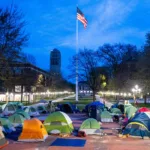
It is the brutal irony of war: social success becomes a tale told beside a campfire, and the line between those who toiled for years and those who were denied opportunity vanishes in a single moment—everyone returned to zero. In the space between house and tent is a suffering that cannot be measured in broken walls alone, but in dignity wounded—a wound that refuses to heal.
Before the latest war, Gaza was home to a segment of women who had carved out stable lives despite the siege. Sumayya Wadi (33), an Arabic language teacher and poet, was one of them. She balanced her profession with her creative writing in a space of stability offered by her home and academic environment.
Henna Abu Hammadeh (33), a university lecturer, lived a similar life. She woke up early to head to work, her arms full of lecture notes for crowded university halls. Her life was a mix of academic research, social engagements, and running her household with relative ease.
Then there’s Iman Hammouda (40), a prominent lawyer who moved between her office and courtrooms in her own car, surrounded by the comforts of a well-kept home and a sense of familial security. Her life was neatly organized and infused with confidence and achievement.
These lives had formed a small oasis of balance and beauty but it all collapsed under the weight of war. According to official statistics from the Palestinian Ministry of Women’s Affairs and the Palestinian Central Bureau of Statistics, over 28,000 salaried women lost their jobs in Gaza, in addition to more than 4,000 self-employed business owners and freelancers. In just a few months, around 32,000 women lost their sources of income.
Voices From the Tent
In the displacement camps, destruction has reached into the intimate details of daily life. The personal testimonies of these three women reveal just how deep the transformation goes.
Wadi says losing her home wasn’t just the loss of four walls it was the theft of the psychological stability that enabled her to write and create. “I used to be the teacher, the students, the pen. Today, everything is about survival. Displacement reshaped how I see myself. I was the woman who prepared lessons each morning and stood confidently before her class.
Now I haggle with vendors over a bar of soap or a loaf of bread. Maybe my body is weaker, but my spirit is stronger. I’m more aware that a person is a home before they have a home.”
Abu Hammadeh shares her own reversal: “This war turned everything upside down. I spend my time doing tasks I never imagined: lighting a fire just to make tea, hand-washing clothes, baking bread for dozens. I lost my job. I chose to stay home during the bombing out of fear. I never thought I’d forget how to turn on the washing machine or that my refrigerator would become a useless decoration.”
Hammouda describes the descent from her professional life into the void: “What hurts most isn’t just losing my house or office, but the question my daughter asks: Why don’t we have a home anymore? I was a strong lawyer, confident in every step. Today, my entire concern is a hot meal and a safe space for the children.”
These stories go beyond daily hardship. They reveal the dismantling of social identity and personal dignity. Women once empowered by careers now find themselves in tents with no privacy, no space to prove themselves, and no privileges.
These personal testimonies align with announcements by the Palestinian Ministry of Education, which reported that more than 12,000 female teachers and academics stopped working due to the destruction of schools and universities. Educated women suddenly became forcibly unemployed, living in displacement camps.
The Collapse of Class
War did not only destroy homes it shattered self-image and erased class distinctions that once shaped social fabric. “Every day is a survival test,” Wadi says. “Dignity now feels like an inner strength you have to fight for. I dream of a quiet place where I can write again and gather the scattered pieces of myself. Writing is my only weapon against the void.”
Abu Hammadeh adds: “The war ripped away all our simple routines and human rights. It forced us into cruel conditions and erased dreams under the canvas roof of a tent. I feel like I’m fighting just to reclaim a sliver of identity and dignity.”
For Hammouda, the transformation is existential: “Everything I thought defined me is gone. I no longer know what success or status mean in this merciless world. Dignity isn’t a position or a title it’s the inner resilience to endure and remain standing.”
War not only erased class divisions in Gaza but redefined dignity itself. These searing testimonies echo UN reports stating that 95% of women-run businesses in Gaza have shut down completely, and nearly 18% of home-based businesses have been destroyed.
Even the legal sector has not been spared: over 70% of law offices have ceased operation, erasing years of hard work and professional achievement overnight.
The Psychological and Social Impact
Clinical psychologist Huda Al-Yazji from Doctors Without Borders warns that this collapse will leave lasting scars: “It might create a temporary sense of equality, but it comes at the cost of deep wounds to self-worth and dignity. Women who have lost everything carry a traumatic experience that will reshape their relationship with work, society, and education in the future.”
Consider the UNFPA report, which stated that over 43,000 pregnant women have been directly impacted by displacement and the collapse of health services a stark measure of the scale of the social and psychological catastrophe.
She adds: “The sudden shift from a stable life to living in a tent leaves a profound psychological toll: a sense of emptiness, loss, and lack of purpose. The ‘forced equality’ of the tent blends solidarity with shame and grief until survival becomes the only definition of identity and dignity.”
Between rubble and tents, war reveals its true face: not just shattered buildings, but a catastrophe of identity, dignity, and social class. Women who once worked to build their standing now face a brutal test not only of what they’ve lost materially, but of how they see themselves.